New York Workers’ Compensation Attorney in 2026: Benefits, Fees, and What Changed
Quick Answer
- New York workers’ comp attorneys typically work on contingency, meaning no upfront cost to you and fees capped by the Workers’ Compensation Board.
- The maximum weekly benefit rose to $1,281.50 on July 1, 2026, a 4.5% increase tied to the state’s average weekly wage.
- If your claim is denied or your benefits are disputed, an attorney can request a hearing before the Workers’ Compensation Board, and you have 30 days to appeal an unfavorable decision.
A New York workers’ compensation attorney handles injury claims covered by the state’s no-fault insurance system. That system pays medical bills and lost wages regardless of who caused the accident. The catch: you trade the right to sue your employer for guaranteed benefits, and those benefits have limits.
More than 34,000 New York workers filed indemnity claims in the first half of 2026 alone . Many of them hit a wall when an insurance carrier disputed their injury, miscalculated their wage rate, or denied treatment outright.
This guide covers what changed in 2026, how attorney fees actually work in New York, when you need a lawyer, and what to do if your claim is denied. It also explains the one deadline that kills more claims than any other: the two-year filing window from your date of injury.
The Facts
| Agency | New York State Workers’ Compensation Board |
| Max Weekly Benefit | $1,281.50 (injuries on/after July 1, 2026) |
| Min Weekly Benefit | $384.45 (same period) |
| Attorney Fee Cap | 15% of award, must be approved by a judge |
| Filing Deadline | 2 years from date of injury (most cases) |
| Hearing Timeline | Decision within 120 days of formal hearing |
| Appeal Window | 30 days from Board decision |
What does a New York workers’ compensation attorney do?
A New York workers’ compensation attorney represents injured workers at every stage of a claim. That means filing the initial paperwork, fighting a denial, presenting evidence at hearings, and negotiating settlements.
The system runs through the New York State Workers’ Compensation Board. It is not a court. Administrative law judges oversee disputes, and the rules are specific to this agency.
Your attorney’s job is to make sure the insurance carrier doesn’t shortchange you. Carriers dispute severity, challenge wage calculations, and delay authorizations. An attorney knows what medical evidence the Board wants and how to present it.
For most cases, the attorney’s fee comes out of your award, not your pocket upfront. The Board must approve every fee. That approval process exists to stop overcharging.
How much does a New York workers’ compensation attorney cost?
Most New York workers’ comp attorneys work on contingency, meaning you pay nothing unless you recover benefits. The standard fee is 15% of your award, and the Workers’ Compensation Board must approve it .
That 15% applies to indemnity benefits, which are wage replacement payments. Medical benefits are not reduced by attorney fees. If the carrier pays your doctor directly, your lawyer’s cut does not touch that money.
Here is how the fee math works in practice:
| Award Type | Attorney Fee | Who Pays |
|---|---|---|
| Wage replacement (indemnity) | 15%, Board-approved | Deducted from your award |
| Medical benefits | $0 | Carrier pays provider directly |
| Settlement (Section 32) | Negotiated, Board-approved | Deducted from settlement |
Some firms advertise “no fee unless you win.” In workers’ comp, that is standard, not a special deal. The contingency model is built into how the system works.
Costs like medical record retrieval and expert evaluations are usually advanced by the firm and recovered from the award if you win. Ask any attorney how they handle expenses before you sign.
When do you actually need a New York workers’ compensation attorney?
You need an attorney when your claim is denied, your benefits are disputed, or your wage rate is wrong. Those three situations are where representation changes outcomes.
A denied claim is not the end. You have the right to challenge it. The Board schedules a hearing, and both sides present evidence. An attorney knows how to build that record.
Wage rate disputes are sneaky. Carriers sometimes calculate your average weekly wage using the wrong 52-week period or exclude overtime and bonuses. That miscalculation follows you for the life of the claim.
You may also want counsel if you face a Section 32 settlement, which closes your case permanently. Once you sign, you cannot reopen it. An attorney can evaluate whether the offer reflects your future medical needs and lost earning capacity.
For simple claims that are accepted and paying correctly, you can handle it yourself. The system allows unrepresented claimants. But the moment something goes sideways, the carrier has a lawyer and adjuster working the file. You should have someone too.
Key Takeaway: New York workers’ comp attorneys cost nothing upfront and are capped at 15% of your award, so hiring one when your claim is disputed is almost always worth the cost.
What is the maximum weekly benefit in New York in 2026?
The maximum weekly benefit for New York workers’ compensation is $1,281.50 for injuries occurring between July 1, 2026, and June 30, 2027 . That is a 4.5% increase from the prior year’s cap.
The minimum weekly benefit is $384.45 for the same period. Both figures come from the New York State Average Weekly Wage, which the Department of Labor set at $1,922.25 for 2025.
Your actual weekly check is based on two-thirds of your average weekly wage before the injury. But it cannot exceed the statewide maximum, no matter how much you earned. If you made $3,000 a week, your check is still capped at $1,281.50.
Here is how the tiers break down:
| Your Pre-Injury Weekly Wage | Two-Thirds Calculation | Your Weekly Benefit |
|---|---|---|
| $500 | $333 | $384.45 (minimum applies) |
| $1,200 | $800 | $800 |
| $1,922.25 (state average) | $1,281.50 | $1,281.50 (maximum) |
| $2,500 | $1,667 | $1,281.50 (capped) |
These rates apply only to new injuries in the July 2026 to June 2027 window. If you are already receiving benefits from an older claim, your rate stays at the level set when you were injured.
How do you file a New York workers’ compensation claim?
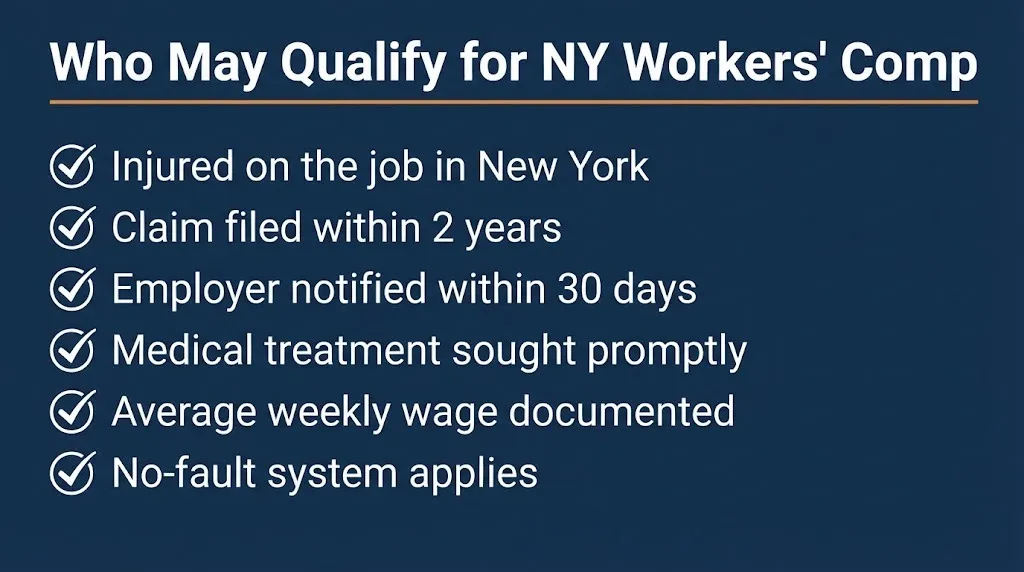
You file a New York workers’ compensation claim by notifying your employer and submitting Form C-3 to the Workers’ Compensation Board. The notification should happen immediately, and the form should follow within 30 days .
Here are the steps in order:
- Report the injury to your employer in writing, the same day if possible.
- Get medical treatment and tell the provider it is a work injury.
- File Form C-3 with the Workers’ Compensation Board within 30 days.
- Notify your employer in writing within 30 days of the accident.
- Keep copies of every form, medical note, and pay stub.
- Watch for the carrier’s response within 18 days of filing.
- Request a hearing if the claim is denied or benefits are delayed.
- Consult an attorney before any settlement offer.
The 30-day notice rule is strict, but the Board can excuse a late notice if you had a reasonable excuse and the employer was not prejudiced. Do not rely on that exception. Report immediately.
What is the deadline to file a New York workers’ compensation claim?
The deadline to file a New York workers’ compensation claim is two years from the date of injury for most cases. For occupational diseases, the clock starts when you knew or should have known the condition was work-related .
Missing that deadline usually means losing the claim entirely. There are narrow exceptions, but they require proof that you lacked knowledge or that the employer concealed the connection.
If you are receiving ongoing benefits and the carrier stops paying, you have two years from the last payment to request a hearing. That is a separate clock from the original filing deadline.
The Workers’ Compensation Board does not send reminders. You have to track these dates yourself. Mark them on a calendar the day you file.
What happens at a New York workers’ compensation hearing?
A New York workers’ compensation hearing is an administrative proceeding before a Workers’ Compensation Law Judge. It is less formal than court, but the rules still matter. The judge reviews evidence, hears testimony, and issues a written decision .
Most disputes start with an informal hearing, which lasts about 15 minutes. The judge tries to get both sides to agree. If that fails, the case moves to a formal hearing.
At the formal hearing, you present medical records, witness statements, and wage documentation. The carrier presents its own evidence. A stenographer records everything. The judge may ask questions directly.
After the hearing, the judge has 120 days to issue a decision. That decision is binding unless either side appeals to the Workers’ Compensation Board’s administrative review process.
You can represent yourself at a hearing. The Board allows it. But the carrier will have an attorney. The judge cannot give you legal advice or help you build your case.
What happens if your New York workers’ comp claim is denied?
A denied New York workers’ comp claim is not final. You have the right to request a hearing and challenge the denial. The carrier must prove its reason for denial, not the other way around .
Common denial reasons include:
- The carrier claims the injury was not work-related.
- You missed the 30-day notice deadline.
- The medical evidence does not support disability.
- A pre-existing condition caused the injury.
When you request a hearing, the Board schedules it and notifies both sides. You bring your evidence. The carrier brings its adjuster and possibly an attorney. The judge decides.
If the judge rules against you, you have 30 days to appeal to the Board’s administrative panel. That appeal is written, not a new hearing. An attorney is strongly recommended at this stage.
How much is the average workers’ compensation settlement in New York?
The average workers’ compensation settlement nationally is around $42,008, but that figure is misleading . Settlements range from a few thousand dollars to over a million, depending on the injury and future medical needs.
In New York, most settlements take the form of a Section 32 agreement, which closes the case permanently. The amount reflects lost wages, future medical costs, and any permanent disability rating.
Here are national averages by injury type for context:
| Injury Type | Average Settlement |
|---|---|
| Amputation of a limb | $115,000 |
| Neck or central nervous system | $90,000 |
| Leg injury | $59,683 |
| Neck injury | $58,507 |
| Knee injury | $34,003 |
| Hand, finger, or wrist | $25,233 |
New York settlements can run higher than these national figures because the state’s wage base is higher. But there is no published New York-specific average that applies to every case.
Never accept a settlement offer without understanding what it closes. A Section 32 ends your right to future benefits, including medical care. Once you sign, you cannot reopen the claim.
Key Takeaway: A Section 32 settlement in New York permanently closes your case, so the amount must cover not just past lost wages but future medical care and any permanent disability.
Reality Check
No legitimate attorney will ask for an upfront fee to file your New York workers’ comp claim. Fees are regulated at 15% and must be approved by the Board. If someone promises a specific settlement amount before reviewing your medical records, that is a red flag. And if you get a text or call saying you owe money to “release” your workers’ comp benefits, it is a scam. The Board does not work that way.
What happens next in a New York workers’ compensation case?
The path from injury to resolution follows a predictable sequence. Here are the stages you can expect.
Immediately: Report the injury to your employer and seek medical care.
Within 30 days: File Form C-3 with the Workers’ Compensation Board and notify your employer in writing.
Within 18 days of filing: The carrier must accept or deny your claim.
If denied: Request a hearing. The Board schedules it, often within a few months.
At the hearing: Present evidence. The judge issues a decision within 120 days.
If you appeal: You have 30 days to file with the Board’s administrative panel.
Settlement: If both sides agree, a Section 32 closes the case permanently with Board approval.
Frequently Asked Questions
Do I need a lawyer for a workers’ comp claim in New York?
Not always. Simple claims that are accepted and paying correctly can proceed without one. You need an attorney when your claim is denied, your benefits are disputed, or you are offered a settlement.
How much does a New York workers’ comp lawyer cost?
Most work on contingency. The fee is capped at 15% of your award and must be approved by the Workers’ Compensation Board. You pay nothing upfront.
What is the maximum weekly benefit in New York for 2026?
The maximum is $1,281.50 for injuries occurring on or after July 1, 2026. The minimum is $384.45 for the same period.
How long do I have to file a workers’ comp claim in New York?
You have two years from the date of injury to file most claims. For occupational diseases, the clock starts when you knew or should have known the condition was work-related.
What happens if my New York workers’ comp claim is denied?
You can request a hearing before a Workers’ Compensation Law Judge. The carrier must justify the denial. If you lose, you have 30 days to appeal.
Can I be fired for filing a workers’ comp claim in New York?
No. New York law prohibits retaliation for filing a workers’ comp claim. If you are fired or demoted because of it, you may have a separate legal claim.
How long does a workers’ comp hearing take in New York?
Informal hearings last about 15 minutes. Formal hearings can take hours and multiple sessions. The judge must issue a decision within 120 days of the hearing.
Can I settle my New York workers’ comp case and still get medical care?
It depends on the settlement terms. A Section 32 can close medical benefits entirely. Read the agreement carefully and have an attorney review it before signing.
Your next step
If you were hurt on the job in New York, report it today and file Form C-3 within 30 days. The two-year filing deadline is the hard stop that kills claims, and the Workers’ Compensation Board will not remind you.
For injuries on or after July 1, 2026, the maximum weekly benefit is $1,281.50. That is your ceiling, no matter what you earned before. An attorney can make sure the carrier calculates your rate correctly and does not shortchange your medical care.