What Law Protects Against Civil Lawsuits When You Help a Victim in Medical Need? 2026 Guide
Quick Answer
- What law protects you? Colorado’s Good Samaritan statute, C.R.S. § 13-21-108, shields good-faith emergency helpers from civil damages.
- What are the limits? Immunity is lost if you act with gross negligence or willful and wanton conduct, not for ordinary mistakes.
- Key exception? The law does not protect you if you were already obligated to care for the victim, like a doctor treating their own patient.
If you stop to help someone in a medical emergency, the last thing you want to worry about is getting sued for trying. Colorado law is designed to prevent exactly that fear. The state’s Good Samaritan statute, C.R.S. § 13-21-108, gives broad civil immunity to people who render emergency care in good faith without compensation .
The protection is not absolute. You lose immunity if your actions were grossly negligent or willful and wanton . But ordinary mistakes, imperfect technique, or a bad outcome do not expose you to liability. The law is meant to encourage action, not perfection.
This article breaks down exactly who is covered, what conduct loses protection, how the law applies to different scenarios like AED use and opioid overdoses, and what you should know before stepping in to help.
The Facts
| Statute | C.R.S. § 13-21-108, Persons rendering emergency assistance exempt from civil liability |
|---|---|
| Coverage | Any person, including physicians, who renders emergency care without compensation |
| Standard | Good faith required. Immunity lost for gross negligence or willful and wanton conduct. |
| Exclusions | Does not apply if you were already obligated to care for the victim |
| Related Laws | AED immunity (§ 13-21-108.1), opioid antagonist immunity (§ 13-21-108.7), ski patrol immunity (§ 13-21-108(3)) |
| Effective | Current through Fall 2025, still in force in 2026 |
What Does Colorado’s Good Samaritan Law Actually Protect?
Colorado’s Good Samaritan law protects you from civil damages when you render emergency care or assistance in good faith, without compensation, at the scene of an emergency. The protection applies to licensed physicians and to any other person who steps in to help .
The statute’s core language is broad. It says any person who “in good faith renders emergency care or emergency assistance to a person not presently his patient without compensation” is not liable for civil damages for acts or omissions made in good faith . That last phrase matters. The law covers acts and omissions. If you do something, or fail to do something, while trying to help, you are protected.
The immunity does not require you to be perfect. It requires you to act in good faith. A misplaced hand, a delayed response, or a technique that does not work as intended does not automatically strip your protection. The bar is set at gross negligence or willful and wanton conduct, not simple mistake .
Key Takeaway: Colorado’s Good Samaritan law protects anyone who helps in an emergency, not just medical professionals. The standard is good faith, not flawless performance.
Who Is Covered by the Good Samaritan Law?
Any person who renders emergency care in good faith is covered, including bystanders, off-duty medical professionals, and volunteers. The statute does not limit protection to licensed physicians or trained responders .
The law covers several specific categories of helpers:
General emergency responders. Any person, including a licensed physician or surgeon, who renders emergency care without compensation at the scene of an emergency is protected .
Rescue unit volunteers. Members of rescue units, even if their organization recovers actual costs, are immune for good-faith emergency care .
Ski patrol volunteers. Ski patrol or ski area rescue unit members are protected even if they receive free skiing privileges as a benefit .
Crisis hotline volunteers. Volunteers who answer crisis hotline calls for nonprofit organizations are immune for good-faith counseling .
Employers of helpers. An employer is not liable for an employee’s emergency care if the employee rendered it during employment and is personally exempt under the statute .
What Conduct Loses Good Samaritan Protection?
You lose Good Samaritan protection if your actions were grossly negligent or willful and wanton. These are high bars that require more than ordinary carelessness.
Gross negligence means a conscious, voluntary act or omission in reckless disregard of a legal duty and the consequences to another party. It is not a momentary lapse or an honest mistake. It is conduct that shows a lack of even slight care.
Willful and wanton conduct means action taken with deliberate intent to harm or with reckless indifference to the rights and safety of others. It is not negligence. It is a conscious choice to act in a way that is likely to cause injury.
The Colorado Lawyer’s 2024 survey of Good Samaritan laws confirms that emergency medical assistance under § 13-21-108(1) retains immunity unless the acts or omissions were grossly negligent or willful and wanton . Ordinary negligence claims are barred by the statute.
Reality Check: No one texts you settlement money first. Filing a claim in any class action is always free. Third-party “claim helpers” charging fees to file Good Samaritan claims are unnecessary and likely predatory. There is no Good Samaritan settlement to claim.
What Is the Exception for Pre-Existing Duty?
The Good Samaritan law does not protect you if you were already obligated to care for the victim. The statute explicitly says it “shall not apply to any person who renders such emergency care or emergency assistance to a patient he is otherwise obligated to cover” .
This exception applies to specific relationships. A doctor treating their own patient in a hospital is not protected by this statute. A nurse caring for a patient assigned to them is not protected. A parent with a legal duty to care for a child may not be protected in some circumstances.
The exception is narrow. It applies only to people who already had a duty to provide care. A bystander who has no prior relationship with the victim is fully covered. An off-duty doctor who happens upon a crash scene and has no obligation to the injured person is covered. The question is whether a pre-existing duty existed before the emergency.
How Does the Law Apply to AED Use?
Colorado has a separate statute for automated external defibrillator (AED) use: C.R.S. § 13-21-108.1. This law provides limited immunity for people who use an AED in an emergency .
The AED immunity is similar to the general Good Samaritan protection but has its own requirements. The person must act in good faith and without compensation. Immunity is lost for grossly negligent or willful and wanton conduct . The law encourages the placement and use of AEDs in public places by reducing liability fears.
If you use an AED on someone in cardiac arrest, you are protected as long as you act in good faith. The device itself provides instructions, and following those instructions is strong evidence of good faith. You do not need medical training to be covered.
How Does the Law Apply to Opioid Overdose Reversal?
Colorado law provides immunity for administering an opioid antagonist, like naloxone, to someone experiencing an overdose. The relevant statute is C.R.S. § 13-21-108.7 .
The law encourages both the administration and distribution of opioid antagonists, including expired ones, for the purpose of saving lives . The immunity is broad. It covers good-faith administration without compensation.
The statute explicitly states it “shall not be interpreted to establish any duty or standard of care in the prescribing, dispensing, or administration of an opioid antagonist” . That means you do not take on legal liability by choosing to help. The law is designed to remove barriers to action.
What About the Federal Volunteer Protection Act?
The federal Volunteer Protection Act of 1997 provides additional protection for volunteers of nonprofit organizations and government entities. Colorado law references this federal statute in some contexts, particularly for land stewardship volunteers .
The federal law protects volunteers from liability for harm caused by their acts or omissions if they were acting within the scope of their volunteer duties and the harm was not caused by willful or criminal misconduct, gross negligence, or reckless misconduct.
For most emergency medical helpers, Colorado’s state Good Samaritan law provides broader and clearer protection. The federal law is a backstop that may apply in specific situations involving nonprofit or government volunteer programs.
What Should You Do If You Want to Help Someone?
If you see someone in medical need, Colorado law is designed to protect you. Here is what to keep in mind:
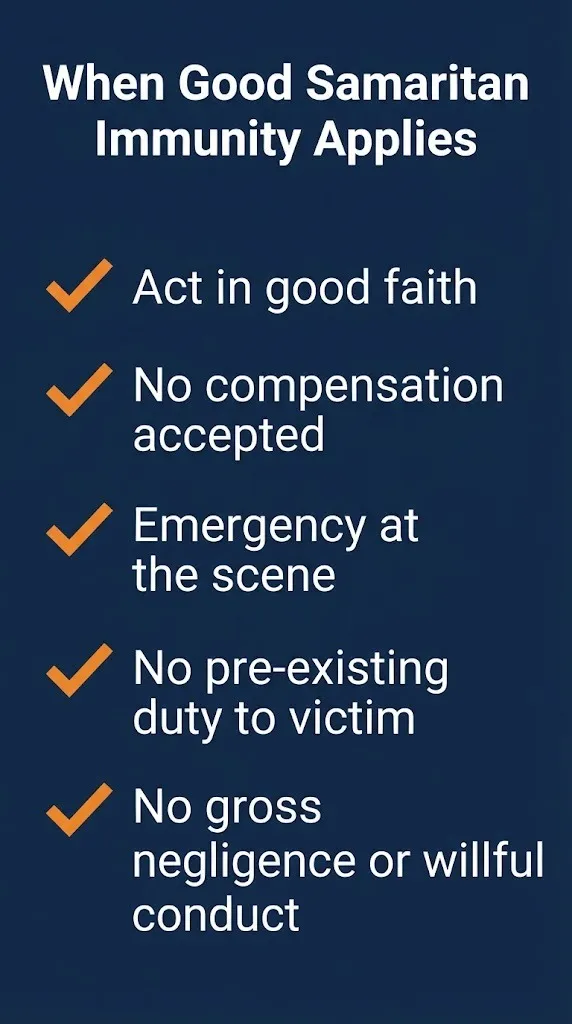
- Act in good faith. Your intent should be to help, not to profit or cause harm.
- Do not accept compensation. The immunity applies only when you act without compensation.
- Stay within your abilities. You are protected for good-faith acts and omissions, but do not attempt procedures you are not trained to perform if safer alternatives exist.
- Call 911 when possible. Emergency responders can take over, and your role becomes support rather than primary care.
- Document what you did. If a dispute arises later, notes about your actions and the circumstances can help establish good faith.
What Happens Next in Good Samaritan Law?
Ongoing: Colorado’s Good Samaritan statutes remain in force through 2026. No legislative changes have been enacted that alter the core protections of C.R.S. § 13-21-108.
Ongoing: Courts continue to apply the gross negligence and willful and wanton standards to determine whether immunity applies in specific cases.
No deadlines: There are no filing deadlines or claim processes related to Good Samaritan immunity. The law operates as a defense if someone sues you for emergency assistance.
Frequently Asked Questions
What law protects me if I help someone in a medical emergency?
Colorado’s Good Samaritan law, C.R.S. § 13-21-108, protects anyone who renders emergency care in good faith without compensation from civil damages.
Does the Good Samaritan law protect me from all lawsuits?
No. It protects you from civil liability for good-faith emergency care, but you can still be sued. The law provides a defense that should result in dismissal if your conduct meets the standard.
What if I make a mistake while helping?
Ordinary mistakes do not strip your protection. You lose immunity only for gross negligence or willful and wanton conduct, which requires more than simple error.
Does the law protect doctors and nurses too?
Yes. Licensed physicians and other medical personnel are covered when they render emergency care outside their normal patient relationships without compensation.
What if I was already responsible for the person’s care?
The law does not protect you if you were already obligated to care for the victim, such as a doctor treating their own patient.
Does the Good Samaritan law cover AED use?
Yes. C.R.S. § 13-21-108.1 provides limited immunity for good-faith AED use in emergencies.
Does the law cover giving someone naloxone for an overdose?
Yes. C.R.S. § 13-21-108.7 provides immunity for administering an opioid antagonist, including expired doses, in good faith.
Can I be sued even if I was acting in good faith?
Yes, anyone can file a lawsuit. But if your conduct meets the Good Samaritan standard, the law provides a strong defense that should result in dismissal.