Barberville Pioneer Settlement in 2026: Lawsuit, Claims, and What This Place Actually Is
Quick Answer
- Is it a lawsuit or settlement? No. The Barberville Pioneer Settlement is a 501(c)(3) nonprofit historical village museum, not a defendant in any consumer class action.
- Can you file a claim for money? No. There is no settlement fund, no claims administrator, and no payout form connected to this organization.
- What actually matters? The museum is open for tours and events, and you can visit for a $10 adult admission if you’re in the area.
You searched for “Barberville Pioneer Settlement settlement” and landed here expecting a claim form. The honest answer is that no such thing exists. The Barberville Pioneer Settlement is a museum, not a lawsuit.
What you’re looking at is a 30-acre living history village in western Volusia County, Florida. It preserves historic buildings from the late 1800s and early 1900s and teaches visitors what rural Florida life looked like before electricity and indoor plumbing.
This article covers what the Settlement actually is, why it shows up in settlement searches, what you can do there in 2026, and how to tell the difference between a real claims process and a museum that simply shares a word with one.
The Facts
| Item | Detail |
|---|---|
| Official Name | Pioneer Settlement for the Creative Arts, Inc. |
| Type | 501(c)(3) nonprofit living history museum |
| Location | 1776 Lightfoot Lane, Barberville, FL 32105 |
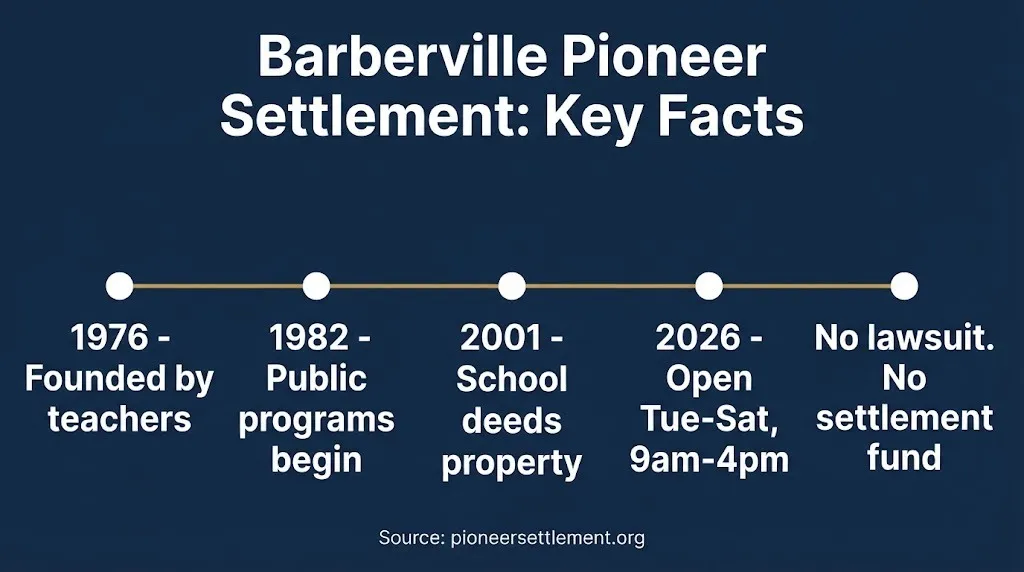
| Founded | 1976 by Volusia County teachers |
| Current Status | Open to the public |
| Fund Size | No settlement fund exists |
| Est. Per Person | Not applicable, no claims process |
| Claim Deadline | None, no settlement exists |
| Administrator | Not applicable |
| Proof Needed | Not applicable |
Is the Barberville Pioneer Settlement a Lawsuit or a Real Settlement?
It is neither. The Barberville Pioneer Settlement is a nonprofit organization founded in 1976 by a group of Volusia County teachers who wanted to preserve Florida’s pioneer history and folk arts. It has never been a defendant in a consumer class action, and there is no settlement fund bearing its name.
The confusion likely comes from two places. First, the word “settlement” appears in the organization’s name, but here it refers to a historical settlement, a place where pioneers lived, not a legal settlement. Second, there are real class action settlements involving companies called Pioneer, like the optical disk drive price-fixing case from the 2000s, but those have nothing to do with this Florida museum.
You cannot file a claim for money from the Barberville Pioneer Settlement because there is no lawsuit and no fund. If you got a text or email promising you money from a “Barberville Pioneer Settlement claim,” treat it as a scam.
What Is the Barberville Pioneer Settlement Actually?
The Barberville Pioneer Settlement is a living history museum that preserves 19 historic structures on a 30-acre campus in rural Volusia County. Visitors walk through buildings that were either built on the property or moved there from nearby communities to save them from demolition.
The centerpiece is the 1919 Central School of Barberville building, which sits in its original location and is listed on the National Register of Historic Places. Other structures include a log cabin from 1875, a turpentine still from 1924, the Huntington Post Office from 1885, and the Astor Bridge Tender’s House from 1926.
The organization’s mission is to teach the public about pioneer life through hands-on experiences, folk life demonstrations, and historical exhibits. It welcomes an estimated 10,000 to 11,000 schoolchildren each year for field trips.
Key Takeaway: The Barberville Pioneer Settlement is a museum, not a legal case, and there is no money to claim from it.
Does the Barberville Pioneer Settlement Have a Settlement Fund or Payout?
No. There is no settlement fund, no payout tiers, and no claims administrator connected to the Barberville Pioneer Settlement. The organization operates as a nonprofit and relies on donations, memberships, event revenue, and grants to stay open.
Its most recent public fundraising campaigns include a project to build a modern restroom facility designed to look like a log cabin, and a restoration effort for a historic caboose that needs approximately $12,500 more to complete. Those are donation requests, not settlement payouts.
If you are looking for a real class action settlement involving a company called Pioneer, the optical disk drive case from 2017 is the closest match. That case involved Pioneer Corporation and Pioneer Electronics, not the Florida museum. The claim deadline for that settlement passed in October 2017.
Who Is Affected by the Barberville Pioneer Settlement?
No one is “affected” in the legal sense because there is no lawsuit. The people connected to the Settlement are visitors, members, volunteers, and donors.
The museum serves local residents in Volusia County, tourists visiting the Daytona Beach area, and school groups from across Florida. Admission is $10 for adults and $4 for children ages 6 to 12. Members and children under 6 get in free.
If you received a notice about a “Barberville Pioneer Settlement” and you are not a museum member or visitor, you are almost certainly looking at a scam or a case of mistaken identity with a different organization.
How Do You Visit the Barberville Pioneer Settlement in 2026?
The Settlement is open to the public for self-guided and docent-led tours. You do not need a reservation for a self-guided visit. Docent-guided tours are available for groups of five or more and require 24-hour advance notice.
Here are the practical details for a 2026 visit:
- Check the hours. The museum is open Tuesday through Saturday from 9 a.m. to 4 p.m. It is closed Sunday and Monday as of the most recent listing.
- Plan for one to two hours. The campus has 19 structures and thousands of artifacts spread across 30 acres.
- Wear comfortable shoes. You will be walking on unpaved paths and through historic buildings.
- Bring cash or a card. Adult admission is $10, children 6 to 12 are $4, and children under 6 are free.
- Check the event calendar. The Settlement hosts monthly “Jamming at the Settlement” music events, a Spring Frolic in late March, and the Fall Country Jamboree in November.
The address is 1776 Lightfoot Lane in Barberville. For GPS, some systems recognize the address as Pierson, FL 32180.
What Events Are Happening at the Barberville Pioneer Settlement in 2026?
The Settlement runs a regular schedule of living history demonstrations, music jams, and seasonal festivals. The 2026 calendar includes “Jamming at the Settlement” on the first Saturday of most months, with musicians of all skill levels invited to bring instruments and play between 11 a.m. and 2 p.m.
The Spring Frolic, a two-day music and heritage festival with eight stages, was held March 28 and 29, 2026. The Fall Country Jamboree, the organization’s largest annual event, typically draws thousands of visitors and is scheduled for the first weekend in November.
Living history demonstrations run throughout the year. Visitors can watch blacksmithing, spinning, weaving, pottery, and other pioneer crafts. The Summer Kitchen serves hamburgers, hot dogs, and barbecue during events.
Reality Check: No legitimate settlement or class action ever asks you to pay a fee to claim your money. If someone contacts you about a “Barberville Pioneer Settlement payout” and asks for payment, bank information, or a processing fee, it is a scam. Real class action claims are always free to file, and real museums do not distribute settlement money.
Why Does “Barberville Pioneer Settlement” Show Up in Settlement Searches?
The most likely reason is the word “settlement” itself. Search engines see that word and assume you want legal settlement information. The same thing happens with place names like “White Settlement, Texas” or “Pioneer, California.”
There is also a real class action history involving companies named Pioneer. Pioneer Corporation and Pioneer Electronics were defendants in an optical disk drive price-fixing case that settled for $10.5 million in 2017. That case involved DVD drives and computers purchased between 2003 and 2008, not a Florida museum.
Those are two completely different entities. The optical disk drive settlement is closed and the claim deadline passed nearly a decade ago. The Barberville Pioneer Settlement is a museum that has never been involved in litigation of that kind.
How to Tell If a Settlement Claim Is Real or a Scam
Real class action settlements follow a predictable pattern. Scams do not. Here is how to tell the difference before you hand over any personal information.
Real settlements:
- Have an official settlement website with a court-approved notice.
- Are administered by a court-appointed claims administrator, often a company like Kroll, Rust Consulting, or Angeion Group.
- Never charge you a fee to file a claim.
- Have a case number and a court where the case was heard.
- Provide a claim deadline and a final approval hearing date.
Scams:
- Contact you by text or social media with an urgent message about money.
- Ask for your Social Security number, bank account, or payment upfront.
- Have no verifiable court records or case number.
- Use a name that sounds like a real organization but does not match any actual lawsuit.
- Promise a specific payout amount before any claims have been processed.
If you are ever unsure whether a settlement is real, search the organization’s name plus “class action” and “case number.” If nothing comes up in court records, it is not real.
What Happens Next for the Barberville Pioneer Settlement
The Settlement has no legal deadlines or court dates to track. Its future is about operations and preservation, not litigation.
Expected late 2026: The Fall Country Jamboree, the organization’s largest annual fundraiser, is scheduled for the first weekend in November.
Ongoing: The museum continues fundraising for its log cabin restroom facility and caboose restoration project. The caboose project needs approximately $12,500 more to reach its goal.
Ongoing: Monthly “Jamming at the Settlement” music events continue on the first Saturday of most months, with live blacksmithing, pottery, and spinning demonstrations from 9 a.m. to 4 p.m.
No legal milestones: There are no claim deadlines, opt-out dates, or final approval hearings because there is no lawsuit.
Frequently Asked Questions
Is the Barberville Pioneer Settlement a class action lawsuit?
No. It is a 501(c)(3) nonprofit living history museum founded in 1976, not a defendant in any class action.
Can I file a claim for money from the Barberville Pioneer Settlement?
No. There is no settlement fund, no claims administrator, and no payout form connected to this organization.
Did I get a text about a Barberville Pioneer Settlement payout?
It is almost certainly a scam. Real class actions never contact you by random text with promises of money.
What is the Barberville Pioneer Settlement?
It is a 30-acre living history village in Volusia County, Florida, that preserves 19 historic buildings from the late 1800s and early 1900s.
How much does it cost to visit the Barberville Pioneer Settlement?
Adult admission is $10. Children ages 6 to 12 are $4. Members and children under 6 are free.
Where is the Barberville Pioneer Settlement located?
It is at 1776 Lightfoot Lane in Barberville, Florida, about 40 minutes west of Daytona Beach.
When is the Barberville Pioneer Settlement open?
As of the most recent listing, it is open Tuesday through Saturday from 9 a.m. to 4 p.m., and closed Sunday and Monday.
Is there a real Pioneer settlement I can claim money from?
The only major settlement involving a company called Pioneer was the optical disk drive price-fixing case, which closed in 2017 and has no remaining claims process.
The single most important thing to remember is this: the Barberville Pioneer Settlement is a museum, not a lawsuit. There is no money to claim. If you want to support it, visit, donate, or become a member. If you got a message promising you money from this name, delete it.