Compensation Planning Software 2026: Market Leaders, Features, and How to Choose
Quick Answer
- Compensation planning software helps HR teams manage salary bands, merit cycles, bonuses, and equity awards in one system.
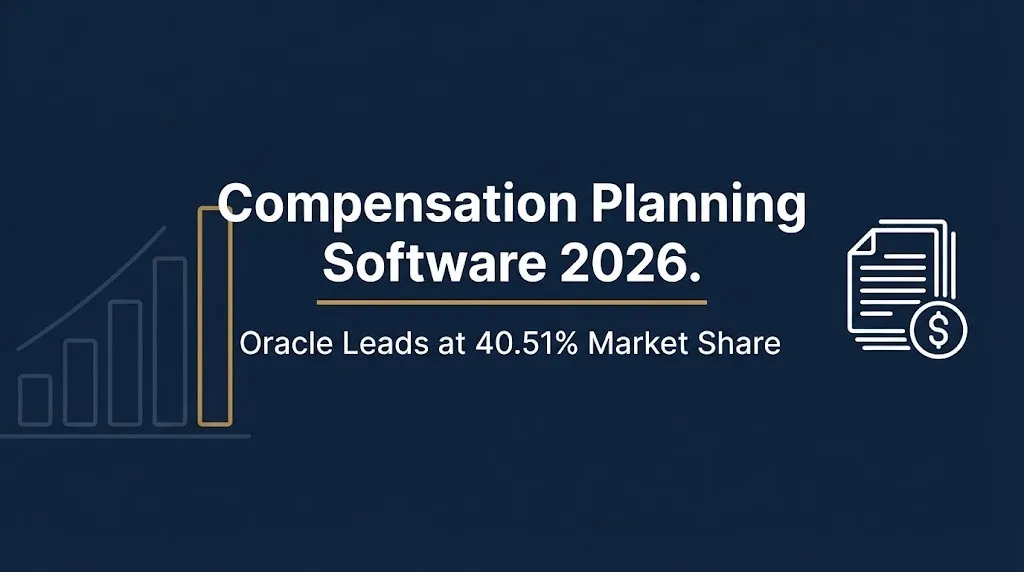
- Oracle HCM Cloud holds 40.51% market share, followed by Workday Compensation at 19.55% and Anaplan at 13.54%.
- Pricing ranges from a few thousand dollars annually for small businesses to six figures for enterprise-grade platforms.
What Is Compensation Planning Software?
Compensation planning software is a platform that helps organizations design, manage, and execute pay programs, including salary structures, merit increases, bonuses, and equity awards.
These tools replace spreadsheets and manual processes with centralized systems that enforce budget guardrails, automate calculations, and provide audit trails. According to Software Advice data, 72% of reviewers rate compensation management as critical or highly important in their payroll and HR systems .
The market serves organizations of all sizes. The majority of compensation management software customers are companies with 10,000+ employees (7,758 companies) or 1,000 to 4,999 employees (7,454 companies), according to 6sense market data .
Key Takeaway: If you are managing pay for more than a dozen employees, a dedicated compensation tool saves time, improves fairness, and reduces compliance risk.
How Much Does Compensation Planning Software Cost?
Compensation planning software pricing varies widely based on company size, features, and deployment model.
Based on SelectHub data, entry-level plans start around $15 per user per month, while enterprise-grade solutions can exceed $56 per user per month or require annual contracts in the six figures .
Here is how pricing typically breaks down:
| Company Size | Typical Annual Cost | Common Platforms |
|---|---|---|
| Small business (under 100 employees) | $2,000 to $10,000 | Salary.com, Paycom |
| Mid-market (100 to 1,000 employees) | $10,000 to $50,000 | Payscale Ascent, HiBob, Barley |
| Enterprise (1,000+ employees) | $50,000 to $250,000+ | Oracle HCM Cloud, Workday, Anaplan |
Pricing depends on whether you need just salary benchmarking or a full planning suite with merit cycles, equity management, and pay equity analytics.
Which Compensation Planning Software Has the Largest Market Share?
Oracle HCM Cloud holds the largest share of the compensation management market with 40.51% estimated market share and 15,586 customers, according to 6sense data .
Workday Compensation follows with 19.55% market share (7,521 customers), and Anaplan ranks third at 13.54% (5,210 customers) .
The remaining market is fragmented among dozens of specialized platforms:
| Platform | Estimated Market Share | Customers |
|---|---|---|
| Oracle HCM Cloud | 40.51% | 15,586 |
| Workday Compensation | 19.55% | 7,521 |
| Anaplan | 13.54% | 5,210 |
| Quotapath | 8.25% | 3,174 |
| SAP SuccessFactors Compensation | 4.46% | 1,714 |
Key Takeaway: Enterprise HCM suites dominate by customer count, but specialized compensation tools often deliver deeper functionality for merit planning, equity, and pay equity analysis.
What Are the Best Compensation Planning Software Options in 2026?
The best compensation planning software depends on your company size, industry, and whether you need a full HCM suite or a specialized compensation tool.
Pave is an AI-native compensation platform that connects to HRIS, ATS, and equity systems to create a real-time data layer. Its AI agent combines research, data science, and compensation analysis to deliver instant answers backed by market data from 9,000+ companies .
Payscale Ascent (formerly Payfactors) is praised by G2 reviewers for centralized job description management and intuitive job pricing workflows. Users note it saves time when filtering market data to find matches .
Salary.com CompAnalyst provides market benchmarks across 1.4 million+ jobs and offers a drag-and-drop editor for managing salary structures, pay ranges, and grades. It is recommended for organizations that need market data and modeling tools .
Compport is a highly customizable SaaS solution for annual salary reviews, incentive schemes, and rewards programs. Gartner reviewers note its budget roll-up feature is strong, though implementation can be challenging with historical data mapping .
Aeqium holds a 4.9-star rating on Gartner Peer Insights (15 reviews), with users praising its intuitive visualization of compensation and stock grant sliders for pre-IPO companies .
How Do You Choose the Right Compensation Planning Software?
Choosing the right platform comes down to matching features to your specific compensation workflows and company size.
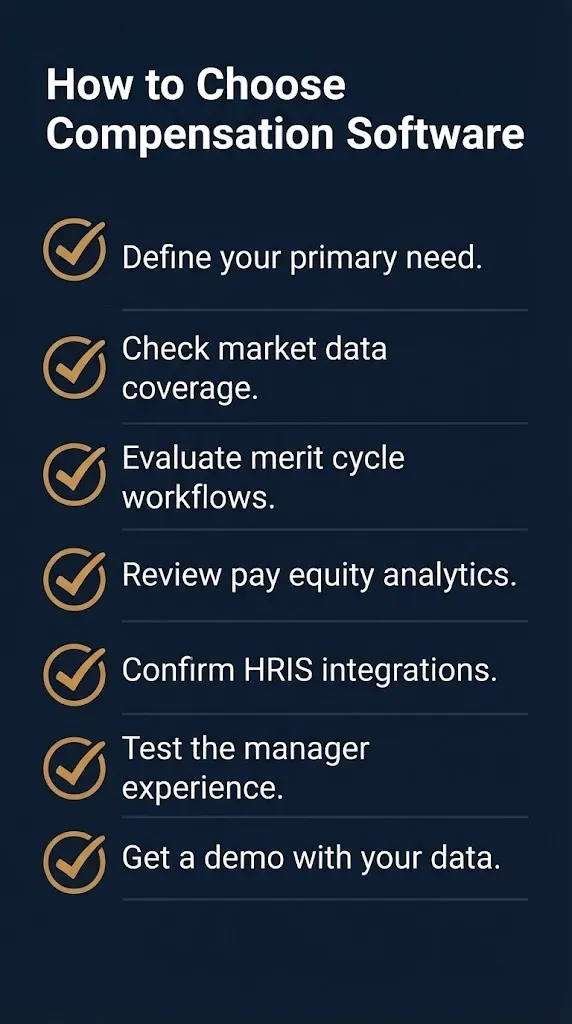
Here is a checklist to run through before you buy:
- Define your primary need. Are you benchmarking jobs, running merit cycles, managing equity, or all three?
- Check market data coverage. Does the platform include salary data for your industry and geographies?
- Evaluate merit cycle workflows. Look for budget guardrails, approval hierarchies, and automated statements.
- Review pay equity analytics. Can the tool identify pay gaps by demographic group?
- Confirm integrations. Does it connect to your HRIS, payroll, and equity management systems?
- Test the manager experience. The best tools make it easy for non-HR managers to make pay recommendations.
- Get a demo with your data. Ask vendors to show you how their tool handles your actual job architecture.
What Features Should You Look For in Compensation Planning Software?
The core features to prioritize are salary structure management, market benchmarking, merit planning, and pay equity analytics.
Salary structure management lets HR create and update pay bands, grades, and ranges without spreadsheets. Look for drag-and-drop editors and automatic range calculations .
Market benchmarking compares internal jobs to external market data. The best platforms offer AI-assisted job matching to reduce manual effort .
Merit planning handles the annual compensation cycle, including budget allocation, manager recommendations, and approval workflows. Lattice’s compensation cycle states show how this works: Draft, Active, Review and Share, and Ended .
Pay equity analytics identifies pay gaps across teams and demographics. This is increasingly important for compliance with EU pay transparency rules and US state laws.
What Happens Next in the Compensation Software Market?
The market is shifting toward AI-native platforms that automate compensation analysis and recommendations.
Pave launched its AI compensation agent in 2026, delivering instant answers backed by real-time market data . beqom released a “Bring Your Own Model” AI platform that lets financial institutions integrate their own machine learning models into compensation workflows . CaptivateIQ announced a portfolio of AI agents for compensation creation, operations, and revenue planning, with general availability expected in late 2026 .
Consolidation is also a trend. Decusoft partnered with Trusaic to offer integrated pay equity and transparency tools for compliance with the EU Pay Transparency Directive .
Here is the likely timeline:
- Late 2026: CaptivateIQ AI agents reach general availability. More vendors launch AI copilots.
- 2027: EU pay transparency rules drive demand for pay equity analytics and reporting features.
- Ongoing: AI-native platforms continue gaining share from legacy HCM suites in mid-market.
Frequently Asked Questions
What is the best compensation management software in 2026?
It depends on your needs. Oracle HCM Cloud leads in market share, Pave excels for AI-native compensation, and Payscale Ascent is strong for market data and job pricing.
How much does compensation planning software cost?
Pricing ranges from $15 per user per month for basic plans to $56+ per user per month or six-figure annual contracts for enterprise platforms.
What features should I look for in compensation software?
Look for salary structure management, market benchmarking, merit planning workflows, pay equity analytics, and integrations with your HRIS and payroll systems.
What is the difference between compensation management and payroll software?
Compensation management focuses on designing and planning pay programs. Payroll software calculates and distributes paychecks and handles tax compliance.
Which compensation software is best for small businesses?
Salary.com and Paycom are frequently recommended for small teams that want reliable benchmarking or payroll-integrated compensation features.
What is an AI compensation agent?
An AI compensation agent is a tool that uses artificial intelligence to answer compensation questions, recommend pay adjustments, and analyze market data in real time.
How do I choose between an HCM suite and a specialized compensation tool?
Choose an HCM suite if you want compensation bundled with HR, payroll, and talent management. Choose a specialized tool if you need deeper compensation features like equity modeling or advanced pay equity analysis.
Start by defining your primary need: benchmarking, merit cycles, equity, or all three. Request demos from two or three vendors and ask them to show how their tool handles your actual job architecture and compensation data. The right platform saves time, improves fairness, and reduces compliance risk.