Maya Kowalski Settlement 2026: Verdict Overturned, New Trial Ordered, and What Happens to the Money Now
Quick Answer
- No settlement exists. A jury awarded $213 million, but the appeals court overturned the entire judgment. The hospital has not paid.
- A new trial is ordered on Maya’s emotional distress, battery, and medical negligence claims. No retrial date is confirmed.
- Separate lawsuit filed in June 2026 against the family’s former attorneys alleging misuse of approximately $42 million in advanced funds.
The Maya Kowalski settlement does not exist. That is the single most important fact for anyone searching this term in 2026. A Florida jury did award the family $213.5 million in 2023 after finding Johns Hopkins All Children’s Hospital liable for false imprisonment, battery, and medical negligence tied to Maya’s 97-day separation from her family. Then an appeals court took it all away. The Florida Supreme Court declined to put it back. No money has changed hands from the hospital to the family.
If you followed the Netflix documentary Take Care of Maya, you know the story. Maya was ten years old when the hospital reported suspected child abuse to Florida’s Department of Children and Families. Her mother, Beata Kowalski, died by suicide during the separation. The trial jury sided with the family. The appeals court did not.
What you may not know is that the family is now fighting its former lawyers in a separate case over millions of dollars that flowed through the case before the verdict collapsed. That second lawsuit is where the real financial questions now live.
Key Takeaway: The headline number everyone remembers, $213 million, is not a settlement. It was a verdict that no longer exists. The only money currently in dispute is the approximately $42 million the family borrowed against that verdict before it was reversed.
Is the Maya Kowalski settlement real or a scam?
It is not real. The Maya Kowalski settlement is a myth. There is no settlement fund, no claims administrator, and no deadline to file a claim. Anyone who tells you otherwise is either confused about the case or trying to take your money.
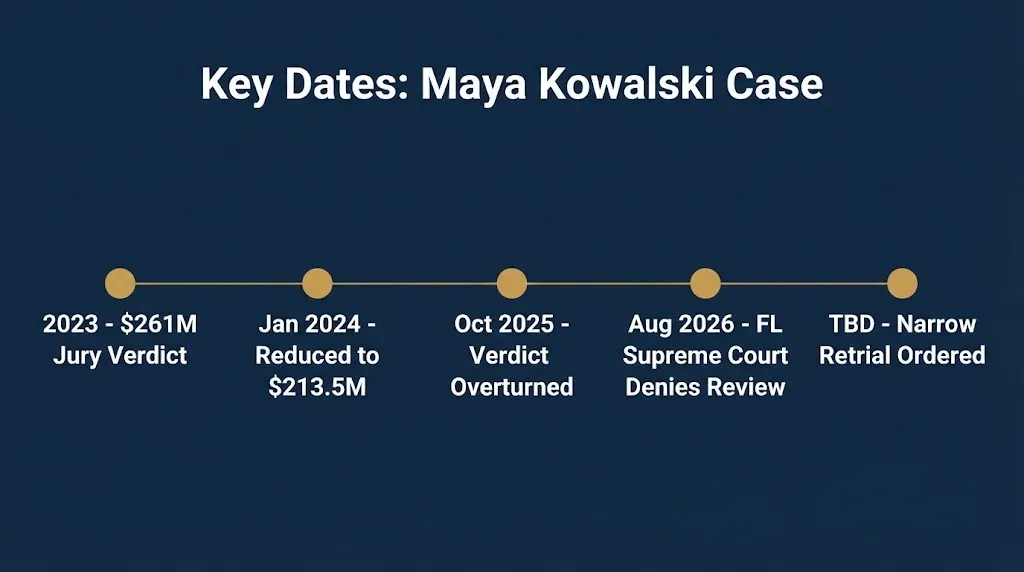
The confusion comes from legitimate news. In November 2023, a Sarasota County jury awarded Maya and her father Jack Kowalski $261 million. The judge reduced that to $213.5 million in January 2024. That number was widely reported as a judgment the hospital would have to pay.
Then, in October 2025, Florida’s Second District Court of Appeal reversed the entire judgment . The court ruled that the hospital was protected by Florida’s mandatory reporter immunity statute, Section 39, for most of the claims . The judges said the trial court should have dismissed the false imprisonment and wrongful death claims before they ever reached the jury.
The Florida Supreme Court declined to review the case in August 2026, ending the family’s attempt to reinstate the verdict . The award is gone. No hospital payment is coming from that judgment.
Reality Check: No one will text you about a Maya Kowalski settlement payout. There is no claim form to fill out. If a website or caller asks for your information to “process your share” of this case, it is a scam. The only real legal action right now is in Sarasota County courtrooms, not in your inbox.
How much money did the Kowalski family actually receive?
The family received no payment from Johns Hopkins All Children’s Hospital. Zero dollars from the hospital verdict. The jury award was reversed before any post-appeal payment could occur.
What the family did receive was an advanced funding loan of approximately $42.1 million, arranged in 2023 and 2024 while the verdict was on appeal . This was not settlement money. It was borrowed against the expectation that the $213 million judgment would survive appeal.
That loan came with heavy costs. Court records describe millions in transaction fees, broker fees, insurance premiums, and restrictions on settlement decisions . The family’s new lawsuit claims the total debt burden from the advance funding and associated costs exceeded $52 million .
So the answer to “how much did they get” is complicated. They received access to borrowed money, not a settlement payout. And that borrowed money is now the subject of a fraud lawsuit against their own former lawyers.
Why did the $213 million verdict get overturned?
The appeals court said the hospital was legally immune from most of the family’s claims. Florida law gives immunity to mandatory reporters who report suspected child abuse in good faith. The court found that once the hospital reported its suspicions to the Department of Children and Families, it was acting as an agent of the state. The hospital was following court orders when it kept Maya separated from her mother.
The Second District Court of Appeal issued a 48-page ruling on October 29, 2025 . It found that the trial judge made multiple errors. Specifically:
- The judge should have issued a directed verdict for the hospital on false imprisonment and wrongful death claims.
- The judge wrongly allowed the jury to consider punitive damages.
- The judge failed to properly apply the immunity statute during the trial.
- “Significant and inflammatory testimony” about dependency court restrictions should not have reached the jury .
The hospital’s attorney called the ruling a “clear and vital message” that mandatory reporters are protected . The family’s attorney said they were disappointed but would persevere .
The appeals court did leave a narrow path forward. It ordered a new trial on three remaining claims: Maya’s intentional infliction of emotional distress, battery, and medical negligence. But the wrongful death claim for Beata’s estate is gone. The fraudulent billing claim is gone. Punitive damages are foreclosed.
Key Takeaway: The appeals court did not say the hospital did nothing wrong. It said Florida law protects hospitals and mandatory reporters from most of these claims. The narrow retrial covers only claims where that immunity does not apply.
What is the new trial about and when will it happen?
The new trial covers three claims that survived the appeal. No retrial date has been confirmed as of September 2026. The case returns to Sarasota County Circuit Court, where it was originally tried.
The surviving claims are:
| Claim | What It Means | Status |
|---|---|---|
| Intentional Infliction of Emotional Distress | Maya’s claim that the hospital’s conduct caused her severe emotional trauma | Survives appeal |
| Battery | Maya’s claim that she was subjected to unwanted physical contact, including being forced to undress for photographs | Survives appeal |
| Medical Negligence | Maya’s claim that the hospital’s treatment fell below the standard of care | Survives appeal |
The wrongful death claim, which sought damages for Beata’s suicide, is permanently barred by the immunity ruling. The fraudulent billing claim is also gone. Punitive damages cannot be awarded in the retrial.
The family’s attorney, Nick Whitney, said after the appeals ruling that “the next jury will see things just like the first one did” . That statement suggests the family intends to pursue the retrial aggressively.
Why is the family suing its own former lawyers?
In June 2026, Maya Kowalski and her father filed a 32-page lawsuit in Sarasota County against attorneys Gregory and Jennifer Anderson and their firm, AndersonGlenn . The lawsuit alleges fraud, breach of fiduciary duty, and constructive fraud.
The core allegations center on the $42 million advanced funding loan the Andersons arranged after the 2023 verdict . The family claims:
- The Andersons collected millions in fees before they were entitled to them .
- Approximately $4 million in disputed client funds were used as collateral for a personal loan to buy a multi-million-dollar home .
- Funds were allegedly used for a yacht, private jet hours, credit card bills, and a vacation home mortgage .
- The fee agreement violated Florida Bar rules and gave the firm an excessive percentage of the family’s recovery .
- Maya, who turned 18 in December 2023, signed a new fee agreement in a hotel room while “emotionally vulnerable” and was not told it might conflict with Bar rules .
The family claims the Andersons have taken almost $15 million in fees and costs, and that the Kowalskis do not have complete records to determine where all the money went . They are seeking a full accounting, a jury trial, and unspecified damages.
Jennifer Anderson has denied all allegations. Her statement said the firm is “truly saddened and stunned” by the lawsuit after eight years of work for the family . No court has made any finding of wrongdoing. The case is in its early stages.
Key Takeaway: The family’s financial fight has shifted from the hospital to its former counsel. The question now is not whether Johns Hopkins will pay, but whether the money that was borrowed against the vanished verdict was handled lawfully.
Who was Beata Kowalski and why is her death central to this case?
Beata Kowalski was Maya’s mother. She died by suicide in January 2017, after 87 days of separation from her daughter . Her death was the emotional core of the trial and the reason the jury awarded wrongful death damages.
Beata believed Maya was suffering from Complex Regional Pain Syndrome, a severe neurological condition. Maya had been treated with ketamine infusions by another doctor, and Beata insisted the hospital continue that treatment. The hospital staff suspected Munchausen syndrome by proxy and reported the family to child protective authorities.
During the separation, Beata was allowed only limited phone contact with Maya. She was not permitted in-person visits for most of the 97 days Maya spent at the hospital. A psychiatrist later determined there was “no evidence” Beata had falsified Maya’s condition . The state’s case against the family was ultimately closed.
Beata’s suicide note expressed despair at being separated from her daughter and treated “like a criminal” . The trial jury found the hospital’s actions caused her death. The appeals court reversed that finding, ruling the hospital was immune from the wrongful death claim under Florida’s child abuse reporting law.
The wrongful death claim is now permanently barred. Beata’s death remains the emotional center of the public story, but it no longer has a path to legal recovery against the hospital.
What happens to the money from the advanced funding loan?
The family’s lawsuit against the Andersons is the only active legal proceeding that could determine what happens to the loaned money. No court has ruled on the allegations yet.
The advanced funding transaction borrowed approximately $42.1 million against the expected verdict . The loan was structured before the appeal was decided. When the verdict was reversed, the collateral backing that loan disappeared.
The family now claims the loan was mismanaged and that some funds were diverted for the Andersons’ personal benefit. The Andersons deny this. The lawsuit asks the court to order a full accounting and to hold the attorneys liable for any improper transactions.
What this means for any money that remains: it depends on what the Sarasota County court finds. If the family prevails, the Andersons could be ordered to repay misappropriated funds. If the Andersons prevail, the family may still owe on the advance funding debt despite losing the verdict.
There is no clear answer yet. The case was filed in June 2026 and remains in its early stages.
What happens next in the Maya Kowalski case?
The case is moving on two parallel tracks: the retrial against the hospital and the fraud lawsuit against the former attorneys.
Expected Fall 2026: Scheduling and discovery in the fraud lawsuit against the Andersons. The attorneys have not yet filed a formal response as of the latest reporting .
Expected Late 2026 or 2027: A retrial date may be set for the three surviving claims against Johns Hopkins All Children’s Hospital. No date is confirmed.
Ongoing: The family’s fight over the advanced funding loan and the alleged misappropriation of funds. This case will determine what, if anything, the family owes or recovers from the money that was borrowed against the vanished verdict.
Closed: The $213 million verdict. The Florida Supreme Court’s refusal to review the case in August 2026 ended the family’s attempt to reinstate it .
Key Takeaway: The Maya Kowalski case is no longer about a hospital payout. It is about a family fighting its own former lawyers over money that was borrowed against a verdict that no longer exists.
Frequently Asked Questions
Is there a Maya Kowalski settlement I can claim?
No. There is no settlement fund and no claims process. The verdict was reversed and the Florida Supreme Court declined to reinstate it in August 2026.
How much was Maya Kowalski awarded?
A jury awarded $261 million in November 2023. The judge reduced it to $213.5 million. The appeals court reversed the entire judgment in October 2025.
Did Johns Hopkins pay the Kowalski family anything?
No. The hospital has not paid the family. The verdict was reversed before any post-appeal payment occurred.
Is Johns Hopkins All Children’s Hospital still facing a trial?
Yes. A narrower retrial is ordered on three claims: Maya’s emotional distress, battery, and medical negligence. No trial date is set.
Why is the family suing its former lawyers?
The family alleges the Andersons mismanaged approximately $42 million in advanced funds, used client money for personal expenses, and charged excessive fees. The Andersons deny all allegations.
What is the advanced funding loan?
It was approximately $42.1 million borrowed against the expected verdict. The family claims the loan terms and handling were fraudulent. The Andersons say the allegations are false.
Can I still file a claim for the Maya Kowalski case?
There is no claim to file. If a website or caller says you can claim money from this case, it is a scam. The only active legal proceedings are in Sarasota County courts.
What is the next important date?
No retrial date is confirmed. The fraud lawsuit against the Andersons is in early stages. Check court records in Sarasota County for scheduling updates.