Marriage Settlement Agreement 2026: What It Covers, How It’s Enforced, and When You Can Change It
Quick Answer
- A marriage settlement agreement is a legally binding divorce contract covering property, support, and custody
- Courts enforce these agreements, and they generally cannot be modified once signed
- Child support terms can be changed if circumstances substantially change or three years pass
A marriage settlement agreement (MSA) is a written contract between divorcing spouses that spells out who gets what, who pays what, and how children will be cared for after the marriage ends. It is not a suggestion or a draft. Once signed and approved by a judge, it binds both parties.
If you are divorcing in 2026, this document will likely control your financial life for years. The terms you agree to now can be enforced against you later.
This guide explains what an MSA covers, how courts enforce it, when you can modify it, and the mistakes that cost people thousands. It also covers what makes an agreement invalid.
The Facts
| Item | Detail |
|---|---|
| Legal Name | Marital Settlement Agreement (MSA) |
| Also Called | Property Settlement Agreement, Divorce Settlement Agreement, Separation Agreement |
| Enforceability | Binding once signed; court incorporates into divorce judgment |
| Typical Contents | Property division, debts, alimony, child custody, child support |
| Modification | Financial terms generally final; child support modifiable under specific rules |
| Invalidity Grounds | Fraud, duress, unconscionability |
| Court Review | Judge may reject terms that are unfair or unclear |
Is a Marriage Settlement Agreement Legally Binding?
Yes, a marriage settlement agreement is legally binding once both spouses sign it. If one party refuses to follow the terms, the other can file the agreement with the court to enforce it.
The agreement becomes part of the divorce judgment if the judge approves it. At that point, it carries the same weight as any court order. Violating it can lead to contempt proceedings, wage garnishment, or liens on property.
Think of it like a contract to buy a house. Once you sign, you cannot wake up the next morning and decide you want different terms. The other party can hold you to what you agreed.
Courts do not rewrite agreements simply because one party later regrets the deal. The law presumes you understood what you signed. That is why legal review before signing matters more than almost anything else in a divorce.
How Much Does a Marriage Settlement Agreement Cost?
There is no fixed cost for a marriage settlement agreement. What you pay depends on whether you hire attorneys, use a mediator, or file without professional help.
For a simple, uncontested divorce where both spouses agree on everything, attorney fees might range from a few hundred to a few thousand dollars. For a contested divorce with complex assets, business valuations, and custody disputes, costs can reach tens of thousands.
Mediation is often cheaper than litigation. A mediator charges hourly, and both spouses typically split the fee. But a mediator does not represent either spouse. The mediator helps you reach an agreement, not advocates for your interests.
If you cannot afford an attorney, some legal aid organizations provide free or low-cost help. Court self-help centers can explain forms but cannot give legal advice.
The real cost is not just the fee you pay now. It is the value of what you give up in the agreement. A clause you do not understand can cost you far more than any attorney fee.
Reality Check: No one from the court calls you demanding payment to “finalize” your divorce agreement. No legitimate mediator asks for your bank login. If someone threatens that you will lose everything unless you pay a fee immediately, that is a scam. Courts do not work that way.
What Does a Marriage Settlement Agreement Cover?
A marriage settlement agreement typically covers property division, debt allocation, alimony, child custody, visitation, and child support. It can also address retirement accounts, insurance, tax filing status, and estate rights.
Here is a breakdown of common terms:
| Category | Typical Provisions |
|---|---|
| Property | Who keeps the house, cars, furniture, bank accounts |
| Debts | Who pays credit cards, mortgages, student loans, medical bills |
| Alimony | Amount, duration, and conditions for spousal support |
| Custody | Legal custody (decision-making) and physical custody (living arrangements) |
| Visitation | Schedule for parenting time, holidays, vacations |
| Child Support | Monthly amount, health insurance, childcare costs |
| Retirement | Division of 401(k)s, pensions, IRAs (may require separate orders) |
| Taxes | Who claims children as dependents, filing status |
The agreement cannot include everything. Some issues, like future modifications to child support, are governed by state law regardless of what the contract says.
Can You Modify a Marriage Settlement Agreement After Signing?
Financial terms in a marriage settlement agreement generally cannot be modified once signed. Property division and debt allocation become final unless both spouses agree to a change and get a new court order.
Child support is the major exception. Under the law, child support can be modified if:
- Circumstances have substantially changed
- Three years have passed since the last order
- Either party’s gross income has changed by 15 percent or more since the order was entered, last modified, or adjusted
Both parents can opt out of the three-year and 15 percent rules if they specifically agree to that in a valid written agreement. But that opt-out must be clear and intentional.
Alimony modification depends on state law and the terms of your agreement. Some agreements state that alimony is non-modifiable. Others allow modification if circumstances change. Read that clause carefully before you sign.
Key Takeaway: Property division is final. Child support can change. Alimony depends on what the agreement says. Know which category each term falls into before you sign.
What Makes a Marriage Settlement Agreement Invalid?
A marriage settlement agreement is invalid if it is substantially unconscionable, or if it resulted from fraud or duress. If a mediator was not impartial, failed to disclose conflicts, or did not fully inform participants about the law and their rights, the agreement can be set aside.
Unconscionability means the agreement is so one-sided that no reasonable person would accept it. Courts do not use this standard lightly. One spouse getting a bad deal is not enough. The deal must shock the conscience.
Fraud means one spouse lied about assets, income, or other material facts. Hiding a bank account or undervaluing a business can void the agreement if discovered later.
Duress means one spouse was pressured or threatened into signing. A threat to take the children or destroy a career can qualify.
If you believe your agreement is invalid, you need to act. Waiting too long can waive your right to challenge it.
How Do You Enforce a Marriage Settlement Agreement?
You enforce a marriage settlement agreement by filing it with the court and asking a judge to hold the other party in contempt. The court can order wage garnishment, property liens, or even jail time for willful violations.
The process generally works like this:
- Document the violation. Gather evidence of what the other party failed to do.
- File a motion with the court. Ask the judge to enforce the specific term.
- Serve the other party. They have a right to respond.
- Attend a hearing. The judge decides whether a violation occurred.
- Get a remedy. The court can order payment, transfer property, or impose penalties.
The other party can defend by claiming they cannot afford to pay. Courts have some discretion in enforcement. But willful refusal to comply is treated more harshly than inability to pay.
What Should You Check Before Signing a Marriage Settlement Agreement?
Before signing, verify that every asset and debt is disclosed, every term is clear, and you understand the long-term consequences. Do not sign under time pressure. Do not sign without reading every line.
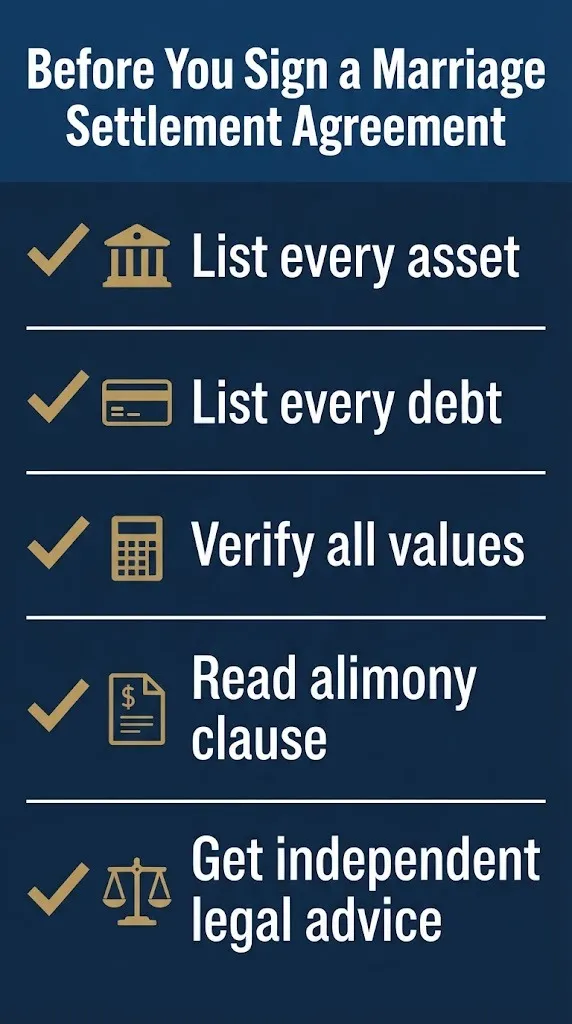
Here is a pre-signing checklist:
- List every asset. Bank accounts, retirement funds, vehicles, real estate, businesses, crypto, valuable personal property.
- List every debt. Mortgages, credit cards, student loans, medical bills, tax obligations.
- Verify values. Do not accept the other spouse’s estimate for a house, business, or retirement account.
- Read the alimony clause. Is it modifiable? Does it terminate on remarriage or cohabitation?
- Read the custody and support terms. Are they realistic and specific?
- Check for hidden assets. Tax returns, bank statements, and business records can reveal omissions.
- Understand the tax consequences. Some transfers have tax implications.
- Get independent legal advice. Your spouse’s attorney does not represent you.
What Happens If You Don’t Follow the Agreement?
If you do not follow the agreement, the other party can ask a judge to enforce it. The judge can order you to comply, pay the other side’s attorney fees, or face contempt penalties.
Contempt can mean fines or jail in serious cases. More commonly, courts order wage garnishment or place a lien on your property. Your credit can suffer. Your ability to refinance or sell assets can be blocked.
Ignoring a court-approved agreement is not like ignoring a credit card bill. It is violating a court order. The consequences are legal, not just financial.
Marriage Settlement Agreement vs. Prenuptial Agreement
A marriage settlement agreement is signed during or after divorce. A prenuptial agreement is signed before marriage. They serve different purposes.
A prenup determines how property will be divided if the marriage ends. An MSA actually divides the property when it does end. A postnuptial agreement is signed during the marriage, similar to a prenup but after the wedding.
If you have a prenup, the MSA must be consistent with it. If they conflict, the court may need to resolve which controls. That is one reason both documents should be drafted by attorneys who understand your full financial picture.
What Happens Next: Timeline for Your Marriage Settlement Agreement
- Before filing: Gather financial documents. Consider mediation or attorney consultation.
- During negotiations: Exchange disclosures. Draft terms. Review every clause.
- Before signing: Get independent legal advice if possible. Verify all values.
- After signing: Submit to the court for incorporation into the divorce judgment.
- After judgment: Follow the terms. If the other party violates them, document and file for enforcement.
- If circumstances change: Determine whether modification is available under state law and your agreement’s terms.
Frequently Asked Questions
What is a marriage settlement agreement?
A written contract between divorcing spouses that divides property, sets support, and resolves custody issues.
Is a marriage settlement agreement legally binding?
Yes. Once signed and incorporated into a divorce judgment, it is enforceable as a court order.
Can you change a marriage settlement agreement after it’s signed?
Property terms generally cannot change. Child support can be modified if circumstances substantially change.
What happens if one spouse doesn’t follow the agreement?
The other spouse can file a motion to enforce. The court can order compliance and impose penalties.
What makes a marriage settlement agreement invalid?
Fraud, duress, or terms so one-sided they shock the conscience can invalidate an agreement.
How long does it take to get a marriage settlement agreement approved?
It depends on the court and whether the divorce is contested. Uncontested cases move faster.
Do you need a lawyer for a marriage settlement agreement?
You do not have to have one, but you will be bound by what you sign. Independent legal advice protects you.
Read every clause before you sign. The terms you agree to today can control your finances for decades. If you do not understand a provision, do not sign until you do.
The most important date is the day you sign, not the day you file.