IP Litigation 2026: Venues, Costs, and What Actually Happens in a Case
Quick Answer
- What this is: Civil lawsuits to enforce or defend patents, trademarks, copyrights, and trade secrets, filed in federal or specialized courts.
- How much: Patent litigation costs run $1 million to $6 million through trial; trademark and copyright cases cost far less, sometimes under $100,000.
- Deadline: No universal deadline. Patent infringement claims carry a 6-year damages lookback under 35 U.S.C. § 286, and you must file promptly.
You found someone using your patented invention, copying your trademark, or stealing your trade secrets. Or you got sued and need to understand what happens next. IP litigation is complex, expensive, and increasingly global, but the basic structure is predictable if you know where to look.
This guide covers where IP cases get filed, what they cost, how long they take, and what remedies courts actually award. It’s built from court statistics, law firm reports, and recent rulings, not law firm marketing copy. One detail that surprises most people: the U.S. is no longer the dominant venue for global patent disputes, and China and Europe now handle a growing share of high-stakes cases .
The Facts
| Case | Individual IP enforcement or defense lawsuit (no class action or settlement fund) |
|---|---|
| Court | U.S. federal district courts, ITC, UPC (Europe), or national courts |
| Status | Active litigation filed daily; no central settlement or claim form |
| Fund Size | Not applicable; damages and settlements are case-specific |
| Est. Per Person | Varies; patent cases often settle in the $100,000 to $10 million+ range |
| Claim Deadline | No universal deadline; patent damages lookback is 6 years |
| Administrator | Not applicable; private litigation between parties |
| Proof Needed | Registration certificates, infringement evidence, damages documentation |
Key Takeaway: IP litigation is private enforcement, not a class action settlement. You file or defend individually, and outcomes depend on your evidence and the venue.
Is IP Litigation Legit or a Scam?
IP litigation is a legitimate legal process, but scam IP enforcement schemes exist. Some entities send demand letters threatening patent or trademark lawsuits without any basis, hoping you’ll pay a settlement fee to avoid trouble.
The legitimate path starts with a registered right. For patents, you need an issued patent. For trademarks, a registration certificate is strong proof of ownership . For copyrights, registration is not required to sue but is required for statutory damages and attorney fees.
If you receive a demand letter, verify the sender’s rights before paying anything. You can check patent and trademark records through the USPTO and copyright records through the U.S. Copyright Office. A legitimate enforcement letter will identify the specific patent or trademark number, the accused product or service, and the alleged infringement.
What Does IP Litigation Cost in 2026?
IP litigation costs range from under $100,000 for simple trademark disputes to $6 million or more for complex patent cases through trial. The cost depends on the technology, the stakes, and the venue.
Here are typical cost ranges by case type:
| Case Type | Cost Through Trial |
|---|---|
| Copyright infringement (simple) | $50,000 to $300,000 |
| Trademark infringement | $100,000 to $500,000 |
| Trade secret misappropriation | $300,000 to $1.5 million |
| Patent litigation (median) | $1 million to $4 million |
| Patent litigation (high-stakes, complex) | $4 million to $6 million+ |
Most IP cases settle before trial. The threat of a multi-million dollar verdict pushes both sides toward resolution. Mediation is common in patent and trade secret cases, and courts increasingly push parties toward alternative dispute resolution .
Reality Check: What IP Litigation Won’t Do
Reality Check: Filing an IP lawsuit does not automatically stop the infringer. Unlike copyright, where a cease-and-desist letter often works, patent and trademark enforcement requires court orders. Preliminary injunctions are hard to get, especially for patents. The eBay v. MercExchange decision removed the presumption of injunctions after patent infringement , and you must prove irreparable harm to get one.
Where Are IP Cases Filed in 2026?
IP cases are filed in federal district courts for patents and copyrights, state or federal courts for trademarks and trade secrets, and specialized venues like the ITC and UPC. Each venue has different rules, timelines, and remedies.
For U.S. patent cases, the top venues in 2026 are:
| District | Share of New Patent Cases (Q1 2026) |
|---|---|
| Eastern District of Texas | 19% |
| District of Delaware | Second overall |
| Western District of Texas | Third overall |
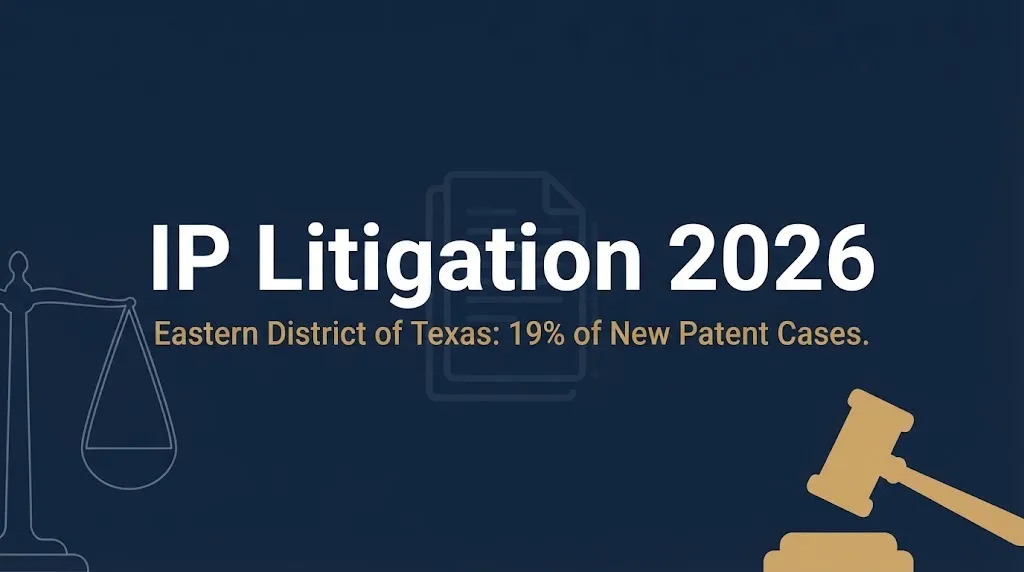
Judge Rodney Gilstrap in the Eastern District of Texas continues to preside over the largest share of patent cases, with 19% of all new litigation in early 2026 . The District of Delaware is the top venue for operating companies, while East Texas dominates NPE (non-practicing entity) cases .
For international cases, the Unified Patent Court (UPC) has become a major venue since its launch, with 305 cases filed in the first seven months of 2026 . The UPC offers faster resolution and broader geographic reach than national courts.
How Long Does IP Litigation Take?
Patent litigation takes a median of about 2.5 years from filing to trial in the U.S. . Trademark and copyright cases move faster, often resolving in 12 to 18 months. The UPC is designed to move faster than U.S. courts, with cases often reaching decision in under a year.
The timeline depends on several factors:
- Venue: East Texas and Delaware have different paces and procedures.
- Complexity: Biotech and software cases with extensive discovery take longer.
- Parallel proceedings: PTAB challenges and foreign litigation can pause or extend timelines.
- Settlement pressure: Mediation and court-ordered ADR can shorten the path to resolution.
What Remedies Can You Get in IP Litigation?
IP remedies include damages, injunctions, and in some cases enhanced damages or attorney fees. The remedy available depends on the type of IP and the facts.
For patent infringement, damages are typically a reasonable royalty or lost profits. The 6-year lookback under 35 U.S.C. § 286 limits how far back you can recover damages. Willful infringement can justify enhanced damages up to three times the compensatory award.
For trademark infringement, remedies include injunctions, damages, and in some cases statutory damages for counterfeiting. Courts can also order the destruction of infringing goods.
For copyright infringement, statutory damages range from $750 to $30,000 per work, or up to $150,000 per work for willful infringement. Actual damages and lost profits are also available.
Trade secret remedies under the Defend Trade Secrets Act include injunctions, damages, and in extraordinary cases, ex parte seizure orders to prevent dissemination of the secret .
What Is the ITC Section 337 Investigation?
An ITC Section 337 investigation is a fast-track proceeding at the U.S. International Trade Commission that addresses IP infringement by imported goods. It is one of the busiest IP venues in the country .
The ITC offers advantages over district court: faster resolution, broader injunctive relief, and the ability to block imports at the border. The remedy is an exclusion order directing U.S. Customs and Border Protection to stop infringing goods from entering the country.
Section 337 investigations require proof of importation and a domestic industry. The domestic industry requirement can be satisfied by significant investment in plant, equipment, labor, or capital, or by substantial investment in engineering, research, or licensing.
The ITC is particularly attractive for cases involving imported products where a district court injunction might not stop the flow of infringing goods.
What Happens Next: Timeline for an IP Case
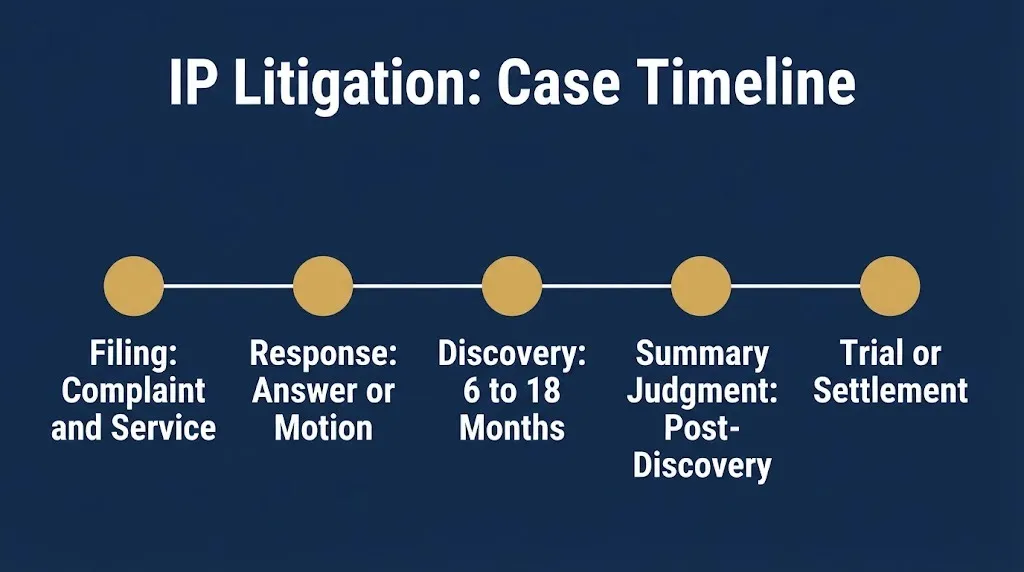
Filing: Complaint filed, filing fee paid, and service on defendant.
Response: Defendant answers or files motion to dismiss, typically within 21 to 60 days.
Discovery: Document production, interrogatories, and depositions, lasting 6 to 18 months.
Expert reports: Damages and infringement experts exchange reports.
Summary judgment: Motions filed after discovery, often deciding the case.
Trial: If no settlement, trial before a judge or jury.
Appeal: Losing party can appeal to the Federal Circuit (patents) or regional circuit.
Frequently Asked Questions
How much does it cost to sue for patent infringement?
Patent litigation typically costs $1 million to $6 million through trial, depending on complexity. Most cases settle before trial, often for less than the full cost of litigation.
Do I need a lawyer for IP litigation?
Yes, for patent cases. Patent litigation is technical and requires an attorney admitted to practice before the USPTO. Trademark and copyright cases can be handled pro se, but the complexity makes representation advisable.
What is the statute of limitations for IP infringement?
Patent damages have a 6-year lookback. Copyright has a 3-year statute of limitations. Trademark infringement claims are subject to laches and state statutes of limitations, typically ranging from 3 to 6 years.
Can I get an injunction to stop infringement?
Yes, but injunctions are not automatic. In patent cases, the eBay decision removed the presumption of injunctions. You must prove irreparable harm, inadequacy of legal remedies, and that the balance of hardships favors an injunction.
What is the ITC and why would I file there?
The ITC is the U.S. International Trade Commission. It handles Section 337 investigations involving imported goods that infringe U.S. IP rights. The ITC is faster than district court and can issue exclusion orders to block imports.
How long do IP cases take?
Patent cases take a median of 2.5 years to trial in the U.S. The UPC moves faster, often deciding cases in under a year. Most cases settle before trial.
What is the UPC and how does it affect IP litigation?
The Unified Patent Court is a new European court that handles patent disputes across participating EU member states. It offers faster resolution and broader geographic reach than national courts .
Can I recover attorney fees in IP litigation?
Yes, in exceptional cases. The Patent Act allows fee shifting for exceptional cases. The Copyright Act allows fees to the prevailing party. Trademark cases allow fees in exceptional circumstances.