NFL Concussion Settlement 2026: Payouts, Deadlines and the June Fraud Audit
Quick Answer
- Yes, it’s real: a court-approved, uncapped fund paying retired players with qualifying diagnoses for 65 years.
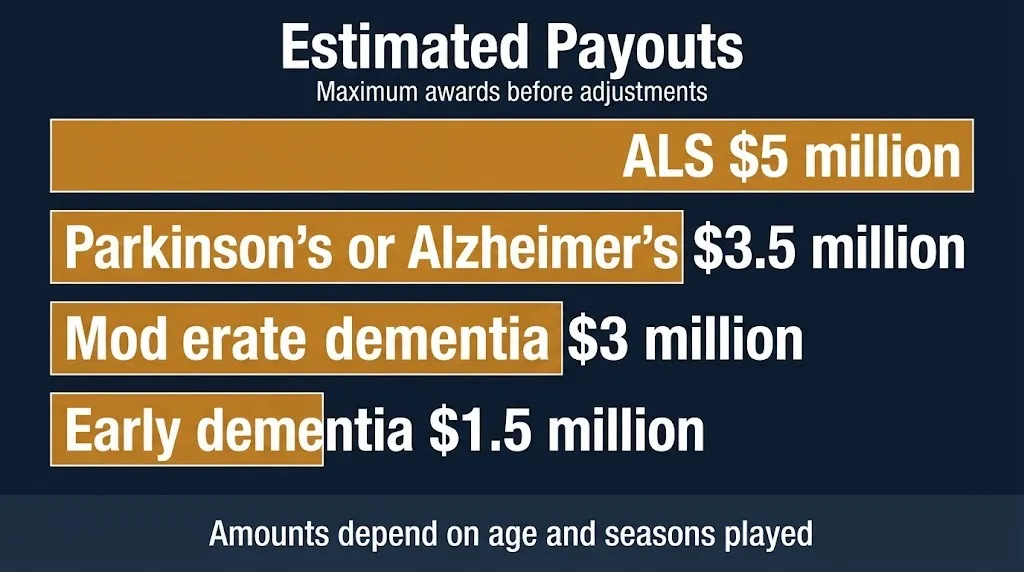
- Awards top out at $5 million for ALS. Your amount depends on diagnosis, age, and seasons played.
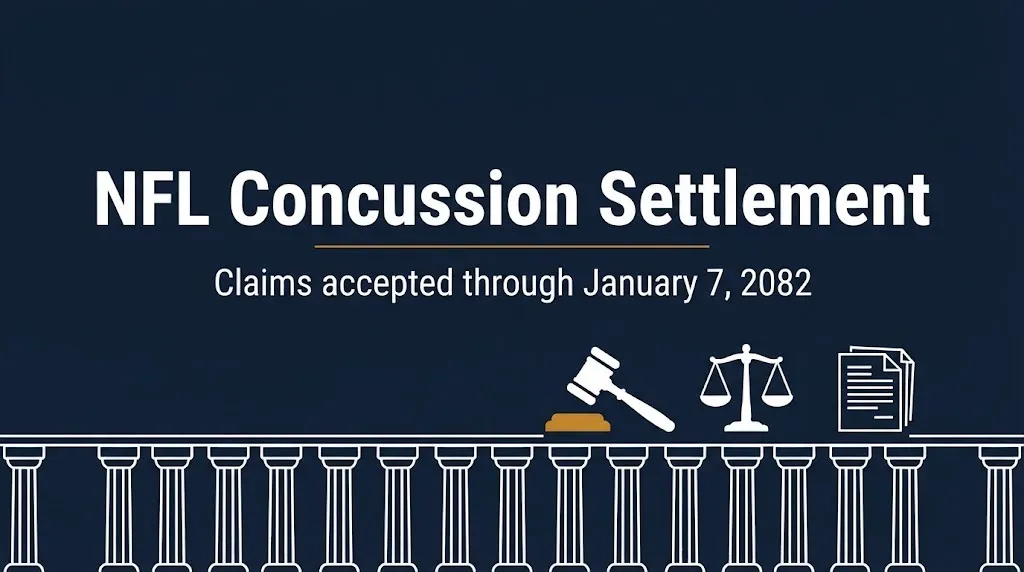
- Claims are due two years after a qualifying diagnosis. The program accepts diagnoses until January 7, 2082.
The NFL concussion settlement is a court-approved, uncapped fund that pays retired players who receive a qualifying brain or nerve diagnosis. ESPN reported in June 2026 that the league has paid more than $1.5 billion so far.
It covers retired players and, in some cases, their families. The date that matters most: a claim package is due two years after a qualifying diagnosis, and the program accepts diagnoses through January 7, 2082.
This guide covers payouts, eligibility, filing steps, and the June 2026 audit that put 98 Parkinson’s claims under a cloud. One surprise: the fund has no cap, yet the NFL’s own insurers are still refusing to reimburse it.
| The Facts | Details |
|---|---|
| Case | In re: National Football League Players’ Concussion Injury Litigation, MDL No. 2323 (E.D. Pa., Judge Anita B. Brody), case no. 2:12-md-02323 |
| Status | Approved 2015, effective January 7, 2017, still paying claims |
| Fund Size | Uncapped. More than $1.5 billion paid (ESPN, June 2026) |
| Est. Per Person | Not yet determined for any one player. Maximum awards run $1.5 million to $5 million |
| Claim Deadline | Two years from a qualifying diagnosis. Diagnoses accepted through January 7, 2082 |
| Administrator | BrownGreer |
| Proof Needed | Diagnosis from a program-approved (Qualified MAF) physician, plus a claim package |
Is the NFL concussion settlement real and still open in 2026?
Yes. The settlement is real, court-approved, and still open to new qualifying diagnoses in 2026.
Judge Brody approved it in 2015. The case sits in the Eastern District of Pennsylvania as MDL No. 2323. The official settlement website lists claims accepted until January 7, 2082.
The NFL never admitted wrongdoing. Players also don’t have to prove football caused their condition. They need a covered diagnosis from an approved doctor.
Think of it like a warranty with no expiration date but a short list of covered defects. Your problem has to be on the list. The program is open, though several older windows inside it have closed. The deadlines section below sorts out which ones.
Is the settlement legit after the 2026 fraud audit?
Yes. The June 2026 audit targeted five law firms and eight doctors, not the fund and not the players’ right to benefits.
Special Masters David Hoffman and Jo-Ann Verrier issued a 51-page decision. It found the claims administrator had a reasonable basis to conclude Parkinson’s claims involved misrepresentation.
The decision doesn’t say any player lacks Parkinson’s disease. It addresses how lawyers pressed the claims. No criminal charges have been filed, according to NBC Sports, though the special masters can refer findings to federal authorities.
Here’s the skeptical read. The NFL said it was pleased and called the remedies necessary. But the league gains when pending claims get denied. Read the decision’s details, not just the press statement.
How much is the NFL concussion settlement worth?
No fixed total exists, because the fund is uncapped. The NFL first estimated $765 million in 2013. The final deal has no ceiling across its 65-year term.
ESPN reported in June 2026 that the league has paid more than $1.5 billion. Other 2026 pages cite $1.2 billion approved or $1.4 billion paid. Those figures differ by date and by “approved” versus “paid.” The administrator’s status reports hold the latest count.
| Measure | Figure | Source |
|---|---|---|
| 2013 tentative estimate | $765 million | ESPN, 2013 |
| Cap on total fund | None (uncapped) | Court-approved settlement |
| Paid to date | More than $1.5 billion | ESPN, June 2026 |
| Approved (different count) | About $1.2 billion | Open Class Actions, July 2026 |
Key Takeaway: The fund has no ceiling, and the NFL has paid more than $1.5 billion so far.
How much can a retired player get from the NFL concussion fund?
Maximum awards run from $1.5 million to $5 million, depending on the diagnosis. Those are ceilings, not promises.
| Qualifying diagnosis | Maximum award |
|---|---|
| ALS (Lou Gehrig’s disease) | $5 million |
| Death with CTE | $4 million (see note) |
| Parkinson’s disease | $3.5 million |
| Alzheimer’s disease | $3.5 million |
| Level 2 neurocognitive impairment (moderate dementia) | $3 million |
| Level 1.5 neurocognitive impairment (early dementia) | $1.5 million |
The CTE row needs a warning. The official Key Dates page says the program no longer accepts pre-effective-date diagnoses, including death with CTE. Many competitor pages still list it as payable.
A player who later gets a diagnosis carrying a bigger award can qualify for an increase, per the court-filed settlement summary.
Why do awards differ by age and seasons played?
Your award is a formula, not a flat check. It starts at the diagnosis maximum and then adjusts for your age at diagnosis and your number of NFL seasons.
The range is wide. One law-firm summary says a newer retiree with ALS gets $5 million. It says an 80-year-old with early dementia gets $25,000. Treat those as illustrations, not quotes for your claim.
Awards reported through 2021 ranged from roughly $27,000 to about $5.3 million, according to a Brooklyn Law School analysis.
Think of it like a trade-in value. The same car is worth less at 200,000 miles than at 20,000. The administrator applies the grid to your specific record, so your figure is not yet determined until it does.
Reality Check: No one from the NFL or the administrator will text you a payout in exchange for a fee. Filing runs through the official settlement program. If a “helper” steers you to an outside doctor who promises a diagnosis, that’s the pattern the June 2026 decision flagged. The official site has a Report Fraud page.
What is the average NFL concussion payout?
No 2026 average is confirmed. The most recent published averages come from 2021 coverage.
CBS Sports reported averages of $516,000 for 379 players with early dementia and $715,000 for 207 players with moderate dementia. Nearly $800 million had been paid by then, according to the Associated Press.
| Diagnosis group | Average award | Players counted | Reported |
|---|---|---|---|
| Early dementia (Level 1.5) | $516,000 | 379 | 2021 |
| Moderate dementia (Level 2) | $715,000 | 207 | 2021 |
The racial-bias fix, covered below, was expected to raise totals. Lawyers at the time said it could add $100 million or more. Check the administrator’s current status reports for updated averages.
Key Takeaway: Awards top out at $5 million for ALS, but your number depends on diagnosis, age, and seasons played.
Who qualifies for the NFL concussion settlement?
You may qualify if you’re a retired NFL player with a covered diagnosis from an approved physician. Families of deceased players may also have routes, covered below.
Here’s the checklist:
- You are a retired player in the settlement class.
- You registered by the listed deadline, August 7, 2017.
- You did not opt out of the class. Opted-out players aren’t covered.
- A Qualified MAF physician made your diagnosis.
- The diagnosis is on the covered list.
- You file within two years of that diagnosis.
Missing one item can sink a claim. The registration deadline is the one most often overlooked. If you’re unsure of your status, check the official site’s registration FAQ before assuming anything.
Which diagnoses does the settlement cover?
Six diagnoses carry monetary awards: ALS, Parkinson’s disease, Alzheimer’s disease, Level 2 neurocognitive impairment, Level 1.5 neurocognitive impairment, and death with CTE.
CTE can only be confirmed after death. That’s why it’s listed as “death with CTE.” A living player can’t file on a CTE diagnosis alone.
Players with mild impairment may still get help. The 2013 deal set aside money for baseline medical exams, capped at $75 million, plus treatment for some who don’t reach an award level.
Only program-approved doctors can make qualifying diagnoses. They must be board-certified, have neurology expertise, and follow anti-influence rules. The official site includes a physician locator.
How do you file an NFL concussion claim?
You file through the official settlement program, not through a third-party website. The steps below follow the program’s structure.
- Confirm your registration status on the official settlement website.
- Use the MAF Physician Locator to find an approved doctor.
- Book an evaluation with that doctor.
- Gather your medical records and NFL playing history.
- Submit the claim package through the claims administrator, BrownGreer.
- Answer any audit or records requests quickly.
- Check for liens on any award, using the site’s lien FAQs.
- If denied, read the Appeals FAQ right away, because windows are limited.
Think of it like a store return with a receipt. The paperwork is the product. A missing record slows everything.
Key Takeaway: Use only approved doctors and the official claims process, because outside shortcuts are exactly what the audit punished.
What is the NFL concussion claim deadline?
For a new diagnosis, the claim package is due two years from the date of diagnosis. That applies to qualifying diagnoses after February 6, 2017.
| Deadline | Date | Status |
|---|---|---|
| Registration | August 7, 2017 | Closed |
| Baseline exam (born on or before June 6, 1974) | June 6, 2019 | Closed |
| Baseline exam (born after June 6, 1974) | June 7, 2027, or before age 45, whichever comes sooner | Open |
| Expanded baseline exam request | March 4, 2024 | Closed |
| New claims under Norming Agreement Section 2.7 | March 4, 2024 | Closed |
| Pre-effective-date diagnoses | February 6, 2019 | Closed |
| Final date for qualifying diagnoses | January 7, 2082 | Open |
The younger-player baseline date comes from the official Key Dates page. Confirm it there before relying on it.
Can a retired player’s family file a claim?
Possibly. The official site has separate FAQ sections for representative claimants and derivative claimants, and a process for appointing a representative.
A representative can act for a player who died or can’t act for himself. A derivative claimant is a family member with a claim tied to the player’s award. The court-filed summary says derivative claimants can share in an increase.
Death with CTE is the exception. The official page says pre-effective-date diagnoses, including death with CTE, are no longer accepted.
Rules differ by situation, and mistakes are costly. Read the site’s FAQs for your exact case. This article reports the program’s structure and doesn’t give legal advice.
What did the June 2026 audit find?
The audit found an alleged scheme to push improper Parkinson’s diagnoses through the fund. The special masters’ 51-page decision was reported on June 9, 2026.
Here’s what the reports say:
- Five law firms and eight doctors were named.
- The firms represented 98 players.
- 57 claims were approved and paid before detection, totaling more than $95 million.
- 37 claims were pending and are subject to denial.
- Four claims were denied or withdrawn.
- Attorneys collected or were due about $20 million in fees.
- ESPN put the alleged fraud at more than $87 million.
The $87 million and $95 million figures differ. Reports don’t reconcile them, so treat both as unconfirmed until the decision itself is read.
Players allegedly got Parkinson’s diagnoses and drugs like levodopa before seeing program doctors. Those doctors then deferred to the paperwork.
Key Takeaway: The audit punished a process abuse, and the decision doesn’t say any player lacks Parkinson’s.
What happens to the Parkinson’s claims caught in the audit?
The 37 pending claims are subject to denial, but those players can submit new claims. The decision also calls for remaking how Parkinson’s is diagnosed under the settlement.
Players’ attorneys argue that stricter criteria may block valid claims. They point to newer tests that count non-motor signs, such as loss of smell and constipation. The NFL disputes that view, per Sportico.
What happens to the 57 paid claims is not yet confirmed. The reports reviewed don’t say whether any money will be recovered.
Think of it like a delayed tax refund after an audit flag. Your claim isn’t necessarily dead. It goes back through a stricter door. If you’re affected, ask your lawyer or the administrator what refiling requires.
Will the NFL’s insurers have to pay for the settlement?
That’s undecided. A New York state court trial over coverage was scheduled to begin October 13, 2026, according to May 2025 reports. Whether that date still holds is not yet confirmed.
The NFL sued its insurers in 2012. It has settled with most of them. As of 2025, TIG Insurance, U.S. Fire Insurance, and North River Insurance had not settled. Justice Andrea Masley denied both sides’ summary judgment motions. More than $1.5 billion is at stake.
An insurer expert argued in a 2022 report that up to 40% of paid players may have overstated symptoms. The NFL called that inconsistent with the insurers’ claim that the league knew the risks.
For you, this fight doesn’t change awards. It decides who reimburses the NFL.
Did the NFL end race-norming in the concussion settlement?
Yes. The NFL agreed to stop using race-based adjustments in dementia testing. The practice assumed Black players started with lower cognitive function, which made qualifying harder.
Two former players sued over it. Judge Brody dismissed their claim but asked for a report. The NFL pledged on June 2, 2021, to halt the practice and review past scores. A modified agreement followed in October 2021.
The court approved the modifications on March 4, 2022. Black retirees could have tests rescored or, in some cases, retested. In 2021, 1,435 dementia claims had been denied, many from Black players, per the Associated Press.
The deadline for new claims under the Norming Agreement passed on March 4, 2024.
Key Takeaway: Race-norming is banned, but the window for new norming-based claims closed March 4, 2024.
Why did the NFL settle the concussion lawsuit?
The NFL settled to avoid a trial and public discovery. Thousands of retired players sued, alleging the league failed to warn them about long-term brain risks. The cases were consolidated as MDL No. 2323.
The tentative 2013 deal was $765 million, announced days before that season began. It set aside $675 million for compensation and capped baseline exams at $75 million.
Judge Brody first balked. She feared the money could run out before all retirees were paid. The final version dropped the cap.
By settling, the league also avoided public disclosure of what it knew and when, as NBC Sports noted. The insurer trial may now surface some of that evidence.
What happens next in the NFL concussion settlement?
The next stages are the insurer trial, changes to Parkinson’s claims, and individual claim deadlines.
October 13, 2026 (scheduled, unconfirmed): New York insurer coverage trial begins, if the date holds.
Expected, date not confirmed: The claims program remakes its Parkinson’s diagnosis process, and the 37 pending players can refile.
June 7, 2027, or before age 45: Baseline exam deadline for players born after June 6, 1974.
Two years after each diagnosis: Claim package deadline for that player.
January 7, 2082: Final date for qualifying diagnoses.
Frequently Asked Questions
Is the NFL concussion settlement still open?
Yes, it is open to new qualifying diagnoses through January 7, 2082.
Some older windows, like registration and pre-2017 diagnoses, have closed.
What is the maximum NFL concussion payout?
The maximum is $5 million, for an ALS diagnosis.
Other maximums run from $1.5 million to $3.5 million.
Your actual award depends on age and seasons played.
Can I get paid for CTE?
Only death with CTE is a listed diagnosis, and CTE can only be confirmed after death.
The official page says pre-effective-date diagnoses, including death with CTE, are no longer accepted.
Do I need a lawyer to file?
The program has a Lawyers FAQ and an attorneys’ fee dispute page, so lawyers are common.
Whether you need one is your decision.
If you hire one, ask about fees in writing.
How long do payments take?
The administrator hasn’t published a confirmed average.
One 2026 legal-news site estimates 18 to 24 months from filing to payment for approved claims.
Treat that as unconfirmed.
Does the fraud audit hurt legitimate claims?
The decision addresses five firms and eight doctors, not every claim.
It also calls for a remade Parkinson’s process, which could slow or change some claims.
Where do I report suspected fraud?
The official settlement website has a Report Fraud page.
Use it if someone offers a diagnosis for a fee or pushes an unapproved doctor.
Start at the official settlement website. Check your registration, find an approved physician, and save every medical record.
If you were just diagnosed, calendar the date now. Your claim package is due two years after that diagnosis.