How to File a Personal Injury Lawsuit 2026: Steps, Deadlines, and What to Expect
Quick Answer
- How long? Most states give you 2 to 4 years to file a personal injury lawsuit.
- How much? There is no set amount. Damages depend on medical bills, lost wages, and severity.
- Key step? Gather medical records and evidence immediately, then consult a lawyer before the deadline.
Filing a personal injury lawsuit is not the first step in most cases. It is often the last resort. The process starts with an accident, an injury, and a decision about whether to pursue compensation. Most people never file a formal lawsuit because their case settles through an insurance claim first.
This article covers the verified steps to file a personal injury lawsuit, the deadlines you cannot miss, and what happens at each stage. One detail worth knowing up front: insurance companies do not negotiate seriously until your medical treatment is complete and your doctor confirms you have reached maximum medical improvement (MMI).
The Facts
| Item | Verified Detail |
|---|---|
| Typical Filing Deadline | 2 to 4 years from injury date, varies by state |
| Settlement Rate | Over 95% of cases settle before trial |
| Most Common Case Type | Car accidents (nearly 60% of tort trials) |
| Trial Rate | Only about 4% of personal injury cases reach trial |
| Average Settlement Timeline | 9 to 18 months for settled cases |
| Payment After Settlement | 3 to 4 weeks after signing agreement |
Is Filing a Personal Injury Lawsuit Worth It?
Filing a personal injury lawsuit is worth it if you have significant damages and clear evidence that someone else caused your injury. The decision depends on the severity of your injuries, the strength of your evidence, and whether the insurance company offers a fair settlement.
Most personal injury lawyers work on contingency. That means you pay nothing upfront and the lawyer takes a percentage of your recovery, typically 33% to 40%. If you lose, you owe nothing for attorney fees.
Filing a lawsuit is not free, though. There are court filing fees, expert witness costs, and deposition expenses. A good lawyer will advance these costs and deduct them from your settlement.
The key question is whether the potential recovery justifies the time and expense. If your medical bills are under $10,000 and liability is clear, an insurance claim may resolve the matter. If you have permanent injuries, disputed fault, or the insurer is lowballing you, a lawsuit may be necessary.
How Much Can You Get from a Personal Injury Lawsuit?
There is no average payout for a personal injury lawsuit. Every case is different. The amount depends on your medical expenses, lost income, pain and suffering, and whether the injury is permanent.
Damages fall into two categories. Economic damages cover financial losses: medical bills, future medical care, lost wages, and property damage. Non-economic damages cover pain, suffering, emotional distress, and loss of enjoyment of life.
Here is what you can document for your claim.
| Damage Type | How to Document It |
|---|---|
| Medical bills | Records, invoices, prescription receipts |
| Lost wages | Pay stubs, employer letter, tax returns |
| Future care | Doctor’s recommendation, life care plan |
| Pain and suffering | Medical records, journal, witness statements |
| Property damage | Repair estimates, replacement receipts |
Not yet determined: The exact value of any settlement. That depends on negotiation, evidence, and the specific facts of your case.
Who May Qualify to File a Personal Injury Lawsuit?
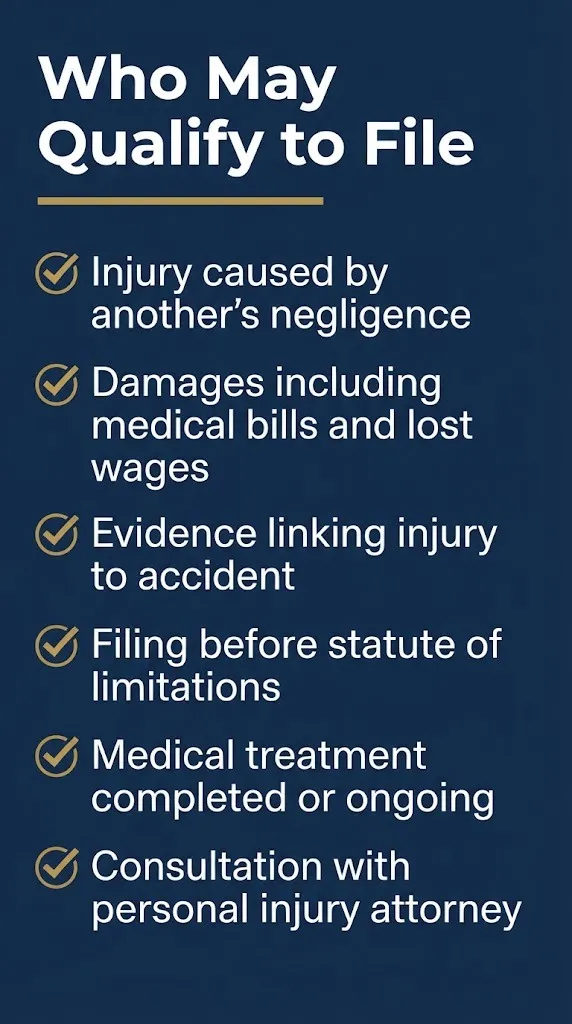
You may qualify to file a personal injury lawsuit if someone else’s negligence caused your injury and you suffered damages as a result. Negligence means the other party failed to exercise reasonable care.
To prove negligence, you must establish four elements:
- Duty of care. The other party had a legal obligation to act safely.
- Breach of duty. They failed to meet that obligation.
- Causation. Their breach caused your injury.
- Damages. You suffered actual losses as a result.
Common personal injury cases include car accidents, slip and falls, dog bites, medical malpractice, and product liability. Car accidents account for nearly 60% of all tort trials.
You do not need to be a U.S. citizen to file. You need to have been injured in the United States and have evidence supporting your claim.
Reality Check
Reality Check: No one texts you settlement money before you file a claim or hire a lawyer. Filing a personal injury lawsuit is not free, but the initial consultation usually is. Lawyers who handle these cases work on contingency, meaning they get paid only if you recover. Any company demanding an upfront fee to “process” your injury claim is a scam.
How Do You File a Personal Injury Lawsuit Step by Step?
You file a personal injury lawsuit by hiring a lawyer, gathering evidence, and submitting a complaint to the correct court. The formal filing starts the litigation process, but most of the work happens before the complaint is ever drafted.
Here are the steps involved:
- Seek medical treatment immediately. This creates a record connecting your injury to the accident.
- Gather evidence. Collect photos, witness names, police reports, and receipts.
- Consult a personal injury lawyer. Most offer free consultations to evaluate your case.
- Send a demand letter. Your lawyer notifies the at-fault party and their insurer of your claim.
- Negotiate with the insurance company. Most cases settle at this stage without a lawsuit.
- File the complaint. If negotiations fail, your lawyer files a formal lawsuit in civil court.
- Serve the defendant. The other party receives legal notice and has 21 to 30 days to respond.
- Proceed through discovery and trial. If no settlement is reached, the case goes to a jury or judge.
The timeline varies. Simple cases may settle in months. Complex cases with disputed liability can take years.
What Is the Statute of Limitations for Personal Injury Lawsuits?
The statute of limitations for personal injury lawsuits is typically two to four years from the date of injury, but it varies by state. Missing this deadline almost always bars you from filing.
Here are the deadlines for some major states.
| State | Statute of Limitations |
|---|---|
| Texas | 2 years |
| Pennsylvania | 2 years |
| California | 2 years |
| New York | 3 years |
| Florida | 4 years |
| Rhode Island | 3 years |
| South Carolina | 3 years |
Some exceptions extend the deadline. If the injured person is a minor, the clock may not start until their 18th birthday. If the injury is not discovered immediately, the “discovery rule” may apply.
Government claims have shorter deadlines. If you are suing a city, state, or federal agency, you may need to file a notice of claim within 60 to 180 days.
What Evidence Do You Need to Prove a Personal Injury Claim?
You need evidence that proves the accident happened, the other party was at fault, and your injuries resulted from their actions. Without strong evidence, your case becomes a “he said, she said” dispute that insurers can easily deny.
The key categories of evidence are:
- Photographs and videos. Scene conditions, vehicle damage, visible injuries, and hazards.
- Medical records. Diagnoses, treatment notes, imaging results, and billing statements.
- Witness statements. Names and contact information of anyone who saw the incident.
- Police reports. Official documentation of the accident and any citations issued.
- Receipts and bills. Medical expenses, lost wage documentation, and out-of-pocket costs.
- Electronic evidence. Dash camera footage, security video, cell phone records, and GPS data.
Start gathering evidence immediately. Memories fade, surveillance footage gets erased, and physical evidence disappears.
Key Takeaway: The statute of limitations is the single most important deadline in a personal injury case. Missing it almost always means losing your right to compensation.
How Long Does a Personal Injury Lawsuit Take?
Most personal injury lawsuits take 9 to 18 months to settle if no trial is required. Cases that go to trial can take two to four years, and appeals can extend that further.
The timeline depends on several factors:
- Medical treatment duration. You cannot settle until you reach maximum medical improvement. This takes 3 to 6 months for minor injuries and 2 to 3 years for severe injuries.
- Liability disputes. If fault is unclear, the case takes longer. Clear liability cases settle faster.
- Case complexity. Simple cases resolve in months. Complex cases with multiple defendants take years.
- Court backlog. Some jurisdictions have years-long waits for trial.
Your lawyer will not file a lawsuit immediately. Most attorneys try to resolve the case through negotiation first. Filing is a last resort when the insurer will not offer a fair settlement.
What Happens After You File a Personal Injury Lawsuit?
After you file a personal injury lawsuit, the defendant is served with legal notice and has 21 to 30 days to respond. Then the case enters discovery, where both sides exchange evidence and take depositions.
The defendant has three options after being served:
- File an answer. They admit or deny the allegations and raise defenses.
- File a motion to dismiss. They argue the complaint has a legal flaw.
- Do nothing. If they ignore the lawsuit, you can seek a default judgment.
Discovery typically lasts 3 to 12 months. It includes interrogatories, document requests, and depositions. After discovery, the case either settles or goes to trial.
Key Takeaway: Filing a lawsuit does not mean you will go to trial. It is a tool to force the insurance company to negotiate seriously.
What Happens Next
Immediately: Seek medical treatment and document your injuries.
Within days: Gather evidence and witness information before it disappears.
Within weeks: Consult a personal injury lawyer for a free case evaluation.
Before the deadline: File your lawsuit if settlement negotiations fail. The deadline is typically two to four years from the injury date.
Frequently Asked Questions
How long do I have to file a personal injury lawsuit?
Most states give you two to four years from the date of injury. Some states, like Texas and Pennsylvania, have a two-year deadline.
Do I need a lawyer to file a personal injury lawsuit?
Yes, for any case with significant damages. Personal injury lawsuits involve complex rules, expert witnesses, and court procedures that are difficult to handle alone.
How much does it cost to file a personal injury lawsuit?
Most personal injury lawyers work on contingency, meaning you pay nothing upfront. The lawyer takes a percentage of your recovery, typically 33% to 40%.
How long does a personal injury settlement take?
Most cases settle within 9 to 18 months. Cases that go to trial can take two to four years or longer.
What evidence do I need for a personal injury claim?
You need medical records, photos, witness statements, police reports, and documentation of lost wages and expenses.
What is maximum medical improvement?
MMI is the point when your doctor determines you have recovered as much as possible. You cannot settle until you reach MMI because future medical costs are unknown.
Will my personal injury case go to trial?
Probably not. Over 95% of personal injury cases settle before trial.
How long after settlement do I get paid?
Most people receive their settlement funds within 3 to 4 weeks after signing the settlement agreement. This time covers lien resolution and check processing.
What You Should Do Now
If you or a family member suffered a personal injury, act before the deadline passes. Gather your medical records, take photos of your injuries and the accident scene, and consult a personal injury attorney for a free case evaluation.
The most important fact: most states require filing within two to four years of the injury. Miss that window and you lose the right to compensation. Check your state’s deadline immediately.