Compensation Defense Mechanism 2026: How Insurers Deny Injury and Malpractice Claims
Quick Answer
- What is it? A legal strategy insurers and defendants use to deny or reduce compensation claims by attacking causation, credibility, or the standard of care.
- How much does it cost you? Denials delay benefits by months. You may need an attorney to appeal.
- Key deadline: Workers’ comp appeals and malpractice filings have strict deadlines. Missing them ends your case.
If you filed a claim for an injury or malpractice and it got denied, you just met a compensation defense mechanism. These are the legal arguments insurers and their lawyers use to avoid paying. They’re not personal. They’re a playbook.
The playbook works because most claimants don’t know the rules. Insurers know that if they deny a workers’ comp claim, a certain percentage of people will just give up. The same goes for malpractice suits. Defense attorneys count on attrition.
But denials aren’t final. They’re often the opening move in a longer process. Understanding how these defenses work is the first step to beating them.
This article breaks down the most common compensation defense mechanisms in 2026, from lack of medical evidence to pre-existing condition arguments. You’ll learn how insurers and defendants build these defenses, and what you can do to counter them.
The Facts
| Item | Detail |
|---|---|
| Common Workers’ Comp Defenses | Lack of medical evidence, AOE/COE dispute, statute of limitations, post-termination |
| Common Malpractice Defenses | No breach of standard of care, no causation, pre-existing health, patient fault |
| Common Personal Injury Defenses | No duty, no breach, no causation, comparative negligence, assumption of risk |
| Key Battleground | Causation. Defendants attack the link between conduct and injury. |
| Your Best Tool | Medical records, expert testimony, and documentation |
What is a compensation defense mechanism?
A compensation defense mechanism is a legal argument a defendant or insurer uses to deny or reduce a claim for compensation. It’s how they avoid paying for injuries, malpractice, or negligence.
These defenses aren’t just for trials. Insurers raise them at the claims stage, during appeals, and in court. The goal is the same: shift the burden back to you.
In workers’ compensation, the system is supposed to be no-fault. You don’t have to prove your employer did anything wrong. But that doesn’t mean claims get approved automatically. Insurers still contest claims for specific reasons.
In malpractice and personal injury cases, you have to prove four things: duty, breach, causation, and damages. A defense mechanism attacks one or more of those elements. If any element fails, your claim fails.
Think of it like a warranty claim on a phone. The manufacturer doesn’t just pay. They look for reasons the damage isn’t covered. Was it dropped? Was it water damage? Did you void the warranty? Compensation defense mechanisms work the same way. They’re looking for the exclusion.
Key Takeaway: Compensation defense mechanisms are legal arguments that attack your claim at its weakest points: causation, credibility, or the standard of care.
What are the most common workers’ compensation defenses?
The most common workers’ compensation defenses are lack of medical evidence, AOE/COE disputes, statute of limitations, and post-termination arguments.
Insurers deny claims for specific reasons. Understanding them helps you prepare a response.
Lack of substantive medical evidence is the most frequent denial. The insurer claims there’s no medical proof linking your injury to your job. You need a doctor to document that connection.
AOE/COE (Arising Out of Employment/Course of Employment) denials argue your injury didn’t happen at work or wasn’t caused by work. Maybe you were commuting. Maybe it happened on a break. The insurer will argue it’s not covered.
Statute of limitations defenses claim you waited too long to file. Every state has deadlines. Miss them, and you lose your right to benefits.
Post-termination defenses argue you were fired before the injury or that your claim is retaliation for termination. Timing matters here.
| Defense | What It Means | How to Counter |
|---|---|---|
| Lack of medical evidence | No proof injury is work-related | Get a medical-legal evaluation from a qualified doctor |
| AOE/COE | Injury not in course/scope of employment | Document when and where the injury happened |
| Statute of limitations | Filed too late | Prove the date of injury or discovery |
| Post-termination | Claim filed after firing | Establish timeline of injury and termination |
Key Takeaway: Workers’ comp denials often hinge on medical evidence and timing. A qualified attorney can help you build the record.
What are the most common medical malpractice defenses?
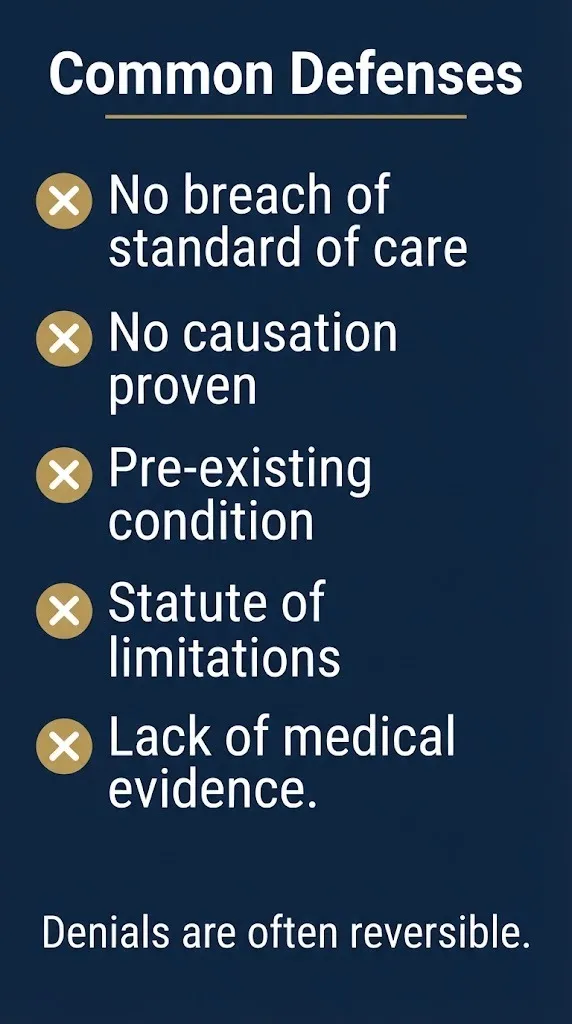
The most common malpractice defenses are no breach of the standard of care, no causation, pre-existing conditions, and patient fault.
Doctors and hospitals don’t admit mistakes easily. They have a standard playbook.
No breach of the standard of care is the first line of defense. The doctor argues that another competent provider would have made the same decisions under similar circumstances. This is why malpractice cases require expert testimony. You need a medical expert to say the doctor deviated from accepted standards.
No causation is the second major defense. The defendant admits something went wrong but denies it caused your injury. They blame your underlying condition or the natural progression of disease.
Pre-existing conditions are used to reframe the timeline. The defense argues your injury started before the alleged negligence, or that your poor health caused the outcome, not the medical care. This is a technical defense that strikes at the heart of causation.
Patient fault shifts responsibility to you. The defense claims you failed to follow medical advice, withheld information, or worsened your own condition.
Key Takeaway: Malpractice defenses attack the standard of care and causation. Expert medical testimony is almost always required to win.
What is the pre-existing condition defense?
The pre-existing condition defense argues that your injury was caused by a condition you already had, not by the defendant’s negligence. It’s one of the most common and effective defenses.
Defense teams examine your full medical history. They look for records showing similar symptoms before the incident. If your back hurt in 2020 and you’re claiming a back injury in 2026, they’ll argue the old problem is the real cause.
This defense is particularly powerful in cases involving degenerative conditions, prior injuries, or chronic health issues. In birth injury cases, hospitals point to genetic disorders or maternal infections. In adult cases, they cite vascular disease, diabetes, or prior neurological injury.
But a pre-existing condition doesn’t automatically kill your claim. The law recognizes that negligent treatment can worsen an existing condition or accelerate harm. The question is whether the defendant’s actions materially contributed to your outcome.
In workers’ comp, the rule is similar. A pre-existing condition that gets aggravated or accelerated by work activity is still compensable. The question is whether the work incident caused a physiological change.
Key Takeaway: Pre-existing conditions don’t automatically bar your claim. The key is proving the defendant’s actions made your condition worse.
What is the standard of care defense?
The standard of care defense argues that the defendant acted as a reasonably competent professional would have under the same circumstances. It’s the primary defense in malpractice and professional negligence cases.
Standard of care isn’t about perfection. It’s about what a competent peer would do. If the doctor’s actions fell within that range, there’s no malpractice, even if the outcome was bad.
This is why malpractice cases require expert witnesses. Your expert must testify that the doctor deviated from accepted practice. The defense’s expert will testify the opposite. The jury decides who’s more credible.
The standard of care varies by specialty, location, and circumstances. A rural family doctor isn’t held to the same standard as a specialist at a teaching hospital. The defense will emphasize the context of the treatment.
To counter this defense, your attorney needs to show specific deviations. Not just “the outcome was bad,” but “the doctor failed to order this test” or “the doctor ignored this warning sign.”
Key Takeaway: Standard of care is the central battleground in malpractice. You need expert testimony to prove a deviation.
How do you fight a compensation denial?
You fight a compensation denial by gathering evidence, filing an appeal, and presenting your case to a judge or appeals board. The process varies by claim type.
For workers’ comp denials, the path usually involves:
- Get a medical-legal evaluation. A qualified doctor documents that your injury is work-related.
- File an appeal. Deadlines are strict. Don’t miss them.
- Attend a hearing. A judge reviews the evidence and decides.
- Appeal further if needed. Some states allow multiple levels of review.
For malpractice and personal injury, the process is different. You file a lawsuit, conduct discovery, and either settle or go to trial. The defense will raise its mechanisms during litigation.
The common thread: evidence wins. Medical records, expert testimony, and documentation are your best tools. Without them, you’re just arguing.
Key Takeaway: Denials are often reversible. The key is acting fast and building a strong evidentiary record.
What is compensation neurosis?
Compensation neurosis is an outdated psychiatric concept suggesting that some people develop or maintain symptoms because they’re seeking financial compensation. It’s rarely used as a formal legal defense today.
The term dates back to the 19th century. It was used to suggest that claimants weren’t really injured, or that they were exaggerating symptoms for financial gain.
Modern psychiatry distinguishes compensation neurosis from malingering. Malingering is intentional faking for external gain. Compensation neurosis was described as a mix of internal and external factors, with unconscious motivations playing a role.
The problem with the concept is that it’s often used to dismiss legitimate claims. Studies showed that many claimants didn’t improve after settlement, which undermined the theory that money was the sole motivation.
In 2026, compensation neurosis is not a standard legal defense. But the underlying skepticism (that claimants are exaggerating for money) still influences how insurers and juries view claims.
Key Takeaway: Compensation neurosis is a historical concept, not a modern legal defense. But the skepticism behind it still affects how claims are evaluated.
Reality Check
A denial letter is not the end of your claim. Insurers deny claims expecting many people to give up. The appeals process exists for a reason. But deadlines are strict. If you miss an appeal window, you can lose your rights permanently. Get advice from an attorney who handles your type of claim. Most work on contingency, meaning you pay nothing unless you recover.
What happens next after a compensation denial?
Immediately: Review the denial letter. Identify the specific reason for denial.
Within days: Consult an attorney. Deadlines for appeals are often short.
Weeks 1 to 4: Gather medical records, witness statements, and any other evidence.
Months 1 to 6: File your appeal or lawsuit. Attend hearings or mediation.
Months 6 to 12+: Resolution. Many denials are reversed or settled.
Frequently Asked Questions
What is a compensation defense mechanism?
It’s a legal argument a defendant or insurer uses to deny or reduce a claim for compensation. Common examples include lack of causation, pre-existing conditions, and no breach of standard of care.
What are the most common workers’ comp defenses?
The most common defenses are lack of medical evidence, AOE/COE disputes, statute of limitations, and post-termination arguments.
Can a pre-existing condition disqualify me from compensation?
Not automatically. The law recognizes that negligent treatment or work activity can worsen a pre-existing condition. The key is proving the defendant’s actions caused additional harm.
What is the standard of care in malpractice?
The standard of care is what a reasonably competent professional would do under similar circumstances. If the defendant’s actions fell within that range, there’s no malpractice.
How do I fight a denied workers’ comp claim?
You can appeal the denial. The process typically involves getting a medical-legal evaluation, filing an appeal within the deadline, and attending a hearing before a judge.
What is compensation neurosis?
It’s an outdated psychiatric concept suggesting symptoms are motivated by a desire for compensation. It’s rarely used as a formal legal defense today.
Do I need a lawyer to fight a compensation denial?
It’s not required, but it helps. Insurers and defense attorneys know the process. A lawyer levels the playing field and can identify defenses you might miss.
How long do I have to appeal a compensation denial?
Deadlines vary by state and claim type. Some are as short as 30 days. Consult an attorney immediately after receiving a denial.
If your claim was denied, don’t wait. The appeal deadline is running. Gather your medical records, consult an attorney, and file before the window closes. The single most important fact: denial is an opening move, not a final judgment, and the evidence you gather now determines whether you win.