Debt Settlement Letter 2026: How to Write One That Creditors Actually Accept
Quick Answer
- A debt settlement letter is a written offer to pay less than you owe to resolve a debt in full.
- Creditors often accept offers starting around 30% of the balance if you have a hardship and can pay a lump sum.
- You have 30 days from a debt collector’s first contact to dispute the debt in writing and preserve your rights.
A debt settlement letter is a written offer that asks a creditor or collector to accept less than the full balance to satisfy an account. It works like a store return without a receipt: you are asking for a favor, and the store can say no. But if you write it right, you can save thousands.
You are likely here because you owe money you cannot pay in full. Maybe a collector is calling. Maybe you got a validation notice. The one deadline that matters most is the 30-day dispute window after a collector first contacts you. Miss it, and you lose leverage.
This article explains what to include, what creditors actually accept, and how the 2026 legal changes affect your strategy. One surprising detail: forgiven debt over $600 can be taxed as income, and most people do not plan for that bill.
The Facts
| Item | Details |
|---|---|
| What It Is | A written offer to settle a debt for less than the full balance |
| Typical Starting Offer | 30% of the total balance |
| Dispute Window | 30 days from collector’s first contact |
| Credit Impact | Missed payments and “settled for less” stay up to 7 years |
| Tax Consequence | Forgiven debt over $600 may be taxable income |
| Key Legal Rule | FDCPA requires collectors to provide validation info |
| Best Delivery Method | Certified mail with return receipt requested |
Is a debt settlement letter legitimate or a scam?
A debt settlement letter is a legitimate, legal tool. You have the right to negotiate with creditors and collectors. No one can stop you from making an offer.

The scam risk comes from third-party “debt relief” companies, not from writing your own letter. Many settlement companies charge fees of 15% to 25% of your enrolled debt with no guarantee of success. Worse, some tell you to stop paying creditors entirely while they “negotiate,” which racks up late fees and damages your credit for nothing.
You do not need to pay anyone to write a letter for you. You can write it yourself in an afternoon. The letter is just a formal proposal, and if the creditor accepts, it becomes a binding contract.
How much should I offer in a debt settlement letter?
Start around 30% of the total balance, but be prepared to negotiate upward. Creditors rarely accept the first offer. A realistic landing zone is 40% to 60% of what you owe.
Here is a rough negotiation ladder:
| Round | Offer Percentage | What to Expect |
|---|---|---|
| First Offer | 30% | Usually rejected, but opens dialogue |
| Counteroffer | 40% to 50% | Creditor may accept if you can pay lump sum |
| Final Offer | 60% | Most common settlement range for DIY negotiators |
Your leverage depends on several factors. Older debts are easier to settle cheaply because the creditor has likely written them off. Debts still within the statute of limitations give you less leverage because the creditor can still sue. If you can pay a lump sum today, you have more power than someone asking for a payment plan.
How do I write a debt settlement letter that works?
A debt settlement letter works when it includes eight specific elements. Skip any one of them, and the agreement may not be enforceable.
Here are the steps:
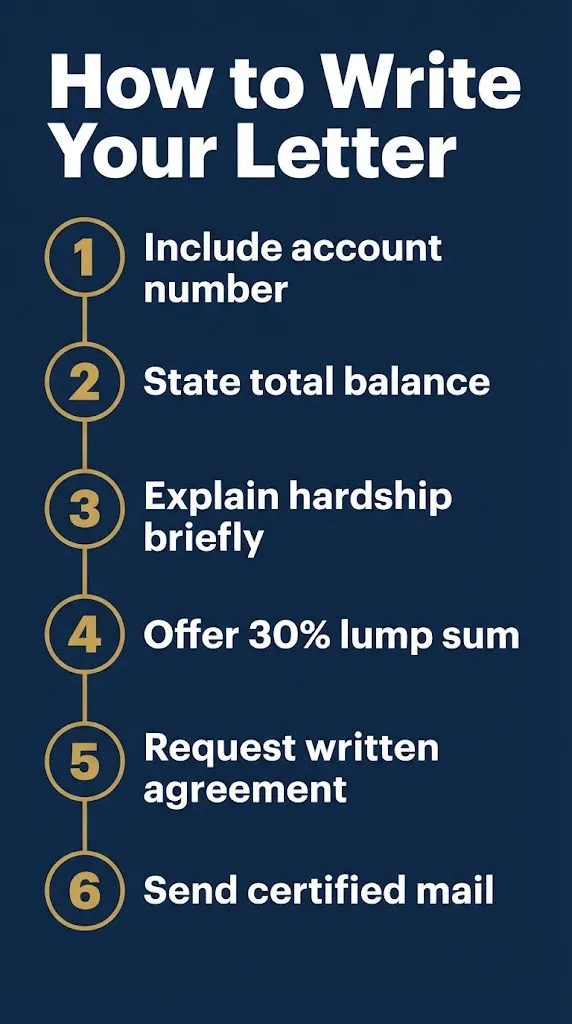
- Include your full name, address, phone number, and the account number. The creditor needs to identify you and the debt.
- State the total balance owed. Use the current amount, including any added interest or fees.
- Explain your hardship briefly. Job loss, medical bills, or reduced income. Keep it short.
- Make a specific lump-sum offer. Offer an exact dollar amount, not a percentage.
- State exactly what you want in return. “Report as paid in full” or “delete the tradeline.”
- Set a deadline for their response. Give them 14 to 30 days to accept.
- Require a written, signed agreement. Never pay based on a phone promise.
- Sign and date the letter. Send it certified mail with return receipt requested.
Key Takeaway: A verbal settlement agreement is not worth the paper it is not printed on. Get the creditor’s signature before you send a dime.
What happens if I don’t get the settlement agreement in writing?
If you do not get the settlement agreement in writing, you have no protection. The creditor can accept your payment and then demand the remaining balance later. This happens more often than you would think.
A written agreement must include the settlement amount, the payment terms, and a statement that the debt is satisfied in full once you pay. It should also state how the creditor will report the account to credit bureaus.
Some creditors will agree to delete the collection account entirely. Others will only report “settled for less than full balance.” The deletion is better for your credit, but it is harder to get. Get whatever they agree to in writing.
Reality Check: No one calls, texts, or emails you to “release” settlement funds. If someone contacts you claiming you owe a fee to settle a debt, it is a scam. Legitimate negotiations happen in writing, and you never pay a third party to accept your own money.
How does debt settlement affect my credit score?
Debt settlement damages your credit score in the short term but may help you recover faster than bankruptcy. The missed payments leading up to settlement and the “settled for less” notation can stay on your credit report for up to seven years .
FICO models penalize collections heavily. Even a paid collection can lower scores by 50 to 100 points depending on your profile . The impact fades over time, but it does not disappear overnight.
The alternative is often worse. If you cannot pay and do nothing, the debt may go to judgment, wage garnishment, or a lawsuit. A settled debt stops the bleeding. A judgment follows you longer.
What are the tax consequences of debt settlement?
Forgiven debt of $600 or more is generally taxable income. If a creditor writes off $5,000 of your balance, you may owe income tax on that $5,000. The creditor will send you a 1099-C form .
You may qualify for the insolvency exclusion if your total debts exceeded your total assets at the time the debt was forgiven. That requires filing IRS Form 982 with your tax return. Many people miss this and get an unexpected tax bill.
Plan for the tax hit before you settle. If you settle a $10,000 debt for $4,000, you have $6,000 in forgiven debt. At a 22% tax rate, that is roughly $1,320 in federal tax, plus state tax in some states. Your savings are real, but they are smaller than they look.
How do I respond to a debt validation notice?
You have 30 days from a debt collector’s first contact to dispute the debt in writing . The collector must provide validation information, including the original creditor, the amount owed, and how to dispute .
If you dispute within 30 days, the collector must pause collection until they respond. If you miss the window, you can still dispute, but the collector does not have to stop.
Send your dispute letter certified mail. State that you dispute the debt and request verification. Do not admit the debt is yours. Do not make a partial payment. Either action can restart the statute of limitations in some states .
How do I deal with old debt that resurfaces?
Old debt that resurfaces is called “zombie debt.” It may be past the statute of limitations, already paid, or not yours at all. Collectors buy old accounts for pennies on the dollar and try to collect whatever they can .
Before you pay anything, request validation. Check your credit reports from all three bureaus. Confirm your state’s statute of limitations. If the debt is time-barred, the collector generally cannot sue you. But making a payment or acknowledging the debt can revive the clock .
If the debt is not yours, dispute it in writing. If it is yours but old, you can still negotiate. Time-barred debt is often settled for less because the collector has no legal leverage.
What happens next in debt settlement?
The next stages depend on how the creditor responds to your letter. Here is the expected timeline:
Days 1 to 30: You send the letter and wait for a response. Certified mail takes a few days to arrive.
Days 30 to 60: The creditor may counteroffer. You negotiate by phone, but confirm everything in writing.
Days 60 to 90: If you reach agreement, you receive a signed settlement letter. You pay the agreed amount.
Weeks after payment: The creditor updates your credit report. This can take 30 to 60 days.
January of next year: The creditor sends Form 1099-C for forgiven debt over $600. You report it on your tax return.
Frequently Asked Questions
Can I write my own debt settlement letter?
Yes. You do not need a lawyer or a settlement company. A clear, specific letter sent certified mail is enough to open negotiations.
How much should I offer to settle a debt?
Start around 30% of the balance. Most settlements land between 40% and 60% of what you owe. Lump-sum offers get better terms than payment plans.
What should a debt settlement letter include?
Your contact information, the account number, the total balance, your hardship explanation, a specific offer, what you want in return, a response deadline, and a signature.
Do I need to get the settlement agreement in writing?
Yes. A verbal agreement is not enforceable. The written agreement must state the amount, the terms, and that the debt is satisfied once you pay.
How long does a debt settlement stay on my credit report?
Up to seven years. The missed payments and the “settled for less” notation both hurt your score.
Will I owe taxes on forgiven debt?
Yes, if the forgiven amount is $600 or more. The creditor sends Form 1099-C. You may qualify for the insolvency exclusion.
What is the 30-day dispute window for debt collectors?
After a collector’s first contact, you have 30 days to dispute the debt in writing. The collector must pause collection until they respond.
Can a debt collector sue me for old debt?
It depends on your state’s statute of limitations. If the debt is time-barred, they generally cannot sue. Making a payment can revive the clock.
What you should do now
If you are ready to negotiate, write your settlement letter today. Include your account number, the total balance, a specific offer around 30%, and a clear statement of what you want in return. Send it certified mail with return receipt requested.
Mark the 30-day dispute window on your calendar if a collector has contacted you recently. That deadline protects your rights. Miss it, and your leverage drops.