DOE Compensation in 2026: What the Term Actually Means and Why It Matters
Quick Answer
- “DOE compensation” usually means benefits under the Energy Employees Occupational Illness Compensation Program Act (EEOICPA) for nuclear weapons workers.
- The main program pays a lump sum of $150,000 for Part B claims and up to $250,000 for Part E claims, plus medical benefits.
- The acronym “DOE” also stands for Department of Energy, Department of Education, or Designated Defense Establishment depending on context.
What Does DOE Compensation Actually Mean?
DOE compensation most commonly means financial benefits paid to former nuclear weapons workers under the Energy Employees Occupational Illness Compensation Program Act of 2000. The Department of Labor runs the program, not the Department of Energy.
That distinction trips up a lot of people. The “DOE” in the program name refers to the Department of Energy sites where these workers were employed. The agency that processes and pays claims is the Department of Labor’s Division of Energy Employees Occupational Illness Compensation.
The program exists because workers at nuclear weapons facilities were exposed to radiation, beryllium, and toxic chemicals for decades without adequate protection. Congress created EEOICPA in 2000 to compensate them.
There is no universal “DOE compensation” payment. Eligibility depends on where you worked, when you worked there, and what illness you developed.
Key Takeaway: DOE compensation refers to EEOICPA benefits for nuclear weapons workers, and the Department of Labor administers the program, not the Department of Energy.
How Much Does DOE Compensation Pay in 2026?
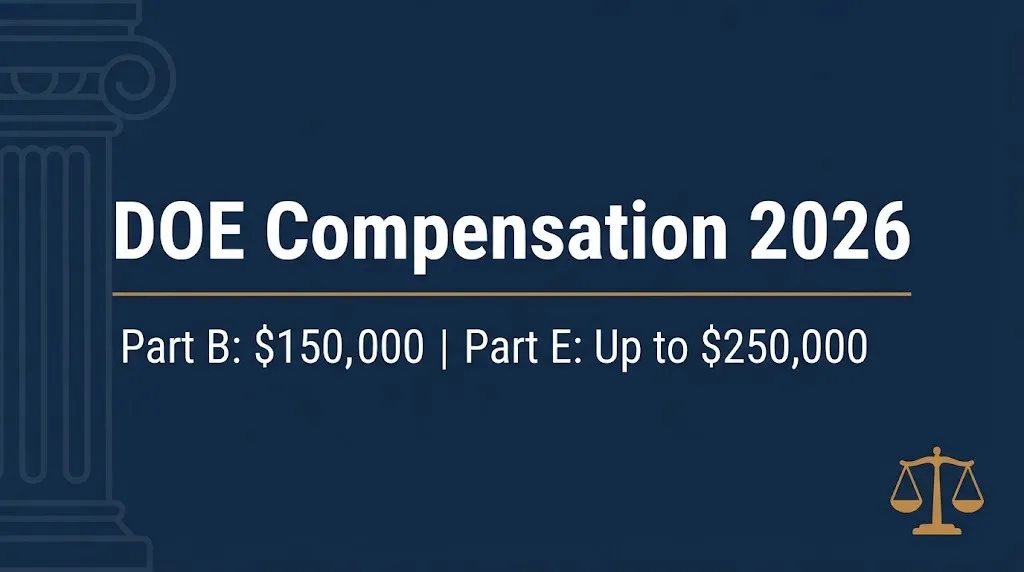
EEOICPA has two main benefit tiers. Part B pays a lump sum of $150,000, and Part E pays up to $250,000, depending on the level of impairment.
Part B covers workers with specified cancers, beryllium disease, and silicosis linked to radiation or toxic exposure at covered facilities. The payment is a flat $150,000, plus medical benefits for the covered condition.
Part E covers a broader range of illnesses if the worker can show exposure to a toxic substance at a DOE facility was at least as likely as not a significant factor in causing the condition. Part E pays up to $250,000 based on a percentage of impairment, plus medical benefits.
| Program Part | Maximum Payment | Medical Benefits |
|---|---|---|
| Part B | $150,000 lump sum | Yes, for covered condition |
| Part E | Up to $250,000 | Yes, for covered condition |
| Survivor benefits | Same limits for eligible survivors | Limited |
The $250,000 Part E maximum applies only to the most severe impairments. Lower impairment percentages pay proportionally less.
Who Qualifies for DOE Compensation?
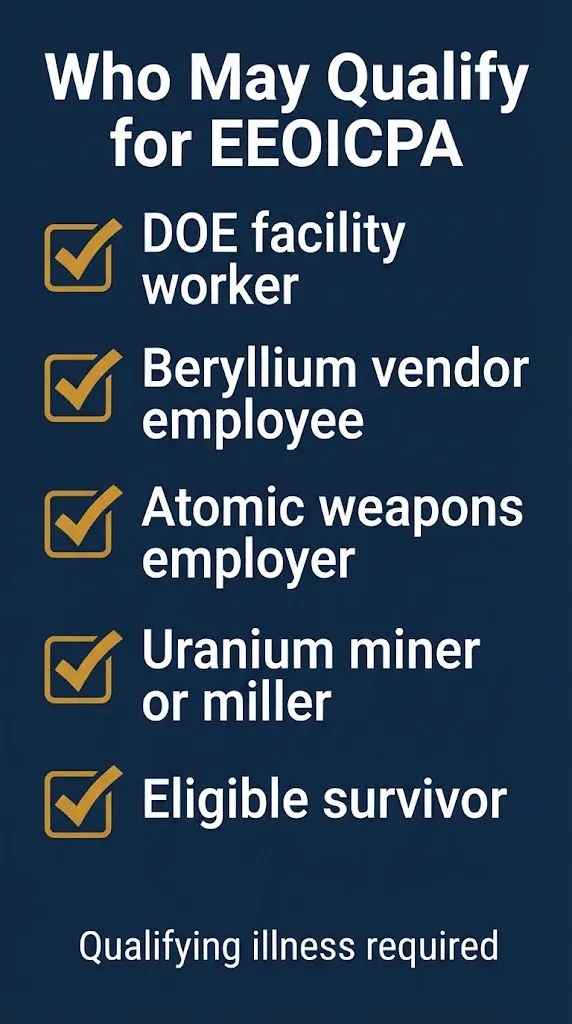
You may qualify for DOE compensation if you worked at a covered DOE facility, a beryllium vendor, or an atomic weapons employer and developed a qualifying illness. The program also covers some survivors of deceased workers.
The covered facilities include major sites like Hanford, Savannah River, Oak Ridge, Los Alamos, and Paducah. Uranium miners, millers, and ore transporters also qualify under a separate category.
Survivors can claim benefits if the worker died from a covered illness. Eligible survivors include spouses, children, and in some cases parents or estates.
A 2026 court case shows how strict the medical evidence standard is. In Counts v. United States Department of Labor, a survivor’s claim for Part E benefits was denied because the medical evidence did not establish that the worker’s rectal cancer was caused by workplace exposure . The case is a reminder that documentation matters as much as eligibility category.
How Do You File a DOE Compensation Claim?
Filing a DOE compensation claim means submitting Form EE-1 to the Department of Labor’s Division of Energy Employees Occupational Illness Compensation. You can file online, by mail, or in person at a resource center.
- Gather employment records showing your time at a covered facility.
- Collect medical records linking your illness to toxic or radiation exposure.
- Complete Form EE-1 for the worker or Form EE-2 for survivors.
- Submit the form to the Division of Energy Employees Occupational Illness Compensation.
- Respond to requests for additional evidence during the review process.
- Appeal if denied through the Final Adjudication Branch or the Office of Administrative Law Judges.
The process can take months to years. Claims with complete documentation move faster. Claims that require dose reconstruction take longer.
Key Takeaway: Filing a DOE compensation claim starts with Form EE-1 and depends on employment records and medical evidence linking your illness to workplace exposure.
Reality Check: No one texts you DOE compensation money first, and you never pay a fee to file a claim. The Department of Labor processes EEOICPA claims directly and for free. If a “claims helper” offers to speed up your payment for a fee, that is not how the program works. Legitimate advocacy groups provide free assistance.
What Is the Difference Between DOE, DOL, and DOJ Compensation?
The acronym “DOE” means different agencies depending on the context. In EEOICPA, it refers to the Department of Energy. In workers compensation and victim services, DOL and DOJ run their own separate programs.
The Department of Labor handles EEOICPA claims through its Division of Energy Employees Occupational Illness Compensation. It also runs the standard federal workers compensation program for federal employees injured on the job.
The Department of Justice in Wisconsin runs the state’s Crime Victim Compensation Program, which pays up to $40,000 per injury or death . That program is funded by court restitution, not tax dollars alone.
The Department of Education handles federal student aid and education grants, not individual compensation payments. When people search “DOE compensation,” they sometimes mean teacher salaries or education department pay scales, which are set by state and local governments .
The one thing all these programs share: they have specific eligibility rules and application forms. Mixing them up wastes time.
What Is the DOE Compensation Court Case About?
The most recent federal court activity involving the acronym “DOE” is not about EEOICPA at all. It is a proposed class action settlement in DOE 1 v. North Carolina Department of Public Safety in the Middle District of North Carolina.
That case involves two anonymous plaintiffs and a settlement with the North Carolina Department of Public Safety. The court granted preliminary approval of the settlement on May 26, 2026, and set a fairness hearing for September 3, 2026 . Class members had until July 20, 2026 to file objections.
This case has nothing to do with EEOICPA or nuclear worker compensation. The “DOE” in the case name is a pseudonym for anonymous plaintiffs, not the Department of Energy. Court records show the parties filed a joint motion for final settlement approval on August 6, 2026 .
If you searched for “DOE compensation” and found this case, you are in the wrong place. This is a North Carolina public safety employment dispute, not a federal benefits program.
How Long Does a DOE Compensation Claim Take?
Most EEOICPA claims take six months to two years to process, depending on complexity. Claims requiring dose reconstruction or medical panel review take longer.
Simple Part B claims with clear cancer diagnoses and documented employment often move faster. Part E claims that require proof of toxic exposure causation take more time because they involve more medical evidence.
If your claim is denied, you can request a hearing before the Final Adjudication Branch. That adds months. Appeals to the Office of Administrative Law Judges add more.
The Department of Labor publishes a claims status tool online. You can check where your claim sits without calling. Calling the resource center works too, but hold times can be long.
What Happens Next
Ongoing: Claims for EEOICPA Part B and Part E benefits are accepted and processed continuously by the Department of Labor.
Ongoing: Survivors may file new claims if a worker died from a covered illness after the worker’s own claim was approved or denied.
September 3, 2026: Fairness hearing held in DOE 1 v. North Carolina Department of Public Safety in the Middle District of North Carolina .
Expected late 2026: Final approval motion pending in the North Carolina case, with payment timeline not yet confirmed.
Ongoing: Medical benefits continue for covered conditions after lump sum payments are made.
Frequently Asked Questions
What does DOE stand for in compensation cases?
DOE most commonly stands for Department of Energy. In the EEOICPA program, it refers to the Energy Department sites where nuclear weapons workers were employed. DOE also stands for Department of Education in other contexts.
How much does DOE compensation pay?
The main EEOICPA program pays $150,000 under Part B and up to $250,000 under Part E, plus medical benefits. Payment amounts depend on which part applies and the level of impairment.
Who qualifies for DOE nuclear worker compensation?
You may qualify if you worked at a covered DOE facility, beryllium vendor, or atomic weapons employer and developed a qualifying illness. Uranium miners and millers also qualify under separate rules.
How do I check my DOE compensation claim status?
You can check your EEOICPA claim status through the Department of Labor’s online claims status tool or by calling the Division of Energy Employees Occupational Illness Compensation resource center.
Is DOE compensation the same as workers compensation?
No. EEOICPA is a federal benefits program for nuclear weapons workers. State workers compensation covers workplace injuries under state law. Some workers qualify for both.
Can survivors claim DOE compensation?
Yes. Surviving spouses, children, and certain other dependents may claim benefits if the worker died from a covered illness. Survivor claims require proof of relationship and medical causation.
What is the deadline for filing a DOE compensation claim?
There is no hard deadline for filing most EEOICPA claims, but medical evidence requirements get harder to meet as time passes. Survivor claims should be filed as soon as possible after a worker’s death.
Does DOE compensation affect Social Security or Medicare?
EEOICPA benefits do not reduce Social Security or Medicare benefits. The payments are separate from those programs. Medical benefits under EEOICPA may coordinate with other coverage.
Closing
DOE compensation means different things depending on which agency you are dealing with, but the most common federal use is EEOICPA benefits for nuclear weapons workers. If you or a family member worked at a covered facility and developed a qualifying illness, the place to start is Form EE-1 with the Department of Labor. Gather your employment and medical records first, because documentation is what moves these claims.