How Long Can a Lawyer Hold Your Settlement Check? 2026 Legal Timelines Explained
Quick Answer
- Is it legal? Yes, but lawyers must follow strict ethics rules on trust accounts.
- How long? Typically 1 to 10 business days after the check clears, depending on lien complexity.
- Key deadline: No fixed federal deadline exists. State bar rules require “prompt” payment.
When a personal injury or lawsuit settlement finally lands, the last thing you want is another wait. You signed the release. The insurance company sent the check. So why isn’t the money in your account yet?
The answer usually isn’t a secret hold by your lawyer. It’s a structured legal process designed to protect you and everyone else with a claim to those funds.
This guide breaks down the real timelines, the state rules that govern your lawyer’s conduct, and the specific reasons a check can sit in a trust account for weeks or months.
The Facts
| Topic | What You Need to Know |
|---|---|
| Legal Rule | State bar ethics rules require “prompt” disbursement |
| Standard Clearing Time | 5 to 10 business days for most checks |
| Large Check Holds | 10 to 15 business days for amounts over $100,000 |
| Typical Total Timeline | 3 to 12 weeks from settlement agreement to payment |
| Dispute Exception | Disputed portions can be held until resolved |
| Regulatory Basis | ABA Model Rule 1.15 and state equivalents |
Is It Legal for a Lawyer to Hold Your Settlement Check?
Yes, it is legal, and in most cases it is actually required. Your lawyer is not allowed to hand you a check the moment it arrives from the insurance company.
The legal profession operates under strict fiduciary rules. When a lawyer receives money that belongs to a client or a third party, that money must go into a dedicated trust account, sometimes called an escrow or IOLTA account . The lawyer cannot mix your settlement money with the firm’s operating funds. This rule against “commingling” exists to protect you from the firm spending your money on office rent or payroll.
State bar associations enforce these rules aggressively. The Ohio Board of Professional Conduct, for example, has explicitly stated that a lawyer may hold funds in trust for a reasonable period to ensure a check clears, typically one week to ten days . Holding funds beyond that without a valid reason can trigger disciplinary action.
The key word in every state’s rulebook is “promptly.” The New York State Bar Association has clarified that “promptly” means within hours or days, not weeks . A lawyer who sits on undisputed client funds for months is not just annoying. They are violating professional conduct rules.
How Long Can a Lawyer Legally Hold Your Settlement Check in 2026?
There is no federal law setting a specific number of days. The answer depends on your state’s bar rules and the specific facts of your case.
What exists is a patchwork of state ethics opinions and disciplinary precedents. Ohio’s ethics board opined that one week to ten days is a reasonable clearing period . Courts in that state have disciplined lawyers for delays of five, six, and even nine months . The message is clear: extended holds without justification are misconduct.
California has pushed reforms in recent years that include a 45-day disbursement presumption in certain contexts . Other states rely on general “promptness” language, leaving the exact timing to be judged case by case.
The practical takeaway for you is this: if your lawyer has held your undisputed funds for more than a few weeks after the check cleared, you have a right to ask hard questions. If they have held them for months, you may have grounds for a bar complaint.
Key Takeaway: The law does not give your lawyer unlimited time. “Prompt” disbursement is an ethical obligation, and courts have punished delays measured in months.
Why Your Lawyer Holds the Check: The Trust Account Process
Your lawyer holds the check because the bank has not yet confirmed the money is real. This is the single most important fact to understand.
When an insurance company mails a settlement check, that check is a promise to pay, not actual funds. The lawyer deposits it into the trust account, and the bank then begins a verification process. Under federal banking regulations, banks can hold funds for several business days to ensure the issuing account has sufficient funds and the check is not fraudulent .
Most standard settlement checks clear in five to ten business days . If the settlement is large, meaning over $100,000, the bank may extend that hold to ten or fifteen business days . The Wisconsin court system’s guidance for lawyers emphasizes that disbursements should never be made until funds are “available for disbursement” under the bank’s policies .
This waiting period is not optional. If your lawyer writes you a check before the settlement check clears, and the settlement check later bounces, the firm could face an overdraft. That would be an ethics violation and could expose other clients’ funds to risk.
What Happens After the Check Clears: Liens and Deductions
Once the money is confirmed, the real work begins: resolving liens. This stage is where most of the delay happens.
Medical providers, hospitals, health insurers, and government programs like Medicare and Medicaid often have legal claims against your settlement. These are called liens. Your lawyer is ethically required to identify and resolve these claims before distributing the remaining funds to you .
Simple private liens might take one to two weeks to negotiate. Medicare and Medicaid liens are a different story entirely. Those require federal reporting and approval processes that can stretch for months . A Medicare final demand letter alone can take 60 to 90 days to arrive .
During this time, the money sits in the trust account. It is not earning interest for your lawyer. It is not being spent. It is being held as a fiduciary duty.
If there is a dispute over a lien amount, the lawyer must hold the disputed portion until the matter is resolved, either through negotiation or a court order . The undisputed portion, however, should still be released to you promptly. Holding the entire settlement because of one contested bill is generally not acceptable .
How Long Can a Lawyer Hold Disputed Funds?
A lawyer can hold disputed funds indefinitely, in theory, until the dispute resolves. But they cannot hold your undisputed money hostage.
The rule is straightforward: if you and a medical provider disagree over how much is owed, your lawyer must keep the contested amount in trust. Everything else, meaning your share and any agreed-upon payments, should go out .
The LeanLaw analysis of this issue notes that a lawyer’s obligation is to disburse the undisputed portion and carry the disputed amount as a separate line item on the client ledger . That reserve stays visible and documented until the fight is over.
If the dispute never resolves, the lawyer cannot simply keep the money. Options include filing an interpleader action to let a court decide, depositing the funds with the court, or eventually escheating the funds as unclaimed property under state law .
For you, this means a portion of your settlement could be tied up for months or even years if a lienholder is aggressive or unresponsive. Your lawyer should keep you informed about the status of those negotiations.
Reality Check: No legitimate lawyer will ever text you asking for a fee to “release” your settlement. Trust accounts exist for your protection. If someone outside the legal process demands payment to unlock your funds, it is a scam.
How Long Does It Take to Get Your Settlement Money in Total?
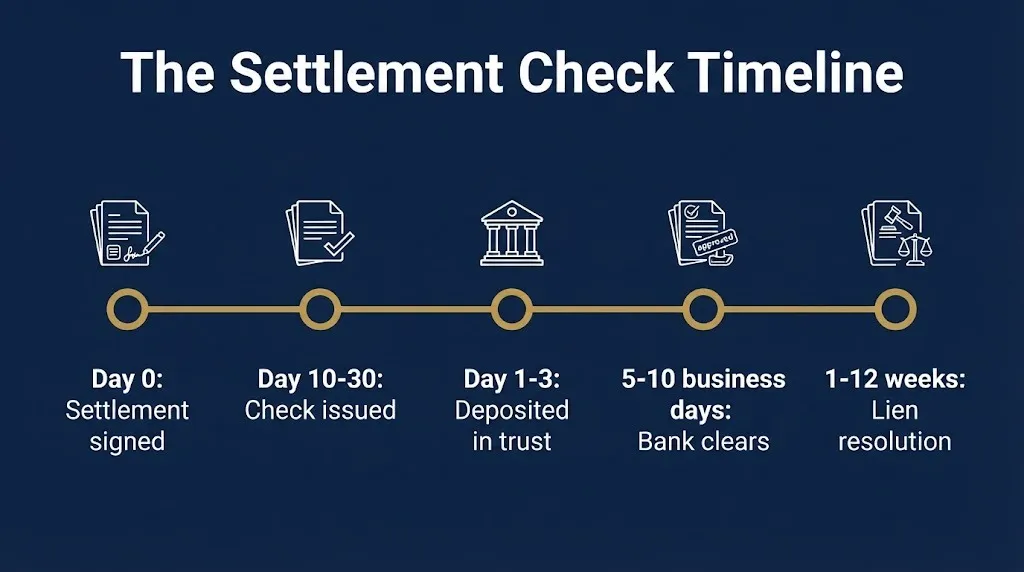
The realistic total timeline from settlement agreement to money in hand is 3 to 12 weeks. That range covers most straightforward cases.
A simple case with few medical bills and no government liens might resolve in two to three weeks after the check clears. An average case with a handful of providers and a private insurer lien might take four to eight weeks. A complex case involving Medicare, Medicaid, or a major hospital system can stretch to two to four months or longer .
Here is the stage-by-stage breakdown:
| Stage | Typical Duration |
|---|---|
| Insurance company issues check after signed release | 10 to 30 days |
| Lawyer deposits check into trust account | 1 to 3 business days |
| Bank clearing period | 5 to 10 business days |
| Lien resolution and negotiation | 1 week to several months |
| Final accounting and disbursement | 1 to 5 business days |
The longest pole in the tent is almost always lien resolution. If you have no liens and no Medicare involvement, your money should move quickly once the check clears.
What Can You Do If Your Lawyer Is Holding Your Money Too Long?
You have options, and you should use them. First, request a written accounting.
Your lawyer is required to notify you promptly when funds arrive and to provide a full accounting when you ask . If they have not done so, a polite written request is the first step.
If the accounting reveals that your undisputed funds are still sitting in trust without a valid reason, you can escalate. Contact your state bar association’s ethics hotline or client assistance program. Every state has a disciplinary body that investigates complaints about lawyers holding client funds.
You can also request that your lawyer release the undisputed portion immediately. If they refuse without justification, that refusal itself may be an ethics violation. Courts have found that failing to promptly return client money when requested is professional misconduct .
Keep all communications in writing. If you have to file a bar complaint, a paper trail makes your case stronger.
Frequently Asked Questions
How long can a lawyer hold a settlement check without paying me?
There is no fixed legal deadline, but “promptly” generally means days, not months. Most state bar rules require disbursement within a week to ten days after the check clears . Extended delays require a valid justification, such as an unresolved lien.
Can my lawyer keep my settlement money to pay themselves first?
Yes, but only the amount they are actually owed. Lawyers deduct their contingency fee and case costs before releasing the remainder to you. That deduction must be documented in a written closing statement . The rest belongs to you.
What if my lawyer holds my settlement for six months?
A six-month hold on undisputed funds is likely an ethics violation. Ohio courts have disciplined lawyers for delays of five, six, and nine months . If your lawyer cannot explain the delay, you should contact your state bar.
Can a lawyer hold my settlement check until Medicare is paid?
Yes, but only the portion needed to satisfy the Medicare lien. Medicare has a statutory right to reimbursement. Your lawyer can hold the disputed or unconfirmed amount while negotiating, but should release your undisputed share .
How long does it take for a settlement check to clear in a lawyer’s trust account?
Most checks clear in 5 to 10 business days. Large checks over $100,000 may take 10 to 15 business days . The lawyer cannot disburse funds until the bank confirms the money is available .
What happens if my lawyer never gives me my settlement money?
That is grounds for a bar complaint and potentially a lawsuit. Failing to deliver client funds is professional misconduct . You can report it to your state bar association and consider hiring another lawyer to pursue the funds.
Is there a law that says how long a lawyer can hold a settlement check?
No single federal law sets a specific number of days. State bar ethics rules and federal banking regulations combine to create the practical timeline. The governing standard is “prompt” delivery under rules like ABA Model Rule 1.15 .
How do I check if my settlement check is being held illegally?
Request a written accounting from your lawyer. If they cannot justify the hold, contact your state bar’s ethics or client protection program. Document everything in writing before escalating.
What Happens Next: The Expected Timeline
Immediately after settlement: Insurance company processes payment, typically 10 to 30 days.
Within 1 to 3 business days of receipt: Lawyer deposits the check into the trust account.
5 to 10 business days after deposit: Bank clears the funds.
1 week to several months after clearing: Lien resolution and negotiation, depending on complexity.
After all deductions are finalized: Final disbursement to you, typically within 1 to 5 business days.
The single most important thing to remember is this: your lawyer is not allowed to hold your money indefinitely. The rules exist to protect you. If the wait feels unreasonable, ask for the accounting. If the answer does not add up, you have recourse through your state bar.