Wrongful Termination California Average Settlement: 2026 Payout Ranges and Case Values
Quick Answer
- Is it real? Yes, wrongful termination claims are legitimate and governed by California employment law.
- How much? Typical settlements range from $5,000 to $100,000 for weaker cases, $50,000 to $250,000 for mid-range cases, and $500,000 to over $1 million for strong cases with punitive damages .
- Key deadline: You generally have 2 to 4 years to file, depending on the legal theory. The clock is running.
When you lose a job you didn’t deserve to lose, the first question is usually about money. How much is a wrongful termination case actually worth in California? The honest answer is that no two cases are identical, and anyone quoting you a precise number before reviewing your facts is guessing.
That said, the 2026 settlement data tells a clear story. California employment lawyers report recognizable ranges based on case strength, lost wages, emotional distress, and employer conduct . Understanding those ranges helps you evaluate any offer that comes your way.
This guide breaks down verified settlement ranges, the factors that move the number up or down, and the deadlines you cannot afford to miss.
The Facts
| Topic | What You Need to Know |
|---|---|
| Typical Settlement Range | $5,000 to $100,000 for weaker cases, higher for strong claims |
| Mid-Range Cases | $50,000 to $250,000 for clear retaliation or discrimination |
| Strong Cases | $500,000 to $2 million+ with punitive damages potential |
| Largest Recent Verdict | $79.5 million judgment in Byrne v. Ameris Bank (July 2026) |
| Statute of Limitations | 2 to 4 years depending on claim type |
| Damages Cap (FEHA) | No statutory cap on compensatory damages |
| Federal Cap (Title VII) | $50,000 to $300,000 based on employer size |
What Is the Average Wrongful Termination Settlement in California?
There is no single average settlement amount in California. Case values vary too widely for one number to be meaningful .
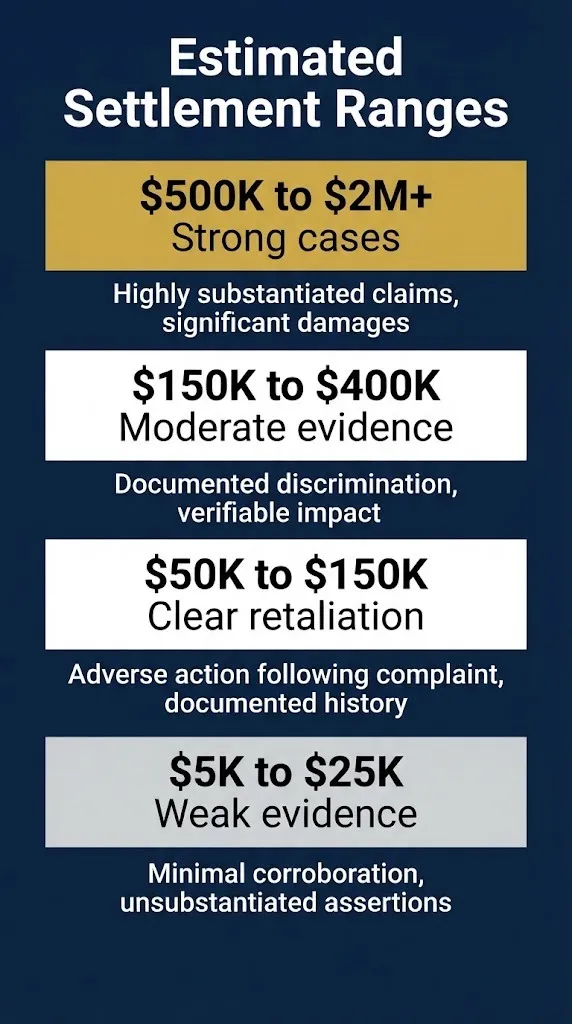
Employment attorneys report that most settlements fall into recognizable bands. Weaker cases with limited evidence and short employment tenures often resolve for nuisance value, typically $5,000 to $20,000 . Mid-range cases with clear retaliation or discrimination evidence settle between $50,000 and $250,000 . Strong cases involving egregious employer conduct, long-tenured employees, or punitive damages potential can reach $500,000 to over $1 million .
The California Civil Rights Department and federal enforcement data show total monetary relief reaching record highs through 2026, with pre-litigation settlements and mediation driving most recoveries . The majority of wrongful termination cases never reach trial. They resolve through negotiation or mediation, often within 6 to 12 months of filing .
Wrongful Termination Settlement Ranges by Case Strength
Settlement values in California track closely with case strength. Here is how the ranges break down based on 2026 data:
| Case Type | Typical Settlement Range | Key Factors |
|---|---|---|
| Weak evidence, short tenure | $5,000 to $25,000 | Minimal lost wages, no documented distress |
| Moderate evidence, 2 to 5 years employed | $50,000 to $150,000 | Clear retaliation, some emotional distress |
| Strong evidence, 5 to 15 years employed | $150,000 to $400,000 | Documented discrimination, significant lost income |
| Egregious conduct, executive or long tenure | $500,000 to $2 million+ | Punitive damages, malice or oppression evidence |
A 74-year-old worker who was fired after 19 years won over $11 million in a San Diego case, with $9 million in punitive damages alone . A former CEO won a $79.5 million judgment against Ameris Bank in July 2026, including $62.9 million in punitive damages .
These outlier verdicts don’t represent typical settlements. They illustrate what happens when juries find malice, oppression, or fraud.
Key Takeaway: The “average” wrongful termination settlement in California is a range, not a number. Most cases settle between $50,000 and $250,000, but strong cases with punitive damages potential can exceed $1 million.
What Factors Determine Wrongful Termination Settlement Amounts in California?
Lost wages, emotional distress, employer conduct, and evidence quality are the four biggest drivers of settlement value. Your salary before termination sets the baseline .
California law allows recovery for past lost wages and benefits, future lost income (front pay), emotional distress, attorney fees, and punitive damages in egregious cases . The longer you were out of work and the higher your compensation, the larger the economic damages.
Emotional distress damages are uncapped in California FEHA cases . A 2026 appellate ruling in Glick v. City of Los Angeles reinstated a $13.1 million verdict for emotional distress even though the officers had stipulated to “garden-variety” distress with no psychiatric diagnosis . California law does not impose a numerical cap on emotional distress damages.
Punitive damages require proof of malice, oppression, or fraud by clear and convincing evidence . When available, they can dwarf compensatory damages. In the Byrne case, punitive damages totaled $62.9 million against Ameris Bank .
How Long Do Wrongful Termination Settlements Take in California?
Most wrongful termination cases settle within 6 to 18 months of filing a lawsuit. Pre-litigation settlements can happen faster, often within 1 to 6 months after a demand letter .
The settlement timeline depends on how quickly both sides agree on value. Cases that settle after discovery but before summary judgment typically resolve 9 to 18 months after filing . Mediation usually occurs 6 to 9 months after filing and resolves the majority of cases that settle .
Cases that proceed to trial take significantly longer. Getting a trial date takes 6 to 12 months after the case is ready, and appeals can add another 6 months to 2 years . That is why most attorneys and clients prefer settlement when the offer is reasonable.
What Is the Statute of Limitations for Wrongful Termination in California?
The deadline to file depends on your legal theory. The shortest is 2 years, and the longest is 4 years from termination .
- Public policy violations (Tameny claims): 2 years from termination
- Breach of implied or oral contract: 2 years
- FEHA discrimination or retaliation: 3 years to file with the Civil Rights Department, then 1 year after right-to-sue letter to file in court
- Whistleblower retaliation (Labor Code 1102.5): 3 years
- WARN Act violations: 3 years
- Breach of written contract: 4 years
The FEHA administrative process requires you to file a complaint with the California Civil Rights Department before suing. That step is mandatory for FEHA claims . If you skip it, the court will dismiss your case.
A plain-life comparison: think of the FEHA process like a warranty claim. You have to submit the paperwork to the manufacturer first. Only after they respond can you escalate to a formal complaint.
Can You Get Punitive Damages in a California Wrongful Termination Case?
Yes, but only if you can prove malice, oppression, or fraud by clear and convincing evidence. Punitive damages are not automatic .
California Civil Code section 3294 allows punitive damages when the employer’s conduct was despicable and deliberately harmful . In employment cases, this often means the employer knew the termination was illegal and proceeded anyway, or fabricated a pretext for firing.
Recent California verdicts show juries are willing to award massive punitive damages. The $79.5 million Ameris Bank judgment included $62.9 million in punitive damages after the jury found the bank acted with malice . A San Diego jury awarded $70 million in punitive damages to a substance abuse counselor who was fired for reporting harassment .
The Ameris Bank case is notable because the employer argued the termination was legitimate, but the jury saw text messages and internal communications showing the real motive was retaliation for complaining about unpaid wages .
Reality Check: No legitimate attorney will guarantee a specific settlement amount before reviewing your evidence. Anyone who promises you a precise dollar figure without seeing your termination letter, performance reviews, and emails is telling you what you want to hear.
How Does the EEOC Damage Cap Affect Your California Settlement?
Federal claims have caps. California state claims do not. This distinction matters enormously for case value .
If you file a federal discrimination claim through the EEOC, compensatory and punitive damages are capped based on employer size:
| Employer Size | Maximum Compensatory + Punitive Damages |
|---|---|
| 15 to 100 employees | $50,000 |
| 101 to 200 employees | $100,000 |
| 201 to 500 employees | $200,000 |
| 500+ employees | $300,000 |
California FEHA claims have no such cap . Compensatory damages for lost wages, front pay, and emotional distress are uncapped. Punitive damages are available under Civil Code 3294 without a statutory ceiling.
This is why experienced California employment attorneys often prefer state court over federal court. The damages ceiling is higher, and the procedural rules are more favorable to plaintiffs.
What Is the Highest Wrongful Termination Verdict in California?
The Byrne v. Ameris Bank judgment of $79.5 million in July 2026 is the largest recent reported wrongful termination verdict in California. A federal jury in the Central District of California found the bank liable for wrongful termination, whistleblower retaliation, and unpaid wages .
The case involved Patrick Byrne, founder of Balboa Capital, who was fired in June 2024 after challenging the bank’s calculation of long-term incentive plan payments . The jury awarded $16.6 million in compensatory damages and penalties, plus $62.9 million in punitive damages. The court also awarded prejudgment interest at 10 percent per year .
Ameris Bancorp reported an $82.5 million pre-tax litigation accrual in its second-quarter 2026 earnings, acknowledging the full amount of the verdict plus related costs . The bank stated it intends to appeal.
This verdict illustrates the potential for “nuclear” outcomes in California when juries find corporate misconduct. It does not represent a typical settlement. But it does affect how employers evaluate risk when deciding whether to settle or fight.
How to File a Wrongful Termination Claim in California
Filing a wrongful termination claim requires careful steps and strict deadlines. Here is the process:
- Document everything immediately: Save your termination letter, performance reviews, emails, and text messages.
- File with the CRD if claiming FEHA violations: This step is mandatory before filing a lawsuit .
- Wait for your right-to-sue letter: The CRD issues this after investigating or declining to investigate.
- File your lawsuit in Superior Court: You have one year from the right-to-sue date .
- Participate in discovery: Exchange documents and sit for a deposition.
- Attend mediation: Most California courts require mediation before trial .
- Negotiate or proceed to trial: Settle if the offer is fair, or take your case to a jury.
The CRD filing requirement is a common trap. If you miss it and go straight to court, your FEHA claim will be dismissed.
Frequently Asked Questions
What is the average wrongful termination settlement in California?
There is no single average, but most cases settle between $50,000 and $250,000. Weaker cases may resolve for $5,000 to $25,000, while strong cases with punitive damages potential can exceed $1 million .
How much can I get for wrongful termination in California?
It depends on your lost wages, emotional distress, and employer conduct. FEHA claims have no cap on compensatory damages. A high earner with 10 years at the company and documented retaliation could see a settlement well into six figures .
How long do I have to file a wrongful termination lawsuit in California?
You have 2 to 4 years depending on your legal theory. Public policy claims have a 2-year deadline. FEHA claims give you 3 years to file with the CRD, then 1 year to sue .
Do I need a lawyer for a wrongful termination case in California?
You can file on your own, but the process is complex and deadlines are strict. Employment attorneys typically work on contingency, meaning you pay nothing unless you recover. Having a lawyer levels the negotiating field with employer counsel .
What is the largest wrongful termination verdict in California?
A $79.5 million judgment was entered in July 2026 in Byrne v. Ameris Bank. The award included $62.9 million in punitive damages after the jury found the bank acted with malice .
How long does it take to get a settlement check after a wrongful termination case?
Typically 30 to 60 days after the settlement agreement is signed. The employer issues the check, it clears, and your attorney deducts fees and costs before releasing the remainder to you .
Can I get unemployment benefits while my wrongful termination case is pending?
Yes, but the employer may contest your claim. Unemployment benefits are separate from a wrongful termination lawsuit. The EDD makes its own determination based on whether you were fired for misconduct.
What if my employer offers me a severance package?
Do not sign anything before having an attorney review it. Severance agreements often include a release of all claims, including wrongful termination. Once you sign, you may give up your right to sue .
What Happens Next: Expected Timeline for Your Case
Pre-litigation settlement: 1 to 6 months after demand letter, if both sides agree on value.
After lawsuit filed: 3 to 9 months for settlement before discovery begins.
After discovery: 9 to 18 months for settlement before summary judgment.
At mediation: 6 to 12 months after filing, the most common settlement point.
On the courthouse steps: 12 to 24 months after filing, if the case survives summary judgment.
The single most important date is your filing deadline. Write it down. If you miss it, your claim is gone regardless of how strong your evidence is.