Law of Compensation 2026: Legal Meaning, Emerson’s Philosophy, and How to Tell Them Apart
Quick Answer
- What it is: A legal term for loss-based recovery, and a separate philosophical idea about universal balance.
- Key legal meaning: Courts order compensation to make a claimant “whole” after injury or loss.
- Key philosophical meaning: Emerson’s essay argues every advantage carries a hidden cost or responsibility.
You searched “law of compensation” and landed on something confusing. Half the results talk about Emerson and karma. The other half talk about torts and restitution. That is not an accident.
The phrase carries two distinct meanings. In law, compensation is a remedy that courts award to replace what someone lost. In philosophy, Emerson used “Compensation” as the title of an 1841 essay arguing that the universe enforces balance.
This guide separates the two. It explains the legal doctrine, the Emersonian idea, and the practical difference between compensation, restitution, and damages.
The Facts
| Topic | What You Need to Know |
|---|---|
| Legal Meaning | A pecuniary remedy awarded to replace a loss caused by injury |
| Key Legal Case | Ghaziabad Development Authority v. Balbir Singh (2004) |
| Philosophical Origin | Ralph Waldo Emerson, “Compensation,” Essays: First Series, 1841 |
| Related Doctrine | Quantum meruit, restitution for unjust enrichment |
| Key Distinction | Compensation is loss-based; restitution is gain-based |
| Statutory Example | Workers’ Compensation Acts (UK 1897, US state systems) |
| Common Misuse | Confusing the legal remedy with the self-help philosophy |
What Is the Law of Compensation in Legal Terms?
In law, the law of compensation refers to the body of rules governing monetary awards that replace a loss. It is a loss-based recovery system.
Compensation is what a court orders a defendant to pay to a claimant who suffered injury or damage. The goal is to restore the claimant to the position they occupied before the harm. Black’s Law Dictionary defines it as “a pecuniary remedy that is awarded to an individual who has sustained an injury in order to replace the loss caused by said injury” .
The Indian Supreme Court case Ghaziabad Development Authority v. Balbir Singh defined compensation in broad terms. It includes “actual loss or expected loss” and extends to “physical mental or even emotional suffering, insult or injury or loss” .
That definition matters because it shows compensation is not just about broken property or medical bills. It covers the full range of harm a person can suffer.
How Is Compensation Different from Restitution?
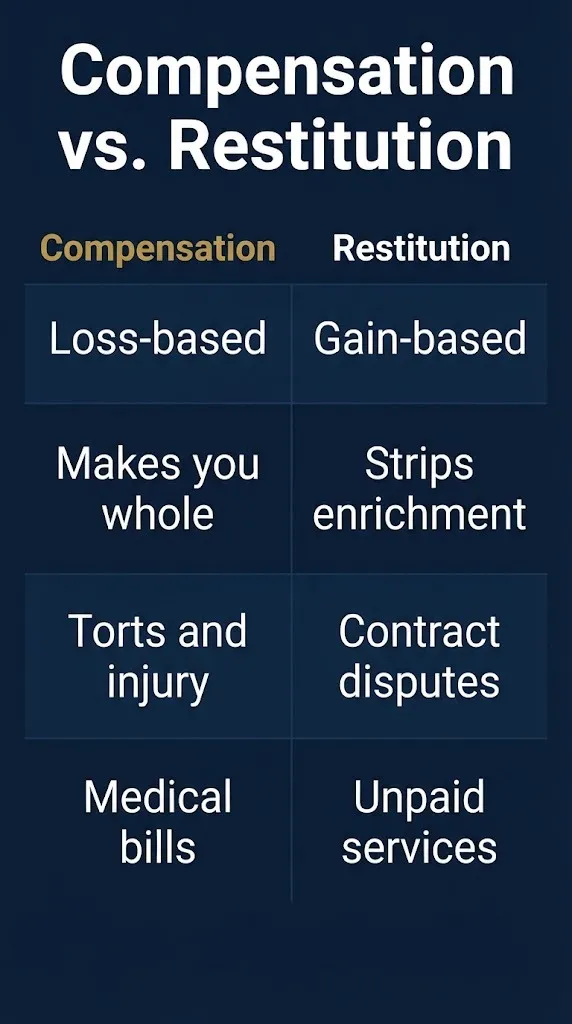
Compensation is loss-based. Restitution is gain-based. That single sentence captures the core distinction.
When a court orders compensation, it looks at what the claimant lost. The defendant pays to make the claimant whole. The defendant’s gain is irrelevant.
When a court orders restitution, it looks at what the defendant gained at the claimant’s expense. The remedy strips away unjust enrichment. Quantum meruit, Latin for “as much as one has deserved,” is the classic example .
A legal forum discussion summarized the difference clearly: “Law of compensation relies on the damage caused beyond the actual damage… Law of compensation usually applies in civil cases especially in cases of torts” .
Here is how they compare:
| Factor | Compensation | Restitution |
|---|---|---|
| Focus | Claimant’s loss | Defendant’s gain |
| Goal | Make claimant whole | Strip unjust enrichment |
| Typical Context | Torts, negligence, injury | Contract disputes, quasi-contract |
| Example | Medical bills after a car crash | Payment for services rendered without a contract |
Key Takeaway: Compensation replaces what you lost. Restitution takes back what the other side wrongly gained. They are different legal tools for different situations.
What Is Emerson’s Law of Compensation?
Emerson’s law of compensation is a philosophical idea that the universe enforces balance. Every advantage carries a cost. Every action produces a reaction.
Ralph Waldo Emerson published “Compensation” in his 1841 collection Essays: First Series . The essay argues that there are natural laws governing the universe, and everyone must follow them or risk failure .
Emerson wrote in his journal in 1831: “Is not the law of Compensation perfect? It holds, as far as we can see, different gifts to different individuals, but with a mortgage of responsibility on every one” .
His core argument: you cannot get something for nothing. If you gain in one area, you lose in another. If you receive a gift, you accept a responsibility. The universe balances itself.
Emerson identified specific patterns. Every excess causes a defect. Every defect causes an excess. Every sweet has its sour. Every evil has its good .
That is not legal doctrine. It is moral philosophy. But the language overlaps, which is why the search results blend the two.
What Are Common Examples of Compensation in Law?
Compensation appears across nearly every area of law, from personal injury to land seizure. The common thread is a loss that needs replacing.
Workers’ compensation is the most visible statutory example. The UK Workmen’s Compensation Act of 1897 introduced compulsory employer insurance for workplace accidents. The gist was “accident arising out of and in the course of the employment” causing personal injury .
Eminent domain provides another example. When the government takes private land for public use, the Constitution requires “just compensation.” That means the full market value of the property on the relevant date .
Motor vehicle accident claims are the most familiar. Compensation covers medical bills, lost wages, pain and suffering, and property damage. The Motor Vehicles Act in India treats compensation as covering “pecuniary loss or non-pecuniary loss” .
Criminal injuries compensation boards exist in many jurisdictions. Courts can order defendants to pay compensation to victims as part of sentencing .
The pattern holds. Wherever someone suffers a loss through another’s act, compensation law provides a remedy.
How Do Courts Calculate Compensation?
Courts calculate compensation by measuring the claimant’s actual loss, not the defendant’s conduct. The measure of damage is the “actual loss to the plaintiff” .
In contract cases, the measure is what the claimant lost because the contract was breached. In tort cases, it is the compensation for loss suffered “directly as a natural consequence of the act complained of” .
Some losses are too remote to recover. The law limits compensation to harms that flow naturally from the wrong. If the connection is too distant, courts deny recovery.
Nominal damages apply when a wrong is proven but no actual loss is shown. The claimant gets a token amount to acknowledge the violation.
Exemplary or punitive damages are different. They are “on an unsparing scale, given in respect of tortious acts committed through malice” . Those punish the defendant. They are not pure compensation.
A plain-life comparison: think of a car repair after an accident. The insurance company pays to restore your car to its pre-crash condition. That is compensation. If the mechanic overcharges the insurer and pockets the difference, the insurer can sue for restitution to get the overpayment back.
Reality Check: No one will text you promising “law of compensation” money from a secret fund. Compensation is awarded through courts, insurance claims, or statutory programs. Anyone demanding upfront payment to “release” compensation is running a scam.
What Is Quantum Meruit and How Does It Relate?
Quantum meruit is an equitable remedy that pays a person the reasonable value of services rendered. It is a form of restitution, not compensation.
The Latin phrase means “as much as one has deserved” . Courts award quantum meruit when someone provides services without a formal contract and the recipient unfairly benefits.
The essential elements of a quantum meruit claim are: valuable services were rendered, for the person sought to be charged, which were accepted and used by that person, under circumstances implying a promise to pay .
The amount recovered is limited to the reasonable value of the services, regardless of any agreement about value. Courts retain discretion in calculating equitable remedies .
Quantum meruit and unjust enrichment are closely related. Unjust enrichment occurs when one person retains money or benefits that in justice belong to another. Quantum meruit is the remedy that fixes it .
Frequently Asked Questions
What is the law of compensation in simple terms?
In law, it is the set of rules for awarding money to replace a loss caused by injury or wrongdoing. The goal is to make the injured person whole again.
What did Emerson mean by the law of compensation?
Emerson argued that the universe enforces balance. Every advantage carries a cost, and every action produces a consequence. You cannot get something for nothing.
What is the difference between compensation and restitution?
Compensation is loss-based, focusing on what the claimant lost. Restitution is gain-based, focusing on what the defendant wrongly gained.
What is quantum meruit?
Quantum meruit is a legal remedy that pays someone the reasonable value of services they provided. It applies when there is no formal contract but the recipient unfairly benefited.
What is an example of compensation in law?
Workers’ compensation is a common example. An employee injured on the job receives medical benefits and wage replacement without having to prove the employer’s negligence.
Is compensation the same as damages?
Compensation is the goal, and damages are the money awarded to achieve it. In practice, the terms often overlap, but “damages” is the broader legal category.
How do courts decide how much compensation to award?
Courts measure the claimant’s actual loss. In tort cases, that means what the claimant suffered as a natural consequence of the defendant’s act.
Does the law of compensation apply to emotional suffering?
Yes. The Ghaziabad Development Authority case defined compensation to include “physical mental or even emotional suffering, insult or injury or loss” .
What Happens Next If You Have a Compensation Claim
Step 1: Document your loss immediately. Medical records, repair estimates, and wage statements matter.
Step 2: Identify the legal basis for your claim. Is it negligence, breach of contract, or a statutory program?
Step 3: Check the deadline. Statutes of limitations vary by claim type and jurisdiction.
Step 4: Consult an attorney if the amount is significant. Most work on contingency.
Step 5: File your claim or lawsuit before the deadline passes.
The law of compensation is a practical doctrine. It exists to replace what you lost when someone else caused the harm. Emerson’s essay is a philosophy about balance. Both use the same words. Only one gets you paid. If you have a real loss, the legal meaning is the one that matters.