Best Lawsuit Loan Companies 2026: Rates, Reviews & What to Avoid Before You Sign
Quick Answer
- Is it legit: Yes. Lawsuit funding is a legal non-recourse cash advance repaid only from your settlement.
- How much: Advances typically range from $500 to $500,000, capped at 10% to 20% of expected settlement value.
- Key deadline: No deadline, but every month the case drags on increases what you owe. Request a payoff schedule first.
A lawsuit loan, properly called pre-settlement funding, gives you cash now while your personal injury case is pending. The money is repaid from your settlement proceeds, not from your pocket, and you owe nothing if you lose .
That non-recourse feature is what makes these products different from regular loans. But it also means the costs run higher. Annual rates often hit 27% to 60%, and compounding interest can eat most of your settlement if the case takes years to resolve .
This guide compares the top lawsuit funding companies in 2026, breaks down the real cost structures, and shows you the questions to ask before you sign anything. One detail stands out: the advertised monthly rate matters far less than whether that rate compounds and whether the contract has a repayment cap .
The Facts
| Product Type | Non-recourse pre-settlement funding (not a loan) |
| Typical Advance | $500 to $500,000, capped at 10-20% of case value |
| Monthly Rates | 2.95% to 5% (simple vs. compound matters most) |
| Annual Rates | 27% to 60% effective |
| Repayment | From settlement only, nothing owed if you lose |
| Funding Speed | 24 hours to 1 week typical |
Is Lawsuit Funding Legitimate or a Scam?
Lawsuit funding is a legitimate financial product used by thousands of personal injury plaintiffs every year, but the industry has bad actors. The key distinction is that reputable funders structure advances as non-recourse purchases of settlement proceeds, not as loans .
That legal distinction matters. Because it’s technically a purchase and not a loan, lawsuit funding often falls outside state usury laws that cap interest rates. This is why some companies can charge rates that would be illegal for banks or credit cards .
Regulation varies dramatically by state. Some states like Arkansas and Ohio have moved to impose transparency requirements and rate disclosures. Others have virtually no oversight. New York’s Consumer Litigation Funding Act, updated in 2026, added new fee caps and disclosure rules for plaintiffs .
The biggest red flag is a company that won’t give you a written payoff schedule showing exactly what you’ll owe at 12, 24, and 36 months. Reputable funders provide this without hesitation .
How Much Do Lawsuit Loans Cost in 2026?
Lawsuit loans cost between 2.95% and 5% per month in advertised rates, but the real cost depends entirely on whether interest compounds and whether the contract has a cap .
Here’s why the difference matters:
| Structure | $10,000 Advance | After 12 Months | After 24 Months |
|---|---|---|---|
| Simple interest at 4%/month | $10,000 | $14,800 | $19,600 |
| Compound interest at 4%/month | $10,000 | $16,010 | $25,633 |
That’s a $6,000 difference on the same advertised rate over two years. Compound interest calculates charges on your growing balance, not just the original amount.
A repayment cap protects you when cases drag on. Without one, your payoff keeps climbing the longer the case stays open. Baker Street Funding caps interest after 2 to 3 years at rates starting from 2.95% fixed per month .
Key Takeaway: The advertised monthly rate tells you almost nothing about total cost. Ask whether interest compounds and whether there’s a repayment cap before comparing any two offers.
Who Qualifies for a Lawsuit Loan?
You may qualify for a lawsuit loan if you have a pending personal injury case with clear liability and a minimum anticipated settlement value. Most funders require cases worth at least $50,000 in expected recovery .
Case types that typically qualify include:
- Car accidents with police reports showing the other driver at fault (highest approval rates)
- Truck accidents (advances from $5,000 to $100,000)
- Slip and fall (advances from $1,500 to $15,000)
- Medical malpractice (lower approval rates, longer review)
- Product liability and defective drug cases
Workers’ compensation eligibility depends on your state. Some states allow it, others don’t .
Your attorney must cooperate with the funding process. If your lawyer refuses to work with funders, you won’t get approved. Discuss funding with your attorney before applying .
What Are the Best Lawsuit Loan Companies in 2026?
The best lawsuit loan companies in 2026 combine transparent pricing, reasonable caps, and strong customer reviews. Here’s how the leading providers compare:
| Company | Monthly Rate | Cap | Funding Time | Best For |
|---|---|---|---|---|
| Baker Street Funding | 2.95%-3.4% fixed | 2-3 years | 24 hours | Low rates, caps |
| Neo Legal Funding | Varies | Varies | Same day | Fast service, reviews |
| Oasis Financial | Varies | Varies | 1-3 days | Large national funder |
| USClaims | Varies | Varies | 1-3 days | Wide case acceptance |
| Fast Cash Legal | Varies | Varies | 1-2 days | Personal injury focus |
Baker Street Funding stands out for publishing its rates publicly and offering caps after 2-3 years. Their non-compounding structure starts at 2.95% per month fixed, and they fund from $1,500 up to $2.5 million .
Neo Legal Funding has strong Trustpilot reviews averaging 4.3 to 4.4 out of 5, with customers repeatedly mentioning fast approval and same-day funding .
Reality Check: No legitimate lawsuit funding company asks you to pay anything upfront. There are no application fees, no processing fees, and no out-of-pocket costs. Repayment comes only from your settlement if you win .
How Do You Compare Lawsuit Cash Advance Offers?
Comparing lawsuit cash advance offers requires looking beyond the headline rate at three critical factors: interest structure, fees, and caps.
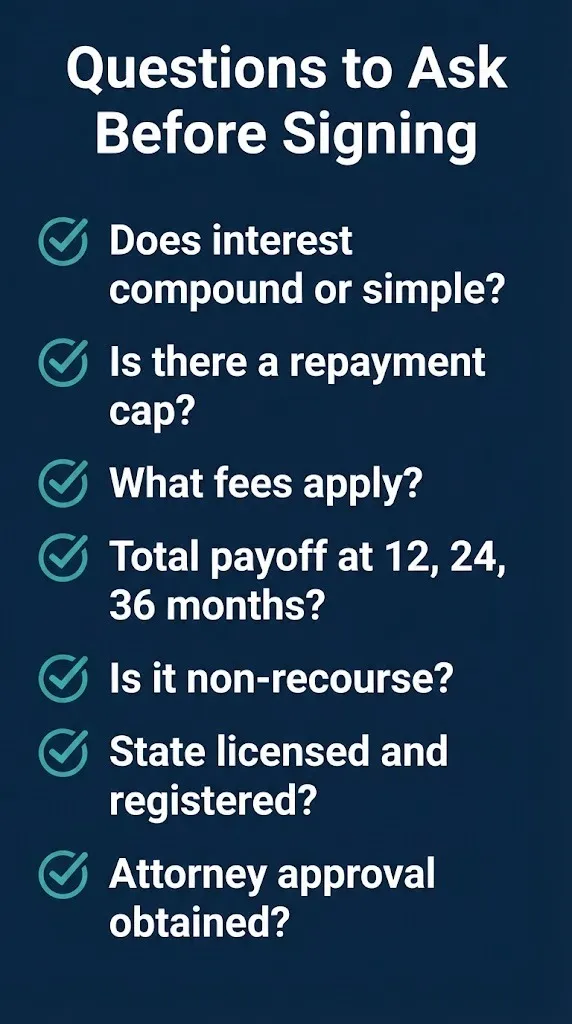
Here’s what to ask every company:
- Does interest compound or is it simple? Simple interest grows in a straight line. Compound interest grows faster because charges build on charges .
- Is there a repayment cap? A cap limits how much your balance can grow over time. Without one, a long case can consume your entire settlement .
- What fees exist? Ask about application, underwriting, processing, origination, maintenance, and wire fees. Reputable companies charge none .
- What’s the total payoff at 12, 24, and 36 months? Get this in writing. If the company won’t provide it, walk away .
- Is the agreement non-recourse? It must state in writing that you owe nothing if you lose .
The most reliable way to evaluate a funder is through your attorney. Personal injury lawyers see these contracts regularly and know which companies deal fairly .
What Are the Risks of Lawsuit Loans?
The biggest risk of a lawsuit loan is that accumulated fees eat most of your settlement. You can win your case and still walk away with very little money .
Here’s a realistic worst-case scenario:
| Item | Amount |
|---|---|
| Settlement | $75,000 |
| Attorney Fee (33%) | -$24,750 |
| Case Costs | -$5,000 |
| Loan Advance | $15,000 |
| Fees (48% compound over 3 years) | $18,600 |
| Total Loan Repayment | -$33,600 |
| Your Take-Home | $11,650 |
In this scenario, the plaintiff won a $75,000 case but took home just $11,650. The lawsuit loan consumed nearly half the settlement.
Other risks include pressure to settle early because the interest clock is ticking, multiple advances that multiply the damage, and predatory companies with hidden fees .
Step-by-Step: How to Get a Lawsuit Loan Safely
Getting a lawsuit loan safely requires preparation and comparison shopping. Here’s the sequence:
- Talk to your attorney first. Some lawyers refuse to work with funders. Get their input before applying .
- Request offers from at least three companies. Comparison shopping can save thousands .
- Ask for the total payoff schedule in writing. Get numbers at 12, 24, and 36 months .
- Verify the non-recourse clause. The contract must state you owe nothing if you lose .
- Check for compounding and caps. Simple interest with a cap protects you most .
- Borrow only what you need. Every extra dollar costs more later .
- Review the contract with your attorney. Never sign without legal review .
What Happens Next After You Apply?
The funding process moves quickly once you apply, but the long-term consequences unfold over months or years.
Within 24 to 72 hours: Underwriting review. The funder contacts your attorney to verify case details. Approval or denial typically comes within 1 to 3 days .
Same day to 1 week: Funds deposited into your account after signed agreement.
Monthly while case pending: Your balance grows according to the contract terms. If rates compound, the growth accelerates.
At settlement: Repayment comes off the top before you receive anything. Attorney fees, case costs, and medical liens are also deducted .
Your take-home: What’s left after everyone else is paid. Run this calculation before signing, not after.
Frequently Asked Questions
Is a lawsuit loan a good idea?
It depends on your financial situation. Lawsuit loans cost far more than traditional loans, but they’re non-recourse and require no credit check or monthly payments. If you can cover expenses another way, that’s usually cheaper.
How much can I borrow against my lawsuit?
You can typically borrow 10% to 20% of your expected settlement value. For a $100,000 case, that’s $10,000 to $20,000 .
What’s the average lawsuit loan interest rate?
Monthly rates range from 2.95% to 5%, with annual effective rates of 27% to 60%. Simple interest is far cheaper than compound over long cases .
Do I have to pay back a lawsuit loan if I lose?
No, if the agreement is truly non-recourse. You owe nothing if your case fails. Read the contract carefully for partial recourse clauses .
Can I get a lawsuit loan without a lawyer?
No, most funders require attorney cooperation to verify case details and honor the repayment lien. If you don’t have an attorney, funding is unlikely .
What’s the difference between simple and compound interest?
Simple interest charges only on the original advance. Compound interest charges on your growing balance, making the payoff much higher over time .
Are lawsuit loans regulated?
Regulation varies by state. Some states have transparency requirements and rate caps. Others have minimal oversight. Check your state’s rules before signing .
How long does it take to get lawsuit funding?
Approval typically takes 24 to 72 hours. Funds are often deposited the same day or within a week of signing .
What Should You Do Before Signing a Lawsuit Loan Agreement?
Talk to your attorney first. Request written payoff schedules from at least three companies showing what you’ll owe at 12, 24, and 36 months. Confirm the agreement is non-recourse and includes a repayment cap.
Borrow only what you need to cover specific expenses. Every additional dollar costs more later. If a company won’t provide clear answers on total cost, walk away.
The single most important number: your total payoff at settlement, not the advertised monthly rate. Get it in writing before you sign anything.