How to Start a Class Action Lawsuit in 2026: Step-by-Step Guide, Costs & Eligibility Rules
Quick Answer
- Is it legit: Yes. Class actions are governed by Federal Rule of Civil Procedure 23 and state equivalents.
- How much: $0 upfront. Attorneys work on contingency, taking 25% to 33% of any settlement.
- Key deadline: Statutes of limitations apply, typically 2 to 4 years from the date you were harmed.
If you’re wondering how to start a class action lawsuit, the short answer is this: you need a common legal problem shared by many people, documentation of your individual harm, and a class action attorney willing to take the case on contingency. You pay nothing out of pocket.
The path isn’t instant. A court must certify your case as a class action before it can proceed on behalf of anyone other than the original plaintiffs. That certification stage is where many cases fail or get reshaped .
This guide walks through the entire process, from identifying whether your issue qualifies to understanding what happens after settlement. One detail stands out: you don’t need a specific number of people to start, but courts generally look for at least 40 affected individuals to justify the efficiency of a class action .
The Facts
| Cost to Start | $0 upfront (contingency fee arrangement) |
| Attorney Fees | Typically 25% to 33% of settlement, approved by court |
| Minimum Class Size | No strict rule, but 40+ members is a common threshold |
| Certification Standard | Federal Rule 23: numerosity, commonality, typicality, adequacy |
| Typical Timeline | 2 to 5 years from filing to payment |
| Lead Plaintiff Award | Often $1,000 to $10,000 service award, court-approved |
What Is a Class Action Lawsuit and How Does It Work?
A class action lawsuit is a single legal proceeding filed by one or a few people on behalf of a larger group who suffered similar harm from the same defendant . The group is called the “class,” and the person filing is the “class representative” or “lead plaintiff.”
The purpose is efficiency. Instead of thousands of individual lawsuits clogging the courts, one case resolves the common issues for everyone. The outcome, whether a settlement or a verdict, binds all class members who don’t opt out .
Think of it like a group insurance claim. One person files the paperwork, but the resolution applies to everyone covered under the same policy. You don’t have to hire your own lawyer or appear in court unless you choose to.
Class actions are most common in consumer fraud, defective products, data breaches, and employment disputes where the individual damages are too small to justify a solo lawsuit .
Who Can Start a Class Action Lawsuit?
Anyone who has been harmed can potentially start a class action, but you must meet specific eligibility criteria to serve as the lead plaintiff. The most important requirement is that you suffered the same type of harm as the people you’re representing.
You cannot file a class action on behalf of a group if you weren’t harmed yourself. The lead plaintiff must be a member of the proposed class, with claims typical of the others .
Here’s what courts look for in the lead plaintiff:
| Requirement | What It Means |
|---|---|
| Live claim | You have an actual, ongoing controversy with the defendant |
| Class membership | You are part of the group you’re representing |
| Typicality | Your claims are similar to other class members |
| Adequacy | You can fairly represent the class interests |
| Clean background | No conflicts of interest with other class members |
The lead plaintiff doesn’t need to be a legal expert. You need to be willing to participate in discovery, sit for a deposition, and review settlement terms if the case resolves .
Key Takeaway: You can start a class action if you were personally harmed and your claims are typical of the group you seek to represent. The court will scrutinize whether you’re an adequate representative.
How Much Does It Cost to Start a Class Action Lawsuit?
It costs $0 upfront to start a class action lawsuit in almost every case. Class action attorneys work on contingency, meaning they only get paid if the case results in a settlement or verdict.
The law firm covers all expenses during litigation: filing fees, expert witnesses, depositions, and administrative costs. Those expenses are later reimbursed from the settlement fund before class members receive their share .
Attorney fees in class actions are typically 25% to 33% of the total settlement, and a judge must approve the amount as reasonable . If the case settles for $10 million, attorneys might receive $2.5 million to $3.3 million, and the remainder goes to class members.
As the lead plaintiff, you may receive a service award on top of your regular claim. These awards are typically $1,000 to $10,000, though they can be higher in complex cases. The court must approve any service award .
What Are the Four Requirements for Class Certification?
The four requirements for class certification under Federal Rule 23 are numerosity, commonality, typicality, and adequacy of representation. All four must be met before a case can proceed as a class action .
Numerosity: The class must be large enough that individual lawsuits would be impractical. There’s no strict number, but courts generally look for at least 40 members .
Commonality: There must be common questions of law or fact that apply to the entire class. If everyone’s situation is different, a class action won’t work .
Typicality: The lead plaintiff’s claims must be typical of the class. If you suffered a rare, extreme reaction while others had minor issues, you may not be an adequate representative .
Adequacy: The lead plaintiff and class counsel must be able to fairly and adequately represent the class. This includes having no conflicts of interest .
If the case seeks money damages, it must also satisfy Rule 23(b)(3): common questions must predominate over individual ones, and a class action must be superior to other methods of resolution .
Step-by-Step: How to Start a Class Action Lawsuit
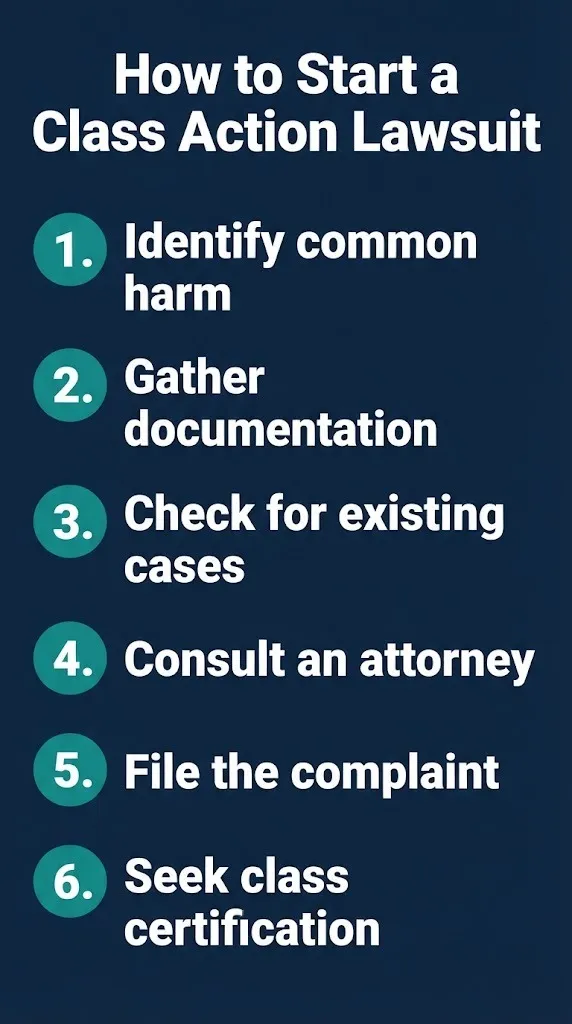
Starting a class action follows a defined sequence. Here’s the process from initial investigation to filing:
- Identify a common legal problem. Confirm that multiple people suffered similar harm from the same company or practice .
- Gather your documentation. Collect receipts, contracts, screenshots, emails, or medical records that show your individual harm .
- Check whether a similar case exists. If a class action is already active, you may be able to join it instead of starting a new one .
- Consult a class action attorney. Most offer free evaluations. They’ll assess whether your case meets the certification requirements .
- File the complaint. Your attorney files a formal complaint in state or federal court, outlining the alleged wrongdoing and the proposed class .
- Survive early motions. Defendants often file motions to dismiss. Your attorney must defeat these to keep the case alive .
- Move for class certification. This is the critical stage. The court decides whether the case can proceed as a class action .
- Litigate, settle, or go to trial. After certification, the case moves through discovery, settlement talks, or trial.
What Happens After the Class Is Certified?
After certification, the court appoints class counsel and the case proceeds toward resolution. Notice is sent to potential class members, giving them the opportunity to opt out or remain in the class.
For Rule 23(b)(3) classes seeking money damages, notice is mandatory and must be the “best practicable” method of reaching class members . Notice typically goes out by mail, email, or publication.
Class members who don’t opt out are automatically included and bound by the outcome. If the case settles, they must submit a claim to receive their share. If it goes to trial and the plaintiff wins, they receive damages through the claims process .
Opt-out rights are typically available to all class members in damages cases. Opting out means you give up your share of any settlement but retain the right to file your own individual lawsuit .
Reality Check: No legitimate class action administrator will ever text you asking for payment to join a settlement. Filing a claim is always free once a settlement exists. Third-party “claim helpers” charging upfront fees are unnecessary and often predatory.
How Long Does a Class Action Lawsuit Take?
A typical class action takes 2 to 5 years from filing to payment, though timelines vary dramatically based on complexity and whether the case settles early.
Here’s a realistic breakdown:
| Stage | Typical Duration |
|---|---|
| Filing to class certification | 6 months to 2+ years |
| Certification to settlement | 6 months to 3+ years |
| Settlement approval to payment | 6 to 18 months |
| Total | 2 to 5 years |
Straightforward consumer cases can resolve in 12 to 18 months. Complex antitrust or securities cases can take a decade or more . The Volkswagen Dieselgate settlement took about two years from scandal to payments.
As lead plaintiff, you sign up for the long haul. Your participation is usually minimal after the initial deposition and discovery phase, but you’ll be involved in major decisions like settlement approval .
What Are the Main Risks of Starting a Class Action?
The main risks of starting a class action are the time commitment, the possibility of dismissal at certification, and the potential for a low individual payout if the class is huge.
If the court denies certification, the case may proceed as an individual lawsuit or be dismissed entirely. Many cases fail at this stage .
Individual payouts in class actions are often small because they’re divided among thousands of members. If a case settles for $5 million and there are 500,000 class members, each person might receive $10 or less after fees and costs .
As lead plaintiff, you also face the risk of being deposed and having your personal information become part of the public record. The defendant’s attorneys will question you under oath about your experience and your role in the case .
What Happens Next in the Class Action Process?
The path forward depends on whether the court certifies the class and whether the defendant settles or fights.
Expected 2026-2027: Certification motion filed and argued. This is the make-or-break stage for most class actions.
Expected 2027: If certified, discovery begins. Both sides exchange documents and take depositions.
Expected 2027-2028: Settlement negotiations or summary judgment motions. Most cases resolve before trial.
TBD: Trial if no settlement. Trials in class actions are rare but possible.
Frequently Asked Questions
How many people do you need to start a class action?
There’s no strict number, but courts generally look for at least 40 affected people. Larger classes are more likely to satisfy the numerosity requirement.
Can I start a class action by myself?
You can file the initial complaint yourself, but you almost certainly need an attorney to navigate certification and litigation. Most class action attorneys offer free consultations.
How much does it cost to file a class action lawsuit?
Nothing upfront. Attorneys work on contingency and cover all costs during litigation. They’re paid from the settlement or verdict if the case succeeds.
What is the lead plaintiff in a class action?
The lead plaintiff is the named representative who files the case on behalf of the class. They participate in discovery and major decisions but don’t handle the legal work.
Do I have to pay to join a class action?
No. If you’re included in a certified class, you’re automatically a member unless you opt out. Filing a claim after a settlement is always free.
What happens if I opt out of a class action?
You give up your share of any settlement but retain the right to file your own individual lawsuit. You can’t rejoin the class later.
How long does it take to get money from a class action?
Typically 2 to 5 years from filing to payment. Settlement approval to distribution alone can take 6 to 18 months.
What types of cases can be class actions?
Consumer fraud, defective products, data breaches, employment disputes, securities fraud, and antitrust violations are common. The key is shared harm from the same defendant.
What Should You Do If You Think You Have a Class Action?
Document everything. Gather receipts, contracts, screenshots, emails, and any records that show how you were harmed. Write down dates, amounts, and what the company did wrong.
Check whether a similar class action already exists. If one does, you may be able to join it. If not, consult a class action attorney for a free evaluation. They can tell you whether your case meets the certification requirements.
The single most important fact: starting a class action costs you nothing upfront, but it requires a common problem shared by many people. If your issue is unique to you, an individual lawsuit may be the better path.