Air Canada Delay Compensation 2026: How Much You’re Owed and the Class Action Explained
Quick Answer
- Air Canada owes $400 to $1,000 CAD per passenger for delays of three hours or more within its control.
- A Quebec class action, authorized January 13, 2026, targets Air Canada delays blamed on staffing coded as safety issues.
- You must file a written compensation claim with Air Canada within one year of the disruption.
Your Air Canada flight got delayed and now you want a straight answer: what does the airline actually owe you? Under Canada’s Air Passenger Protection Regulations (APPR), Air Canada must pay $400 to $1,000 CAD per passenger for a delay of three hours or more, if the cause was within the airline’s control.
That single rule affects millions of Air Canada passengers every year, and it just got more contested. A Quebec Superior Court class action, authorized January 13, 2026, alleges Air Canada systematically labeled staffing-related delays as safety issues, a classification that would have wrongly stripped passengers of compensation they were owed.
This article breaks down exactly how much you’re entitled to, how the pending class action might affect your individual claim, and how to escalate if Air Canada denies you. One detail most sites bury: the federal regulator sitting on your complaint had a backlog of more than 97,000 unresolved cases as of May 2026.
The Facts: What’s Verified So Far
| Category | Verified Detail |
|---|---|
| Case | Class action against Air Canada over flight delays attributed to staffing shortages, Quebec Superior Court |
| Status | Authorized to proceed on January 13, 2026; allegations not yet proven; no trial date confirmed |
| Fund Size | Not applicable, case remains in litigation with no settlement reached |
| Est. Per Person | Not yet determined; based on the existing APPR range of $400 to $1,000 per passenger |
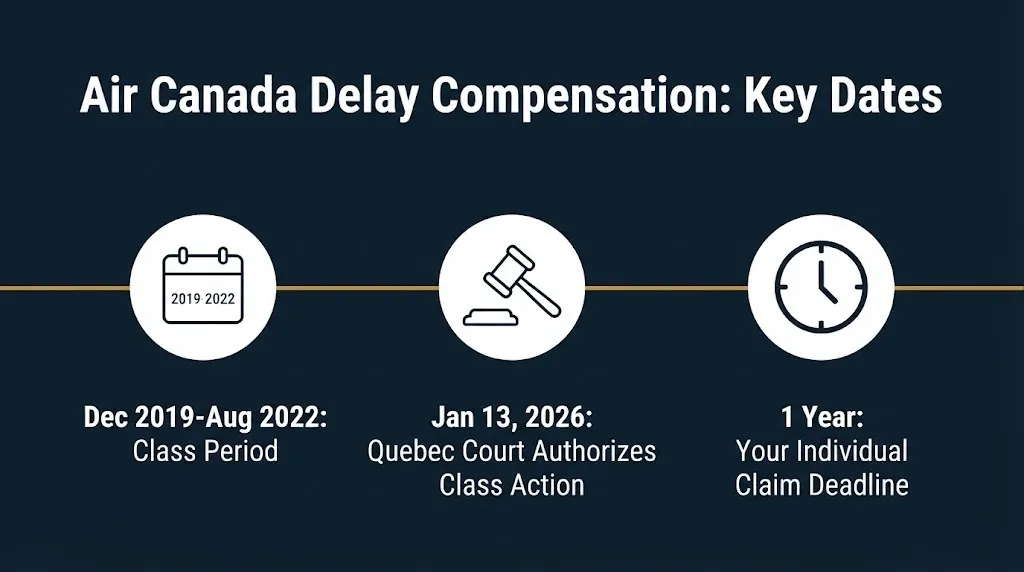
| Class Period | December 15, 2019 to August 7, 2022 |
| Individual Claim Deadline | 1 year from the date of the disruption, filed in writing with the airline |
| Administrator | Not applicable, no settlement administrator has been appointed |
| Proof Needed | Booking confirmation, boarding pass or itinerary, and the airline’s written reason for the delay |
This is an active lawsuit, not a settled fund. Anyone telling you a specific per-person payout for the class action right now is guessing, not reporting.
Is Air Canada Really Required to Pay Delay Compensation?
Yes, Air Canada is legally required to pay compensation for delays of three hours or more when the cause was within its control. This obligation comes from the federal Air Passenger Protection Regulations, which apply to every large Canadian carrier.
The rule only kicks in under specific conditions. The delay must be at least three hours at your final destination, the cause must be within the airline’s control, and it must not be required for safety.
Airlines routinely dispute whether a given delay counts as “within their control.” That’s exactly the dispute driving the current class action against Air Canada, which alleges staffing shortages were miscoded as safety issues to avoid paying out.
Key Takeaway: Air Canada owes compensation for controllable delays of three hours or more, but the airline and passengers frequently disagree on what counts as “within the airline’s control.”
How Much Compensation Can You Get From Air Canada for a Delayed Flight?
Your compensation amount depends entirely on how late you arrived at your final destination, not how late the plane departed. As a large carrier, Air Canada follows the higher compensation tier under the APPR.
| Delay Length at Final Destination | Air Canada Compensation (Large Carrier) |
|---|---|
| 3 hours to less than 6 hours | $400 CAD |
| 6 hours to less than 9 hours | $700 CAD |
| 9 hours or more | $1,000 CAD |
If Air Canada offers you a rebooked flight departing up to two hours before your original time and arriving less than four hours after your original arrival, the compensation amount can be reduced by 50 percent. This reduction only applies when you accept the alternative arrangement.
Compensation is paid per passenger, not per booking, so a family of four delayed nine or more hours could collectively be owed up to $4,000 CAD. Air Canada may offer travel vouchers instead of cash, but any voucher must be worth more than the cash amount and cannot expire.
Does the Air Canada Class Action Affect Your Compensation Claim?
The pending class action does not replace your right to file an individual APPR claim right now. You can still pursue compensation directly with Air Canada or through the Canadian Transportation Agency while the lawsuit proceeds.
The Quebec Superior Court authorized this class action on January 13, 2026, allowing it to move forward on the claim that Air Canada’s staffing shortages, including crew shortages, fall within the airline’s operational control rather than qualifying as safety exemptions. The suit alleges Air Canada implemented an internal policy of classifying staffing-related delays as safety-related, potentially denying passengers compensation they were owed.
The class covers passengers who, between December 15, 2019 and August 7, 2022, arrived at their final destination at least three hours late on Air Canada, Air Canada Rouge, or Air Canada Express flights, when the delay was attributed to staffing issues or shortages.
Air Canada disputes the allegations. The airline has stated the specific question of crew constraints being coded to safety was investigated by the CTA, which found no systemic issues and levied no fines. None of the allegations have been proven in court, and the case remains in the litigation phase with no settlement fund established.
Key Takeaway: This class action could eventually recover compensation for a specific group of delayed passengers from 2019 to 2022, but it has not resulted in any settlement, fund, or confirmed payout amount.
Reality Check: No one from Air Canada or a class action law firm will call or text you out of the blue offering settlement money right now, because no settlement exists yet. Filing an individual APPR compensation claim with Air Canada is always free, and you don’t need to pay anyone a percentage just to submit it yourself.
How to File an Air Canada Delay Compensation Claim
Filing correctly the first time saves you months of back and forth. Here’s the process reported by the Canadian Transportation Agency and current APPR guidance.
- Confirm your delay was three hours or more at your final destination
- Note the reason Air Canada gave for the delay, in writing if possible
- Gather your booking confirmation, boarding pass, and any rebooking documents
- Submit a written compensation claim directly to Air Canada
- Specify the compensation tier you believe applies ($400, $700, or $1,000)
- Keep copies of every communication and reference number
- If denied or ignored, escalate to the Canadian Transportation Agency
- File your CTA complaint within one year of the original disruption
Air Canada’s own denial letter often becomes your best evidence if you later escalate, especially if it cites a vague or unsupported safety classification.
What Is the Deadline to Claim Air Canada Delay Compensation?
You must submit your compensation claim to Air Canada in writing within one year of the delay or cancellation. This deadline applies to individual APPR claims, separate from any deadline tied to the ongoing class action.
Miss the one-year window and Air Canada can lawfully deny your claim on timing grounds alone, regardless of how strong your case is otherwise. There is currently no confirmed opt-out or claim-filing deadline for the staffing-shortage class action itself, since the case has not reached a settlement stage.
Key Takeaway: The one-year filing deadline for individual APPR claims is the deadline that actually affects you today, not any date tied to the still-unresolved class action.
What Happens If Air Canada Denies Your Claim?
A denial from Air Canada is not the final word on your compensation. You can escalate the dispute to the Canadian Transportation Agency (CTA), the federal body with binding authority over airline compliance.
There is no fee to file a CTA complaint. The agency first attempts facilitation between you and the airline before moving to formal adjudication if that fails.
Reported CTA processing timelines:
- Acknowledgment of your complaint: 5 to 10 business days
- Contact with the airline: 2 to 4 weeks
- Facilitation and mediation phase: 30 to 60 days
- Formal adjudication, if needed: 3 to 12 months
If the CTA formally adjudicates your case, its decision is binding on Air Canada. You can also pursue your claim independently through small claims court, and no APPR rule requires you to pay a third-party service a percentage of your payout to file on your behalf.
How Long Does an Air Canada Compensation Claim Take?
A straightforward, undisputed claim can be paid by Air Canada within weeks of submission. Disputed claims that require CTA involvement take considerably longer, especially given the agency’s current backlog.
If your complaint reaches formal adjudication, expect the process to take three to twelve months from the point the CTA actually starts working your file. That’s separate from how long your complaint may sit in the queue before an officer is assigned.
Why Is the Canadian Transportation Agency’s Complaint Backlog So Bad?
The CTA’s air travel complaint backlog exceeded 97,000 cases as of May 1, 2026, according to Transport Canada’s Spring Economic Update. That backlog is the primary reason many passengers wait years, not months, for a resolution.
In response, the federal government announced plans in May 2026 to shift the backlog to a neutral third-party dispute resolution organization, cap complaint resolution at 90 days once a file is actively assigned, and raise penalties for systemic airline violations to as much as $1 million CAD. Legislation to implement these changes had not been passed as of this writing.
Until new amendments are formally registered in the Canada Gazette, Part II, the current three-tier compensation matrix ($400, $700, $1,000) remains the governing law. The CTA’s existing complaint resolution officer process, once actually assigned, is capped at 90 days with a binding decision.
Key Takeaway: The backlog sits before your case is even assigned an officer, so patience with the queue matters as much as the strength of your claim itself.
Why Are Passengers Suing Air Canada Over Staffing-Coded Delays?
Passengers allege Air Canada avoided paying legitimate compensation by mislabeling staffing shortages as safety-related exemptions. Under the APPR, delays required for genuine safety reasons are exempt from compensation, but staffing and scheduling failures generally are not.
The lawsuit’s core argument is that flight crew shortages fall within an airline’s operational control and responsibility, not an unforeseeable safety event. A partner at the law firm representing the class stated that before this ruling, individual passengers had been left to pursue Air Canada through regulatory channels entirely on their own.
Air Canada has pushed back publicly, stating that the CTA previously investigated the crew-constraints-as-safety question and found no systemic issues, with no fines levied. The court’s certification decision does not determine guilt. It only allows the case to proceed toward a possible trial.
Does Air Canada Delay Compensation Apply to Connecting or International Flights?
APPR compensation applies to any flight to, from, or within Canada, including connecting itineraries, as long as the delay at your final destination meets the three-hour threshold. Codeshare flights follow the rules of whoever actually operated the flight, not necessarily who you booked through.
If you’re flying a route also covered by another regime, such as a European Union flight connecting through Canada, you may have a choice between the APPR and EU261 protections. You can claim under whichever framework is more favorable, but you cannot recover compensation twice for the same disruption under two different jurisdictions.
What’s the Difference Between Air Canada’s Policy and What the Law Requires?
Air Canada states its policy is to fully comply with APPR requirements, but stated policy and enforced practice aren’t always the same thing. That gap is precisely what the pending class action puts to the test.
Think of it like a store’s return policy sign versus what actually happens at the counter. The sign says returns are accepted, but if the clerk keeps finding reasons to deny yours, the written policy isn’t protecting you in practice.
The APPR sets the legal floor. Air Canada’s internal classification decisions, like whether a given delay counts as safety-related, determine whether that floor is actually being honored on individual flights.
What Happens Next: Timeline to Watch
January 13, 2026: Quebec Superior Court authorized the staffing-shortage class action to proceed.
May 1, 2026: Transport Canada announced plans to overhaul the CTA complaint process and raise penalties, but no legislation has passed yet.
Ongoing: The class action proceeds toward trial; no settlement fund or per-person payout has been established.
Expected: Further court proceedings and possible Transport Canada legislation on CTA reform, with no confirmed dates yet.
Frequently Asked Questions
How much compensation does Air Canada owe for a delayed flight?
Air Canada owes $400 to $1,000 CAD per passenger for delays of three hours or more within the airline’s control.
The exact amount depends on how late you arrive at your final destination.
Delays of 9 hours or more qualify for the maximum $1,000 CAD payment.
Is the Air Canada delay compensation lawsuit a real class action?
Yes, it’s a real class action authorized by the Quebec Superior Court on January 13, 2026.
It targets flight delays between December 15, 2019 and August 7, 2022 that Air Canada attributed to staffing shortages.
None of the allegations have been proven, and Air Canada disputes the claims.
Do I need to join the class action to get compensation now?
No, you can file an individual APPR compensation claim with Air Canada right now, separately from the class action.
The class action has not reached a settlement stage, so there’s no fund to claim from yet.
Filing your own claim protects your rights regardless of how the lawsuit eventually resolves.
What is the deadline to file an Air Canada compensation claim?
You must submit your claim in writing to Air Canada within one year of the delay or cancellation.
Missing this deadline can result in your claim being denied on timing grounds alone.
There is currently no separate claim deadline tied to the class action itself.
What if Air Canada denies my compensation claim?
You can escalate the dispute to the Canadian Transportation Agency at no cost.
The CTA can formally adjudicate your case and issue a binding decision against Air Canada.
Expect the process to take several months, especially given the agency’s current backlog.
Why does the Canadian Transportation Agency take so long to resolve complaints?
The CTA had a backlog exceeding 97,000 air travel complaints as of May 2026.
Once an officer is actually assigned to your file, the process is capped at 90 days.
The wait before that assignment is where most of the delay happens.
Can I get compensation if Air Canada says the delay was for safety reasons?
Genuine safety-related delays are exempt from APPR compensation under current law.
The pending class action specifically challenges whether staffing shortages were wrongly classified as safety issues.
If you believe your delay was miscategorized, you can still file a claim and escalate to the CTA if denied.
Start by checking your delay length against your final destination arrival time, not your departure time, since that’s what determines your compensation tier. File your written claim with Air Canada now, since the one-year deadline runs regardless of how the pending class action eventually resolves.