NFA Lawsuit 2026: What the Federal Court Ruling Means and Who’s Covered
Quick Answer
- A Texas federal court ruled NFA registration requirements for suppressors and short-barreled firearms unconstitutional on August 5, 2026.
- The ruling protects only named plaintiffs, their members, and their customers, not the general public nationwide.
- The government has until October 5, 2026 to appeal; no notice of appeal has been filed as of this writing.
Yes, the NFA lawsuit is real, and a federal judge already ruled on it. On August 5, 2026, a U.S. District Court in Texas held that National Firearms Act registration requirements for suppressors and short-barreled firearms can no longer be enforced, because Congress zeroed out the taxes those requirements were built to collect.
This ruling affects anyone who owns, sells, or wants to buy a suppressor, short-barreled rifle, or short-barreled shotgun, but not everyone equally. The injunction only covers named plaintiffs and their customers, and the government still has until October 5, 2026 to file an appeal.
This article breaks down exactly who’s protected right now, what changed on the ground the moment the ruling took effect, and what happens if the government appeals. One detail most coverage buries: the first legal suppressor transfer without ATF registration in 92 years happened within minutes of the injunction taking effect.
The Facts: What’s Verified So Far
| Category | Verified Detail |
|---|---|
| Case | Silencer Shop Foundation v. ATF, No. 6:25-CV-056 (consolidated with Jensen v. ATF, No. 6:26-CV-277) |
| Court | U.S. District Court, Northern District of Texas, San Angelo Division |
| Judge | James Wesley Hendrix |
| Status | Final judgment and permanent injunction entered August 5, 2026; injunction took effect August 13, 2026 |
| Who’s Covered | Named plaintiff organizations, 15 plaintiff states, and their current and future members and customers, not the general public |
| Items Affected | Suppressors, short-barreled rifles, short-barreled shotguns, and NFA “any other weapons” (AOWs) |
| Not Affected | Machine guns and destructive devices remain fully regulated and taxed under the NFA |
| Appeal Deadline | October 5, 2026 (60 days from final judgment) |
| Underlying Trigger | The One Big Beautiful Bill Act reduced NFA making and transfer taxes on these items to $0, effective January 1, 2026 |
| Related Cases | Roberts v. ATF (E.D. Kentucky, filed February 26, 2026); additional litigation reported pending in Missouri |
This is a live legal situation, not a settled question. Anyone claiming this ruling applies to every American right now is getting ahead of what the court actually ordered.
Is the NFA Lawsuit Real? What Did the Court Actually Rule?
Yes, this is a real, decided federal case, not speculation or a rumor circulating in gun forums. On August 5, 2026, Judge James Wesley Hendrix of the U.S. District Court for the Northern District of Texas entered final judgment in Silencer Shop Foundation v. ATF, consolidated with Jensen v. ATF.
The court held that specific NFA registration, application, and approval requirements can no longer be justified under Congress’s constitutional taxing power. That’s because the One Big Beautiful Bill Act, signed July 4, 2025, reduced the making and transfer taxes on suppressors, short-barreled rifles, short-barreled shotguns, and AOWs to zero, effective January 1, 2026.
The court’s reasoning is narrow and specific. It ruled these requirements existed constitutionally only because they supported tax collection, and once the tax dropped to $0, that constitutional foundation disappeared. The court did not rule on Second Amendment grounds, only on Congress’s Article I taxing authority.
Key Takeaway: A federal court has ruled NFA registration requirements unconstitutional for untaxed items, but only as a matter of Congress’s taxing power, not as a broader Second Amendment ruling.
What Does the NFA Ruling Actually Change for Suppressor and SBR Buyers?
For covered buyers, the ruling eliminates the ATF registration and approval process entirely for suppressors, short-barreled rifles, and short-barreled shotguns. That’s on top of the tax already dropping to $0 back on January 1, 2026.
Before this ruling, buyers still had to file a Form 4, wait for ATF approval, and get entered into the National Firearms Registration and Transfer Record, even though no tax was owed. This ruling removes that registration step for people covered by the injunction.
| What Changed | Before August 13, 2026 | After August 13, 2026 (Covered Buyers Only) |
|---|---|---|
| Tax Owed | $0 (since Jan. 1, 2026) | $0 |
| ATF Form 4 Filing | Required | Not required |
| Registration in NFRTR | Required | Not required |
| Waiting Period for Approval | Weeks to months | Same-day transfer possible through covered dealers |
This does not apply to machine guns or destructive devices, which remain fully taxed and registered under existing NFA rules. It also does not apply to every buyer nationwide, only to those covered by the injunction, which the next section explains.
Who Is Covered by the NFA Injunction Right Now?
You’re covered by this injunction only if you’re a named plaintiff, a member of a plaintiff organization, a resident of one of 15 plaintiff states, or a customer of a covered commercial plaintiff. This is not a nationwide ruling that protects every American automatically.
The plaintiff coalition includes the American Suppressor Association, National Rifle Association, Second Amendment Foundation, Firearms Policy Coalition, Gun Owners of America, Silencer Shop Foundation, SilencerCo, Palmetto State Armory, B&T USA, and individual plaintiffs.
The 15 plaintiff states are:
- Alaska, Georgia, Idaho, Indiana, Kansas
- Louisiana, Montana, North Dakota, Oklahoma
- South Carolina, South Dakota, Texas, Utah
- West Virginia, Wyoming
If you don’t live in one of those states, you can still gain coverage by becoming a member of one of the plaintiff organizations, or by purchasing through a covered commercial plaintiff like Silencer Shop, since the injunction extends to their current and future customers.
Key Takeaway: This is a party-specific injunction, not a nationwide rule change, so coverage depends on your state, your organizational memberships, and who you buy from.
Reality Check: No dealer or organization needs to charge you a large fee to “guarantee” injunction coverage beyond a normal membership or purchase. If a seller claims this ruling protects every buyer nationwide regardless of state or membership, that claim goes beyond what the court actually ordered.
How Do You Know If You’re Covered by the NFA Injunction?
You can check your coverage status by confirming three things: your state of residence, any relevant organizational memberships, and which dealer you’re buying from. This determines whether you can legally skip NFA registration under the current injunction.
Steps to confirm your status:
- Check if you live in one of the 15 plaintiff states listed above
- If not, check whether you’re a current member of NRA, SAF, ASA, FPC, GOA, or a related plaintiff organization
- Confirm the specific membership predates or includes your transaction date
- If buying commercially, confirm the dealer is one of the named commercial plaintiffs or their designated network
- Keep documentation of your membership or state residency with your purchase records
- Consult a firearms attorney if your coverage status is unclear before completing a transaction
Buyers who don’t clearly fit these categories should not assume coverage. Several legal analyses reviewed for this article specifically warned against assuming protection based on general news coverage alone.
How Can You Buy a Suppressor Without NFA Registration Right Now?
Covered buyers can now complete suppressor purchases through participating dealers without filing an ATF Form 4 or waiting for approval. This is only true for buyers who fall within the injunction’s coverage, described above.
Some commercial plaintiffs, including Silencer Shop, have stated publicly that eligible customers can complete purchases and pick up suppressors from a selected dealer after passing a standard firearm background check, similar to purchasing a standard rifle or handgun.
Key Takeaway: The practical change for covered buyers is real and immediate, but it depends entirely on confirming coverage first, not assuming it applies broadly.
What Should You Do If You’re Not Covered by the Injunction?
If you don’t fall within the injunction’s coverage, you should continue following standard NFA procedures for now. Several firearms law firms specifically advised buyers and dealers outside the plaintiff group to keep filing Form 1s and Form 4s as usual.
This caution exists because the ruling remains subject to appeal, and acting on assumed coverage that doesn’t actually apply to you could create legal exposure. Multiple related NFA challenges also remain pending in other courts, including Kentucky and Missouri, which could eventually expand or complicate the legal landscape further.
Will the Government Appeal the NFA Ruling?
As of the most recent verified reporting, no formal notice of appeal has been filed by the government. A member of Congress has stated the administration confirmed it will not appeal, but the Department of Justice has not made that position official on the record.
The government’s own on-record statement described the ruling as still under assessment. This distinction matters because informal statements from lawmakers are not the same as a binding legal position from DOJ.
Key Takeaway: Reports of the government declining to appeal remain unconfirmed by DOJ itself, so the appeal window staying open should not be treated as resolved.
What Is the Deadline for the Government to Appeal?
The federal government has until October 5, 2026 to file a notice of appeal with the Fifth Circuit Court of Appeals. This deadline comes from the standard 60-day window under the Federal Rules of Appellate Procedure, counted from the August 5, 2026 entry of final judgment.
The government already missed an earlier, shorter window. The court initially stayed its ruling for seven days to let the government seek emergency relief, but that stay expired without the government requesting an extension or filing anything with the Fifth Circuit.
Missing that first window meant the injunction became fully operative on August 13, 2026. It did not, however, end the government’s ability to pursue a standard appeal through October 5.
What Happens If the Ruling Gets Appealed or Overturned?
If the government appeals by October 5, 2026, the case moves to the Fifth Circuit Court of Appeals, and the government could separately request a stay of the injunction while that appeal proceeds. A granted stay would pause the injunction’s effect during the appeal process.
If no appeal is filed by the deadline, the district court’s ruling and injunction remain in effect as the current governing law for covered parties. Legal analysts covering the case noted the underlying constitutional question could ultimately reach the U.S. Supreme Court, especially since related cases are also proceeding in other federal courts.
What Is the National Firearms Act and Why Was It Challenged?
The National Firearms Act of 1934 established a $200 tax and registration system for specific firearm categories, including suppressors, short-barreled rifles, and short-barreled shotguns. It was justified constitutionally under Congress’s power to levy taxes, not as a standalone regulatory scheme.
This lawsuit’s core argument is straightforward. Once the One Big Beautiful Bill Act reduced those taxes to zero in 2025, plaintiffs argued Congress lost its constitutional basis for maintaining the registration and approval system built around collecting that tax.
Think of it like a toll booth left standing after a road becomes free. If the toll was the only legal reason the booth existed, removing the toll raises real questions about whether the booth can still stop you.
What Other NFA Lawsuits Are Pending in 2026?
Beyond the Texas case, at least one other major NFA challenge remains active. Roberts v. ATF was filed February 26, 2026 in the U.S. District Court for the Eastern District of Kentucky, representing a third lawsuit challenging the NFA’s constitutionality following the tax elimination.
Legal commentary reviewing the Texas ruling also noted related NFA litigation is pending in Missouri, though fewer public details are currently confirmed about that case’s specific status. Multiple parallel challenges increase the odds this issue eventually reaches a higher court for a broader resolution.
Does This Ruling Affect Machine Guns or State Laws?
No, machine guns and destructive devices remain fully subject to existing NFA taxes and registration requirements. The court’s ruling applies specifically to categories where Congress reduced the tax to zero, and machine guns were not included in that tax reduction.
State laws are also unaffected by this federal ruling. States that ban suppressors or short-barreled firearms outright keep those bans in place regardless of the federal injunction, and states requiring NFA compliance as a matter of state law may still expect buyers to follow the standard federal process to satisfy that state requirement.
What Happens Next: Timeline to Watch
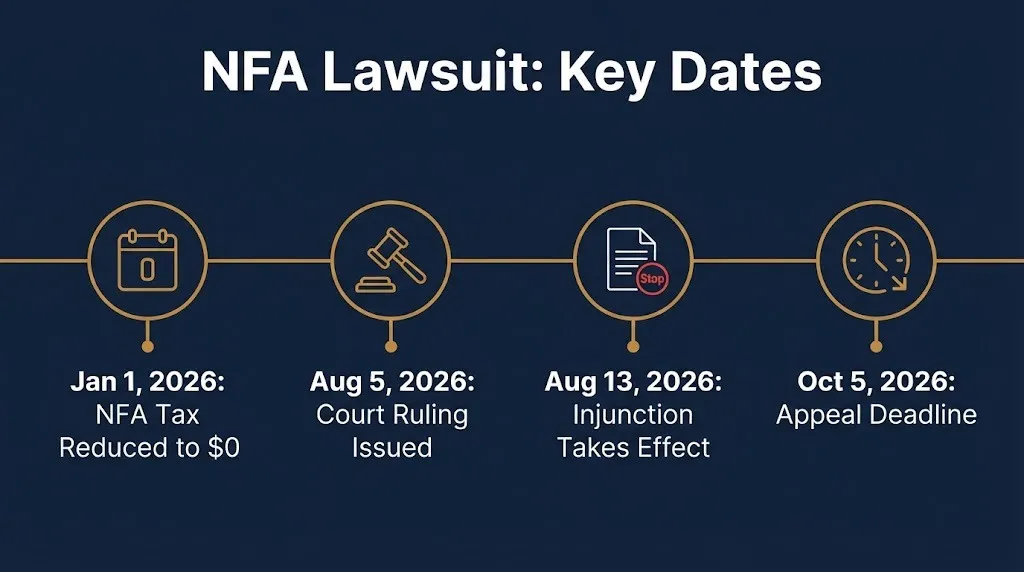
August 5, 2026: Final judgment and permanent injunction entered in Silencer Shop Foundation v. ATF.
August 13, 2026: Injunction became operative after the government did not seek an extended stay.
October 5, 2026: Deadline for the government to file a notice of appeal with the Fifth Circuit.
Expected: A Fifth Circuit ruling if an appeal is filed, with the possibility of eventual Supreme Court review given related pending cases.
Frequently Asked Questions
Is the NFA lawsuit ruling real?
Yes, a federal judge in Texas issued a real, final judgment on August 5, 2026 in Silencer Shop Foundation v. ATF.
The ruling struck down NFA registration requirements for suppressors and short-barreled firearms as unconstitutional.
It has not been overturned, and the injunction remains in effect as of this writing.
Does the NFA ruling apply to everyone in the country?
No, the injunction only covers named plaintiffs, 15 specific plaintiff states, and their current and future members and customers.
It is not a nationwide rule change for every American.
Buyers outside these categories should continue following standard NFA procedures.
Do I still have to pay the NFA tax on a suppressor?
No, the $200 making and transfer tax on suppressors was already reduced to $0 starting January 1, 2026 under the One Big Beautiful Bill Act.
This August 2026 court ruling additionally removed the registration requirement, but only for covered buyers.
Buyers outside the injunction’s coverage should still follow the standard registration process, even though no tax is owed.
Will the government appeal the NFA ruling?
As of the most recent verified reporting, no formal notice of appeal has been filed.
A lawmaker stated the administration confirmed it won’t appeal, but the Department of Justice has not made that position official.
The government has until October 5, 2026 to file an appeal.
Does this ruling affect machine guns?
No, machine guns and destructive devices remain fully subject to existing NFA taxes and registration requirements.
The ruling applies only to categories where Congress reduced the associated tax to zero.
Machine gun taxes were not included in that tax reduction.
What other NFA lawsuits are active in 2026?
Roberts v. ATF was filed February 26, 2026 in the U.S. District Court for the Eastern District of Kentucky.
Additional related litigation has been reported as pending in Missouri.
These parallel cases increase the likelihood the underlying constitutional question eventually reaches a higher federal court.
How do I know if I’m covered by the NFA injunction?
You’re covered if you live in one of the 15 named plaintiff states, belong to a plaintiff organization, or buy through a named commercial plaintiff.
Coverage does not apply automatically to every buyer nationwide.
Confirm your specific status before assuming you can skip standard NFA registration.
Confirm your specific coverage status before assuming this ruling applies to you, since the injunction protects named parties and their customers, not the general public. Watch October 5, 2026 closely, since that’s the deadline that determines whether this ruling heads to the Fifth Circuit or stands as the current law for covered buyers.