Cosmic Crisp Apple Lawsuit 2026: The Full Case Explained
Quick Answer
- The Cosmic Crisp apple lawsuit is a business dispute over tree licensing, not a consumer safety or pesticide case.
- There is no money for consumers to claim, since this was never a class action against apple buyers.
- There is no deadline to worry about, because no consumer claims process has ever opened for this case.
If you searched “Cosmic Crisp apple lawsuit” expecting a consumer settlement, here’s the direct answer: there isn’t one. The real Cosmic Crisp apple lawsuit was a patent and licensing fight between Washington State University and a Seattle agricultural technology company, resolved years ago.
This matters because a few low-quality sites have started describing a “Cosmic Crisp apple lawsuit” involving pesticide exposure and consumer compensation claims. We found no court filing, agency action, or credible reporting that supports that version of events. What we did find is a well-documented intellectual property battle that shaped how Cosmic Crisp trees got into the ground.
This guide lays out what actually happened: who sued whom, what a federal appeals court ruled in August 2020, and why the dispute even landed in tech industry coverage. One detail worth knowing upfront: the company that sued WSU no longer exists, having shut down in 2019 after losing in court.
The Facts
| Category | Verified Status |
|---|---|
| Case | Phytelligence, Inc. v. Washington State University (breach of contract), and WSU’s countersuit for patent and trademark infringement |
| Court | King County, Washington Superior Court (contract claim) and U.S. District Court, Western District of Washington (patent claim), with appeal to the U.S. Court of Appeals for the Federal Circuit |
| Status | Resolved. Federal Circuit affirmed judgment in WSU’s favor on August 25, 2020 |
| Fund Size | Not applicable, this was never a consumer class action and created no settlement fund |
| Est. Per Person | Not applicable, no consumer payout exists or is expected |
| Claim Deadline | Not applicable, there is no consumer claims process tied to this case |
| Administrator | Not applicable, no settlement administrator was ever appointed |
| Proof Needed | Not applicable, consumers are not part of this litigation |
Is There a Cosmic Crisp Apple Lawsuit Consumers Can Join?
No. The Cosmic Crisp apple lawsuit was a business dispute between Washington State University and a licensing partner, not a case consumers were ever part of or could join.
The lawsuit centered on who had the legal right to grow and sell WA 38 trees, the patented tree that produces Cosmic Crisp apples. It never involved allegations that the apples themselves were unsafe, mislabeled, or harmful to buyers.
Why the confusion exists:
- The word “lawsuit” attached to a well-known grocery product invites assumptions about consumer settlements.
- Some low-quality sites have published speculative content describing pesticide and health claims that don’t match any court record we found.
- The real case involved corporate licensing, patents, and trademarks, not product safety.
Key Takeaway: The Cosmic Crisp apple lawsuit is real, but it’s a corporate IP dispute, and there was never a consumer class action attached to it.
Is the Cosmic Crisp Apple Lawsuit About Pesticides or Food Safety?
No. We found no verified lawsuit, FDA action, or regulatory filing alleging Cosmic Crisp apples pose a pesticide or food safety risk.
Some online content frames “the Cosmic Crisp apple lawsuit” around pesticide exposure and consumer health claims. We could not verify any court case matching that description, and it does not match the documented WSU-Phytelligence litigation or the related nursery lawsuit covered later in this guide.
If you’ve seen this pesticide framing elsewhere, treat it with real skepticism. A search of court records and established agriculture and legal press turns up one consistent story: a licensing and patent fight, not a safety scandal.
How Much Money Could I Get From the Cosmic Crisp Apple Lawsuit?
Not applicable. There is no settlement fund, payout, or compensation tied to the Cosmic Crisp apple lawsuit for consumers, because this was never a class action against apple buyers.
The financial stakes in this case involved businesses, not individual shoppers. WSU sought compensation for patent infringement and attorney’s fees from Phytelligence, a claim that a court later denied even after ruling in WSU’s favor on the underlying infringement question.
| Party | Financial Outcome |
|---|---|
| Consumers who bought Cosmic Crisp apples | No claim exists, no payout involved |
| Washington State University | Won the underlying case; court denied its request for added attorney’s fees |
| Phytelligence, Inc. | Lost the case, ceased operations in 2019 |
| Washington growers | Not part of the lawsuit; continued planting trees throughout |
If any website or message tells you that you can file a claim as a consumer related to this case, that claim isn’t supported by anything in the public record.
Is There a Cosmic Crisp Settlement Fund Open Right Now?
No. There is no open settlement fund related to the Cosmic Crisp apple lawsuit, and there never has been one for consumers.
This bears repeating because search interest in “Cosmic Crisp apple lawsuit settlement” suggests people are actively looking for a claim form that doesn’t exist. The underlying corporate litigation concluded in 2020 with a Federal Circuit ruling, not a settlement, and it involved no consumer fund at any stage.
Reality Check: No legitimate settlement ever asks you to pay money upfront or text you out of nowhere about a grocery store apple. Since no consumer settlement exists here at all, treat any message claiming otherwise as false, and never share payment or banking details in response to one.
What Should I Do If I See an Ad or Text About a Cosmic Crisp Apple Settlement?
Verify the claim directly against court records before doing anything else, since no consumer settlement for Cosmic Crisp currently exists. Any message claiming otherwise should be treated as unverified until proven true.
- Do not click links in unsolicited texts or emails about the “settlement.”
- Search the case name directly rather than trusting a forwarded message.
- Check official court record databases for any related consumer filing.
- Report suspected scam messages to the FTC if you receive one.
- Remember that real class actions never ask for payment to “release” your funds.
- Assume any claim of a Cosmic Crisp consumer payout is false until verified.
How Do I Verify If a Lawsuit Claim About a Food Product Is Real?
You verify a food product lawsuit claim by checking it against actual court filings, not by trusting a headline or a forwarded text. Real class actions leave a paper trail.
- Search for the exact case name and court where it was allegedly filed.
- Look for a case number, since legitimate lawsuits always have one.
- Check whether established legal or industry press covered the filing.
- Be cautious of sites using vague language like “consumer claims” without naming a court.
- Cross-reference any settlement website against a state attorney general’s consumer alerts page.
Key Takeaway: A real lawsuit has a case number, a court, and a documented paper trail. If a source can’t produce those, treat the claim as unverified.
What Is the Cosmic Crisp Apple Lawsuit Actually About?
The real Cosmic Crisp apple lawsuit is a licensing dispute over who had the right to commercially grow and sell WA 38 trees, the patented tree behind the Cosmic Crisp apple. Washington State University developed the variety and controlled who could propagate it.
WSU professor Bruce Barritt began breeding the cultivar in 1998, crossing Honeycrisp and Enterprise apples to create WA 38. The university applied for a plant patent in 2012 and later trademarked the commercial name Cosmic Crisp, ultimately receiving U.S. Plant Patent No. 24,210.
In November 2012, WSU signed a propagation agreement with Phytelligence, a Seattle-based agricultural technology company. That agreement let Phytelligence grow WA 38 trees but restricted selling them without a separate license, a distinction that became the center of the entire legal fight.
Who Is Phytelligence and Why Did It Sue WSU?
Phytelligence was a Seattle-based agricultural biotechnology startup, spun off from WSU research, that specialized in fast tree propagation using tissue culture technology. WSU professor Amit Dhingra founded the company in 2011 and served as its chief science officer.
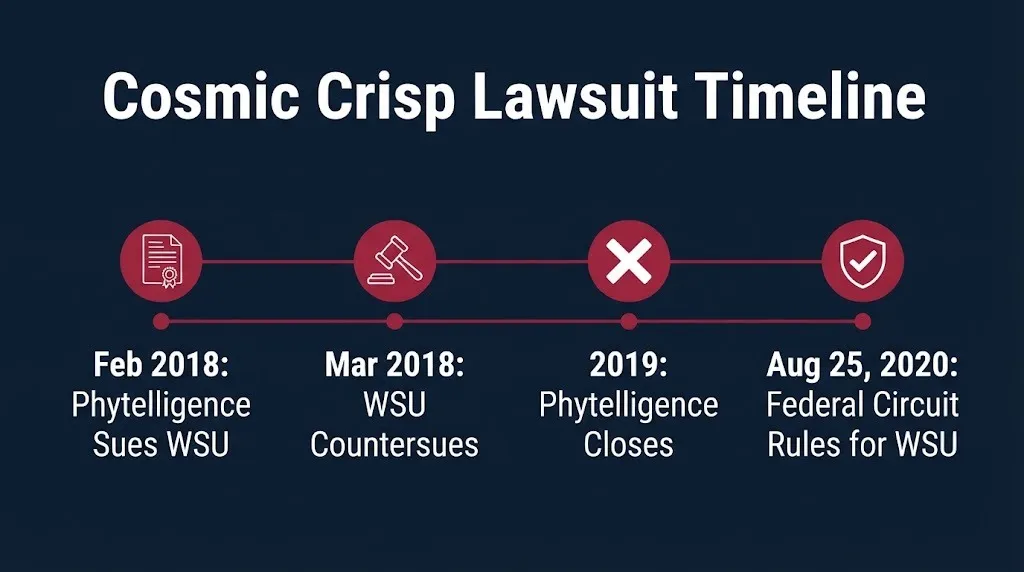
Phytelligence sued WSU first, filing in King County Superior Court on February 26, 2018. The company claimed its 2012 agreement with WSU granted it an option to obtain a commercial license to sell Cosmic Crisp trees, and that WSU wrongly blocked that path.
According to court filings, when Phytelligence tried to exercise that option in 2016, WSU directed the company instead toward the Northwest Nursery Improvement Institute, a licensing body it never joined. WSU had separately contracted Proprietary Variety Management in 2014 to handle Cosmic Crisp’s commercial licensing.
Key Takeaway: Phytelligence sued first, arguing WSU denied it a licensing path the company believed its contract guaranteed.
What Did WSU Claim Against Phytelligence?
WSU countersued Phytelligence on March 8, 2018, alleging the company sold roughly 135,000 WA 38 trees to Evans Fruit Company in April 2016 without ever obtaining the required commercial license. WSU filed a breach of contract claim in King County Superior Court and a separate patent and trademark infringement suit in the U.S. District Court for the Western District of Washington.
Phytelligence disputed the core factual claim, with then-CEO Ken Hunt stating the company never actually grafted the trees in question and that the deal with Evans Fruit was canceled and refunded. Evans Fruit’s president confirmed that account in press interviews at the time.
WSU also alleged Phytelligence violated Washington’s Consumer Protection Act through how it represented the university’s actions publicly, and sought to bar the company from using the Cosmic Crisp trademark.
Bold fact: WSU had terminated its propagation agreement with Phytelligence on January 16, 2018, weeks before either lawsuit was filed.
What Is the Angel’s Grafting and Nursery Lawsuit?
The Angel’s Grafting and Nursery lawsuit is a separate federal case filed by Proprietary Variety Management, WSU’s licensing partner, accusing a Tieton, Washington nursery of propagating and selling unlicensed Cosmic Crisp trees. The complaint was filed in the U.S. District Court for the Eastern District of Washington.
The lawsuit alleged Angel’s Grafting and Nursery propagated tens of thousands of WA 38 trees for multiple growers starting in 2016, without holding a license to do so. One grower reportedly destroyed his trees to avoid being pulled into the litigation.
This case confirms that Cosmic Crisp licensing disputes weren’t limited to the Phytelligence matter, since WSU’s licensing partners pursued at least one additional unlicensed-propagation case. We could not confirm a final court outcome for this specific case in current records.
Who Won the Cosmic Crisp Apple Lawsuit?
Washington State University won. A federal district court granted WSU summary judgment in 2019, and the U.S. Court of Appeals for the Federal Circuit affirmed that ruling on August 25, 2020.
The appellate panel found that Phytelligence violated propagation rules by shipping roughly 135,000 WA 38 trees without a license, and that the company’s contract never granted it an enforceable right to sell trees without WSU’s separate approval. The court called Phytelligence’s arguments on appeal “unpersuasive.”
Case outcome summary:
- District court: Ruled for WSU, dismissed Phytelligence’s breach of contract claims.
- Federal Circuit: Affirmed the district court, ruling for WSU on August 25, 2020.
- Attorney’s fees: A court separately declined to award WSU additional compensation for legal costs.
- Phytelligence: Ceased operations and filed for receivership in September 2019, before the appeal was even decided.
What’s the Latest Legal Status of Cosmic Crisp in 2026?
The core Cosmic Crisp apple lawsuit has been fully resolved since the Federal Circuit’s August 2020 ruling, and we found no new consumer-facing legal action tied to the case as of this update. WSU continues to control Cosmic Crisp’s patent and trademark rights.
Washington growers have since planted millions of WA 38 trees under the university’s licensing system, with production scaling into the millions of boxes annually in the years following the apple’s December 2019 retail launch. No new major litigation involving WSU and Cosmic Crisp licensing surfaced in our research for this update.
Key Takeaway: As of late 2026, the Cosmic Crisp legal saga is historical, not active, and it never involved a path for consumers to file a claim.
Who Owns the Cosmic Crisp Apple Patent and Trademark?
Washington State University owns both the plant patent and the trademark rights to Cosmic Crisp. The university holds U.S. Plant Patent No. 24,210 covering the WA 38 tree variety.
WSU licenses commercial production through Proprietary Variety Management, which in turn works with the Northwest Nursery Improvement Institute to supply licensed nurseries and growers. This licensing structure is exactly what both the Phytelligence and Angel’s Grafting cases fought over.
Washington state growers, who secured exclusive North American access to the variety for at least a decade after launch, have invested roughly half a billion dollars in Cosmic Crisp production based on that licensing structure.
Is Cosmic Crisp Apple Safe to Eat?
Yes, based on available evidence, there is no confirmed food safety issue, recall, or regulatory action tied to Cosmic Crisp apples. The litigation covered in this guide involved business licensing, not product safety.
Cosmic Crisp, developed as a cross between Honeycrisp and Enterprise apples, was designed for taste, crispness, and extended shelf life, and it launched to consumers in December 2019 after a heavily funded marketing campaign backed by Washington state agencies. Nothing in the court record we reviewed alleges a health risk to consumers.
That’s worth comparing to a simpler everyday situation: it’s a bit like hearing a company is “in litigation” and assuming a product recall, when the fight was actually over a supplier contract behind the scenes, invisible to anyone just buying the product off the shelf.
What Happens Next
Resolved, August 25, 2020: The Federal Circuit’s ruling closed out the core WSU v. Phytelligence litigation.
Resolved, 2019: Phytelligence ceased operations, removing the company from any further legal proceedings.
Status unconfirmed: The final outcome of the separate Angel’s Grafting and Nursery case was not independently confirmed in our research.
Ongoing, unrelated to litigation: WSU continues to manage Cosmic Crisp licensing through Proprietary Variety Management as the apple remains in commercial production.
Frequently Asked Questions
Is the Cosmic Crisp apple lawsuit real?
Yes, a real lawsuit exists, but it’s a corporate patent and licensing dispute, not a consumer case.
Washington State University sued former partner Phytelligence over unlicensed tree sales.
A federal appeals court ruled in WSU’s favor on August 25, 2020.
Can I file a claim in the Cosmic Crisp apple lawsuit?
No, there is no consumer claims process, because this was never a class action against apple buyers.
The lawsuit involved WSU, a licensing partner, and a now-closed agricultural technology company.
No settlement fund or payout has ever existed for consumers in this case.
Did Cosmic Crisp apples get recalled?
No, we found no confirmed recall or food safety action tied to Cosmic Crisp apples.
The lawsuit covered in this guide involved tree licensing rights, not product safety.
Treat any claim of a pesticide-related recall or lawsuit with skepticism unless a court record confirms it.
Who won the WSU Cosmic Crisp lawsuit?
Washington State University won the case against Phytelligence.
A federal district court ruled for WSU, and the Federal Circuit affirmed that ruling on August 25, 2020.
Phytelligence had already ceased operations by the time the appeal was decided.
What happened to Phytelligence after the lawsuit?
Phytelligence shut down operations and filed for receivership in September 2019.
This happened before the Federal Circuit issued its final ruling in WSU’s favor.
The company no longer exists as an operating business.
Is there a Cosmic Crisp apple settlement I should watch for?
No, there is no pending settlement, because the underlying litigation ended in a court ruling, not a settlement agreement.
No consumer claims process has ever been associated with this case.
Any message suggesting otherwise should be treated as unverified.
Why is a fruit lawsuit categorized under tech news?
Phytelligence was an agricultural technology startup using tissue culture propagation methods, which drew coverage from tech outlets like GeekWire.
The case involved patent and licensing disputes common to technology-sector litigation.
That’s why some publications, including this one, cover it alongside other tech-adjacent legal disputes.
Bottom Line
The Cosmic Crisp apple lawsuit is a closed corporate licensing fight, not a consumer case, and there’s no claim form waiting for you. If you’re a Cosmic Crisp shopper, there’s nothing to file and nothing to watch for.
The one date worth remembering is August 25, 2020, when the Federal Circuit affirmed Washington State University’s win, closing the book on the dispute that shaped how Cosmic Crisp trees reached orchards nationwide.