Environmental Litigation in 2026: What’s Real, What’s Pending, and What It Means for You
Quick Answer
- Environmental litigation is real and active in 2026, with major cases pending in federal courts across the country.
- Settlement amounts in environmental cases vary widely, from $150 million to $12.5 billion depending on the scope of claims.
- Key deadlines and court dates are case-specific; check individual settlement websites or court dockets for exact dates.
Environmental litigation refers to legal actions brought to enforce environmental laws, recover damages for pollution-related harms, or hold companies accountable for environmental contamination. In 2026, these cases span federal and state courts, involve government agencies, private citizens, and environmental organizations, and seek remedies ranging from monetary compensation to injunctive relief.
If you live near a contaminated site, work in an industry exposed to pollutants, or have been affected by environmental harms, these cases may affect your legal rights. Some settlements have already resulted in payments, while others remain in early procedural stages. The single most important thing to understand is that environmental litigation is not one case but many, each with its own timeline, eligibility rules, and outcomes.
This article breaks down what is currently active, what has settled, how you might qualify for compensation, and what deadlines matter. One surprising fact: the longest-running environmental case under the Resource Conservation and Recovery Act began in 2000 and did not end until a consent decree was entered years later, showing that these cases can outlast the people who file them.
The Facts
| Case | Multiple active cases (see sections below) |
|---|---|
| Status | Mixed: some settled, some pending, some at Supreme Court |
| Fund Size | Varies by case; largest recent PFAS settlement up to $12.5 billion |
| Est. Per Person | Case-dependent; one Peru settlement averaged about $109,000 per claimant |
| Claim Deadline | Case-specific; check individual settlement websites |
| Administrator | Varies by case; often appointed by the court |
| Proof Needed | Depends on case type; often documentation of exposure or residency |
Is Environmental Litigation Real or a Scam?
Environmental litigation is real and legitimate. These cases are filed in federal and state courts, assigned case numbers, and overseen by judges. The United States Supreme Court is currently reviewing one such case involving climate claims by Boulder County and the City of Boulder against Suncor Energy and ExxonMobil.
However, scams exist that use the language of environmental litigation to trick people. The legitimate process involves court filings, public dockets, and formal settlement administration. No one texts you saying you won money from an environmental lawsuit. No one asks for payment to file a claim on your behalf. If you receive unsolicited messages about environmental settlement money, treat them as suspect until you verify through the official court docket or settlement website.
The distinction matters because real environmental litigation has produced billions in actual payouts. In 2026 alone, Chemours, DuPont, and Corteva reached a $455 million settlement with North Carolina and local entities over PFAS contamination. That is a real settlement with real money moving through a formal process.
Key Takeaway: Environmental litigation is a legitimate legal process with verifiable court records, but always confirm any settlement opportunity through official court or agency sources before sharing personal information.
How Much Money Can You Get From Environmental Litigation?
How much you could receive depends entirely on which case you are part of and what type of harm you can document. There is no standard environmental litigation payout. Amounts range from thousands to hundreds of thousands of dollars per person, and some cases involve no direct payments to individuals at all.
For context, here is what different environmental cases have produced or proposed in recent years:
| Case Type | Settlement Amount | Per-Person Estimate | Status |
|---|---|---|---|
| PFAS contamination (NC) | $455 million | Not yet determined | Pending court approval |
| Peru metallurgical pollution | $150 million | About $109,000 average | Partially resolved |
| Bayer Roundup claims | Proposed settlement | $10,000 to $165,000 | Proposed, disputed |
| 3M PFAS drinking water | Up to $12.5 billion | Varies by water system | Final approval March 2024 |
The Bayer Roundup settlement proposal illustrates why you should not assume a headline number means a large check. Critics noted that the proposed deal would pay $675 million to lawyers while plaintiffs with cancer would receive an average of $10,000 to $165,000 each.
For the North Carolina PFAS settlement, payments will total $455 million over fifteen years, with Chemours covering half. The agreement still requires court approval and dismissal of the underlying lawsuits before it takes effect.
Reality Check: No one can promise you a specific settlement amount before a court approves a fund and a claims administrator calculates individual awards. If someone guarantees you a payout, that is a red flag. Filing a claim is always free.
Who May Qualify for Environmental Litigation Claims?
Who may qualify for environmental litigation claims depends on the specific case, but common eligibility factors include geographic proximity to a contamination site, documented exposure to a pollutant, or ownership of affected property. You generally must be able to show a connection between the defendant’s conduct and a harm you suffered.
For example, the Doe Run settlement in Peru covered more than 1,380 claims from residents of La Oroya who alleged health damages from a metallurgical complex. The settlement involved about one-third of the actions filed. In the Maine mercury case, the plaintiffs were environmental organizations suing under RCRA’s citizen suit provision, not individuals seeking personal injury damages.
If you are wondering whether you qualify for a specific environmental case, the answer starts with the case’s class definition or claim form requirements. Courts approve who is included and who is excluded. You cannot opt in to a case where you do not meet the definition.
Key Takeaway: Eligibility is determined by the court-approved class definition or claim criteria for each specific case, not by general environmental exposure alone.
How to File an Environmental Litigation Claim
How you file depends on whether the case is a class action settlement with an open claims process or an active lawsuit where you need your own attorney. For settled class actions, the process typically follows a standard claims administration procedure.
If you are part of a settlement class and want to file a claim, here are the general steps:
- Find the official settlement website or court-approved notice.
- Read the class definition to confirm you are included.
- Locate the claim form on the settlement website or request one by mail.
- Gather documentation proving your eligibility (residency, property ownership, medical records if applicable).
- Complete the claim form accurately and legibly.
- Submit by the claims deadline, usually by mail or online.
- Keep a copy of everything you submit.
- Wait for the claims administrator to process and verify your submission.
The Monsanto PCB settlement provides an example of how these processes work. Class members received checks based on an allocation method developed by counsel and approved by the court. Opt-outs had to be postmarked by a specific date and mailed to the settlement administrator.
Reality Check: Filing a claim is free. Third-party services that charge fees to “help” you file are unnecessary. The settlement administrator is the only entity that processes claims.
Chemours, DuPont, and Corteva PFAS Settlement 2026
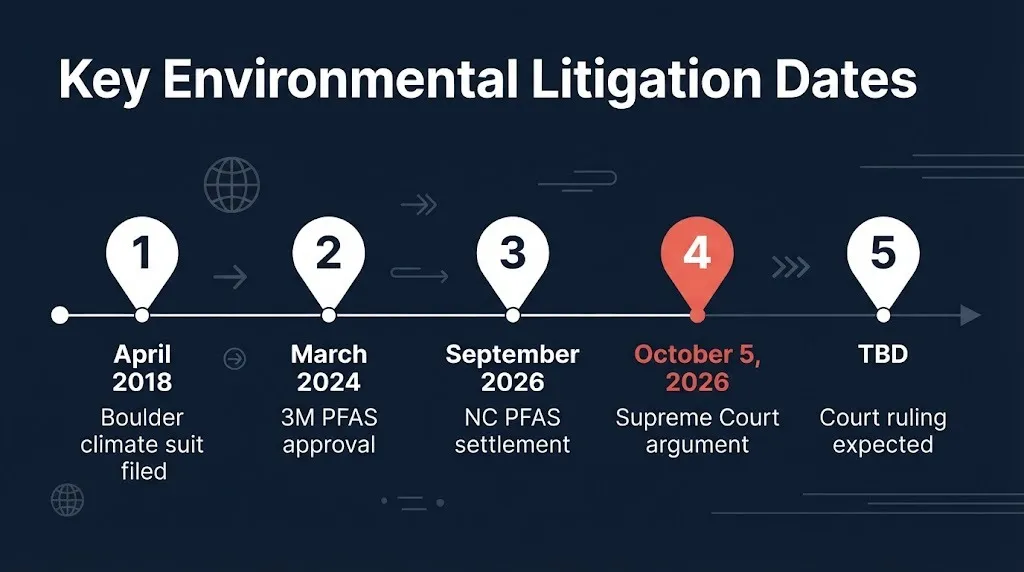
The Chemours, DuPont, and Corteva PFAS settlement is a $455 million agreement reached in September 2026 with North Carolina and eleven local entities over contamination tied to the Fayetteville Works plant and other historical discharges.
Payments will be made over fifteen years, beginning within 30 days of the agreement’s execution. Under a 2021 cost-sharing arrangement, Chemours bears 50% of the settlement cost, while DuPont and Corteva split the remainder. The settlement covers site-specific discharges and statewide firefighting foam contamination, closing gaps left by earlier national PFAS settlements.
The eleven local entities involved include Bladen, Brunswick, Columbus, Cumberland, New Hanover, Robeson, and Sampson counties, along with the City of Lumberton, Town of Wrightsville Beach, Village of Bald Head Island, and the Lower Cape Fear Water and Sewer Authority. These entities had been excluded from the 2024 US Public Water System Class Settlement.
The agreement still requires court approval and dismissal of the underlying lawsuits before it takes effect. Personal injury claims and natural resource damage claims from other states remain largely outside every PFAS settlement reached so far.
Key Takeaway: The North Carolina PFAS settlement is significant but limited in scope, covering government entities rather than individual personal injury claims, and still requires court approval.
Boulder Climate Case at the Supreme Court
The Boulder climate case is a lawsuit filed by Boulder County and the City of Boulder against Suncor Energy and ExxonMobil, originally filed in April 2018, seeking to hold the companies responsible for climate-related harms. The Supreme Court is hearing oral argument on October 5, 2026.
The case has survived repeated attempts by the companies to move it to federal court or dismiss it. In May 2025, the Colorado Supreme Court concluded that federal law did not preempt Boulder’s claims and that they could proceed under state law. The companies then petitioned the U.S. Supreme Court, which granted review but also directed the parties to brief whether the Court has jurisdiction to hear the case at all.
The lawsuit seeks to make fossil fuel companies pay what Boulder characterizes as their fair share of climate-driven harms. It is not about regulating emissions or stopping fossil fuel production. The plaintiffs argue that Colorado is already experiencing extreme heat, wildfires, drought, and poor air quality, all of which create significant public costs.
The Department of Justice took the unusual step of filing an unsolicited brief supporting Suncor’s petition, despite having opposed a similar petition in a different climate case during a previous administration. The Supreme Court’s decision could affect dozens of similar state-law climate tort suits pending across the country.
Key Takeaway: The Boulder case is the most closely watched environmental litigation of 2026 because its outcome could determine whether state-law climate claims can proceed nationwide.
What Happens Next in Environmental Litigation
The next stages in major environmental cases depend on court rulings and settlement approvals. Here is the expected timeline for the most significant active matters:
October 5, 2026: Supreme Court oral argument in the Boulder climate case against Suncor and ExxonMobil.
Late 2026 or early 2027: Supreme Court decision in the Boulder case, expected after briefing and argument.
Pending: Court approval of the $455 million North Carolina PFAS settlement; dismissal of underlying lawsuits required before it takes effect.
Ongoing: Claims administration for previously approved settlements, including the 3M PFAS drinking water settlement.
TBD: Any new settlements or court rulings in other pending environmental cases; check official court dockets for updates.
Frequently Asked Questions
What is environmental litigation?
Environmental litigation means legal action to enforce environmental laws or recover damages for pollution-related harm. It includes citizen suits, government enforcement actions, and class actions against companies accused of contamination.
Is environmental litigation the same as a class action?
No, environmental litigation can take several forms. Some cases are class actions, where one lawsuit represents many affected people. Others are citizen suits brought by organizations under laws like the Clean Water Act or RCRA. Government agencies can also sue directly.
How do I know if I am part of an environmental settlement?
You know you are part of a settlement class if you receive official notice by mail or if a court-approved notice is published. You can also check the official settlement website for the case. If you are not sure, contact the settlement administrator listed in court documents.
Do I need a lawyer to file an environmental claim?
For most class action settlements, you do not need a lawyer to file a claim. The claims administrator handles the process. If you are filing your own lawsuit for personal injuries, you should consult an attorney licensed in your jurisdiction.
What is a settlement administrator?
A settlement administrator is the entity appointed by the court to handle notices, claim forms, and payments in a class action settlement. They are independent of the parties and report to the court.
Can I still file a claim if I missed the deadline?
If you missed the claims deadline, you generally cannot file a late claim unless the court grants an extension. Check the official settlement website for any updates on deadlines or reopenings.
What is the difference between a settlement and a judgment?
A settlement is an agreement between parties to resolve a case, usually with court approval. A judgment is a court’s final decision after trial. Settlements often involve payments or other remedies, while judgments can include damages and injunctions.
How long does environmental litigation take?
Environmental litigation can take years, sometimes decades. One RCRA case filed in 2000 was still active years later, illustrating the long timeline these cases often follow. Settlement approval and claims processing add additional time.
What You Should Do Now
If you believe you may be affected by an environmental case, start by finding the official court docket or settlement website. Do not rely on social media posts or unsolicited messages. Court documents are public and will tell you who is covered, what deadlines apply, and how to file a claim.
Calendar the claims deadline if one applies to you. Gather any documentation that shows your connection to the case, whether that is proof of residency, property records, or medical records. The single most important date is the one that applies to your specific situation, so verify it directly through the court or administrator before taking any action.