Adobe Lawsuit in 2026: Settlement Status, Free Months, and What Users Can Actually Claim
Quick Answer
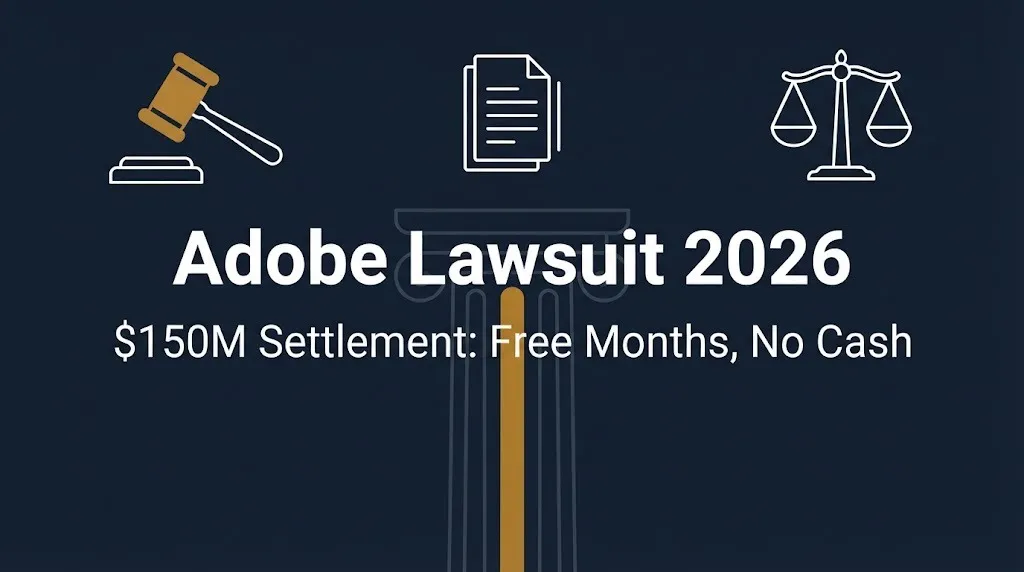
- Adobe settled the DOJ’s hidden cancellation fee case in March 2026 for a total package valued at $150 million.
- Affected users get two free months of Adobe service, not a cash refund, with activation available until December 31, 2027.
- Eligibility covers US users who paid early termination fees on Creative Cloud between January 2019 and July 2025.
The Adobe lawsuit refers to a federal enforcement action filed by the Department of Justice and Federal Trade Commission in June 2024 over hidden subscription cancellation fees . Adobe settled in March 2026 without admitting wrongdoing. If you paid an early termination fee to cancel an Adobe subscription, you may qualify for two free months of service. That is not a cash payment, and that distinction has frustrated many users.
Adobe’s subscription practices affected millions of Creative Cloud customers. The most important fact is that the settlement does not include cash refunds. The $75 million penalty goes to the government, and the $75 million in “free services” comes as two-month credits or access codes. The deadline to activate those benefits for former users is December 31, 2027 .
This article breaks down what the settlement covers, who qualifies for the free service benefit, how Adobe’s cancellation process worked, and what separate class actions are still active. One surprising detail: Adobe’s own Terms of Use required users to opt out of arbitration within 30 days of signing up, a deadline almost no one meets .
The Facts
| Case | US v. Adobe Inc. (DOJ/ FTC enforcement action) |
|---|---|
| Status | Settled March 2026; court approval pending |
| Fund Size | $75 million civil penalty + $75 million in free services |
| Est. Per Person | Two free months of Adobe service (no cash) |
| Claim Deadline | Former users must activate by December 31, 2027 |
| Administrator | Adobe (proactive outreach to eligible users) |
| Proof Needed | Adobe account history showing early termination fee payment |
Is the Adobe Lawsuit Real or a Scam?
The Adobe lawsuit is real, and the settlement is confirmed by the Department of Justice, Adobe’s own press release, and major news outlets . The case was filed in the U.S. District Court for the Northern District of California and resolved through a proposed stipulated order in March 2026.
However, scams often use high-profile settlements to trick people. No one will text you saying you have unclaimed Adobe settlement money. No one will ask for payment to release your free months. Adobe is handling outreach directly and automatically. If you were an active subscriber, the credit appears in your billing settings within 72 hours of the email .
For former users, Adobe sends a link to claim two months of free access to a single app. The list includes Photoshop, Illustrator, Acrobat Studio, and Premiere Pro. You do not need to provide a credit card to activate that benefit, and access expires after two months unless you choose to subscribe .
The separate private class actions are also legitimate. Cases like Lyon v. Adobe Inc. and Foret v. Adobe Inc. are pending in federal court, but they have not produced settlements or payouts .
Key Takeaway: The DOJ settlement is legitimate and confirmed, but it provides free service credits rather than cash, and Adobe handles outreach automatically without requiring payment from you.
How Much Money Can You Get From the Adobe Settlement?
The Adobe settlement pays nothing in cash to affected users. The $75 million civil penalty goes to the U.S. Treasury. The $75 million in “free services” is delivered as two free months of Adobe access, either as an automatic account credit for current subscribers or as a claim link for former users .
Here is what the settlement actually provides:
| Settlement Component | Amount | Recipient |
|---|---|---|
| Civil penalty | $75 million | U.S. Department of Justice |
| Free services fund | $75 million | Eligible Adobe customers |
| Per-person benefit | Two free months | Individual users |
For a current subscriber paying $59.99 per month for Creative Cloud, two free months represents about $120 in value . For a former user who claims two months of a single app like Photoshop, the value is roughly $43 based on current single-app pricing.
The math matters because some settlement aggregator sites have claimed individual payouts could reach $500 or more . That is not accurate for this DOJ settlement. No cash claim process exists. The private class actions could theoretically produce different outcomes, but they remain in early litigation stages with no settlement fund and no claim deadline .
Reality Check: No one is sending you a check from the Adobe DOJ settlement. The benefit is two free months of service. If a website tells you to pay a fee to claim Adobe settlement cash, that is a scam. Filing anything related to this settlement costs nothing.
Who Qualifies for Adobe’s Free Months?
You qualify for Adobe’s free service benefit if you had a Creative Cloud subscription between January 2019 and July 2025 and paid an early termination fee during that window . The fee must have been higher than the cost of a standard month-to-month plan to qualify.
The eligibility rules break down into two groups:
- Current subscribers: Two free months are applied automatically to your account. No action required beyond checking your billing settings.
- Former subscribers: You receive an email with a link to claim two months of free access to a single Adobe app. You must activate by December 31, 2027.
The DOJ order also applies to anyone who was “prevented from canceling” due to Adobe’s practices, though Adobe’s outreach focuses on users who actually paid the fee .
If you believe you paid an early termination fee but never received an email, check the address associated with your Adobe account. Adobe said it will “proactively reach out to the affected customers once the appropriate filings with the Court are made and accepted” . Court approval of the stipulated order is the trigger for full outreach.
How Do I Claim My Adobe Free Months?
You claim your free months by responding to Adobe’s email or checking your account settings. There is no external claims website, no form to download, and no fee to pay.
For active subscribers, the process is automatic:
- Watch for an email from Adobe confirming your eligibility.
- Check your billing settings within 72 hours of the email.
- Verify that two free months appear as a credit.
- Confirm the credit applies before your next renewal date.
For former subscribers, the process requires one action:
- Find the email from Adobe with the claim link.
- Click through to the offer page.
- Select one app from the eligible list (Photoshop, Illustrator, Acrobat Studio, or Premiere Pro).
- Activate the two free months without entering payment information.
- Use the access before it expires, since the benefit does not roll over.
The deadline for former users is December 31, 2027 . There is no deadline pressure for current subscribers because the credit applies automatically to their accounts.
Key Takeaway: The claim process is simple and free, handled directly by Adobe through email and account credits, with a December 31, 2027 activation deadline for former users.
What Did Adobe Actually Do Wrong?
Adobe was accused of violating the Restore Online Shoppers’ Confidence Act (ROSCA) by hiding early termination fees and making cancellation deliberately difficult . ROSCA requires companies to clearly disclose material subscription terms and provide a simple way to cancel.
The government’s complaint alleged three core problems. First, Adobe used fine print and inconspicuous hyperlinks to hide the existence and amount of early termination fees. Second, the fees themselves were substantial: 50% of remaining payments on annual plans, which could reach hundreds of dollars . Third, Adobe forced subscribers through “convoluted and inefficient cancellation processes filled with unnecessary steps, delays, unsolicited offers, and warnings” .
The DOJ’s statement was blunt: “Consumers should not have to navigate a digital maze to cancel a subscription” . U.S. Attorney Craig Missakian said the government would “continue to hold responsible any company that uses deceptive business practices” .
Adobe denied wrongdoing throughout. The company stated: “We have always prioritized giving our customers the flexibility to choose the plan that best fits their needs” and said it had “streamlined and increased transparency” in sign-up and cancellation processes . The settlement resolved claims against Adobe and two executives, Maninder Sawhney and David Wadhwani, without admissions of liability .
Going forward, Adobe must clearly disclose early termination fees, send reminders before free trials convert to paid plans, and provide simple cancellation methods .
What Other Adobe Lawsuits Are Still Active?
Several private class actions against Adobe remain active in federal court, separate from the DOJ settlement. These cases involve different legal theories and have not produced any settlement fund or payout.
The Lyon v. Adobe Inc. case, filed in the Northern District of California, alleges copyright infringement related to Adobe’s AI training. Plaintiffs claim Adobe downloaded and used copyrighted books in the SlimPajama dataset to train its SlimLM models without authorization . Adobe filed its answer in May 2026, denying the allegations .
A separate privacy class action challenges Adobe’s Experience Cloud Identity (ECID) tracking technology. Plaintiffs allege Adobe tracked users across websites and mobile apps without consent to create detailed profiles and sell targeted ads . Adobe moved to dismiss in February 2026, arguing plaintiffs failed to allege lack of consent or actual harm .
Another case, Foret v. Adobe Inc., challenges Adobe’s subscription renewal practices under California’s Automatic Renewal Law. The court allowed some class claims to proceed in September 2026, finding that Adobe’s one-year contractual limitation period and arbitration clause did not automatically bar the case .
None of these cases have reached settlement. If any settle in the future, a new claims process would be established with its own deadlines and eligibility rules.
Key Takeaway: Separate private class actions against Adobe over copyright, privacy, and renewal practices remain active but have produced no settlement money, and any future payouts would come through new claim processes.
Why Is Adobe Being Sued Over AI Training?
Adobe faces copyright class action claims over its use of the SlimPajama dataset to train small language models. The lawsuit alleges Adobe downloaded, copied, and used copyrighted books without permission .
The technical details matter here. Plaintiffs claim Adobe’s SlimLM models, optimized for document assistance on mobile devices, were pre-trained using SlimPajama, which contains millions of text samples . The complaint states Adobe “downloaded, copied, stored, optimized and used copies of the SlimPajama dataset which included Plaintiffs’ copyrighted works” .
Adobe does not dispute that SlimPajama was used to pre-train the SlimLM models. The company’s answer admits that “SlimPajama was used to pre-train SlimLM models” but denies the remaining allegations . The legal question is whether that use constitutes fair use or infringement.
This case is separate from the DOJ settlement and the subscription litigation. It is also separate from Adobe’s public statements about its Firefly AI model, which Adobe claims is trained on licensed and public domain content. The SlimLM research project is distinct from the commercially released Firefly product.
No trial date has been set. The case is in early discovery and class certification stages, with deadlines extending into 2027 and 2028 .
What Happens Next in the Adobe Litigation
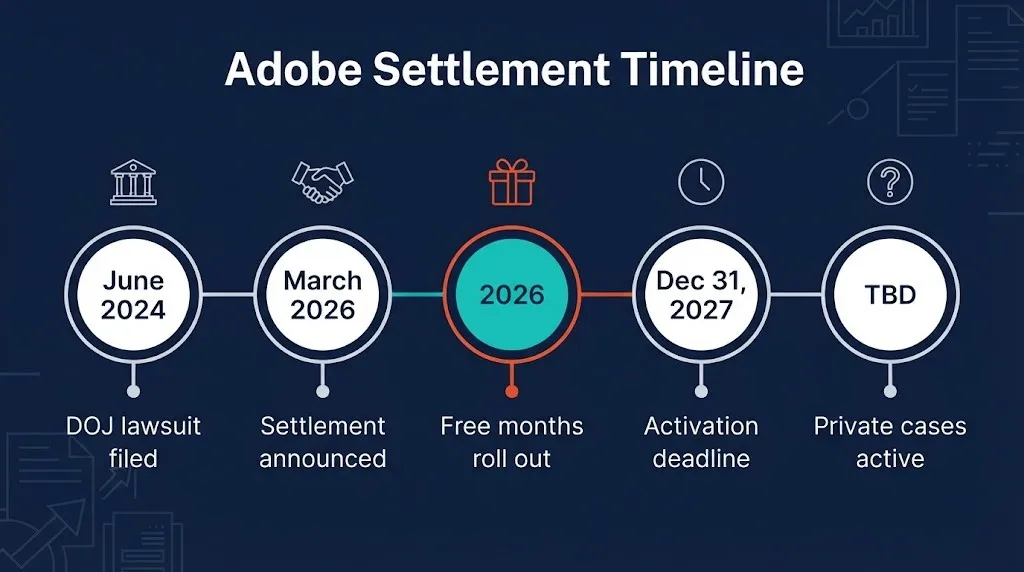
The next stages depend on court approval and ongoing private litigation. Here is the expected timeline:
Pending: Court approval of the DOJ stipulated order, which triggers full outreach to eligible customers.
Ongoing: Adobe sends emails to affected users about free service credits; former users have until December 31, 2027, to activate.
Expected 2027: Class certification briefing in Lyon v. Adobe and other pending cases.
Expected 2027-2028: Summary judgment and potential trial in copyright and privacy cases.
TBD: Any settlement in private class actions; no claims process exists for those cases yet.
Frequently Asked Questions
Is the Adobe settlement real?
Yes, the DOJ announced the settlement in March 2026, and Adobe confirmed it. The court must still approve the stipulated order.
How much money will I get from the Adobe settlement?
Nothing in cash. The benefit is two free months of Adobe service, delivered as an account credit or claim link.
How do I claim my free Adobe months?
Current subscribers get automatic credits. Former subscribers must use the link in Adobe’s email and activate by December 31, 2027.
Who qualifies for the Adobe free months?
US users who had Creative Cloud between January 2019 and July 2025 and paid an early termination fee that was higher than a month-to-month plan.
Did Adobe admit wrongdoing?
No. Adobe denied the government’s claims and settled without admitting liability.
What is the deadline for the Adobe settlement benefit?
Former users must activate their two free months by December 31, 2027. There is no cash claim deadline because no cash is offered.
Are there other Adobe lawsuits?
Yes. Private class actions over AI training data, privacy tracking, and renewal practices remain active with no settlements yet.
What happens if I don’t claim the free months?
If you are a former user and do not activate by December 31, 2027, the benefit expires and you receive nothing.
What You Should Do Now
Check the email address associated with your Adobe account for a message about the settlement. If you are a current subscriber, verify that two free months appear as a credit in your billing settings within 72 hours of that email.
If you are a former subscriber who paid an early termination fee, find the claim link and activate your two free months before December 31, 2027. Do not pay anyone to help you claim this benefit. Adobe handles it directly at no cost.