Emotional Pain and Suffering Settlement in 2026: How Much You Can Expect and What Proves Your Claim
Quick Answer
- Emotional pain and suffering settlements compensate for mental anguish, not just physical injury, and amounts vary by severity and documentation.
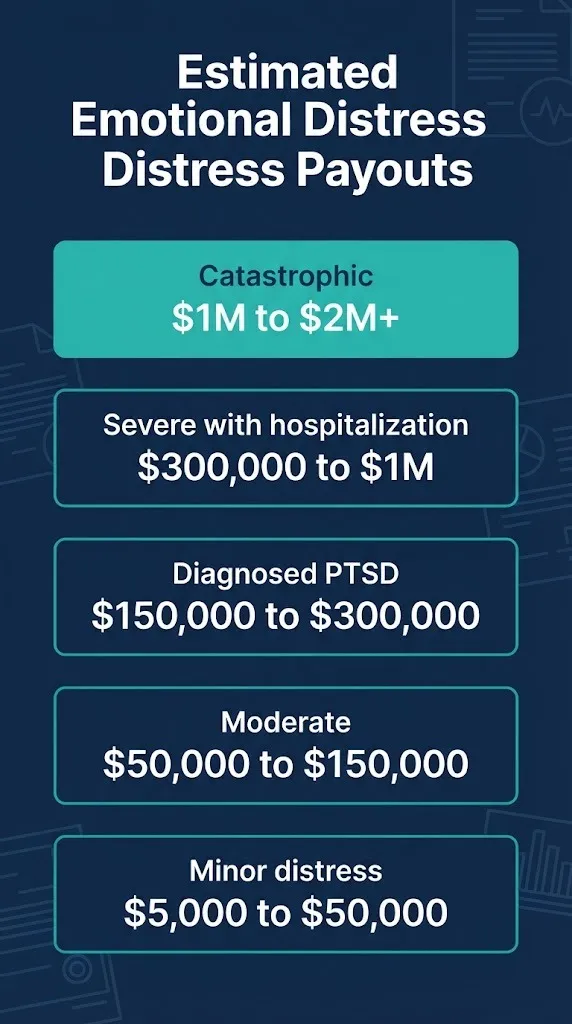
- Typical ranges run from $5,000 to $50,000 for minor distress, $50,000 to $300,000 for diagnosed PTSD with treatment, and higher for severe cases.
- A documented diagnosis from a licensed mental health professional is the single strongest factor in increasing your settlement value.
Emotional pain and suffering settlement amounts depend on how well you can document the psychological harm you suffered. A person with a formal PTSD diagnosis and a year of therapy records may recover ten times more than someone with the same accident but only self-reported anxiety. The gap isn’t about the severity of what happened. It’s about what a jury or adjuster can see in the file.
If you were injured in an accident, experienced harassment, or witnessed something traumatic, you may be entitled to compensation beyond your medical bills. The most important number to understand is the multiplier applied to your economic damages. That factor typically ranges from 1.5x for minor cases to 10x or higher for catastrophic ones.
This article breaks down what emotional distress settlements actually pay, how the multiplier method works, what documentation moves the number up, and what deadlines apply. One surprising fact: a California appellate court ruled in July 2026 that “garden-variety” emotional distress has no numerical cap, reinstating a $13.1 million jury verdict.
The Facts
| Case | Personal injury, employment, and civil rights claims |
|---|---|
| Status | Active; settlements and verdicts occurring nationwide |
| Fund Size | Not applicable (case-by-case compensation) |
| Est. Per Person | $5,000 to $2M+, depending on severity and documentation |
| Claim Deadline | 2 years typical for personal injury; 6 months for government defendants |
| Administrator | Not applicable; negotiated with insurers or awarded at trial |
| Proof Needed | Medical records, diagnosis, treatment history, witness statements |
What Is an Emotional Pain and Suffering Settlement?
An emotional pain and suffering settlement is money paid to compensate you for the psychological impact of an injury or wrongful act. It covers anxiety, depression, PTSD, humiliation, sleep disruption, and loss of enjoyment of life. It is separate from your medical bills and lost wages, though those economic damages help calculate the total.
Courts and insurers divide damages into two buckets. Economic damages are objective: doctor bills, therapy costs, prescription receipts, pay stubs showing missed work. Non-economic damages are subjective: how the injury made you feel, how it changed your daily life, how it affected your relationships.
Emotional distress falls into the non-economic bucket. Because it has no receipt, insurers and defense attorneys fight harder against it. That’s why documentation matters more here than anywhere else in a personal injury case. A treating therapist’s records are the closest thing you have to a receipt for invisible harm.
Key Takeaway: Emotional pain and suffering settlements compensate the psychological toll of an injury, and because these damages are subjective, documentation from treating professionals carries enormous weight.
How Much Is an Emotional Distress Settlement Worth?
Emotional distress settlements typically range from $5,000 to $50,000 for minor cases without lasting impairment, $50,000 to $300,000 for diagnosed PTSD with ongoing treatment, and $300,000 to $2 million or more for severe cases involving hospitalization or suicide attempts . The exact number depends on severity, documentation, jurisdiction, and whether the case settles or goes to trial.
Here is a breakdown by case type based on recent settlement data:
| Case Scenario | Economic Damages | Multiplier | Non-Economic Estimate |
|---|---|---|---|
| Driving anxiety, minor whiplash | $12,500 | 2.5x | $31,000 |
| Diagnosed PTSD with back injury | $66,000 | 4x-6x | $90,000+ |
| Severe PTSD preventing work | $110,000 | 5x-7x | $350,000-$550,000 |
| PTSD with catastrophic injury | $1M+ | 7x-10x+ | $6M non-economic |
A Texas example shows how the math works in practice. A rear-end collision with whiplash and four months of driving anxiety produced $12,500 in economic damages. Applying a 2.5x multiplier for the emotional component added $31,000, for a total settlement range of $30,000 to $55,000 .
At the other end, a Los Angeles pedestrian struck by a vehicle suffered a partial foot amputation and severe PTSD. The case resolved with a stipulated verdict of $7 million, including $6 million in non-economic damages .
Reality Check: No calculator can tell you what your case is worth. The multiplier method gives a framework, not a guarantee. Adjusters and juries apply it differently, and jurisdiction matters enormously. A Cook County, Illinois case is worth more than the same facts in a conservative rural county.
What Is the Multiplier Method for Pain and Suffering?
The multiplier method estimates non-economic damages by multiplying your total economic damages by a factor between 1.5 and 10. The factor reflects injury severity, treatment duration, and how clearly the harm is documented.
Here is the standard severity table:
| Severity Level | Multiplier Range | Typical Cases |
|---|---|---|
| Minor | 1.5x to 2.5x | Whiplash, soft tissue, full recovery in weeks |
| Moderate | 2.5x to 4x | Single fractures, persistent pain, concussion |
| Significant | 4x to 5x | Surgical fractures, herniated discs, scarring |
| Severe | 5x to 7x | Multiple fractures, mild TBI, partial disability |
| Catastrophic | 7x to 10x+ | Severe TBI, spinal cord injury, amputation |
A PTSD diagnosis from a licensed psychologist typically supports a 4x to 6x multiplier on economic damages, according to the same framework . Without formal diagnosis, awards rarely exceed the medical bills themselves .
The multiplier is a negotiation tool, not a formula. Defense adjusters start lower and push you to justify every point. Your attorney uses treatment records, witness statements, and your own testimony to argue for the higher end of the range.
What Documentation Proves Emotional Distress?
The documentation that proves emotional distress includes treating therapist or psychiatrist records with DSM-5 diagnoses, prescription history for psychiatric medications, lost work documentation, testimony from family or coworkers, and standardized assessment tools like PCL-5 for PTSD or PHQ-9 for depression .
Here is what to gather and why each piece matters:
- Treatment records with a DSM-5 diagnosis. A licensed professional’s formal diagnosis carries more weight than your own description of symptoms.
- Prescription history. Medication for anxiety, depression, or sleep confirms the severity and duration of your distress.
- Lost work documentation. If distress impaired your ability to work, pay stubs and employer statements quantify the impact.
- Witness statements. Family and coworkers can describe changes they observed in your mood, behavior, and daily function.
- Standardized assessments. PCL-5, PHQ-9, and similar tools provide objective scores that track severity over time.
A California appellate court ruling in July 2026 reinforced that even “garden-variety” distress, meaning distress within ordinary jurors’ experience, can support large awards without expert testimony . In Glick v. City of Los Angeles, the court reinstated a $13.1 million verdict after a trial judge had cut it by 97% . The appellate court held that there is no numerical cap on emotional distress damages and that lay testimony alone can support an eight-figure award when the harm is within common experience .
That ruling doesn’t mean you should skip treatment. It means your own testimony about humiliation, sleepless nights, and strain on your marriage has value, especially when combined with other evidence.
Key Takeaway: A formal diagnosis and treatment records are the strongest proof of emotional distress, but your own testimony and witness observations can also support substantial awards, even without expert testimony.
How Do You File an Emotional Distress Claim?
You file an emotional distress claim by submitting a demand to the at-fault party’s insurer or by filing a lawsuit in civil court. Most cases settle through negotiation before trial, but the threat of litigation drives the settlement value.
Here are the steps:
- Get medical and mental health treatment. A gap in treatment hurts your claim.
- Gather all records. Medical bills, therapy notes, prescriptions, and pay stubs.
- Document your symptoms. Keep a journal of sleep disruption, anxiety attacks, and limits on daily activities.
- Collect witness statements. Family, friends, and coworkers who observed changes.
- Send a demand letter. Your attorney presents the evidence and a settlement figure to the insurer.
- Negotiate. Most insurers counter low; your attorney uses the records to push back.
- File suit if needed. If negotiation stalls, a complaint is filed in civil court.
- Prepare for trial. Even if you settle, trial preparation strengthens your position.
The statute of limitations for emotional distress tied to personal injury is typically two years from the date of the incident in many states, including California under Code of Civil Procedure §335.1 . For employment-based emotional distress under FEHA, you must file an administrative complaint with the Civil Rights Department and obtain a right-to-sue notice before going to court . Claims against government entities require an administrative tort claim within six months .
What Factors Increase or Decrease Settlement Value?
The factors that increase emotional distress settlement value include a formal diagnosis, ongoing treatment, documented work impairment, egregious defendant conduct, and a plaintiff-friendly jurisdiction. Factors that decrease value include gaps in treatment, pre-existing conditions, weak causation evidence, and conservative venues.
Here is how these factors play out:
Increase value:
- DSM-5 diagnosis from a psychiatrist or psychologist
- Consistent treatment over months or years
- Medication prescribed for anxiety, depression, or sleep
- Lost wages or reduced earning capacity
- Witnesses who confirm behavioral changes
- Defendant’s conduct was intentional or reckless
Decrease value:
- No formal diagnosis
- Long gaps between treatment visits
- Pre-existing mental health conditions
- No lost work or income impact
- Conservative venue with defense-friendly juries
- Weak evidence linking the event to your symptoms
The Glick case shows how much venue and judicial philosophy matter. The trial judge thought $13.1 million was “absurd” for garden-variety distress and slashed it to $375,000. The appellate court disagreed and reinstated the full verdict . Two courts, same facts, radically different outcomes.
How Long Does an Emotional Distress Settlement Take?
Emotional distress settlements typically take 6 to 24 months to resolve, depending on complexity and whether litigation is required. Simple cases with clear liability and well-documented distress may settle in 6 to 12 months. Complex cases involving disputed liability or severe trauma often take 12 to 24 months or longer .
The timeline breaks into phases. Pre-suit negotiation can resolve a case in months if the insurer accepts liability and the records are clear. If the insurer disputes liability or the damages are large, your attorney files suit. Litigation adds discovery, depositions, expert reports, and court scheduling. Trial adds more time.
Most cases still settle. Insurers dislike the uncertainty of a jury, especially in venues known for large emotional distress awards. Your attorney’s willingness to prepare for trial often determines how quickly the insurer makes a serious offer.
What Are the Common Mistakes That Hurt Emotional Distress Claims?
The most common mistakes that hurt emotional distress claims are skipping treatment, exaggerating symptoms, hiding pre-existing conditions, and failing to document the impact on daily life. Each one gives the defense a reason to discount or deny your claim.
Skipping treatment is the biggest problem. If you say you suffer from anxiety but never saw a therapist, the insurer will argue your distress isn’t severe enough to warrant compensation. A gap of months between the incident and your first appointment suggests the event didn’t cause the harm.
Exaggerating symptoms backfires when the defense requests your social media. Photos of you hiking, dancing, or traveling undercut claims that you can’t leave the house. Keep your profiles private and assume anything you post could end up in front of a jury.
Hiding pre-existing conditions is worse than having them. If you treated for anxiety before the accident, the defense will find out. Disclose it upfront and let your attorney argue that the incident worsened a manageable condition into something unmanageable.
Failing to document daily life leaves money on the table. A journal recording sleep disruption, panic attacks, and activities you’ve given up creates a record the adjuster can’t dismiss as vague.
What Happens Next in Your Emotional Distress Claim
The next stages depend on whether you’re in pre-suit negotiation or litigation. Here is the typical timeline:
Immediate: Seek treatment and document symptoms. Start a journal today.
Weeks 1-4: Gather medical records, therapy notes, and witness statements. Your attorney sends a demand letter.
Months 1-6: Negotiation with the insurer. Most cases settle here if liability is clear.
Months 6-18: If negotiation fails, your attorney files suit and discovery begins.
Months 18-24+: Trial preparation and possible trial if no settlement is reached.
Settlement: Payment typically arrives within 30 to 60 days after agreement.
Frequently Asked Questions
How much can I get for emotional pain and suffering?
Typical settlements range from $5,000 for minor distress to $300,000 or more for diagnosed PTSD. Severe cases with hospitalization can exceed $1 million.
What is the multiplier method for pain and suffering?
The multiplier method multiplies your economic damages by 1.5x to 10x depending on injury severity. A 4x multiplier on $50,000 in bills equals $200,000 in non-economic damages.
Do I need a diagnosis to claim emotional distress?
A formal diagnosis from a licensed mental health professional dramatically increases your settlement value. Without one, awards rarely exceed your medical bills.
How long do I have to file an emotional distress claim?
Most personal injury claims have a 2-year statute of limitations. Employment claims may have different deadlines, and government claims require notice within 6 months.
Can I claim emotional distress without physical injury?
It depends on your state. Most states require a physical impact or proximity to danger for negligent infliction. Intentional infliction claims can proceed without physical injury if the conduct was extreme.
What if I had anxiety before the accident?
Pre-existing conditions don’t bar your claim. You can recover for the worsening of a prior condition, but you must disclose it and let your attorney argue causation.
How much does an emotional distress lawyer cost?
Most work on contingency, taking 33% to 40% of the recovery. You pay nothing upfront.
Will my case go to trial?
Most emotional distress cases settle. But preparation for trial is often what forces a fair settlement.
What You Should Do Now
If you’re experiencing emotional distress from an injury or wrongful act, start treatment now. Every week without documentation makes your claim harder to prove. Keep a daily journal of symptoms, sleep problems, and activities you’ve had to give up.
Gather your medical records and any witness statements. Contact a personal injury attorney who handles emotional distress claims in your state. Most offer free consultations. The single most important step is creating a paper trail that shows the harm is real, ongoing, and connected to what happened to you.