Medical Device Lawsuit 2026: How Cases Work, Verdicts, Deadlines
Quick Answer
- Most medical device lawsuits are individual injury claims coordinated in federal MDLs, not class actions.
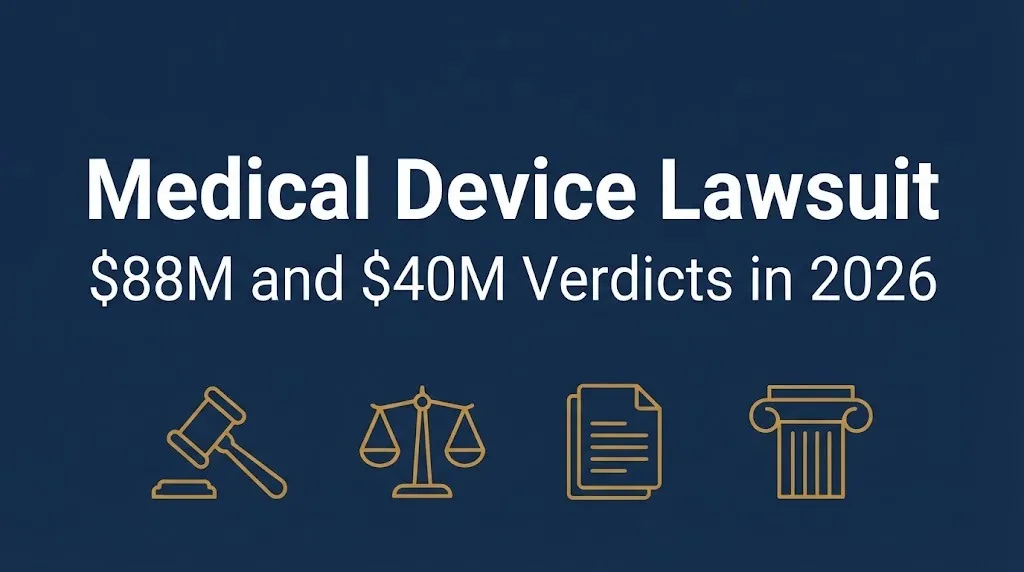
- Per-person payouts aren’t set. 2026 verdicts reached $88 million (hernia mesh) and $40 million (port catheter).
- Filing deadlines vary by state, ranging from one to six years, so check yours promptly.
A medical device lawsuit is a product liability claim against a device maker. Most are individual cases grouped in federal MDLs, not class actions.
It affects patients with implants, ports, filters, mesh, and recalled machines. Filing deadlines run from one to six years, depending on your state.
This guide covers how these cases work, what 2026 verdicts show, and what to check first. One surprise: Medtronic’s own SEC filing says its $88 million verdict could be overturned.
The Facts
| Case | Medical device product liability litigation (individual suits, mostly federal MDLs, no single case) |
| Status | Active. Multiple MDLs pending per the JPML report dated October 1, 2026 |
| Fund Size | None for device litigation overall. Check each device’s docket |
| Est. Per Person | Not yet determined. Depends on injury, device, and state |
| Claim Deadline | Varies by state, from one to six years |
| Administrator | None unless a specific settlement names one |
| Proof Needed | Device identification, medical records, proof of injury |
Is a medical device lawsuit a class action?
Most medical device lawsuits aren’t class actions. They’re individual injury cases grouped in federal multidistrict litigation, known as an MDL.
In an MDL, each plaintiff keeps a separate case, separate damages, and the right to a trial. In a class action, claims merge into one group led by representatives. One outcome then binds the class.
Device injuries differ too much for one-size-fits-all treatment. A fractured port catheter isn’t an infection, and neither is a failed hip implant. That’s why device litigation leans on individual proof.
| Feature | MDL | Class action |
|---|---|---|
| Your status | Individual plaintiff | Member of a class |
| Trial | Test (bellwether) trials, then remand | One trial for the class |
| Payout basis | Your injury and records | Often a shared lump sum |
| How you’re included | You hire counsel and file | Often automatic unless you opt out |
Some device disputes do use classes. Philips’ consumer economic-loss settlement reportedly carries a $479 million minimum.
Can you sue a medical device company?
Yes, you may be able to sue a device maker, but the FDA approval path can decide whether your claim survives. Devices approved through full premarket approval (PMA) face strong preemption defenses. Most 510(k)-cleared devices don’t.
The Supreme Court drew that line twice. In Medtronic v. Lohr (1996), 510(k) clearance didn’t block state injury claims. In Riegel v. Medtronic (2008), an 8-1 Court held that PMA devices are largely shielded.
| FDA pathway | Typical device class | Do state-law claims proceed? |
|---|---|---|
| 510(k) clearance | Most Class II devices | Generally yes (Lohr) |
| PMA approval | Class III devices | Mostly barred, with narrow exceptions (Riegel) |
Manufacturers raise preemption early. It’s the defense that can end a case before a jury ever hears it.
One narrow exception exists. Claims that a maker violated its own FDA-approved specifications may still proceed. Ask which pathway your device took before you assume you have a claim.
How much do medical device lawsuits pay?
Per-person payouts are not yet determined, because no standard amount exists across device litigation. Your outcome depends on the device, your injury, your state, and your records.
Verdicts show what juries awarded in single trials. They aren’t offers, and they don’t set anyone else’s value.
| Case | Device | Date | Result |
|---|---|---|---|
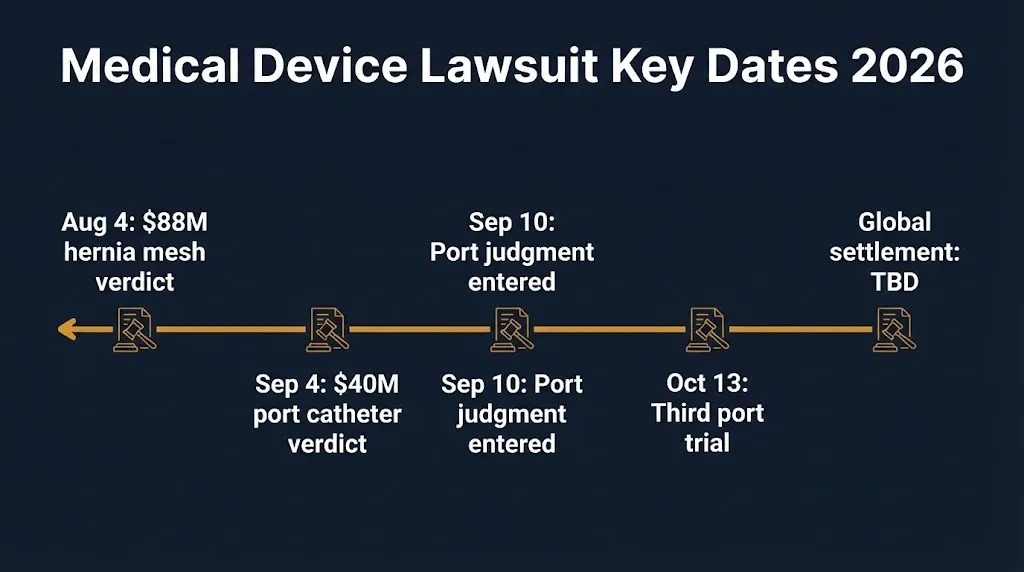
| Patterson v. Covidien (D. Mass.) | Symbotex hernia mesh | Aug. 4, 2026 | $88 million compensatory ($77M patient, $11M spouse) |
| Divelbliss v. Becton, Dickinson (D. Ariz.) | Bard implanted port catheter | Sept. 4, 2026 | $40 million compensatory, no punitive damages |
| First Bard port bellwether (D. Ariz.) | Bard implanted port catheter | May 2026 | Partial defense verdict, hung jury on design defect |
Plaintiff’s counsel told Reuters the $88 million award was by far the largest in more than a dozen hernia mesh and transvaginal mesh trials. That’s a lawyer’s claim, not a court finding.
Key Takeaway: A medical device lawsuit is usually an individual MDL claim, its viability can hinge on the FDA pathway, and no standard per-person payout exists.
Does a big verdict mean you’ll get paid that much?
No. One verdict is one plaintiff’s result, and it can shrink or disappear after post-trial motions and appeals. Medtronic’s SEC filing says it’s reasonably possible some or all of the $88 million could be overturned.
Bellwether trials test claims. They don’t pay everyone. Think of them as a comparable sale in real estate: useful for pricing, but your home still sells for its own number.
Your own value usually turns on:
- Severity of injury
- Revision or removal surgery
- Documented complications
- The device model
- State law and venue
Both 2026 verdicts were compensatory only. The Bard jury declined punitive damages, and the Covidien jury didn’t award them.
Reality Check: No one texts you device settlement money first. Trackers reported no global settlement fund for Bard port catheters and no public claim form for Cook IVC filters as of October 2026. Be wary of “claim now” offers and anyone who wants fees before a case exists.
Do you qualify to file a medical device lawsuit?
You may qualify if a device injured you, you can identify it, and you’re within your state’s deadline. Eligibility depends on facts, so only a licensed attorney can evaluate your case.
Use this checklist to see where you stand:
- You had a device implanted, used, or prescribed.
- You can name the maker, model, and lot or serial number.
- You suffered an injury, such as fracture, infection, migration, or revision surgery.
- Your medical records document the complication.
- Your state’s filing deadline hasn’t passed.
- Your device’s FDA pathway allows state-law claims.
- You kept the removed device, or asked in writing that the hospital hold it.
Step seven matters more than people expect. Hospitals can discard explanted devices as medical waste.
Missing one item doesn’t end your options. It tells you what to gather first.
How long do you have to file a medical device lawsuit?
Your deadline is set by state law, and a 50-state survey of prescription product cases found limits from one to six years. Two years is the most common period.
Many states use a discovery rule. The clock starts when you knew, or should have known, the device caused your injury. A few states don’t recognize it.
Some states also set a statute of repose, an outer cutoff measured from the device’s sale, such as 10 to 15 years. State law governs even when your case sits in a federal MDL.
| Term | What it means |
|---|---|
| Statute of limitations | Time to sue after your injury accrues |
| Discovery rule | Clock starts when you learn the cause |
| Statute of repose | Absolute cutoff from the sale date |
| Tolling agreement | Agreement that pauses the clock |
Think of a warranty. It can start at purchase or at discovery, and missing it ends the claim.
Key Takeaway: Verdicts don’t set your payout, but your state’s one-to-six-year filing deadline can end your claim regardless of the verdicts.
How do you file a medical device lawsuit, step by step?
You file by hiring a product liability attorney who files a complaint in state or federal court. Many plaintiff firms offer free case reviews and work on contingency, according to firm websites.
Follow these steps:
- Get medical care, and ask for your device’s name, model, and lot number.
- Request your complete medical and implant records.
- Ask the hospital in writing to hold any removed device.
- Save bills, photos, and a log of your symptoms.
- Check for an FDA recall and your state’s deadline.
- Consult a licensed product liability attorney.
- Your attorney files in state court, or directly into an active MDL if the court allows it.
- The case enters discovery, then bellwether trials or settlement talks.
In active MDLs, a direct filing order lets plaintiffs file straight into the MDL court. That saves waiting for a transfer.
How do you check if your medical device was recalled?
Search the FDA’s medical device recall database using your device’s name, model, or manufacturer. The FDA sorts each recall into Class I, II, or III by health hazard.
- Find your device ID card or implant record.
- Write down the brand, model, and serial or lot number.
- Search the FDA recall database.
- Read the recall’s classification.
- Search MAUDE, the FDA’s public adverse event database.
- Ask your doctor or the manufacturer about any notices.
- Report your own device problem to the FDA.
| Recall class | FDA definition (summarized) |
|---|---|
| Class I | Reasonable probability of serious adverse health consequences or death |
| Class II | May cause temporary or reversible harm, or serious harm is remote |
| Class III | Not likely to cause adverse health consequences |
Recall classes run opposite to device classes. Class III devices carry the highest regulatory risk, but a Class I recall is the most serious.
Which medical device lawsuits are active in 2026?
At least six large medical device MDLs held pending cases on October 1, 2026, per the Judicial Panel on Multidistrict Litigation report.
| MDL | Device | Pending cases | Total filed |
|---|---|---|---|
| 2666 (D. Minn.) | Bair Hugger warming devices | 8,424 | 10,828 |
| 2570 (S.D. Ind.) | Cook IVC filters | 6,470 | 11,478 |
| 2974 (N.D. Ga.) | Paragard IUD | 4,224 | 4,552 |
| 3081 (D. Ariz.) | Bard implanted port catheter | 4,140 | 4,420 |
| 3044 (E.D.N.Y.) | Exactech polyethylene orthopedic | 1,838 | 1,847 |
| 3014 | Philips recalled CPAP and ventilators | 623 | 1,033 |
Other dockets exist. The Covidien hernia mesh MDL (3029, D. Mass.) is in bellwether trials. A Cartiva implant MDL (3172) formed on February 5, 2026.
One tracker counted 24 medical device MDLs holding about 53,370 pending actions in July 2026. That was 26.2% of all pending MDL cases.
Key Takeaway: Device litigation is a large share of federal MDLs, and the biggest dockets are the Bair Hugger, Cook IVC, and Paragard cases.
What happened in the 2026 bellwether trials?
Two bellwether trials produced plaintiff verdicts in 2026, and a third is scheduled for October 13. Each result applies to one plaintiff.
Covidien hernia mesh: A Boston jury found on August 4, 2026 that Covidien failed to adequately warn about its Symbotex mesh. The patient had the implant in 2017. Medtronic said it “strongly” disagrees and will challenge the verdict.
Bard port catheter: The first bellwether ended in May with a partial defense verdict and a hung jury on design defect. In the second, a Phoenix jury found design defect and failure to warn on September 4. It rejected fraudulent concealment and punitive damages.
- Judgment in Divelbliss was entered on September 10, 2026.
- The third trial, Lattanzio, is an infection claim set for October 13, 2026.
- About 10,350 related hernia mesh cases were pending nationwide, according to one newspaper account.
Mixed results matter. One plaintiff win and one partial defense verdict show juries don’t rule one way.
Is there a settlement for medical device lawsuits right now?
There’s no single settlement for medical device lawsuits. Each device has its own docket, and most large ones have no global deal as of October 4, 2026.
| Litigation | Settlement status (verified) |
|---|---|
| Bard port catheter | No global settlement or fund |
| Cook IVC filters | Partial settlement terms reached October 2025, not public; no claim form |
| Covidien hernia mesh | Mediation ended without a global settlement |
| Philips CPAP | Personal injury settlement of about $1.1 billion reported in 2024 |
Cook’s partial deal is the one to watch for scams. Trackers say its terms haven’t been made public, so no one can quote real payout figures.
If you see a claim form for a device settlement, check the case name, court, and administrator. Real settlements publish all three.
What is medical device litigation and how does an MDL work?
Medical device litigation is the body of product liability suits over injuries from devices, usually organized as MDLs under 28 U.S.C. § 1407. A seven-judge panel decides whether to create one.
The Judicial Panel on Multidistrict Litigation picks a single judge to manage pretrial work. Cases that don’t settle or get dismissed return to their home districts for trial.
| Stage | What happens |
|---|---|
| Transfer | The panel centralizes related federal cases |
| Leadership | The judge appoints a plaintiffs’ steering committee |
| Master complaint | Common claims are pleaded once |
| Discovery | Both sides exchange documents and experts |
| Bellwethers | Test cases go to juries |
| Resolution | Settlement, dismissal, or remand for trial |
Timelines are long. The Bard port MDL formed in August 2023 and saw its first plaintiff verdict in September 2026. Cook’s IVC MDL is about twelve years old and still holds thousands of cases.
Key Takeaway: An MDL is a pretrial system, not a payout fund, and it can take years before verdicts or settlements arrive.
What are the types of defective medical device claims?
Defective medical device claims fall into three main types: design defect, manufacturing defect, and failure to warn. Many suits plead all three.
| Claim | Meaning | 2026 example |
|---|---|---|
| Design defect | The device’s design is unsafe | Bard jury found design defect (Divelbliss) |
| Manufacturing defect | This unit deviated from its specifications | None cited in the 2026 verdicts |
| Failure to warn | Makers didn’t adequately warn doctors or patients | Covidien jury (Patterson); Bard jury |
Some plaintiffs add fraud claims. The Bard jury declined fraudulent concealment. A plaintiff firm said the Covidien jury found fraud and concealment, which we couldn’t confirm in other coverage. Treat that as the firm’s claim.
Defect type shapes your evidence. Design claims need proof across the product line. Warning claims focus on what doctors were told.
Why does the 510(k) versus PMA pathway matter so much?
The pathway determines how strongly federal law shields the manufacturer. PMA is the FDA’s most rigorous review. A 510(k) clearance shows a device is “substantially equivalent” to an earlier one.
Riegel began in 1996 when a Medtronic balloon catheter burst during an angioplasty. The Court held 8-1 that PMA requirements preempt most state tort claims. Lohr had held the opposite for a 510(k) pacemaker lead.
| Question | PMA device | 510(k) device |
|---|---|---|
| Review type | Device-specific safety review | Comparison to a predicate |
| Usual defense | Express preemption | Weaker preemption |
| Remaining claim | Violation of FDA-approved specs | Design, manufacturing, warning |
Here’s the skeptical read. A manufacturer’s “FDA approved” line can be technically true and legally irrelevant. Cleared isn’t approved.
Ask your lawyer which pathway applies. It’s one of the first questions in any device case.
Do device recalls and FDA reports prove your case?
No. A recall tells you the FDA classified a health hazard. It doesn’t decide who owes you money or whether your injury came from the device.
Recalls are common. One study counted 13,623 recalled devices between 2018 and 2022. Most recalls are voluntary, though the FDA can order one under 21 CFR Part 810.
The Philips CPAP timeline shows how it works. The FDA issued a safety communication on June 30, 2021 and labeled the recall Class I on July 22, 2021.
Use recall records as evidence and as a starting point:
- A recall can help identify affected models and dates.
- MAUDE reports show adverse events others reported.
- Neither replaces your medical records.
A recall is like a store pulling a product: it signals a problem, but it doesn’t refund you.
Key Takeaway: Recalls and FDA reports support a claim, but your own records and your state’s law still decide whether you can recover.
What happens next in medical device litigation?
Few dates are confirmed. One trial is scheduled, and several rulings are expected.
October 13, 2026: The third Bard port bellwether, Lattanzio, an infection claim, begins.
Expected, date not confirmed: The court rules on Medtronic’s post-trial challenges to the $88 million Covidien verdict.
Expected, date not confirmed: Further bellwether scheduling in the Covidien hernia mesh MDL.
Expected, date not confirmed: Any global settlement announcements. None existed for Bard port or Covidien as of October 4, 2026.
Frequently Asked Questions
What is a medical device lawsuit?
It’s a product liability claim against a device maker over an injury the device allegedly caused.
Claims usually allege design defects, manufacturing defects, or failure to warn.
Is a medical device lawsuit a class action?
Usually not.
Most are individual cases coordinated in federal MDLs, where each plaintiff keeps a separate claim.
How much do medical device lawsuits pay per person?
No standard per-person amount exists.
Outcomes depend on the device, injury, state, and records, and 2026 verdicts were single-plaintiff results.
How long do I have to file a medical device lawsuit?
State law sets the deadline, and surveys show limits from one to six years.
Discovery rules and repose statutes can change when your clock starts and ends.
Can I sue if my device was FDA approved?
Maybe, but PMA-approved devices face strong preemption defenses under Riegel.
Most 510(k)-cleared devices don’t, so identify your pathway first.
What was the biggest medical device verdict of 2026?
A Boston jury awarded $88 million against Medtronic’s Covidien unit on August 4, 2026.
Medtronic says it will challenge the award.
Who decides whether cases become an MDL?
The Judicial Panel on Multidistrict Litigation decides, under 28 U.S.C. § 1407.
It’s a seven-judge panel that also picks the judge and district.
Start with the device. Write down its brand, model, and any recall notice, and keep every medical record.
Don’t wait for a global settlement that may never come. Check your state’s filing deadline today, because it can run as short as one year.