Birth Control Lawsuit 2026: Depo-Provera Brain Tumor Claims, Paragard Verdict, and What You Need to Know
Quick Answer
- Birth control lawsuits are real, active, and growing, with major claims against Pfizer (Depo-Provera) and Teva (Paragard IUD).
- Depo-Provera settlement amounts are not yet public; a pre-settlement funding company estimates potential payouts near $250,000 on average.
- The most urgent deadline is November 30, 2026, the registration cutoff for the Depo-Provera settlement program.
If you used a birth control product and later received a serious diagnosis, you are not imagining the connection. Thousands of women have filed lawsuits alleging that pharmaceutical companies failed to warn them about dangerous side effects. The two biggest battles right now are over Depo-Provera, an injectable contraceptive linked to brain tumors, and Paragard, a copper IUD that can break during removal.
This is not a single class action where everyone gets a check automatically. These are individual injury claims bundled together in federal court. That distinction matters enormously for how you file, what you might recover, and how long it takes. If you have a meningioma diagnosis after using Depo-Provera, the November 30, 2026 deadline is the one date you cannot afford to miss.
The Facts
Case | In re: Depo-Provera Products Liability Litigation, MDL No. 3140; Paragard IUD MDL
Status | Active litigation with settlement program for Depo-Provera; Paragard bellwether trial ended in defense verdict
Fund Size | Depo-Provera settlement amount confidential; estimated over $1.2 billion by third-party analysts
Est. Per Person | Not yet confirmed; estimates around $250,000 average, but unverified
Claim Deadline | November 30, 2026 for Depo-Provera settlement registration
Administrator | BrownGreer (Depo-Provera Settlement Administrator)
Proof Needed | Medical records linking product use to diagnosis; eligibility screening required
Is the birth control lawsuit real or a scam?
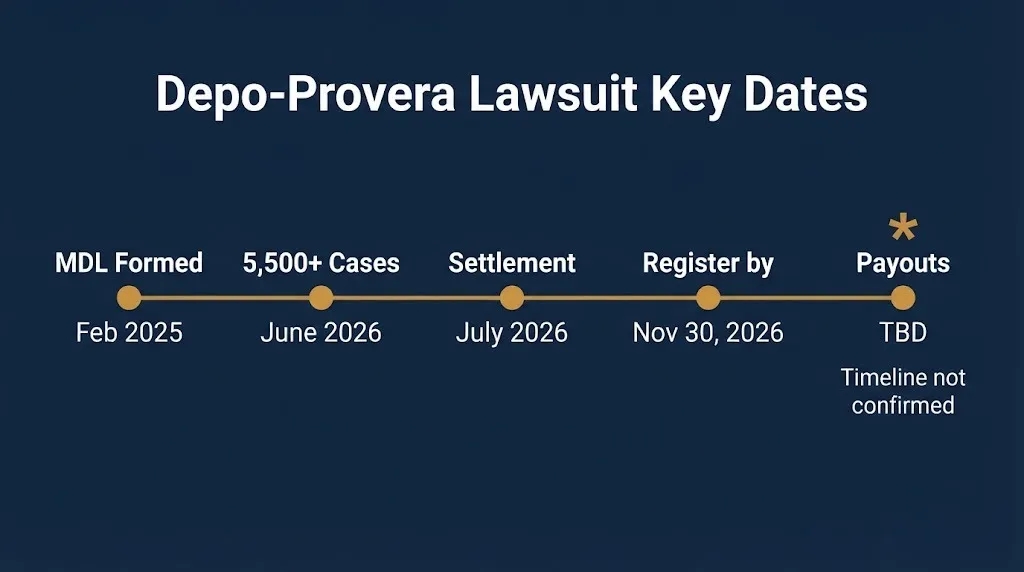
The birth control lawsuits are real, court-supervised litigation, not a scam, but you should be skeptical of anyone who contacts you first. The Depo-Provera litigation is consolidated in the U.S. District Court for the Northern District of Florida under MDL No. 3140 . It has grown to more than 5,500 cases as of June 2026, making it one of the fastest-growing mass torts in the country . Pfizer, the manufacturer, is the defendant.
The Paragard litigation is separate. That MDL involves Teva Pharmaceuticals and the Cooper Companies, and it centers on a copper IUD that plaintiffs say is prone to breaking inside the uterus during removal . In February 2026, a Georgia federal jury returned a complete defense verdict for Teva in the first bellwether trial . That verdict does not end the litigation, but it is a significant win for the defense.
The scam risk is real, though. Predatory “claim aggregators” and lead-generation sites often mimic official settlement pages. They collect your information and sell it. The legitimate process involves a court-appointed administrator, BrownGreer, and your own attorney if you have one . No one from the court will text you asking for a processing fee.
How much could you get from a birth control lawsuit?
The amount you could receive is not yet determined because the Depo-Provera settlement terms are confidential and no public payout schedule exists. A pre-settlement funding company, Legal Bay, estimated in August 2026 that approximately 5,000 claims could resolve for more than $1.2 billion, which would average roughly $250,000 per participating claimant . Legal Bay also suggested that severe injury cases could approach $1 million .
Those numbers are estimates, not confirmed awards. Neither Pfizer nor the plaintiffs’ leadership nor the settlement administrator has published an average payout or a tier structure . The court’s August 10, 2026 case management order only confirmed that a settlement agreement dated July 22, 2026 exists .
For the Paragard IUD claims, no settlement has been reached at all. The first bellwether trial ended in a defense verdict in February 2026, which means plaintiffs face a longer and less certain road .
What factors will likely drive your individual payout if a settlement program applies to you?
- Severity of your meningioma diagnosis. Larger tumors, surgical intervention, and residual symptoms typically support higher awards.
- Duration of Depo-Provera use. Longer use is associated with stronger causation arguments.
- Your age at diagnosis. Younger claimants may have greater lifetime impact and damages.
- Quality of medical documentation. Clear records linking injection history to tumor diagnosis strengthen your claim.
Key Takeaway: The $250,000 average figure circulating online is an unverified estimate from a funding company, not a court-approved number. Treat any specific dollar amount you see as speculative until the settlement administrator publishes a payment grid.
Reality Check: No one can promise you a specific payout before your claim is reviewed under the settlement program’s criteria. Be wary of any attorney or “advocate” who guarantees a dollar figure. The settlement agreement itself is confidential, and the eligibility rules are being applied case by case.
Who qualifies for a Depo-Provera birth control lawsuit?
You may qualify for a Depo-Provera claim if you received the injection, used it for a meaningful period, and were diagnosed with a meningioma brain tumor. Eligibility criteria reported by law firms handling these cases include:
- Product use: You were treated with brand-name Depo-Provera, Depo-SubQ Provera 104, or an authorized generic version of medroxyprogesterone acetate injections .
- Injection history: You received at least two injections, though some firms describe the threshold as roughly one year of treatment, about four injections .
- Diagnosis: You were diagnosed by a healthcare professional with a cerebral meningioma or other brain tumor after using the product .
- Timing: You are within your state’s statute of limitations for filing a claim .
Not everyone qualifies. Cases may be disqualified if you only used a non-authorized generic, received fewer than two injections, were diagnosed with a brain tumor before using Depo-Provera, or cannot medically link your condition to the drug . The settlement program has its own eligibility rules that may differ from the litigation criteria, and those rules are not fully public .
How do you file a Depo-Provera birth control lawsuit?
Filing a Depo-Provera claim starts with confirming your eligibility and then securing legal representation, because these cases are individual lawsuits, not a simple claims form. Here are the steps:
- Confirm your product use. Gather any records showing Depo-Provera injections, including pharmacy records, clinic notes, or immunization-style cards.
- Confirm your diagnosis. You need documentation of a meningioma or brain tumor from a healthcare provider.
- Contact a mass tort attorney. Most firms handling these cases work on contingency, meaning you pay nothing unless there is a recovery .
- Do not delay for medical records. Attorneys can request your records for you; you do not need them in hand to start .
- Meet the settlement registration deadline if applicable. The court set November 30, 2026 as the registration deadline for eligible claimants participating in the settlement program .
- Complete the eligibility screening. The settlement administrator, BrownGreer, will evaluate claims under the program’s criteria .
- Wait for the claims process. Settlement implementation in mass torts can take years, and individual award schedules are not yet public .
What is the Paragard IUD lawsuit about?
The Paragard IUD lawsuit is a separate mass tort alleging that the copper intrauterine device can break during removal, leaving fragments inside the uterus and causing serious injuries. Teva Pharmaceuticals and the Cooper Companies are the primary defendants . The litigation is consolidated in a federal MDL in Georgia, with over 3,000 claims filed .
The first bellwether trial, Rickard v. Teva Pharmaceuticals USA, Inc., ended on February 4, 2026, with a complete defense verdict . The plaintiff, a Florida woman, alleged failure to warn and design defect . The jury sided with Teva. That outcome is a setback for plaintiffs, but it does not resolve the remaining cases. Bellwether trials are designed to test arguments, and one verdict does not dictate the outcome of thousands of others.
Teva has also argued that federal preemption bars the failure-to-warn and design defect claims . The judge deferred ruling on that motion after the verdict. If the court ultimately accepts the preemption defense, it could narrow the litigation significantly. For now, the Paragard cases continue, but the path to a settlement is longer than the Depo-Provera track.
What birth control lawsuits are still active in 2026?
Several birth control lawsuits remain active, but the Depo-Provera brain tumor litigation and the Paragard IUD MDL are the two largest. The Yaz and Yasmin litigation is largely resolved in the United States. Bayer paid over $2 billion to settle approximately 10,300 blood clot claims, with average payouts of $212,000 to $220,000 per case . That U.S. settlement closed in 2019. A separate Canadian settlement of CAD $9,050,000 was reached in April 2026 for Yasmin and Yaz users in Canada .
The contraceptive coverage litigation is a different category entirely. It is not an injury lawsuit. A coalition of 22 state attorneys general, led by California’s Rob Bonta, filed an amicus brief in March 2026 supporting Pennsylvania and New Jersey in their challenge to Trump-era regulations that expanded religious and moral exemptions to the ACA’s contraception coverage mandate . The NAACP also signed onto a brief in that case . That litigation is about insurance coverage, not product liability, and it does not involve individual payouts.
Key Takeaway: The Yaz and Yasmin settlements are closed, the Depo-Provera settlement program is active with a November 30 deadline, and the Paragard litigation is still in trial phase after a defense verdict.
What happens next in the Depo-Provera and Paragard lawsuits?
The next stages depend on which litigation you are tracking, but both have clear upcoming milestones.
Depo-Provera:
- November 30, 2026: Registration deadline for eligible claimants participating in the settlement program .
- Late 2026 into 2027: Settlement administrator processes claims and applies eligibility criteria.
- 2027 and beyond: Individual awards determined; payment schedules not yet public.
Paragard:
- Late 2026: Post-verdict motions, including Teva’s preemption arguments, continue to be litigated.
- 2027: Additional bellwether trials possible, or global settlement negotiations if defense and plaintiff leadership find a path.
For Depo-Provera claimants, the immediate action is ensuring your registration is completed by the deadline if you are participating in the settlement program. For Paragard claimants, the litigation remains uncertain, and consulting an attorney about your individual case is the only way to assess your options.
Frequently Asked Questions
Is the Depo-Provera birth control lawsuit a class action?
No, it is a multidistrict litigation, not a class action. Each claimant files an individual lawsuit, and payouts depend on individual injury severity .
What is the average Depo-Provera settlement payout?
There is no confirmed average payout. A pre-settlement funding company estimated roughly $250,000 per claim, but that figure is unverified and not court-approved .
What is the deadline to file a Depo-Provera claim?
The court set November 30, 2026, as the registration deadline for eligible claimants in the settlement program . Statutes of limitations also vary by state.
Do I need medical records to start a birth control lawsuit?
No, you do not need records in hand to contact an attorney. Lawyers can request medical records on your behalf as part of the legal process .
Did Teva win the Paragard IUD trial?
Yes, a Georgia federal jury returned a complete defense verdict for Teva in the first Paragard bellwether trial on February 4, 2026 .
Can I still file a Yasmin or Yaz lawsuit?
The U.S. Yasmin and Yaz settlement closed in 2019. New U.S. claims are likely time-barred, though a Canadian settlement is proceeding separately .
Are birth control lawsuits free to file?
Most mass tort attorneys handle these cases on contingency, meaning you pay no upfront fees and owe nothing unless there is a recovery .
The Bottom Line
The birth control lawsuit landscape in 2026 has two active fronts: a Depo-Provera settlement program with a hard November 30 deadline, and a Paragard litigation still fighting through bellwether trials after a defense verdict. If you used Depo-Provera and have a meningioma diagnosis, the registration deadline is the single most important date on your calendar. Gather what records you have, speak with a qualified attorney, and do not let the deadline pass while you wait for perfect documentation.