Compensation for the Number of Units an Employee Produces in 2026: Piece Rate Pay, Legal Risks, and What Workers Can Recover
Quick Answer
- Is it legal? Yes, piece rate pay is legal, but it does not excuse minimum wage or overtime obligations under federal law .
- How much can you recover? Unpaid overtime and minimum wage differentials, plus liquidated damages in some cases. Amounts depend on your hours and pay records.
- Most important rule: Your employer must pay you at least $7.25 per hour for every hour worked, even if your piece rate earnings fall short .
If you get paid by the number of units you produce, you are working under a piece rate system. That is legal in the United States. What is not legal is paying you only by the piece and ignoring minimum wage or overtime rules.
The Department of Labor is direct about this: most employees have the right to be paid at least the federal minimum wage of $7.25 per hour for all hours worked, regardless of whether you are paid by the hour, the day, or at a piece rate . If your piece rate earnings for a workweek divided by your hours worked falls below $7.25, your employer owes you the difference.
This article breaks down how piece rate pay actually works, what courts have said about overtime, the state laws that go further than federal rules, and the real settlements workers have recovered when employers got it wrong.
The Facts
| Issue | Federal Rule |
|---|---|
| Minimum wage | $7.25 per hour for all hours worked, even piece rate |
| Overtime | 1.5 times regular rate for hours over 40 in a workweek |
| Regular rate calculation | Total piece rate earnings divided by total hours worked |
| Overtime premium | Additional half-time based on the regular rate |
| Recordkeeping | Employer must keep records of hours worked and wages paid |
| State variations | California and Washington require separate pay for rest breaks and nonproductive time |
Is piece rate pay legal in 2026?
Piece rate pay is legal in 2026. The federal Fair Labor Standards Act permits employers to pay employees based on units produced, jobs completed, or operations performed, as long as minimum wage and overtime requirements are met .
The system is simple on paper. You get a fixed rate for each unit. Produce ten units at $5 each, earn $50. The time you spent does not directly determine your pay. Efficiency and output do .
But the FLSA does not let an employer use piece rate as a shield against wage laws. The Department of Labor states plainly that employers must pay at least the federal minimum wage for all hours worked regardless of whether employees are paid by the hour, the day, or at a piece rate .
Some states set a higher bar. California does not allow averaging piece rate earnings across a workweek to satisfy minimum wage. Piece rate employees in California must be paid at least minimum wage for each hour and minute of work . Washington State requires minimum wage for each hour worked, rejecting the federal weekly averaging approach .
Key Takeaway: Piece rate pay is legal, but it never overrides your right to minimum wage for every hour worked.
How is overtime calculated for piece rate employees?
Overtime for piece rate employees is calculated by first finding your regular rate. That rate is your total piece rate earnings for the workweek divided by total hours worked. You are then owed an additional half-time for each hour over 40 .
This is where many employers get it wrong. They assume piece rate workers are exempt from overtime because they are not paid hourly. That is false.
The Department of Labor’s regulation on pieceworkers lays out the math. Suppose you earn $491 at piece rates for 46 hours of productive work and receive $8.00 per hour for 4 hours of waiting time. Total compensation is $523. Divide that by 50 total hours. Your regular rate is $10.46 per hour .
For the 10 overtime hours, you are owed an additional $52.30 (10 hours at half the regular rate of $5.23). Total pay for the week: $575.30 .
The Department of Labor’s garment industry guidance states the rule without ambiguity: employers must pay time and one-half when employees work more than 40 hours in a week, even if they are paid at piece rates .
Key Takeaway: Your overtime rate is based on your average hourly earnings, not your piece rate alone. Employers who skip this step owe back wages.
What settlements have piece rate workers recovered?
Piece rate workers have recovered settlements ranging from $575,000 to $1.22 million in recent misclassification and unpaid overtime cases. The common claim: employers treated piece rate workers as independent contractors and skipped overtime pay.
| Case | Settlement | Workers | Court | Year |
|---|---|---|---|---|
| Beasley v. Custom Communications | $1,220,000 | 296 technicians | E.D.N.C. | Settled |
| Nicks v. Koch Foods | $1,207,000 | 272 live-haul crew | N.D. Ill. | Settled |
| Nicks v. Peco Foods | $575,000 | 130 chicken catchers | N.D. Ala. | Settled |
In Beasley v. Custom Communications, piece rate paid technicians installed satellite TV and internet equipment. They worked well over 40 hours per week and received no overtime . The $1.22 million settlement covered approximately 296 workers.
Nicks v. Koch Foods involved live-haul chicken catching crews. They were paid a piece rate per 1,000 chickens caught, worked over 40 hours, and got no overtime. The $1.2 million settlement covered 272 workers .
Nicks v. Peco Foods followed the same pattern with 130 crew members and a $575,000 settlement .
The legal theory in all three: the employers misclassified piece rate workers as independent contractors to avoid overtime obligations. That misclassification is not a defense.
Key Takeaway: The most common piece rate lawsuit claims unpaid overtime and misclassification. If you worked over 40 hours and got no overtime, you may have a claim.
Reality Check: No employer can legally pay you nothing for rest breaks or waiting time just because you are on a piece rate. If you are required to be at work, you are working. Federal law and several state laws require compensation for that time. If your pay stub shows zero earnings for a week where you worked, that is a red flag.
Which states require separate pay for rest breaks and nonproductive time?
California and Washington require employers to pay piece rate workers separately for rest breaks and nonproductive time. These states reject the federal weekly averaging approach and require minimum wage for each hour worked .
California’s rules are the strictest. Piece rate employees must be paid at least minimum wage for each hour and minute of work. Employers must pay separately for rest and recovery periods and other nonproductive time at specified rates .
Washington State law also requires minimum wage for all hours worked. Employers must pay for rest breaks separately. Courts have rejected the argument that piece rate earnings can be averaged across a week to cover rest periods .
New York requires piece rate employees to receive at least minimum wage for each hour worked and overtime at the appropriate rate. Employers must provide detailed wage statements showing units produced and piece rate earnings .
Federal law is less protective on this point. The FLSA allows weekly averaging for piece rate workers, which means rest breaks can be folded into the average as long as the total meets minimum wage. But state law can override that floor.
Key Takeaway: If you work in California or Washington, your employer owes you separate pay for rest breaks. Federal averaging does not apply.
How do you prove you are owed unpaid piece rate wages?
You prove unpaid piece rate wages with records of your hours worked, your piece rate earnings, and your pay stubs. The burden is on the employer to keep accurate records, but you should keep your own .
The Department of Labor requires employers to keep records of all wages paid and all hours worked . That includes piece rate workers. If your employer did not keep those records, that is a violation in itself.
Here is what to gather:
- Pay stubs showing piece rate earnings and any hourly compensation.
- Time records you kept yourself, including start times, end times, and break times.
- Production records showing units completed and the rate paid per unit.
- Texts or emails about work schedules, assignments, or pay disputes.
- Names of coworkers who did the same work and were paid the same way.
If your pay stubs do not show hours worked, that is a recordkeeping violation. In many cases, courts allow workers to estimate hours if the employer failed to keep records.
The FLSA gives you the right to recover unpaid wages plus an equal amount in liquidated damages in many cases. That means if you are owed $2,000 in back wages, you could recover $4,000. Your state may have additional penalties.
Key Takeaway: Keep your own records. If your employer’s records are missing or wrong, your documentation becomes the evidence.
What are the most common piece rate pay violations?
The most common piece rate violations are failure to pay minimum wage when piece earnings are low, failure to pay overtime for hours over 40, misclassification as independent contractor, and failure to pay for nonproductive time like rest breaks and waiting.
Here is the pattern that shows up again and again:
- Low-production weeks. You work 30 hours but produce few units because of equipment problems or slow workflow. Your piece earnings fall below $217.50 (30 hours at $7.25). Your employer owes you the difference .
- Overtime weeks. You work 50 hours, produce 200 units at $2 each, earn $400. Your regular rate is $8 per hour. You are owed an additional $40 (10 hours at half-time of $4) .
- Independent contractor misclassification. Your employer calls you a contractor to avoid payroll taxes and overtime. But if they control your schedule, tools, and work, you are an employee .
- Unpaid rest breaks. You work an 8-hour shift with two 15-minute breaks. Your employer pays only for units produced. Those 30 minutes are hours worked and must be paid .
Key Takeaway: The violations cluster around low-production weeks and overtime. If your pay fluctuates below minimum wage or you work over 40 hours without extra pay, you may be owed money.
What is the federal minimum wage for piece rate workers in 2026?
The federal minimum wage for piece rate workers in 2026 is $7.25 per hour. That means your piece rate earnings for a workweek must equal at least $7.25 multiplied by your hours worked .
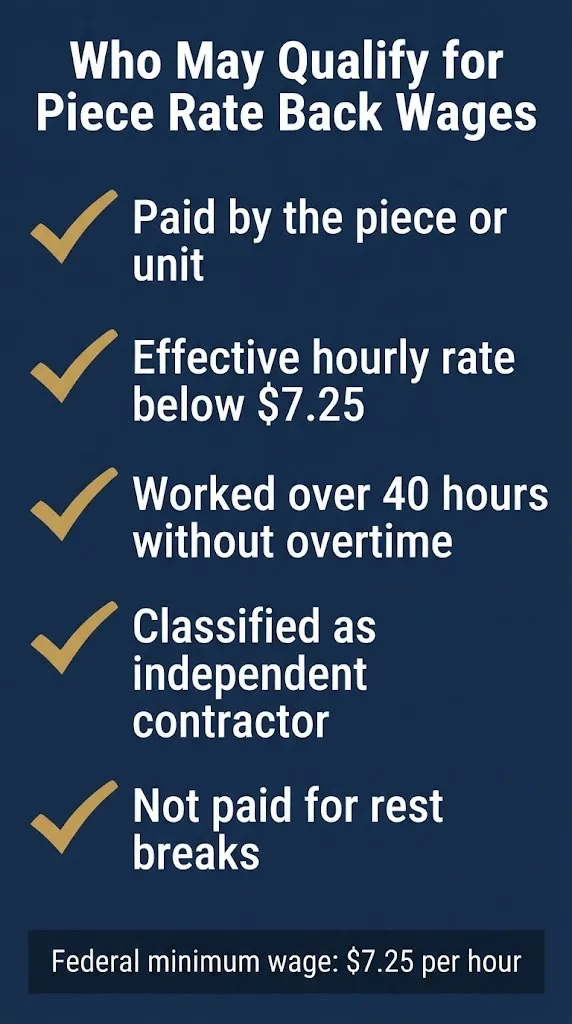
The math is simple but employers sometimes ignore it. If you work 40 hours and earn $250 in piece rate, your effective hourly rate is $6.25. That is below federal minimum wage. Your employer owes you $40 to bring you up to $290.
The Department of Labor states that piece rate employees must receive at least the federal minimum wage for all hours worked, regardless of the payment method . State minimum wages can be higher. In California, for example, the state minimum wage is higher than $7.25 and applies to piece rate workers on an hourly basis .
If your employer claims that a low-production week is your fault, that does not change the minimum wage obligation. The law requires payment for hours worked, not just units produced.
Key Takeaway: The federal floor is $7.25 per hour. Your state may set a higher floor. Your employer must pay the higher of the two.
What happens next: piece rate enforcement in 2026 and 2027
October 2026: The Department of Labor continues enforcing minimum wage and overtime rules for piece rate workers across industries, including garment, agriculture, and installation services .
Expected late 2026: State-level enforcement in California and Washington continues to focus on separate compensation for rest breaks and nonproductive time .
Ongoing: Class action litigation against employers that misclassify piece rate workers as independent contractors continues in federal courts .
Expected 2027: New state legislation may expand piece rate protections in additional states, following the California and Washington model.
Frequently Asked Questions
Is it legal to pay employees by the piece in 2026?
Yes, piece rate pay is legal. The FLSA permits it as long as you receive at least minimum wage for all hours worked and overtime for hours over 40.
How do I calculate my hourly rate if I am paid by the piece?
Divide your total piece rate earnings for the workweek by the total hours you worked. That gives you your regular rate for overtime calculations.
Can my employer pay me less than minimum wage if I produce few units?
No. Your employer must pay you at least $7.25 per hour for every hour worked, even if your piece rate earnings fall short.
Am I entitled to overtime if I am paid by the piece?
Yes. If you work over 40 hours in a workweek, you are entitled to overtime. The rate is based on your average hourly earnings from piece rate pay.
What can I do if my employer misclassified me as an independent contractor?
You can file a wage claim with the Department of Labor or consult an employment attorney. Misclassification is a common claim in piece rate lawsuits.
Do I get paid for rest breaks if I am on piece rate?
Under federal law, rest breaks are generally counted as hours worked and must be paid. California and Washington require separate compensation for rest breaks.
How far back can I recover unpaid piece rate wages?
The FLSA allows recovery of unpaid wages for up to two years, or three years if the violation was willful.
What should I do if my pay stub does not show hours worked?
That may be a recordkeeping violation. Keep your own records of hours and production, and consider filing a complaint with the Department of Labor.
What You Should Do Next
Start by checking your recent pay stubs against your hours worked. Calculate your effective hourly rate for each workweek. If any week falls below $7.25 per hour, or if you worked over 40 hours without overtime pay, you may have a claim.
Keep your own records of hours, units produced, and pay received. The Department of Labor and employment attorneys use those records to build wage claims.
The most important number to remember: $7.25 per hour. That is the federal floor for every hour you work, no matter how you are paid.