Sperm Donation Compensation 2026: What Donors Actually Get Paid, Tax Rules, and the Legal Risks Nobody Mentions
Quick Answer
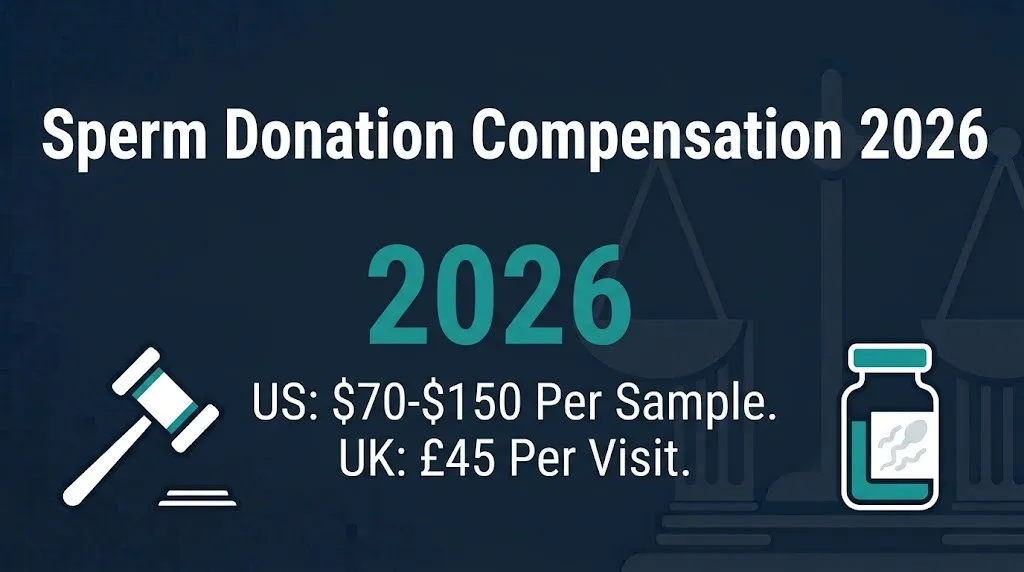
- U.S. sperm donors typically earn $70 to $150 per sample, with structured programs paying $4,000 to $10,000+ over six months.
- UK sperm donors receive £45 per clinic visit as expense compensation, not payment, and it’s illegal to pay more.
- Sperm donor compensation is generally not taxable in the UK, but U.S. tax treatment varies by amount and classification.
Sperm donation is not a job. It’s a compensated medical procedure with strict eligibility requirements, and the money is meant to cover your time and expenses, not to serve as income.
But the numbers matter. If you’re considering donating, you need to know what banks actually pay, how long the process takes, and what happens to that money at tax time.
More importantly, you need to understand the legal risks. In some states, if you donate outside a licensed physician’s supervision, you can be treated as the child’s legal father and ordered to pay child support. That’s not a scare tactic. It’s how the law works in Kansas and several other states.
This guide breaks down compensation rates by country, the tax rules, the legal protections, and the risks that donor contracts don’t always cover.
The Facts
| Item | Detail |
|---|---|
| U.S. Compensation Range | $70 to $150 per sample |
| U.S. Annual Earnings (High Volume) | Over $10,000 |
| UK Compensation | £45 per clinic visit |
| UK Maximum (6 months, weekly) | £1,170 |
| Structured Program (6 months) | $4,000 average |
| Premium Program Range | $5,000 to $10,000+ |
| Tax Treatment (UK) | Not taxable |
| Legal Protection | Varies by state; physician involvement often required |
How Much Do Sperm Donors Get Paid in the United States?
Sperm donors in the United States typically receive $70 to $100 per sample, with some banks paying up to $150 per donation visit. The exact amount depends on the bank, your location, and the program structure.
A 2025 study published in Fertility and Sterility collected data from 18 licensed sperm banks across the U.S., India, the UK, and Australia. U.S. donors received $70 to $100 per sample, with high-volume donors earning over $10,000 annually.
Fairfax Cryobank, one of the largest U.S. sperm banks, pays donors an average of $4,000 over a six-month program, at $150 per donation visit.
Premium programs pay more. ACRC Global advertises sperm donor compensation starting at $5,000 and reaching $10,000 or more based on background and qualifications.
| Bank/Program | Per-Visit Rate | Program Total |
|---|---|---|
| U.S. Average | $70 to $100 | Varies |
| Fairfax Cryobank | $150 | $4,000 (6 months) |
| Premium Programs | Varies | $5,000 to $10,000+ |
The gap between $70 and $150 per visit reflects different business models. Some banks pay per sample. Others pay per visit regardless of sample quality. Premium programs charge recipients more and share that revenue with donors who meet higher criteria.
How Much Do Sperm Donors Get Paid in the UK?
UK sperm donors receive £45 per clinic visit as compensation for expenses, not payment for sperm. The Human Fertilisation and Embryology Authority (HFEA) sets this rate and it is illegal to pay donors more than their reasonable expenses.
The £45 rate took effect on October 1, 2024, marking the first increase since 2011. It was raised from £35 to reflect inflation.
The London Sperm Bank explains that the £45 covers travel expenses, time spent attending appointments, and potential loss of earnings. If you donate weekly for six months, you could receive up to £1,170 total.
The HFEA is explicit that this is not income. “The amount offered is not a payment, and a person should never feel compelled to donate for financial gain”.
| Item | Amount |
|---|---|
| Per clinic visit | £45 |
| Maximum (6 months, weekly) | £1,170 |
| Taxable? | No |
| Can banks pay more? | Only for documented excess expenses |
Is Sperm Donation Compensation Taxable?
Sperm donor compensation is not taxable in the UK because it is classified as reimbursement for expenses, not income. U.S. tax treatment depends on how the compensation is classified and the total amount received.
In the UK, the HFEA and sperm banks are clear that the £45 per visit is compensation for out-of-pocket costs. Her Majesty’s Revenue and Customs does not treat it as taxable income.
In the U.S., the situation is less clear. The IRS has not issued specific guidance on sperm donor compensation. If the payments are structured as compensation for time and expenses, they may not be taxable. If they are structured as payment for a product (sperm), they could be considered taxable income.
The practical reality is that most U.S. sperm donors do not receive a 1099 form from sperm banks. But that doesn’t mean the income is tax-free by default. If you earn significant amounts, consult a tax professional.
What Are the Legal Risks of Sperm Donation?
The biggest legal risk for sperm donors is being declared the child’s legal father and ordered to pay child support. This happens when the donation does not follow state law requirements, particularly the requirement that a licensed physician perform the insemination.
Kansas law provides a clear example. Under Section 23-2208(f), a donor of semen provided to a licensed physician for use in artificial insemination is treated as if he were not the birth father, unless there’s a written agreement otherwise.
But that protection disappears if the sperm was not provided to a licensed physician. In Kansas v. W.M., a known donor provided sperm directly to a woman who inseminated herself at home. The Kansas Department for Children and Families successfully argued that the non-paternity rule did not apply, and the donor was ordered to pay child support.
The court found that the written agreement stating the donor would have no rights or responsibilities was unenforceable because the parties did not follow the statutory requirements.
| Scenario | Legal Protection? |
|---|---|
| Donation through licensed physician | Yes, in most states |
| Known donor, home insemination | No, varies by state |
| Donation through sperm bank | Yes, contract governs |
| Informal arrangement | High risk of paternity |
Reality Check: No one is going to text you offering money to donate sperm. Legitimate sperm banks have rigorous screening processes, including genetic testing, medical history, and psychological evaluation. If someone contacts you claiming you can make quick cash through sperm donation with no screening, that’s a scam. And if you donate outside a licensed physician’s supervision, you could be on the hook for child support for 18 years.
How Do You Become a Sperm Donor?
Becoming a sperm donor requires passing medical, genetic, and psychological screening. Most banks reject the vast majority of applicants.
Here’s the typical process:
- Initial application: Provide age, health history, and basic information.
- Medical screening: Blood tests for infectious diseases and genetic conditions.
- Semen analysis: Your sperm count, motility, and morphology must meet bank standards.
- Genetic evaluation: Carrier screening for inherited conditions.
- Psychological evaluation: Counseling by a qualified mental health professional.
- Donation period: Usually 6 to 12 months, with regular visits.
- Quarantine: Samples are held for 6 months before use.
The FDA requires a 6-month quarantine for anonymous semen donations to screen for infectious diseases. Directed donors have different requirements.
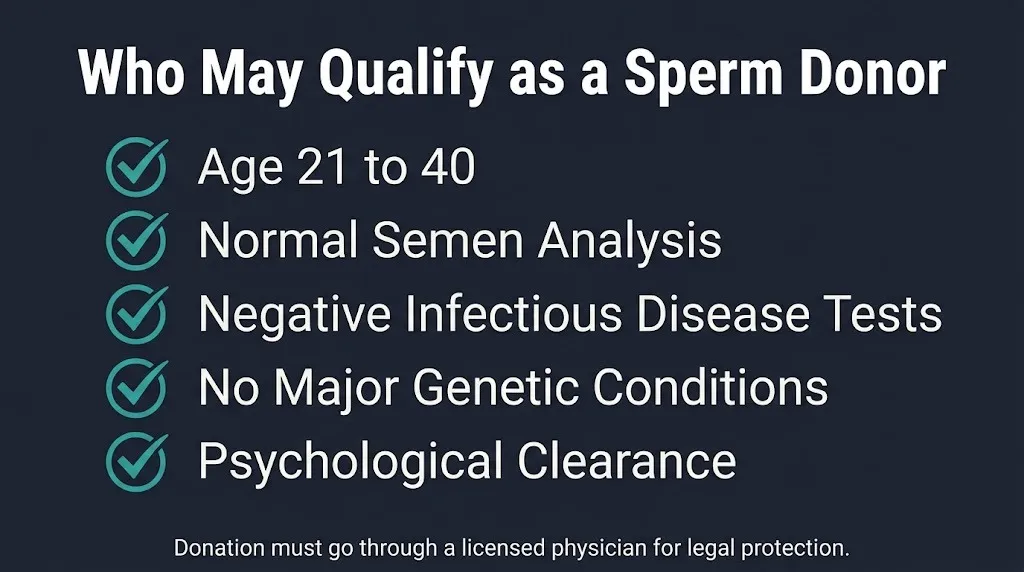
Age matters too. The American Society for Reproductive Medicine recommends donors be at least 21 years old and ideally under 40 to minimize risks associated with paternal age.
What Are the Eligibility Requirements for Sperm Donors?
Sperm donor eligibility requirements include age minimums, health standards, and genetic screening. Most banks reject 90% or more of applicants.
The core requirements are:
- Age: Legal adult, ideally 21 to 40
- Health: Normal semen analysis results, no serious medical conditions
- Genetic screening: No carriers for major inherited diseases
- Infectious disease testing: Negative for HIV, hepatitis, and other conditions
- Psychological clearance: Mental health evaluation
- Commitment: Ability to donate regularly for 6 to 12 months
The study of 18 sperm banks found that high-demand donor profiles, including postgraduate education and specific ethnicities, were associated with premium pricing. But this doesn’t mean certain ethnicities are paid more as a blanket policy. It means banks may charge recipients more for sperm from donors with certain characteristics.
What Happens to Sperm Donor Compensation in Other Countries?
Sperm donor compensation varies widely by country, from India’s ₹800 per sample to premium U.S. programs paying over $10,000 annually. The range reflects different regulatory approaches and market dynamics.
The Fertility and Sterility study compared rates across four countries. India had the lowest compensation at ₹800 median per sample (range ₹500 to ₹1,200), translating to ₹20,000 to ₹25,000 annually. U.S. donors earned $70 to $100 per sample. UK donors received £45 per visit under the HFEA’s fixed rate.
The study noted that donor compensation remains disproportionately low compared to sperm bank earnings, particularly in developing nations. Profit margins exceeded 100% in many private setups.
| Country | Per-Sample Compensation | Annual Range |
|---|---|---|
| India | ₹800 median | ₹20,000 to ₹25,000 |
| United States | $70 to $100 | $10,000+ |
| United Kingdom | £45 per visit | Up to £1,170 (6 months) |
The study also found that informal donor networks, operating outside legal frameworks, were active in at least three Indian cities and five U.S. states. These unregulated arrangements carry significant legal risks for both donors and recipients.
What Other Legal Issues Affect Sperm Donors?
Beyond paternity risk, sperm donors can face lawsuits over genetic conditions, identity disclosure, and breach of contract. The case law is evolving and outcomes vary by state.
In Johnson v. Superior Court, a child sued a sperm bank after inheriting autosomal dominant polycystic kidney disease from an anonymous donor. The court required disclosure of the donor’s identity but ruled that the child’s “wrongful life” claim was not recognized.
In Paretta v. Medical Offices for Human Reproduction, parents sued after their child was born with cystic fibrosis from a donor who carried the gene. The sperm bank apparently knew about the genetic risk but did not disclose it.
Massachusetts saw a case where a woman sued a sperm bank to learn her donor’s identity so she could collect child support. The bank’s lawyer argued that granting the request “would end sperm donation as it exists today in Massachusetts”.
These cases show that donor anonymity is not absolute. Courts can order disclosure in some circumstances, and donors can be drawn into litigation years after their donations.
Frequently Asked Questions
How much do sperm donors get paid per donation?
U.S. sperm donors typically receive $70 to $150 per sample. UK donors receive £45 per clinic visit as expense compensation.
Can you make a living donating sperm?
No. Sperm donation is not designed to be a job or career. U.S. donors earning over $10,000 annually are rare and donate at high volume.
Is sperm donor compensation taxable?
In the UK, no. It’s classified as expense reimbursement, not income. U.S. tax treatment varies and you should consult a tax professional.
Do sperm donors have to pay child support?
Usually not if the donation goes through a licensed physician and a sperm bank. But if you donate outside that framework, courts can declare you the legal father and order support.
How long does it take to become a sperm donor?
The screening process takes weeks to months. Donation commitments typically run 6 to 12 months with regular visits.
What disqualifies you from being a sperm donor?
Low sperm count, infectious diseases, genetic conditions, age outside the recommended range, and failure to pass psychological screening.
Can sperm donors remain anonymous?
Not always. Courts have ordered disclosure in some cases, and laws vary by jurisdiction. Donors should not assume permanent anonymity.
What is the maximum sperm donor compensation in the UK?
The HFEA sets compensation at £45 per clinic visit. Banks cannot legally pay more except to cover documented excess expenses.
What Happens Next: Sperm Donation Process Timeline
Application and screening: Weeks to months. Medical tests, genetic screening, semen analysis, psychological evaluation.
Approval and donor agreement: If accepted, you sign a contract governing your rights, compensation, and anonymity terms.
Donation period: Typically 6 to 12 months, with visits every few days or weekly depending on the bank.
Sample quarantine: The FDA requires a 6-month quarantine before samples can be used.
Ongoing obligations: Depending on your contract and state law, you may have ongoing obligations or protections. Read the fine print.
The most important step is the first one: only donate through a licensed physician and a reputable sperm bank. That’s your primary legal protection.