Premises Liability Settlement Amounts in 2026: Real Ranges, Real Cases, Real Deadlines
Quick Answer
- Typical range: Minor injuries settle for $10,000 to $50,000. Moderate fractures run $50,000 to $500,000. Severe injuries exceed $1 million.
- What drives value: Injury severity, clear evidence of the property owner’s notice, available insurance coverage, and your comparative fault.
- Critical deadline: Most states give you 2 years from the injury date to file. Government property claims can require notice in as little as 90 days.
If you slipped on a wet floor at a grocery store or tripped on a broken sidewalk, you’re probably wondering what your case is actually worth. The honest answer: premises liability settlement amounts vary wildly, and anyone who quotes you a single number without asking questions is guessing.
In 2026, reported settlements range from $5,000 for a minor sprain with quick recovery to $2 million for catastrophic injuries like paralysis . The middle ground, where most cases land, is narrower than the headlines suggest.
What you get depends on four things: how badly you were hurt, how clearly the property owner knew about the hazard, how much insurance coverage exists, and whether you share any blame. Those four factors control almost everything.
This article breaks down verified 2026 settlement data, explains how cases are valued, and shows you the exact steps to protect your claim before evidence disappears.
The Facts
| Topic | 2026 Verified Data |
|---|---|
| Typical Minor Injury Range | $10,000 to $50,000 |
| Typical Moderate Injury Range | $75,000 to $500,000 |
| Typical Severe Injury Range | $500,000 to $5,000,000 |
| Median Award: Retail Stores | $82,500 |
| Median Award: Residential Property | $75,000 |
| Typical Time to Check | 3 to 6 weeks after signing release |
| Government Claim Notice | As short as 90 days |
What Are the Average Premises Liability Settlement Amounts in 2026?
The average premises liability settlement in 2026 falls between $50,000 and $150,000 for cases with clear liability and moderate injuries, but severe cases regularly exceed $1 million.
A 2026 analysis by The Ledger Law Firm breaks settlements into three tiers based on injury severity :
| Injury Severity | Settlement Range | Examples |
|---|---|---|
| Minor | $10,000 to $50,000 | Sprains, bruises, soft tissue injuries |
| Moderate | $75,000 to $500,000 | Fractures, torn ligaments, herniated discs |
| Severe / Catastrophic | $500,000 to $5,000,000 | TBI, spinal cord damage, paralysis, wrongful death |
The Siddons Law Firm published similar figures in March 2026, with soft tissue injuries settling between $10,000 and $50,000, and complex fractures requiring surgery reaching $100,000 to $500,000 .
The property type matters too. A 2026 research summary found median awards of $250,000 for industrial property injuries, $125,000 for recreational facilities, and $82,500 for retail stores . Commercial properties carry higher insurance limits than residential homes, which raises settlement potential.
Key Takeaway: Most premises liability cases settle between $50,000 and $150,000, but the range stretches from $5,000 to over $5 million depending on injury severity and insurance coverage.
How Are Premises Liability Settlements Calculated?
Premises liability settlements are calculated by adding economic damages (medical bills, lost wages) to non-economic damages (pain and suffering), then adjusting for liability strength and insurance limits.
The math looks something like this: add your medical expenses, lost income, and future care costs. Multiply that figure by a pain-and-suffering factor, usually between 1.5 and 5 depending on injury severity. Then discount for any comparative fault you share.
A 2026 guide from Daniel Stark Law explains that settlement timelines vary from a few months to two years or longer, depending on treatment duration and liability disputes . The longer your treatment, the higher your medical bills, and the more documentation you have to support a higher demand.
Three multipliers drive value upward:
- Clear notice. Maintenance logs, prior complaints, or surveillance footage showing the hazard existed long enough for the owner to fix it .
- Permanent injury. Scars, limited mobility, or ongoing pain increase non-economic damages.
- Strong insurance coverage. Commercial general liability policies often carry $1 million or more per occurrence.
What drives value down? Gaps in medical treatment, inconsistent statements about how the fall happened, and evidence you were distracted or somewhere you shouldn’t have been.
Recent 2026 Premises Liability Settlements (Real Cases, Real Numbers)
Verified 2026 settlements include $2 million for a paralysis case in Virginia, $950,000 for a delivery driver injured by porch collapse, and $1.7 million for a Kansas slip-and-fall.
These aren’t hypotheticals. These are reported, dated settlements from 2026.
| Case | Settlement | Injury | Date Resolved | Jurisdiction |
|---|---|---|---|---|
| Bench collapse paralysis | $2,000,000 | Paralysis | April 24, 2026 | Virginia |
| Porch decking collapse | $950,000 | Cervical fusion, dysphagia | May 21, 2026 | Virginia |
| Kansas slip-and-fall | $1,700,000 | Worker injuries | May 12, 2026 | Kansas |
| Cook County premises claim | $5,000 | Premises liability | September 2026 | Illinois |
The Virginia paralysis case resolved for policy limits after extensive litigation. The plaintiff had $497,000 in medical bills, and the case settled for $2 million . The delivery driver’s case started with a $350,000 pre-suit offer from the defense, then settled for $950,000 after litigation .
The $5,000 Cook County settlement shows the other end of the spectrum: a smaller claim, likely with minor injuries or disputed liability .
Reality Check: No one calls you offering settlement money. If you get a text or email saying you’re owed a premises liability payout, it’s a scam. Real claims start when you report the incident and seek medical care. Insurance adjusters don’t cold-call injury victims.
How Long Does a Premises Liability Settlement Take?
Most premises liability settlements take 3 to 6 months for minor injuries and 1 to 2 years for cases requiring surgery or litigation.
The timeline from injury to check follows a predictable pattern, but the length varies by case complexity.
A 2026 analysis from Phillips Law Offices found that slip-and-fall and premises liability cases typically deliver a check 3 to 6 weeks after you sign the release . The long wait happens before the settlement, not after.
Here’s the realistic sequence:
- Injury and treatment: Weeks to months, depending on recovery.
- Demand package preparation: 1 to 3 months after maximum medical improvement.
- Negotiation with insurer: 1 to 6 months.
- Settlement agreement and release: 2 to 4 weeks.
- Check issuance: 3 to 6 weeks after signed release .
If your case goes to litigation, add 6 to 18 months. Discovery, depositions, and mediation extend everything.
Think of it like a tax refund with a dispute attached. The money exists, but nobody releases it until the paperwork is complete and everyone agrees on the number.
Who May Qualify for a Premises Liability Settlement?
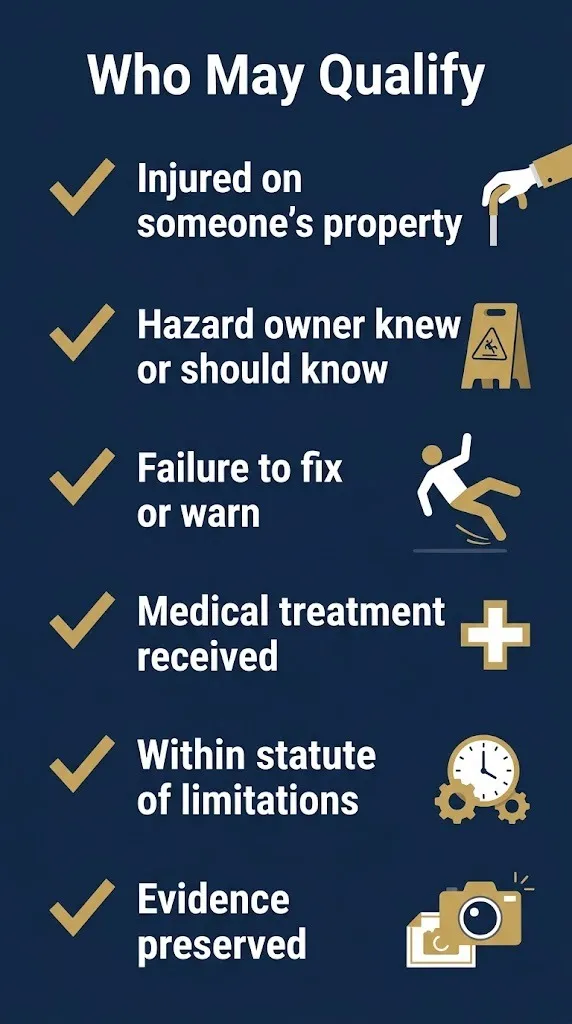
You may qualify for a premises liability settlement if you were injured on someone else’s property because of a hazardous condition they knew or should have known about and failed to fix or warn you about.
The legal standard is negligence: the property owner owed you a duty of care, breached that duty, and that breach caused your injury .
Not everyone injured on someone else’s property has a claim. Your legal status on the property matters:
- Invitees: Customers, delivery workers, and anyone the owner invites for business. Highest duty of care.
- Licensees: Social guests and people with permission to be there. Moderate duty.
- Trespassers: No permission. Very limited duty, usually only to avoid intentional harm .
The most common qualifying scenarios include:
- Slip and fall on a wet floor without warning signs
- Trip and fall on broken or uneven stairs
- Falling merchandise or debris
- Inadequate lighting in a parking lot or stairwell
- Negligent security leading to assault
- Dog bites
- Elevator or escalator malfunctions
You must prove four things: duty, breach, causation, and damages . Missing any one of those elements weakens or kills the claim.
What Evidence Do You Need to Prove a Premises Liability Claim?
You need medical records linking your injury to the incident, photos of the hazard before it was fixed, witness statements, and maintenance or inspection records showing the owner knew about the danger.
Evidence disappears fast in premises liability cases. Floors get mopped. Stairs get repaired. Surveillance footage gets overwritten. The property owner’s insurance adjuster moves quickly to limit exposure .
What to collect immediately:
- Photos of the hazard. The wet floor, the broken step, the uneven pavement. Take them before you leave the scene if you can.
- Witness contact information. Names, phone numbers, and short written statements if possible .
- Incident report. Ask the manager or property owner for a copy before you leave.
- Medical documentation. Go to the doctor within 24 to 72 hours. Delays give the insurer an argument that your injury wasn’t serious or wasn’t caused by the fall .
- Your clothing and shoes. Don’t wash them. Store them in a clean bag. They may become evidence .
A 2026 guide from Kash Legal emphasizes that maintenance logs, inspection checklists, and prior complaints are the gold standard for proving the owner knew about the hazard . Your attorney can request these through a preservation letter or subpoena.
Key Takeaway: Evidence in premises liability cases disappears within days or weeks. Document the scene, get witness information, and seek medical care immediately to protect your claim.
How Do You File a Premises Liability Claim? (Step-by-Step)
Filing a premises liability claim means reporting the incident, documenting the hazard, seeking medical treatment, sending a demand letter to the property owner’s insurer, and negotiating a settlement or filing a lawsuit.
Here are the steps in order:
- Report the incident immediately. Tell the manager, landlord, or property owner. Ask for an incident report copy .
- Seek medical treatment. Go within 24 to 72 hours. Document everything .
- Photograph the hazard and your injuries. Before the condition is fixed .
- Collect witness information. Names, numbers, and brief statements .
- Preserve evidence. Send a written preservation request to the property owner for surveillance footage and maintenance logs .
- Consult a premises liability attorney. Early representation locks down evidence and protects your rights .
- Prepare a demand package. Medical records, bills, lost wage documentation, and a settlement demand .
- Negotiate or file suit. Most cases settle. If not, your attorney files a complaint before the statute of limitations expires .
The statute of limitations for private property claims is typically two years in most states, but government property claims can require notice in as little as 90 days . Missing that deadline can bar your claim entirely.
What Deadlines Apply to Premises Liability Claims in 2026?
The statute of limitations for premises liability is typically two years from the injury date for private property, but government claims can require notice in 90 days or less.
Deadlines are the hardest part of any injury claim. Miss one, and you lose everything.
| Claim Type | Deadline | Source |
|---|---|---|
| Private property lawsuit | 2 years from injury | |
| Government property notice | 90 days to 6 months | |
| Insurance reporting | Days to weeks (policy-dependent) |
Alabama’s two-year statute is typical for private property . New Jersey also uses a two-year window for private claims but imposes a 90-day notice requirement for public property injuries .
The 2026 Kash Legal guide warns that property owners and insurers set their own internal deadlines for reporting, often requiring notice within days of the incident . Missing those administrative deadlines can give the insurer grounds to deny your claim even if you’re within the statute of limitations.
Calendar every deadline the moment you know it. Treat them like a warranty expiration: once they pass, you have no recourse.
What Happens Next in a Premises Liability Case?
Expected next steps include completing medical treatment, sending a demand package, negotiating with the insurer, and either settling or filing a lawsuit before the statute of limitations expires.
Here’s the typical timeline from where you are now to resolution:
- Now to 3 months: Complete medical treatment and reach maximum medical improvement (MMI).
- 3 to 6 months: Your attorney prepares and sends a demand package to the insurer.
- 6 to 12 months: Negotiation period. Most cases settle here.
- 12 to 18 months: If no settlement, file a lawsuit and begin discovery.
- 18 to 24 months: Mediation, trial preparation, or trial if needed.
The single most important thing you control is medical documentation. Every appointment, every treatment note, every bill strengthens your claim.
Frequently Asked Questions
How much is the average premises liability settlement in 2026?
The average falls between $50,000 and $150,000 for moderate injuries with clear liability.
Minor injuries settle lower, around $10,000 to $50,000.
Severe injuries with permanent damage can exceed $1 million .
What is the most common premises liability settlement amount?
The most common range is $25,000 to $100,000 for slip-and-fall injuries requiring medical treatment but not surgery.
Soft tissue injuries and simple fractures dominate this bracket .
How long does it take to get a settlement check after signing a release?
It typically takes 3 to 6 weeks after signing the release for premises liability cases .
Medical liens and insurance processing can extend that timeline.
Can I file a premises liability claim if I was partly at fault?
Yes, but your recovery may be reduced by your percentage of fault.
Most states use comparative negligence rules that reduce your award proportionally .
What if the property owner didn’t know about the hazard?
You may still have a claim if the owner should have known through reasonable inspection.
Constructive notice means a hazard existed long enough that a reasonable owner would have discovered it .
Do I need a lawyer to file a premises liability claim?
No, but cases with legal representation typically settle for higher amounts.
Insurance adjusters negotiate for the company, not for you .
What’s the difference between premises liability and workers’ compensation?
Workers’ compensation covers employees injured on the job, regardless of fault.
Premises liability covers visitors and can provide additional damages like pain and suffering .
How long do I have to file a premises liability lawsuit?
Typically two years from the injury date for private property .
Government claims require notice in as little as 90 days .
If you’re dealing with a premises liability injury, start documenting now. Take photos, get witness names, and see a doctor. Evidence disappears faster than you think.
The deadline that matters most is your state’s statute of limitations. For private property, that’s usually two years. For government property, it can be 90 days. Calendar it today.