Sexual Harassment Lawsuit 2026: Deadlines, Damage Caps and Recent Payouts
Quick Answer
- A sexual harassment lawsuit is a real Title VII claim, not one shared settlement fund.
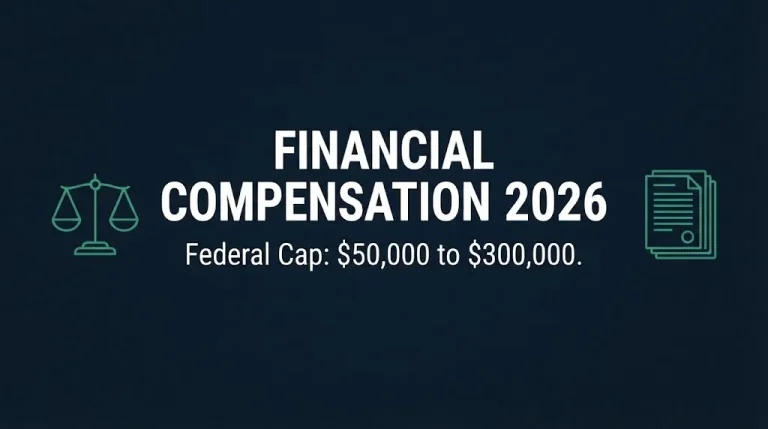
- Federal caps limit compensatory and punitive damages to $50,000 to $300,000; back pay sits outside them.
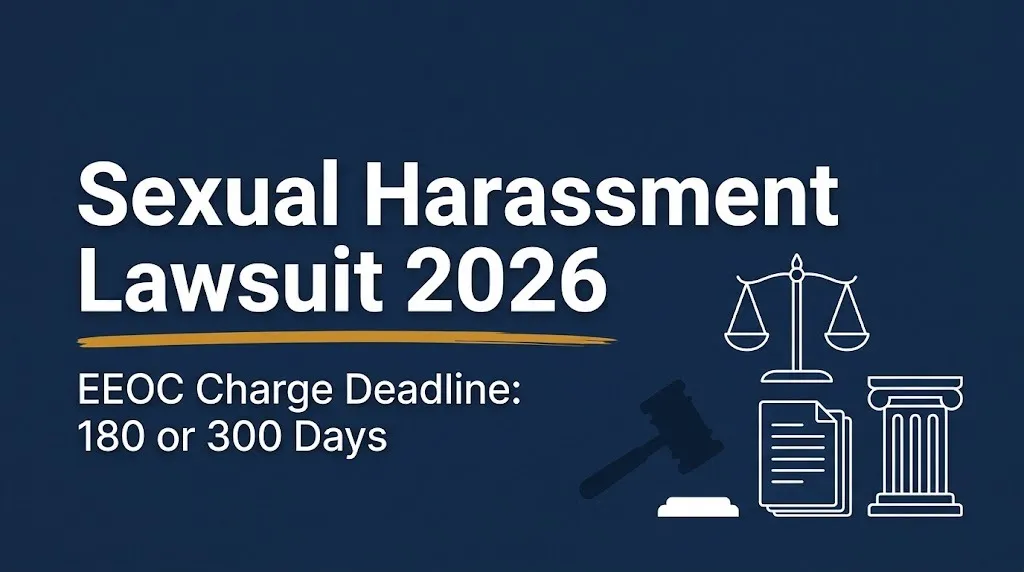
- File an EEOC charge within 180 days, or 300 days if your state has a matching agency.
A sexual harassment lawsuit is a legal claim against an employer, not a form you file for a shared payout. Right now, no single class settlement covers it.
This affects workers at employers with 15 or more employees. The number that matters most is 180 days, stretched to 300 in many states.
Below, you’ll find damage caps, 2026 payouts, and the EEOC changes. One surprise: the EEOC filed a record-low 93 lawsuits in fiscal 2025.
The Facts
| Case | No single case. This guide covers individual and EEOC-filed claims under Title VII |
| Status | Case by case. No open class settlement with a public claim form confirmed |
| Fund Size | Not yet confirmed (no shared fund) |
| Est. Per Person | Not yet determined. Federal cap on compensatory and punitive damages: $50,000 to $300,000 |
| Claim Deadline | EEOC charge: 180 days, or 300 days in many states |
| Administrator | None. No settlement administrator applies |
| Proof Needed | No claim form. Evidence of unwelcome conduct, built case by case |
Is there a single sexual harassment lawsuit settlement you can claim in 2026?
No. You can’t file a claim against one shared sexual harassment lawsuit settlement in 2026, because none is open to the public.
Most payouts come from individual cases or EEOC suits aimed at one employer. Each has its own money, its own terms, and its own clock.
Law Compensate checked court reports and EEOC-linked coverage. We found no class fund with a public claim form for this topic.
Here’s what 2026 coverage did show:
- EEOC suits that end in settlements, like the Bouchon case in Las Vegas.
- Payouts by government employers, including Seattle and Ventura County.
- Small-business resolutions, like the Oklahoma sunroom builder case.
If a named class settlement appears later, check the official settlement website and the court docket first. Until then, treat any text promising a payout with suspicion.
How much is a sexual harassment lawsuit worth in 2026?
A sexual harassment lawsuit has no fixed value, and verified 2026 settlements ran from $150,000 to $3 million in total.
Those figures are single outcomes, not averages. Several covered more than one worker, so your share could look very different.
Think of a headline total like a restaurant bill split many ways. The big number says little about what lands in one person’s pocket.
Value usually turns on four things:
- The employer’s size, which sets the cap on certain damages.
- Lost wages and benefits, which sit outside that cap.
- How long and how severe the conduct was.
- Whether the employer retaliated after a complaint, which can push a case toward punitive damages.
The reports we checked didn’t publish per-person amounts. Treat any exact “average payout” figure with caution.
What are the federal damage caps for sexual harassment claims?
Federal law caps combined compensatory and punitive damages at $50,000 to $300,000, depending on employer size.
| Employer size | Cap on compensatory and punitive damages |
|---|---|
| 15 to 100 employees | $50,000 |
| 101 to 200 employees | $100,000 |
| 201 to 500 employees | $200,000 |
| 501 or more employees | $300,000 |
The cap works like a credit limit on one category of damages. A jury can award more, but the judge trims it back.
One reported case shows the gap. A jury awarded $36 million in punitive damages, and the combined award was cut to $300,000.
A plaintiffs’ attorney quoted by SHRM says the caps were set in 1991 and haven’t been raised. Some state laws work differently, so check yours before assuming the federal cap applies.
Key Takeaway: No shared fund exists, and federal caps limit compensatory and punitive damages to between $50,000 and $300,000.
What have employers paid in 2026 harassment settlements?
Verified 2026 reports show employer payouts from $150,000 to $3 million, with most announced by agencies or local governments.
| Reported | Defendant | Amount | Detail |
|---|---|---|---|
| Mid-July 2026 | Bouchon / Thomas Keller Restaurant Group | $2 million | EEOC suit filed in 2018 in the District of Nevada |
| Aug. 26, 2026 | Sunrooms and More Design Center | $150,000 | Case 5:24-cv-01016, Western District of Oklahoma |
| June 4, 2026 | City of Seattle | $2.6 million | Four female police officers; suit filed July 2024 |
| March 2026 | Ventura County | $3 million | Second woman’s suit, filed in 2022 |
| April 14, 2026 | Ventura County | $285,000 | Former executive’s suit, filed in 2023 |
Read these with a skeptical eye. Ventura County denies the allegations in both settlements. A payout isn’t a court finding.
The Seattle figure comes from an event-tracking aggregator, so confirm it against city records. The other four came from trade or agency-linked coverage.
Does back pay count against the damages cap?
No. Back pay and front pay sit outside the federal cap.
The cap covers compensatory damages (like emotional harm) and punitive damages combined. Lost income is a separate bucket. Uncapped back and front pay may make a plaintiff whole for actual economic harm.
Here’s how the buckets split:
- Capped: compensatory and punitive damages, combined.
- Not capped: back pay and front pay.
- Not money: reinstatement and injunctive relief often accompany damages.
The EEOC also says employers may be required to stop discriminatory practices and take steps to prevent them. That’s why settlements often list training and policy changes next to a dollar figure.
If you lost a job or hours, your wage losses could matter more than the cap. Your own numbers will vary.
Who may qualify to bring a sexual harassment claim?
You may qualify if you work for an employer with 15 or more employees and faced unwelcome sexual conduct tied to your job.
Title VII reaches employers with 15 or more employees. The victim doesn’t have to be of the opposite sex.
You may qualify if:
- Someone made unwelcome sexual advances or comments at work.
- The person was a supervisor, coworker, customer, or vendor.
- The conduct affected your job, hurt your work, or made the workplace hostile.
- You file within the deadline that applies to you.
Federal employees must contact an EEO counselor within 45 days. That’s a different process with a much shorter clock.
Reality Check: Nobody texts you settlement money first, and no court pays a harassment claim you never filed. Be wary of anyone who guarantees a payout or demands fees up front. Verify any notice with the court docket or the agency directly.
Key Takeaway: Back pay sits outside the cap, and 2026 payouts in verified reports ran from $150,000 to $3 million.
How do you file a sexual harassment charge with the EEOC?
You file by submitting a signed charge to the EEOC, and options include mail, online, or in person at a field office.
- Check your deadline: 180 or 300 days from the last incident.
- Write down dates, places, names, and any witnesses.
- Submit your charge to the EEOC through one of the filing options.
- Expect the EEOC to notify your employer within 10 days.
- Watch for the employer’s response, which the EEOC shares with you.
- Reply within about 30 days if the EEOC asks for your response.
- Consider voluntary mediation if the EEOC offers it.
Sources differ on how much of the process happens online. Confirm the current filing options with your local EEOC field office.
Federal employees follow a separate path with a 45-day window. Don’t assume the private-sector steps apply.
How long do you have to file a sexual harassment lawsuit?
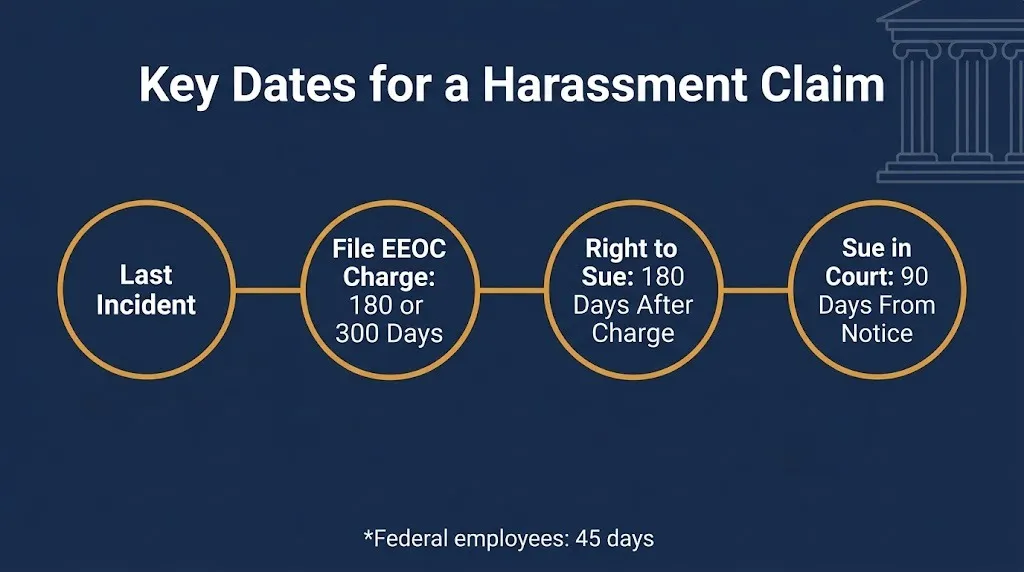
You generally have 180 days to file an EEOC charge, extended to 300 days where a state or local agency enforces a similar law.
| Step | Deadline |
|---|---|
| EEOC charge | 180 days, or 300 days in many states |
| Ongoing harassment | Counts from the last incident |
| Federal employees | 45 days to contact an EEO counselor |
| Request a right-to-sue notice | After 180 days from your charge |
| Sue after the notice | 90 days from receipt |
| New York state law | Up to three years |
Think of it like a store return window. The clock runs from the incident, not from the day you decide to act.
In harassment cases, the clock runs from the last incident, though the EEOC reviews earlier ones. Internal grievances, union grievances, or arbitration generally don’t pause the EEOC deadline.
Courts have allowed equitable tolling in narrow situations. Don’t count on it.
Can your employer force you into arbitration over a sexual harassment claim?
Usually no. A 2022 federal law lets you choose court over a pre-dispute arbitration agreement in sexual harassment disputes.
It’s like fine print in a gym contract that a new law overrides. The clause still exists, but it can’t block this kind of claim.
Here’s what the law does and doesn’t do:
- Does: Bars enforcement of pre-dispute arbitration agreements and joint-action waivers if you choose court.
- Doesn’t: Stop you and your employer from agreeing to arbitrate after a dispute arises.
- Timing: It applies to disputes arising on or after March 3, 2022.
In December 2025, a New Jersey appeals court ruled that the federal law bars arbitration of entire cases that include harassment claims. The Sixth Circuit reached a similar view, noting the word “case” in the statute.
The next section covers a July 2026 ruling that went the other way on older claims.
Key Takeaway: File with the EEOC within 180 or 300 days, then sue within 90 days of your notice.
What proof helps a sexual harassment claim?
Proof can start with your own detailed account, because the EEOC recognizes this conduct is often private, with no eyewitnesses.
Common items people gather include:
- Dated notes of each incident, with places and names.
- Texts, emails, and chat messages.
- Reports to HR and any replies.
- Names of coworkers who saw or heard something.
- Reviews, schedules, or pay records from before and after the conduct.
For quid pro quo claims, the link to a job decision matters. A single advance can count if it’s tied to employment benefits.
Older EEOC question-and-answer guidance suggests telling the harasser the conduct is unwelcome. Do that only where it’s safe for you.
This is a list of common evidence, not a legal checklist. A licensed employment attorney can tell you what your case needs.
How long does an EEOC sexual harassment investigation take?
An EEOC investigation usually takes about 10 months, according to a Cornell Law School summary.
Think of it like a delayed tax refund. The agency has your file, but the timing isn’t yours to control.
You aren’t locked in, though. Under Title VII, you may ask for a right-to-sue notice once 180 days have passed since filing.
Here’s the rough path:
- Charge filed, and the employer is notified.
- Optional mediation, if both sides agree.
- Investigation of the employer’s response and your evidence.
- A decision to sue, or a notice letting you sue yourself.
The EEOC filed only 93 lawsuits in all of fiscal 2025. A notice letting you sue on your own is a realistic outcome.
What changed at the EEOC for harassment cases in 2026?
In January 2026, the EEOC voted 2 to 1 to rescind its 2024 harassment guidance.
| Date | EEOC action |
|---|---|
| Jan. 14, 2026 | First public meeting with a full quorum |
| Jan. 21, 2026 | Voted 2 to 1 to require Commission approval for new lawsuits |
| Jan. 22, 2026 | Voted 2 to 1 to rescind the harassment guidance |
The majority argued the guidance exceeded Title VII, particularly on gender identity. Title VII itself didn’t change. The vote removed agency guidance, not the statute.
Chair Lucas said rescinding the guidance gives employers no license to harass. Her record will show whether that holds.
Context matters here. The 93 suits in fiscal 2025 were a record low, and the agency lacked a quorum for most of that year.
What did the Combs v. Netflix ruling decide about arbitration?
On July 8, 2026, the Ninth Circuit held that the EFAA didn’t apply because the dispute arose before March 3, 2022.
Jessica Combs accepted a Netflix job in May 2017. Her termination came in December 2021, and she sued in July 2024.
Because the dispute and the claim both predated the law, the court sent the case to arbitration. The panel also said when a dispute arises is a fact-specific question in every case.
Here’s the lesson for readers:
- Older claims may still face arbitration.
- Claims arising after March 3, 2022, get stronger protection.
- Your own dates decide which side of the line you’re on.
The ruling lines up with other appeals courts on the effective date. If your employment ended near 2022, the exact dates deserve a careful look.
What counts as sexual harassment under federal law?
Federal law treats sexual harassment as sex discrimination: unwelcome sexual conduct that affects a job, interferes with work, or creates a hostile workplace.
| Type | What it means |
|---|---|
| Quid pro quo | Submission to the conduct is a condition of the job, or is used for job decisions |
| Hostile environment | Conduct that unreasonably interferes with work or creates an intimidating or offensive workplace |
The conduct must be unwelcome. Unlawful harassment can happen without firing or economic injury.
It also doesn’t always look sexual. Sabotaging a coworker’s work because of her sex can qualify.
Not every rude workplace moment crosses the line. Title VII doesn’t reach all sexual conduct, only unwelcome conduct that becomes a term or condition of employment.
Does one incident count as a sexual harassment claim?
Usually a single incident isn’t enough for a hostile environment claim, unless the conduct is quite severe.
A hostile environment claim usually requires a pattern of offensive conduct. That’s why dates and details matter so much.
Quid pro quo works differently. One sexual advance can count if it’s linked to granting or denying a job benefit.
Here’s a quick comparison:
- One offhand comment: usually not enough alone.
- Repeated comments or touching: may build a hostile environment.
- One advance tied to a promotion or firing: may be quid pro quo.
Severity changes the math. A serious assault isn’t judged like a clumsy joke.
If you’re unsure, the EEOC will review all incidents when it investigates, even older ones, as long as one falls inside your deadline.
Key Takeaway: Federal law covers quid pro quo and hostile environment claims, and a single incident usually needs to be severe.
What happens next if you file a sexual harassment claim?
Here’s the typical order of events, with dates only where sources confirm them:
- Day 0: Your clock started at the last incident. File within 180 or 300 days.
- Within 10 days of filing: The EEOC notifies your employer.
- After 180 days: You may request a right-to-sue notice.
- Expected around 10 months: The typical investigation window ends, though timing varies.
- 90 days after you receive the notice: Your lawsuit must be filed or the right is lost.
Frequently Asked Questions
How much can you get from a sexual harassment lawsuit?
There’s no fixed amount, and it depends on your employer’s size and your losses.
Compensatory and punitive damages are capped at $50,000 to $300,000, while back pay sits outside the cap.
Can you sue for sexual harassment without going to the EEOC?
For most Title VII claims, you must file an EEOC charge first.
Such a filing is nearly always required before an employment discrimination lawsuit.
State-law routes can differ, so check your state agency.
Can men file a sexual harassment lawsuit?
Yes, men can file.
The victim doesn’t have to be of the opposite sex.
Does my employer have to be a certain size?
For Title VII, the employer needs 15 or more employees.
That’s the threshold in the federal law.
Some state laws may reach smaller employers.
What if my employer retaliates after I complain?
Retaliation is separately unlawful under federal law.
The EEOC enforces laws against retaliation for complaining or participating in an investigation.
Document any change in your pay, schedule, or duties.
What is a right-to-sue notice?
It’s an EEOC letter that lets you file your own lawsuit.
You must file within 90 days of receiving it, or you lose that right.
Is there a class action settlement I can join right now?
Law Compensate found no open class settlement for this topic as of October 15, 2026.
Individual and EEOC cases have their own terms.
Check the court docket before trusting any notice.
Start with your deadline. Count 180 days from the last incident, or 300 if your state has a matching agency, and put it on your calendar.
Then gather your dates, messages, and witness names. Any notice that promises a payout should be checked against the court docket or the EEOC. The date that matters most: 180 days.