Deferred Compensation Chicago 2026: Your 457(b) Plan, Limits, and Enrollment
Quick Answer
- Chicago’s 457(b) deferred comp plans are voluntary retirement accounts for city, county, and state employees.
- The 2026 contribution limit is $24,500, with higher caps for older workers.
- Enrollment is available year-round through your employer’s plan administrator.
Deferred compensation in Chicago means a Section 457(b) retirement plan offered by government employers. These plans let you set aside pre-tax or Roth dollars from each paycheck to supplement your pension .
The City of Chicago, Cook County, the State of Illinois, and the Chicago Transit Authority all run their own 457(b) plans. Each has different administrators, investment options, and enrollment rules. But the core mechanics are the same across all of them.
This article breaks down the 2026 contribution limits, who can enroll, how the different Chicago-area plans compare, and what changing in the next two years could affect your retirement savings.
The Facts
| Detail | Status |
|---|---|
| Plan type | Section 457(b) deferred compensation |
| 2026 regular limit (under 50) | $24,500 |
| Age 50+ catch-up limit | $32,500 |
| Age 60-63 catch-up limit | $35,750 |
| Special 457(b) catch-up | $49,000 |
| City of Chicago administrator | Nationwide Retirement Solutions |
| State of Illinois administrator | Empower |
| Enrollment | Year-round for most plans |
What is deferred compensation in Chicago?
Deferred compensation in Chicago is a voluntary 457(b) retirement savings plan offered to government employees. You contribute part of your salary before or after taxes, and the money grows tax-deferred until retirement .

The plans are authorized under Section 457 of the Internal Revenue Code. They’re separate from your pension. Cook County’s benefits office describes them as a way to “bridge the gap between your defined benefit plan (pension) and how much you will need while in retirement” .
City of Chicago employees can contribute on a pre-tax or Roth (after-tax) basis. The plan is administered by Nationwide Retirement Solutions .
State of Illinois employees have the same options through Empower. The State 457 plan is open to University of Illinois employees and other state workers .
Key Takeaway: A Chicago deferred compensation plan is a 457(b) account that lets you save extra for retirement on top of your pension. It’s voluntary and funded through payroll deductions.
What are the 2026 contribution limits for Chicago deferred compensation?
The 2026 contribution limits for Chicago-area 457(b) plans are $24,500 for employees under 50, $32,500 for age 50 and older, and $35,750 for ages 60 through 63 .
These limits apply to all the Chicago-area plans:
| Age Group | 2026 Limit | How It’s Calculated |
|---|---|---|
| Under 50 | $24,500 | Standard IRS limit |
| Age 50-59 | $32,500 | $24,500 + $8,000 catch-up |
| Age 60-63 | $35,750 | $24,500 + $11,250 catch-up |
| Age 64+ | $32,500 | $24,500 + $8,000 catch-up |
| Special 457(b) catch-up | $49,000 | Available in 3 years before normal retirement age |
The Special 457(b) Catch-Up is unique to government plans. If you’re within three years of your normal retirement age, you can contribute up to $49,000, which is double the standard limit .
You can’t stack the age 50+ catch-up and the Special catch-up in the same year. You use the more generous one .
Key Takeaway: The 2026 limit is $24,500 for most employees, but older workers can contribute significantly more. The Special 457(b) catch-up allows up to $49,000 in your final three working years.
Who is eligible for deferred compensation in Chicago?
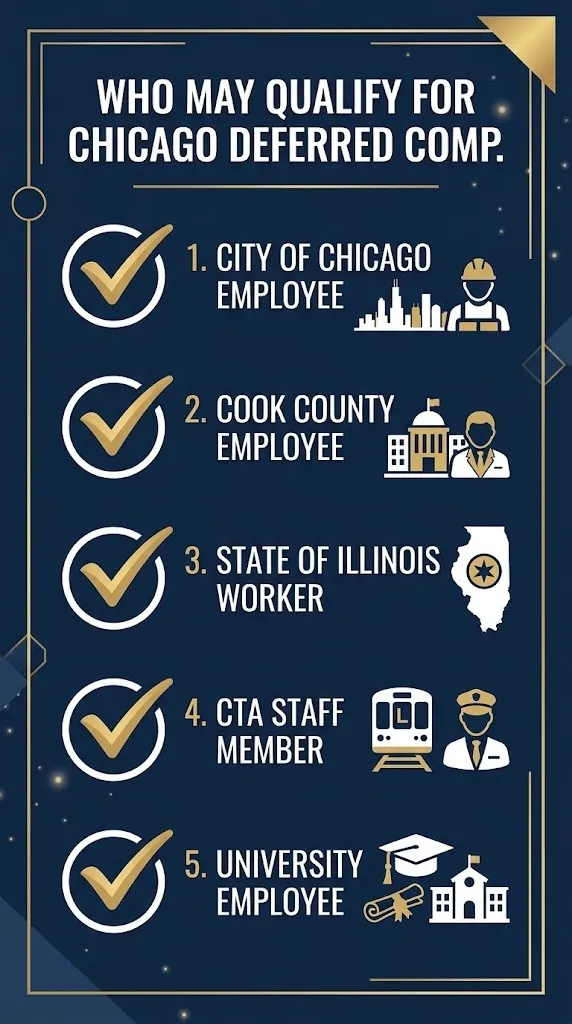
You’re eligible for a Chicago deferred compensation plan if you’re a government employee with a participating employer. That includes City of Chicago workers, Cook County employees, State of Illinois workers, and CTA staff .
Here’s who qualifies under each plan:
- City of Chicago: All city employees are eligible. Some Collective Bargaining Agreements provide matching contributions into a 401(a) match plan .
- Cook County: All county employees can enroll in the 457(b) plan. The county has about 20,000 plan participants .
- State of Illinois: State employees, including University of Illinois staff, are eligible. There are some restrictions for employees hired on or after July 1, 2023 .
- CTA: Chicago Transit Authority employees participate through the CTA Deferred Compensation Committee .
You don’t need to be eligible for state health insurance or other benefits to participate in the State 457 plan. The minimum contribution is $10 per pay period or 1% of gross pay .
How do you enroll in a Chicago deferred compensation plan?
You enroll by contacting your employer’s plan administrator and completing the enrollment form. City of Chicago employees enroll through Nationwide; State of Illinois employees enroll through Empower .
Here’s the enrollment process for City of Chicago employees:
- Visit the Chicago Deferred Compensation Plan website or call 1-877-677-3678 .
- Register for a monthly webinar or schedule an appointment with a Retirement Specialist .
- Choose your contribution amount and investment options.
- Set up payroll deductions.
- Review your beneficiary designations.
For State of Illinois employees, enroll through www.myillinoisdcplan.com or call (833) 969-4532 .
Enrollment is available year-round. You can start, stop, or change your contributions at any time .
How do Chicago deferred compensation plans compare across employers?
Chicago deferred compensation plans are similar in structure but differ in administrators, investment options, and fees. The core 457(b) rules are the same, but the details vary by employer.
| Employer | Administrator | Roth Option | Key Feature |
|---|---|---|---|
| City of Chicago | Nationwide | Yes | Buyout deferral available |
| Cook County | Nationwide | Yes | 20,000 participants |
| State of Illinois | Empower | Yes | Special catch-up to $49,000 |
| CTA | Committee-managed | Available | Separate 457 and 401(k) plans |
The CTA plan is overseen by a Deferred Compensation Committee that meets regularly to review plan performance, hardship distributions, and loan activity. In May 2026, the committee reviewed 117 hardship transactions totaling $356,629 .
Cook County’s plan was amended and restated in July 2025 to update compliance and operations .
What is the City of Chicago deferred compensation plan fee change for 2026?
The City of Chicago plan has new administrative fees and a revised fund lineup effective August 28, 2026 .
Starting September 30, 2026, participants pay a 0.0213% administrative fee assessed monthly. On a $10,000 balance, that’s about $2.13 per year .
The plan is also changing its investment options:
| Fund Being Removed | Mapped To | New Expense Ratio |
|---|---|---|
| T. Rowe Price Retirement Target Date Funds | State Street GTC Retirement Income Builder Series | 0.045% |
| Lord Abbett Developing Growth Fund | Harbor Small Cap Growth Fund | 0.80% |
| Allspring Special Mid Cap Value Fund | Vanguard Mid Cap Index Fund | 0.03% |
The new lineup includes lower-cost index funds from Vanguard, which should reduce overall investment expenses for most participants .
What changes are coming for Chicago deferred compensation in 2027?
Automatic enrollment is coming for newly hired Chicago city employees under Senate Bill 1454, which was signed into law in July 2026 .
Starting January 1, 2027, new Chicago police officers, firefighters, and municipal employees will be automatically enrolled into the city’s deferred compensation plan. The default contribution is 3% of salary, with automatic 1% annual increases .
Employees have 30 days to opt out. They can also opt out of the automatic increases .
The law applies to municipalities with populations of 500,000 or more, which currently means only Chicago. The goal is to supplement Tier 2 pensions, which are less generous than the Tier 1 benefits older workers receive .
State Senator Robert Martwick, who sponsored the measure, said: “Having both a pension and a deferred compensation plan creates a more resilient retirement strategy” .
What happens next
Ongoing: Enrollment remains open year-round for eligible Chicago-area government employees.
September 30, 2026: First administrative fee assessment under the City of Chicago’s new fee structure .
January 1, 2027: Automatic enrollment begins for newly hired Chicago city employees under SB 1454 .
Ongoing: CTA Deferred Compensation Committee meets regularly to review plan performance and participant activity .
TBD: Future IRS contribution limits for 2027.
Frequently Asked Questions
What is deferred compensation in Chicago?
It’s a Section 457(b) retirement plan offered to City of Chicago, Cook County, State of Illinois, and CTA employees. You save pre-tax or Roth dollars through payroll deductions .
What is the 2026 contribution limit for Chicago deferred compensation?
The limit is $24,500 for employees under 50. It rises to $32,500 for age 50+ and $35,750 for ages 60-63 .
Who is eligible for a Chicago deferred compensation plan?
Most government employees, including City of Chicago workers, Cook County employees, State of Illinois workers, and CTA staff .
How do I enroll in the City of Chicago deferred compensation plan?
Contact Nationwide Retirement Solutions at 1-877-677-3678 or visit the plan website. Enrollment is available year-round .
What is the Special 457(b) Catch-Up?
A provision that lets employees within three years of retirement contribute up to $49,000 per year, double the standard limit .
Can I take a loan from my Chicago deferred compensation plan?
Yes. CTA’s plan tracks outstanding loan statistics for both 457 and 401(k) plans. Loan terms vary by employer .
What is changing with Chicago deferred compensation in 2027?
Newly hired Chicago city employees will be automatically enrolled at a 3% default contribution rate starting January 1, 2027 .
Is deferred compensation the same as a pension?
No. A pension is a defined benefit plan funded by your employer. Deferred compensation is a defined contribution account you fund yourself through voluntary contributions .
Closing
Deferred compensation in Chicago gives government employees a way to save extra for retirement beyond their pension. The 2026 contribution limit is $24,500, with higher caps for older workers. Enrollment is open year-round, and automatic enrollment starts in 2027 for newly hired city workers. Check your employer’s plan website to confirm your current contribution rate and investment options.