Felony DWI Lawsuit 2026: What Victims Can Actually Sue For, State Deadlines, and Why the Criminal Case Is Not Your Payday
Quick Answer
- A felony DWI lawsuit is a civil claim for money damages, not a criminal charge or public settlement fund.
- Payouts depend on your injuries, insurance limits, and state law, with no fixed per-person amount.
- Filing deadlines vary by state, from one year in Tennessee to three years in New York and Mississippi.
You searched for felony DWI lawsuit because someone drove drunk, someone got hurt, and you need to know whether there is money at the end of this. There is, but it does not come automatically. The criminal case punishes the driver. The civil case pays you.
A felony DWI is a criminal classification. It usually involves repeat offenses, injury, death, or aggravating factors like a suspended license or a child in the car . That felony label can strengthen your civil claim because a conviction becomes evidence of negligence.
The number that matters most is your state’s statute of limitations. In Tennessee, you have one year to file, extended to two if criminal charges are filed . In New York, Mississippi, and Arkansas, you have three years . Miss that window and your claim disappears.
This article breaks down what a felony DWI lawsuit actually is, what you can recover, how dram shop claims work, and the state-by-state deadlines that decide whether you still have a case.
The Facts
| Item | Detail |
|---|---|
| Case Type | Civil personal injury claim, not a class action |
| Status | Individual cases filed state by state |
| Fund Size | No public fund. Damages depend on injuries and insurance |
| Est. Per Person | Not standardized. Varies by case, injury, and coverage |
| Claim Deadline | State-specific, from 1 to 3 years |
| Administrator | None. Cases go through civil courts |
| Proof Needed | Medical records, police report, BAC evidence, insurance details |
Is a Felony DWI Lawsuit Real or a Scam?
A felony DWI lawsuit is real, but it is not a settlement you sign up for online. It is a civil court case you file with a lawyer against the impaired driver and sometimes the bar or host that served them . There is no administrator, no claim form, and no fund waiting for applicants.
The confusion comes from the word “lawsuit.” People hear it and picture class action settlement pages. This is different. A felony DWI lawsuit is personal. It belongs to the injured person or the family of someone killed.
If a website tells you to “file a claim” for a felony DWI settlement, close it. That is not how these cases work. You hire a lawyer, you file in civil court, and you either settle with an insurer or go to trial.
Key Takeaway: A felony DWI lawsuit is an individual civil case, not a public settlement program with a claim form.
How Much Can You Get From a Felony DWI Lawsuit?
There is no fixed payout amount in a felony DWI lawsuit. What you can recover depends on your medical bills, lost wages, pain and suffering, the driver’s insurance policy limits, and whether punitive damages are available in your state . Some cases settle for policy limits. Others go to trial for far more.
Insurance is the first stop. Most drivers carry minimum coverage that is far too low for a serious DWI crash. In Texas, the minimum is $30,000 per person and $60,000 per accident . A single night in a trauma unit can exceed that. If the driver is underinsured, your own uninsured motorist coverage may fill the gap.
Punitive damages are the wildcard. They are designed to punish the driver, not just compensate you. Some states allow them in DWI cases with no cap. Others limit them sharply .
| Damage Type | What It Covers |
|---|---|
| Compensatory | Medical bills, lost wages, vehicle damage |
| Non-economic | Pain, suffering, emotional distress |
| Punitive | Punishment for reckless conduct, where allowed |
| Dram shop | Claims against bars or hosts that overserved |
Not yet determined: Your specific case value. No two DWI injury claims are identical.
Reality Check
Reality Check: No one texts you settlement money from a felony DWI case. There is no public fund, no administrator, and no online form. If a page claims you can claim DWI settlement cash without a lawyer or court filing, it is collecting your data. Real DWI claims require evidence, medical records, and a filing in civil court.
How Do You File a Felony DWI Lawsuit?
You file a felony DWI lawsuit by hiring a personal injury lawyer, gathering evidence, and submitting a civil complaint in the appropriate court before your state’s deadline. The criminal case does not file it for you. The prosecutor works for the state, not for you .
Here are the steps that actually matter:
- Get medical treatment immediately. Your records are your case.
- Call the police and get the crash report. The BAC evidence lives there.
- Photograph everything. The scene, your injuries, the vehicles.
- Do not give a recorded statement to the other driver’s insurer. They are building a defense .
- Hire a lawyer who handles DWI injury claims. They coordinate with the criminal case.
- File the civil complaint before your state’s deadline. Missing it ends your claim.
- Preserve evidence. Bar receipts, surveillance footage, and witness names disappear fast.
The criminal case can slow the civil one down, but it also helps. A felony conviction makes proving negligence much easier because the jury does not have to re-decide whether the driver was impaired .
What Is the Filing Deadline for a Felony DWI Lawsuit?
The filing deadline for a felony DWI lawsuit depends on your state. It is not a single national rule. Miss it and your right to sue is gone, no matter how strong the evidence.
| State | Injury Deadline | Wrongful Death Deadline |
|---|---|---|
| Tennessee | 1 year, extended to 2 if criminal charges filed | Varies |
| Texas | 2 years | 2 years |
| Georgia | 2 years | 2 years |
| Kentucky | 2 years | 2 years |
| California | 2 years | 2 years |
| New Jersey | 2 years | 2 years |
| New York | 3 years | 2 years |
| Mississippi | 3 years | 3 years |
| Arkansas | 3 years | 3 years |
Dram shop claims can have shorter deadlines than the injury claim itself. Kentucky’s dram shop deadline is one year, while the injury claim runs two . That means the bar claim can expire while the driver claim is still alive.
Key Takeaway: Your state’s deadline is the single most important date in your case, and dram shop claims may expire sooner than the injury claim.
What Is a Dram Shop Claim in a Felony DWI Lawsuit?
A dram shop claim is a lawsuit against the bar, restaurant, or social host that served the impaired driver. It exists because the driver may have no money and minimal insurance, while the establishment may have deeper pockets and its own liability coverage .
New York’s Dram Shop Act and Texas Alcoholic Beverage Code Section 2.02 both allow claims against establishments that serve obviously intoxicated patrons . California’s rule is narrower and applies mainly to serving minors .
These claims are not automatic. You have to prove the establishment knew or should have known the patron was drunk. Bar receipts, surveillance footage, and witness testimony are the evidence that makes or breaks a dram shop case.
Social host liability is a separate theory. If a private person served the driver at a party, some states allow claims, but the rules are stricter and vary widely.
What Happens Next in a Felony DWI Lawsuit?
The case moves through a predictable sequence, but the criminal case running alongside it changes the timing.
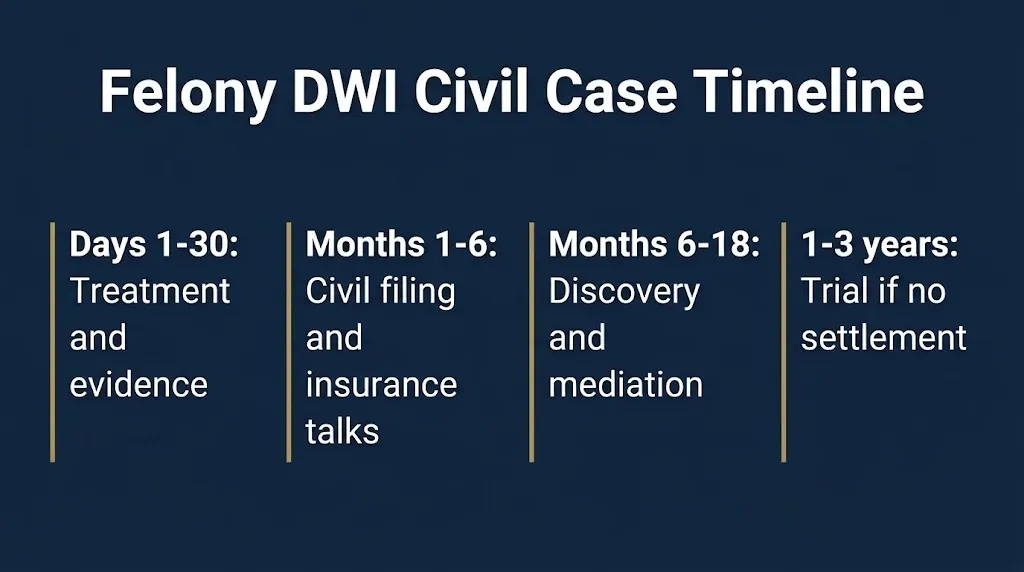
Immediate (Days 1 to 30): Medical treatment, crash report, evidence preservation. Your lawyer investigates.
Expected Months 1 to 6: Civil complaint filed, insurance negotiations begin. The criminal case may still be pending.
Expected Months 6 to 18: Discovery, depositions, mediation. Most cases settle here if liability is clear.
Expected 1 to 3 years: Trial if settlement fails. Felony DWI cases with catastrophic injuries can take longer.
Not yet confirmed: Any specific date for your case. Every jurisdiction moves at its own pace.
The criminal conviction, if it comes, is leverage. It can push the insurer toward a settlement rather than risk a jury seeing the felony on record.
Frequently Asked Questions
Can you sue someone for a felony DWI?
Yes. An injured victim can file a civil lawsuit against the impaired driver, separate from the criminal case.
How much can you sue for in a felony DWI case?
There is no fixed amount. Damages depend on your injuries, lost wages, insurance coverage, and state law on punitive damages.
What is the statute of limitations for a felony DWI lawsuit?
It varies by state, from one year in Tennessee to three years in New York, Mississippi, and Arkansas.
Can you sue a bar for over-serving a drunk driver?
Yes, in many states under dram shop laws, if you can prove the establishment served an obviously intoxicated person.
Does a felony DWI conviction help a civil lawsuit?
Yes. A conviction can be used as evidence of negligence, making the civil case easier to prove.
What if the drunk driver has no insurance?
You may recover through your own uninsured motorist coverage, or by suing the driver personally and pursuing assets.
Can you file a felony DWI lawsuit without a lawyer?
You can, but DWI injury cases involve insurance disputes, evidence preservation, and deadlines. A lawyer is strongly recommended.
How long does a felony DWI lawsuit take?
Straightforward cases can settle in 12 to 18 months. Complex injury cases or trials can take three to five years.
The Bottom Line
A felony DWI lawsuit is not a public settlement. It is your civil case against the driver who hurt you, and it runs on your state’s deadline. In Tennessee, that deadline can be one year. In New York and Mississippi, it is three. Do not wait to find out which one applies to you.