Who Is Exempt From Workers’ Compensation Insurance in California? 2026 Rules
Quick Answer
- True exemptions in California are limited to certain owners, corporate officers with written waivers, and independent contractors who pass the ABC test.
- There is no payout or settlement amount here; this is about who must buy insurance and who can legally skip it.
- The date that matters most is January 1, 2028, when the contractor no-employee exemption expires for most license classifications.
Who is exempt from workers’ compensation insurance in California is a shorter list than most business owners assume. The state requires coverage for essentially every employer with even one employee, including part-time, seasonal, and family workers . The exemptions that do exist are tied to ownership status, written elections, or a worker’s legal classification as a true independent contractor. They are not tied to how small your business is or how few hours someone works.
You are likely searching this because you own a small business, you are a sole proprietor, or you just hired your first helper and someone told you that you might not need a policy. That advice can be expensive if it is wrong. California has no small-business exemption and no headcount threshold . The penalties for skipping coverage start at $1,500 per employee for the stop-order assessment and climb much higher for contractors under newer laws .
This article breaks down the specific categories that can legally go without a standard policy, the paperwork that makes an exemption valid, and the 2028 deadline that will force many contractors back into the insurance market. One detail that catches people off guard: filing an exemption form does not protect you if you later hire someone, and the state is building an audit process to check exactly that .
The Facts
| Item | Status |
|---|---|
| Case Type | Regulatory compliance, not a lawsuit or settlement |
| Status | Active law with a major deadline change on January 1, 2028 |
| Fund Size | Not applicable |
| Est. Per Person | Not applicable, this is about insurance premiums and penalties |
| Claim Deadline | No claim deadline, but penalty exposure starts immediately upon uninsured work |
| Administrator | California Division of Workers’ Compensation and Division of Labor Standards Enforcement |
| Proof Needed | Written waiver, exemption certificate, or independent contractor classification |
Is there a small business exemption from workers compensation in California?
No. California has no small business exemption from workers’ compensation insurance. If you employ even one person, the coverage requirement attaches to your business, regardless of your annual revenue, payroll size, or the number of hours that person works .
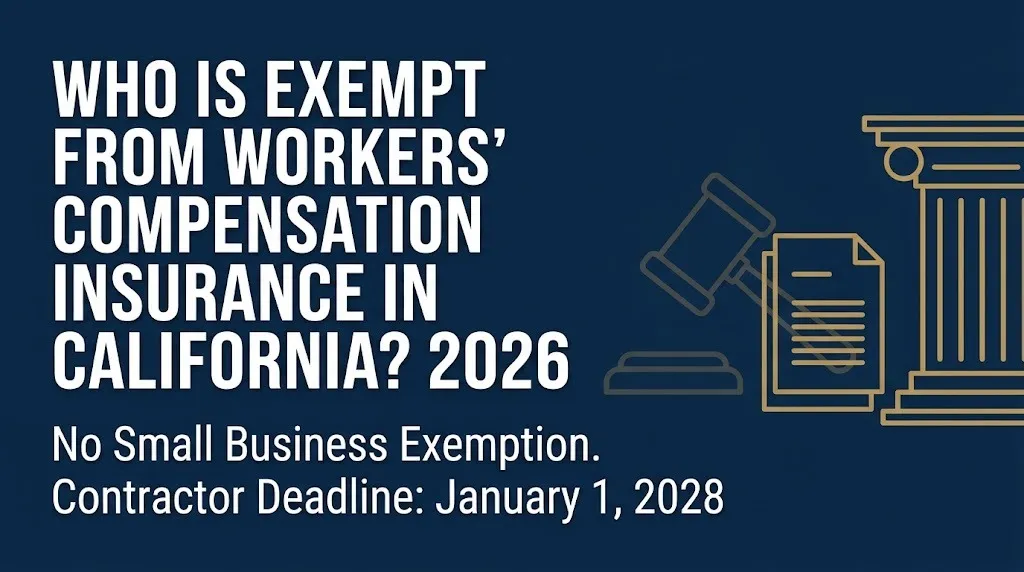
The confusion usually comes from mixing up “small business” with “sole proprietor.” A true sole proprietor with no employees is not an employer in the eyes of the workers’ comp system, so there is no coverage requirement to meet. The moment that sole proprietor hires someone, even a family member who helps a few hours a day, the exemption disappears. The state labor code treats that helper as an employee, and you must have a policy .
Who is actually exempt from workers compensation in California?
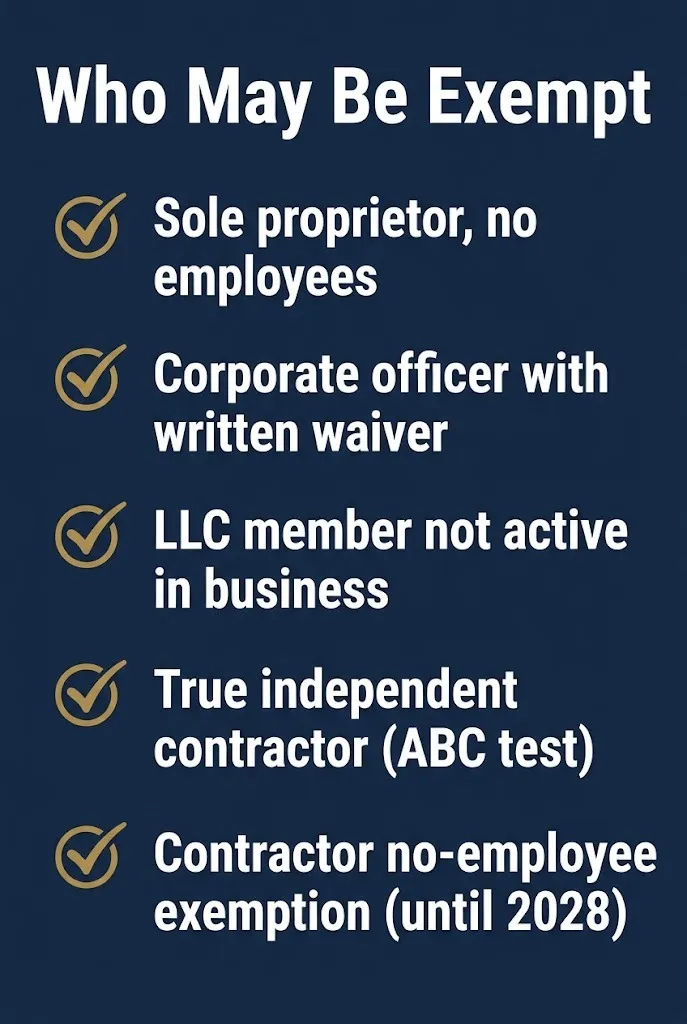
The verified exemption categories are specific: sole proprietors with no employees, certain corporate officers and directors who fully own the business and file a written waiver, LLC members who do not work in the business, and independent contractors who pass the ABC test . Each one has conditions that can void the exemption if you get them wrong.
Sole proprietors can elect to purchase coverage for themselves, but they are not required to do so when they have no employees. Corporate officers and directors who fully own the corporation can come under the workers’ comp provisions only by election, which means they must file the proper written waiver to stay exempt . LLC members who are not active in the business fall outside the employer definition, but managing members who work in the business may not. Independent contractors are not covered by your policy, but California presumes every worker is an employee, and the business bears the burden of proving otherwise under the ABC test .
What is the ABC test and why does it matter for exemptions?
The ABC test decides whether a worker is a true independent contractor or an employee who must be covered. If the worker fails any part of the three-part test, California treats them as an employee, and your exemption claim collapses. This is the single most common way business owners get an exemption wrong.
The test asks three questions. First, is the worker free from your control and direction in how the work is performed? Second, does the worker perform work that is outside the usual course of your business? Third, is the worker customarily engaged in an independent trade or occupation of the same nature as the work you hired them for? A worker who answers no to any of these is likely an employee, which means you need a policy .
Misclassification is expensive. The state labor commissioner presumes the worker is an employee, and the burden sits on you to prove otherwise . If you get it wrong, you face the same uninsured-employer penalties as a business that simply skipped the policy.
What is the contractor no-employee exemption and when does it end?
The contractor no-employee exemption lets certain licensed contractors with zero employees file a certificate instead of buying a policy. That exemption is real, but it is temporary and shrinking. Under current law, the exemption for most classifications expires on January 1, 2028 .
Some classifications already lost the exemption years ago and cannot use it today. If you hold a C-8 Concrete, C-20 HVAC, C-22 Asbestos Abatement, C-39 Roofing, or C-61/D-49 Tree Service license, you must carry coverage even with zero employees . Licenses qualified by a Responsible Managing Employee (RME) also cannot file the no-employee exemption .
For everyone else holding an active contractor license with no employees, the exemption remains available until the 2028 cutoff. The exemption does not renew automatically. You must recertify at every license renewal cycle, and if you hire your first employee, the exemption is invalid and you must get coverage on file within 90 days .
Key Takeaway: A contractor exemption is a temporary paperwork status, not a permanent right, and it disappears the moment you hire a covered worker or the 2028 deadline arrives.
How much are the penalties for claiming an exemption you do not qualify for?
Penalties for a false exemption or uninsured work are steep, and they got steeper in 2026. Under Senate Bill 291, which took effect January 1, 2026, a contractor who employs a covered worker without maintaining coverage faces a minimum civil penalty of $10,000 per violation for a sole-owner licensee and $20,000 per violation for a partnership, corporation, LLC, or tribal business . Subsequent violations can push the total higher.
For non-contractor employers, the general uninsured penalty still applies. The Division of Labor Standards Enforcement can assess the greater of twice the premium you would have paid or $1,500 per employee for the period you were uninsured . Failing to carry coverage is also a misdemeanor punishable by up to one year in county jail, a fine of at least $10,000, or both .
A false exemption is not a paperwork shortcut. It is a violation that the Contractors State License Board can use as cause for discipline, and the board can block your license renewal until you file valid coverage or a valid exemption .
What happens if you are injured and your employer claimed an exemption but should not have?
If you are hurt on the job and your employer was illegally uninsured, you still have a path to benefits. The Uninsured Employers Benefits Trust Fund (UEBTF) can pay workers’ compensation benefits to injured workers whose employers failed to carry required coverage . The fund pursues the employer for reimbursement, but it does not pay penalties or interest to the worker .
More importantly, an illegally uninsured employer loses the exclusive remedy protection that normally blocks civil lawsuits. That means an injured worker may be able to file a civil action against the employer in addition to a workers’ comp claim . The employer also faces criminal exposure and penalty assessments that can reach $100,000 in some cases .
If you suspect your employer is uninsured, the warning signs include cash-only pay, refusal to provide policy information, and being labeled an independent contractor while your schedule and supervision look like a regular job . You can report an uninsured employer to the nearest Division of Labor Standards Enforcement office .
Reality Check: Filing an exemption certificate does not make you exempt if you have employees. The form is a statement about your business on the day you sign it, and the state is building an audit process to verify those claims, with a report to the Legislature due by January 1, 2027 .
What changes on January 1, 2028 for California contractors?
January 1, 2028 is the date the no-employee exemption expires for most active contractor license classifications in California. After that date, active licensees generally must have workers’ compensation insurance or self-insurance on file, regardless of whether they have employees .
The only remaining exemption after 2028 is a narrow one for a no-employee joint venture that files the required statement . If you are a solo contractor holding a B or C-10 license and you plan to stay active, you will need a policy. The alternative is placing your license on inactive status, which lets you stop contracting without buying coverage you will not use .
Insurance carriers expect a wave of first-time policy applications in late 2027. A first-time workers’ comp account takes time to underwrite, and a wrong legal name or license number can delay the certificate filing with the Contractors State License Board. Starting the process in early 2027 is the calmer move .
What happens next in 2026 and beyond?
The exemption rules are not static. The state is actively tightening enforcement, and the 2028 deadline is already driving planning for contractors and their insurers.
Now through December 31, 2026: SB 291 penalties are active. Contractors claiming a no-employee exemption should confirm their classification is still eligible and that they have no covered workers.
Expected early 2027: The Contractors State License Board reports its proposed verification process to the Legislature by January 1, 2027, under SB 291 .
Expected mid to late 2027: First-time workers’ comp policy applications should be filed well before the 2028 cutoff to allow underwriting and certificate processing time.
January 1, 2028: The no-employee exemption expires for most active contractor classifications. Active licensees must have coverage or self-insurance on file.
Ongoing: Non-contractor employers face the same uninsured penalties as before, and the UEBTF continues to pay benefits to injured workers of illegally uninsured employers.
Frequently Asked Questions
Is a sole proprietor exempt from workers compensation in California?
A sole proprietor with no employees is not required to carry workers’ compensation insurance. A sole proprietor who hires even one employee becomes an employer and must carry coverage.
Do corporate officers need workers compensation in California?
Corporate officers and directors who fully own the corporation can be exempt if they file a proper written waiver. Without that waiver, they may be treated as covered employees.
Does California have a family member exemption for workers comp?
No general family exemption exists. A narrow exclusion applies to certain residential employees who worked fewer than 52 hours or earned less than $100 in the 90 days before an injury. Working for a family business is not the same as being employed by a parent or spouse .
Can I be exempt if I only hire independent contractors?
You do not need to cover true independent contractors under your policy. The risk is misclassification. California presumes every worker is an employee, and you must prove the ABC test applies.
What happens if my contractor exemption expires in 2028?
Active contractor licensees who currently hold a no-employee exemption will need workers’ comp insurance or self-insurance on file by January 1, 2028. Placing the license on inactive status is the alternative if you stop contracting.
How do I file for a contractor no-employee exemption in California?
Eligible licensees file the exemption certificate with the Contractors State License Board. The form certifies no-employee status under penalty of perjury, and it must be recertified at each license renewal .
What is the penalty for not having workers comp insurance in California?
For non-contractors, the assessment is the greater of twice the unpaid premium or $1,500 per employee, plus possible criminal fines. For contractors under SB 291, minimum civil penalties are $10,000 per violation for sole owners and $20,000 for other business entities .
Can I sue my employer if they did not have workers comp insurance?
If your employer was illegally uninsured and you were injured, you may be able to file a civil lawsuit in addition to a workers’ comp claim. The employer loses the exclusive remedy protection that normally applies when coverage is in place .