Mandatory Settlement Conference in 2026: What It Means, Who Has to Show Up, and What Happens If You Don’t
Quick Answer
- A mandatory settlement conference is a court-ordered meeting where parties try to settle before trial.
- It does not create a settlement fund or guarantee payment; no payout amount exists.
- The key deadline is court-specific, and missing it can trigger sanctions or dismissal.
A mandatory settlement conference is a court-ordered settlement negotiation. The judge can set one on the court’s own motion or at any party’s request, and the goal is to resolve the case without a trial .
It is not a class action settlement you can join. It is not a claims process. It is a procedural step inside an active lawsuit, and the people affected are the parties already in that case.
This article covers what the conference requires, who must attend, what gets filed beforehand, and what happens when someone refuses to show up. One detail surprises most people: in California, the settlement conference statement must include a good faith settlement demand and a good faith offer, not just a summary of the case .
The Facts
| Item | Verified Detail |
|---|---|
| What it is | A court-ordered settlement negotiation before trial |
| Who sets it | The court on its own motion, or any party by request |
| Key California rule | Rule 3.1380, California Rules of Court |
| Statement deadline | Five court days before the initial conference date |
| Who must attend | Trial counsel, parties, and persons with full settlement authority |
| Consequence of skipping | Sanctions, including dismissal or default in some courts |
| Payout amount | Not applicable; no fund exists |
| Claim deadline | Not applicable; this is not a claims process |
Is a mandatory settlement conference legit or a scam?
A mandatory settlement conference is a legitimate court procedure, not a scam, and it carries no fee to the public. The term describes a judge-ordered meeting inside a pending lawsuit, and courts across the country use it to push parties toward resolution before trial .
Scam risk exists in a different place. Anyone who calls you claiming a mandatory settlement conference means you are owed money is lying. No court orders a conference to hand out cash to strangers.
The legitimate version looks like this: a scheduling order sets a date, the lawyers file confidential statements, and the parties meet with a judge or magistrate. The discussion is off the record and confidential in many courts . Nothing about that process creates a public payout.
How much money can you get from a mandatory settlement conference?
There is no per-person payout from a mandatory settlement conference because the conference itself does not establish a fund. Any money that changes hands comes from a settlement agreement the parties reach, and the amount depends on the claims, the evidence, and the negotiation.
A court order setting a conference is not a verdict. It is not an award. It is a calendar event.
In federal court, a magistrate judge may preside over the conference and push both sides to evaluate the case realistically . If a number is agreed to, it becomes a private settlement term. The public does not get a share.
Key Takeaway: A mandatory settlement conference creates no settlement fund, no claims window, and no public payout amount.
Who has to attend a mandatory settlement conference?
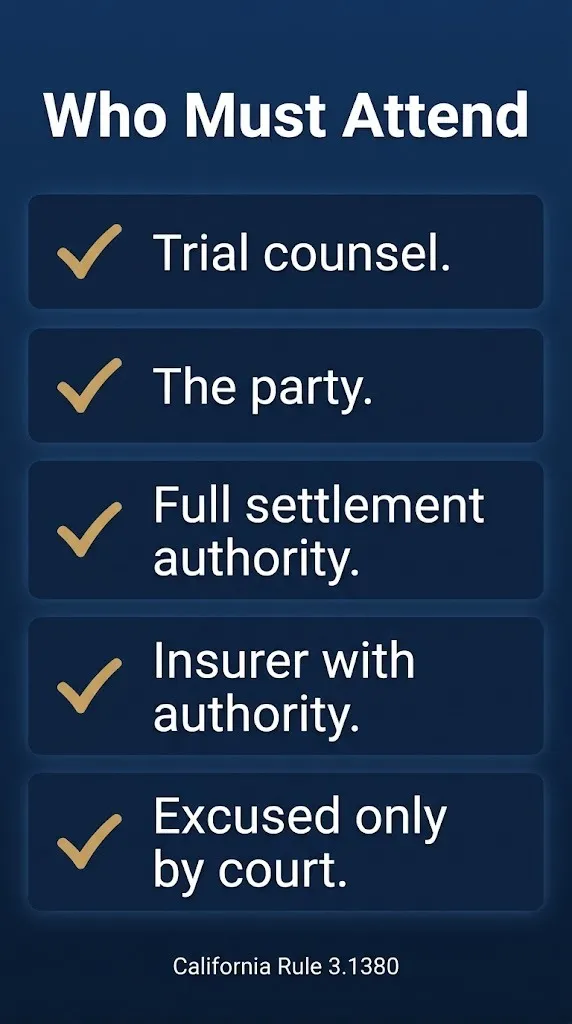
Trial counsel, the parties themselves, and any person with full authority to settle must personally attend a mandatory settlement conference, unless the court excuses them for good cause . That means the person in the room must be able to say yes to a number, not just take notes and call a supervisor.
California Rule 3.1380 is blunt about this. If consent to settle is required from someone else, that person with the consensual authority must be physically present .
Federal courts use similar language. A Southern District of California order required all party representatives and claims adjusters with full and unlimited authority to negotiate and enter a binding settlement to appear, and warned that failure to attend or obtain a proper excuse would be grounds for sanctions .
A common comparison: it is like a home repair estimate where the person who shows up cannot approve any discount. The court does not want that person in the room. It wants the one who can sign.
What must be in a settlement conference statement?
A settlement conference statement must include a good faith settlement demand, an itemized damages breakdown for each plaintiff, a good faith settlement offer from each defendant, and a detailed discussion of the facts and law on liability and damages . California requires this filing no later than five court days before the initial conference date .
This is not a casual summary. The statement must serve the other parties and the court.
Local rules can add more. Some federal judges require the statement to be lodged confidentially with chambers rather than filed publicly, and they limit the page count . A Southern District of California order set a deadline of 21 days before the conference for exchanging formal settlement proposals and 14 days before for meeting and conferring .
The practical effect is simple. The negotiation starts in writing before anyone walks into the room.
How do you prepare for a mandatory settlement conference?
Preparation for a mandatory settlement conference requires five concrete steps: confirm the date and format, gather the damages records, identify who holds settlement authority, draft the statement against the local rule, and prepare a realistic demand or offer.
- Confirm the date, time, and whether the court requires in-person or remote appearance.
- Pull medical bills, lost wage records, repair estimates, or other damage documentation.
- Identify the person with full settlement authority and confirm they will attend.
- Read the local rule for the statement format, page limit, and filing method.
- Draft the good faith demand or offer with a damages itemization attached.
- Serve or lodge the statement by the court’s deadline, not the day before.
Missing the statement deadline matters. California courts can treat a failure to advise the court that a conference will not proceed as a violation of a court order punishable by monetary sanctions .
Reality Check: No one texts you money because a mandatory settlement conference is scheduled. Filing or attending a conference is a court process, and the court does not charge you a fee to participate. Third-party “settlement trackers” demanding payment to “release your conference funds” are not connected to any court.
What happens if you skip a mandatory settlement conference?
Skipping a mandatory settlement conference can result in sanctions, including dismissal of the action, default, an order to pay the other side’s expenses and attorney fees, or other penalties the court chooses . The court treats willful failure to attend as interference with orderly procedure.
California judges have similar tools. A local rule in Sacramento warns that failure to comply can lead to striking pleadings, dismissal, default judgment, or an order to pay reasonable costs and attorney fees .
The sanctions power is not theoretical. A federal order in the Southern District of California stated that failure to attend the conference or obtain a proper excuse would be considered grounds for sanctions .
If you are a party and you cannot attend, the move is to ask the court for an excuse before the date. Not after.
What happens next after a mandatory settlement conference?
After a mandatory settlement conference, three outcomes are possible: the case settles, the case moves toward trial, or the court sets another conference. No public payout schedule follows because the conference is a private negotiation step.
If the parties reach an agreement, the terms are documented and the case is dismissed or resolved by stipulation. If they do not, the case returns to the trial calendar.
Some courts schedule follow-up settlement conferences if the judge believes more discussion will help . Others leave the next step to the assigned trial judge.
For anyone outside the lawsuit, there is nothing to claim. The conference does not open a window for public filings.
Key Takeaway: The only deadline that matters in a mandatory settlement conference is the one in your court’s order, and missing it can cost you the case.
What happens next: timeline for a typical mandatory settlement conference
Before the conference (date set by court): The court issues a notice or scheduling order setting the conference date and any statement deadline .
Five court days before (California): The settlement conference statement is due to the court and the other parties .
Conference date: Parties, trial counsel, and persons with full authority to settle appear, either in person or by video if the court allows .
At the conference: The judge or magistrate facilitates discussion off the record and pushes both sides to evaluate risk .
After the conference: The case either settles in principle, returns to the trial track, or gets a follow-up conference date.
Frequently Asked Questions
Is a mandatory settlement conference the same as a settlement?
No.
A mandatory settlement conference is a meeting ordered by the court.
A settlement is an agreement the parties may or may not reach at that meeting.
Do I have to attend a mandatory settlement conference if I am a party?
Yes, in most courts.
California Rule 3.1380 requires parties and persons with full settlement authority to personally attend unless excused for good cause .
A lawyer cannot substitute for the client’s authority to say yes.
Can a mandatory settlement conference be held by video?
Yes, if the court allows it.
A Southern District of California order set an MSC by video conference and required parties to meet and confer if they wanted an in-person session .
The format is set by the individual judge.
What is a good faith settlement demand?
It is a settlement proposal made in good faith, meaning it is based on a realistic evaluation of the case rather than an arbitrary number.
California requires it in the settlement conference statement .
Does a mandatory settlement conference cost money to attend?
No court fee is charged to the public for a mandatory settlement conference.
The costs are attorney fees and the parties’ own preparation expenses.
What happens if the other side does not show up to a mandatory settlement conference?
The court can impose sanctions on the non-appearing party.
Possible penalties include paying the other side’s expenses, dismissal, default, or other sanctions the court chooses .
How long does a mandatory settlement conference last?
The length varies by court and case.
Some run a few hours; complex cases can run a full day or more.
The court controls the schedule.
Is a mandatory settlement conference public?
The conference discussions are often confidential and off the record.
A federal order stated that MSC discussions would be off the record, privileged, and confidential .
The settlement conference statement may also be lodged confidentially rather than filed publicly.
The one date to put on your calendar
Find the court’s order and read the statement deadline first. In California, that is five court days before the conference, and missing it can bring sanctions . If you are a party, confirm who holds full settlement authority and make sure that person is in the room, by video or in person, on the date the court set. Nothing about a mandatory settlement conference creates a public claim, so ignore any message that says otherwise and check the docket for the real deadline.