Georgia Workers’ Compensation Cheat Sheet 2026: Rates, Deadlines, and What Changed Since 2021
Quick Answer
- Is it legit? Yes. Georgia workers’ comp is a no-fault system run by the State Board of Workers’ Compensation.
- How much? You can receive two-thirds of your average weekly wage, capped at $800 per week in 2026.
- Key deadline: Report your injury to your employer within 30 days and file your claim within one year.
If you’re searching for a Georgia workers’ compensation cheat sheet, you’re probably hurt, confused, and getting conflicting numbers from your employer and the internet. The system is real, it’s administered by the state, and it has hard deadlines that can wipe out your claim if you miss them.
The numbers you see online are a mess because rates change every July 1. A page citing the 2021 max of $675 is four years out of date. This cheat sheet pulls the verified 2026 figures, explains what changed since 2021, and gives you the deadlines that actually matter right now.
The Facts
| Item | Verified Detail |
|---|---|
| System Name | Georgia Workers’ Compensation, administered by the State Board of Workers’ Compensation |
| Coverage Threshold | Employers with 3 or more regular employees |
| 2026 Max Weekly Benefit | $800 per week |
| 2021 Max Weekly Benefit | $675 per week |
| Benefit Rate | 66.67% of average weekly wage |
| Report Deadline | 30 days to notify employer |
| Filing Deadline | 1 year from injury or last authorized medical treatment |
| Administrator | Georgia State Board of Workers’ Compensation |
Is the Georgia workers’ comp cheat sheet real or a scam?
The Georgia workers’ comp system is real, state-run, and not a scam. It’s a no-fault insurance system that pays medical bills and partial wages when you’re hurt on the job. Employers with three or more regular employees must carry coverage.

The scam risk isn’t the system itself. It’s the people who call you after a workplace injury promising to “maximize” your claim for an upfront fee. Georgia workers’ comp doesn’t work through paid claim helpers. You file with the State Board, not a third-party processor.
One trap worth knowing: some employers misclassify workers as independent contractors to dodge coverage. The Board looks at control, not labels. If your boss sets your schedule and tells you how to do the job, you’re likely an employee regardless of what the paperwork says.
How much does Georgia workers’ comp pay in 2026?
Georgia workers’ comp pays two-thirds of your average weekly wage, capped at $800 per week for 2026. The minimum weekly benefit is $50, or your full wage if it’s lower than that .
The cap matters more than most people realize. If you earned $1,500 per week before your injury, two-thirds is $1,000. You still only get $800. The cap is a ceiling, not a floor.
Here’s how the 2026 rate compares to recent years:
| Accident Year | Max Weekly Benefit |
|---|---|
| 2026 | $800 |
| 2023-2024 | $800 |
| 2022-2023 | $725 |
| 2021-2022 | $675 |
The jump from 2021 to 2023 was driven by HB 480, which raised the cap for injuries on or after July 1, 2023 . If you were injured in 2021 and someone quotes you $675 as the current max, they’re reading an old chart.
What is the 2021 Georgia workers’ comp rate?
The 2021 Georgia workers’ comp maximum weekly benefit was $675 per week for injuries occurring between July 1, 2019 and June 30, 2022 . That’s the number that applies if your date of injury falls in that window, not the 2026 rate.
This distinction matters because your benefit rate is locked to your date of injury, not the date you file. A worker hurt in 2021 gets the 2021 cap applied to their claim, even if the case drags into 2026.
Why does anyone still search for the 2021 rate? Some claims take years to resolve. A disputed 2021 injury can still be litigated now. The old rate stays attached to the old injury date.
Key Takeaway: Your benefit cap is set by your injury date, not the current year, so a 2021 injury still uses the $675 weekly maximum.
Who may qualify for Georgia workers’ compensation?
You may qualify for Georgia workers’ comp if you’re an employee at a covered business and you suffered a work-related injury or illness. Coverage kicks in for employers with three or more regular employees, whether those workers are full-time, part-time, or seasonal .
Some workers are exempt. Sole proprietors, partners, independent contractors, and most farm laborers don’t count. Corporate officers and LLC members count toward the three-employee threshold but up to five can sign written exemptions .
The injury must arise out of and in the course of employment. That covers accidents, repetitive trauma, occupational diseases, and aggravation of pre-existing conditions. It does not cover willful misconduct, intoxication, or injuries sustained while skipping work rules.
If your employer had coverage and you were hurt on the job, you likely meet the basic eligibility bar. Whether your specific injury and medical evidence support a claim is a separate question.
What is the deadline to file a Georgia workers’ comp claim?
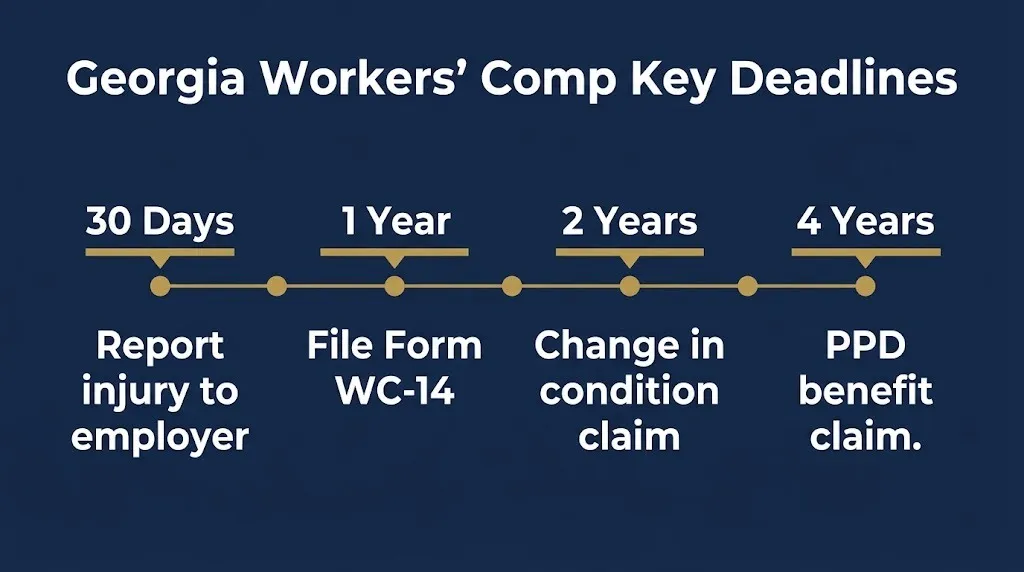
You must report your injury to your employer within 30 days and file a formal claim with the State Board within one year of the injury or last authorized medical treatment . Missing either deadline can end your claim.
The 30-day reporting rule is the first gate. Tell your supervisor immediately, even if the injury seems minor. A delayed report gives the insurer grounds to dispute.
The one-year filing deadline is the hard stop. You file Form WC-14 with the State Board. There are exceptions that can extend the clock, but they’re narrow and fact-specific.
| Deadline | What It Covers | Consequence of Missing |
|---|---|---|
| 30 days | Report injury to employer | Claim may be disputed or denied |
| 1 year | File Form WC-14 with the Board | Right to benefits may be barred |
| 2 years | Change in condition claim | Window closes from last income payment |
| 4 years | PPD claim | Window closes from last income payment |
Think of it like a store return window. The policy is written on the receipt, and no amount of explaining that you “meant to come in sooner” gets you a refund after the date passes.
Key Takeaway: The 30-day reporting rule and the one-year filing deadline are separate gates, and missing either one can kill an otherwise valid claim.
What benefits does Georgia workers’ comp cover?
Georgia workers’ comp covers medical treatment, wage replacement, permanent disability payments, and death benefits for dependents. Medical care comes first, with no copays or deductibles for authorized treatment .
The income benefits break into categories based on your work status:
- Temporary Total Disability (TTD): You can’t work at all. Pays two-thirds of your wage, up to $800 per week, for up to 400 weeks.
- Temporary Partial Disability (TPD): You’re back at work but earning less. Pays two-thirds of the wage gap, up to 350 weeks.
- Permanent Partial Disability (PPD): You have a lasting impairment. Pays based on a body-part schedule and your impairment rating.
- Permanent Total Disability (PTD): You’re permanently unable to work. May continue for life in catastrophic cases.
Medical benefits cover ER visits, surgery, therapy, prescriptions, imaging, and equipment. You choose your doctor from a panel of at least six physicians your employer must post .
Reality Check: No one calls you from the State Board offering to “release” your workers’ comp money for a fee. Filing is free, and the Board doesn’t use paid intermediaries to process claims.
How do you file a Georgia workers’ comp claim?
Filing a Georgia workers’ comp claim starts with reporting the injury, not with paperwork. The formal claim only happens if the employer or insurer disputes benefits.
Here are the steps:
- Report the injury to your supervisor within 30 days.
- Get medical treatment from your employer’s posted physician panel.
- Confirm the employer filed Form WC-1 with its insurer within 21 days.
- File Form WC-14 with the State Board if benefits are denied or delayed.
- Attend any scheduled hearings before an Administrative Law Judge.
- Appeal an adverse decision within 20 days if needed.
The employer files the first form. You only file WC-14 if there’s a dispute. Most straightforward claims never require you to file anything with the Board directly.
What changed in Georgia workers’ comp for 2026?
The biggest 2026 change is procedural, not a rate jump. HB 1001 clarified how the statute of limitations works for occupational disease claims, setting the clock from the date a doctor links your condition to work .
The 2026 maximum weekly benefit remains $800, the same as 2023 through 2025. The rate didn’t increase this year. The cap has been at $800 since July 1, 2023 .
For occupational disease claims, the old rules left the “date of knowledge” open to argument. HB 1001 now pins it to the diagnosis or the date you reasonably should have known, whichever comes first . That’s a meaningful shift for workers with conditions that develop slowly.
If you were injured in 2021, the 2021 rate of $675 still governs your claim. The 2026 update doesn’t retroactively raise old injury caps.
What happens next in a Georgia workers’ comp case?
Most Georgia workers’ comp cases follow a predictable path from injury to resolution. The timeline depends on whether your claim is accepted or disputed.
Here’s the expected sequence:
- Immediately: Report the injury and get treatment from the panel doctor.
- Within 21 days: Employer files Form WC-1 or a notice of denial.
- If denied: You file Form WC-14 to trigger the Board process.
- Months 2 to 6: Medical treatment, impairment rating, and benefit payments.
- If disputed: Hearing before an Administrative Law Judge, then possible appeal.
- At maximum medical improvement: PPD rating assigned and benefits calculated.
The 400-week TTD cap runs from your injury date, not from when payments start. That’s a subtle clock issue that can shorten benefits if there’s a delay in filing.
Frequently Asked Questions
How much is the maximum weekly benefit in Georgia for 2026?
The maximum weekly workers’ comp benefit in Georgia is $800 for 2026. It’s been at that level since July 1, 2023.
What was the Georgia workers’ comp rate in 2021?
The 2021 maximum weekly benefit was $675. That rate applies to injuries occurring between July 1, 2019 and June 30, 2022.
Can I choose my own doctor for a Georgia workers’ comp claim?
You choose from your employer’s posted panel of at least six physicians. You generally cannot pick a doctor outside that panel for authorized treatment.
What happens if I miss the 30-day reporting deadline?
Your claim may be disputed or denied. The 30-day rule is separate from the one-year filing deadline, and missing either can jeopardize benefits.
How long can I receive TTD benefits in Georgia?
TTD benefits can last up to 400 weeks from your injury date for non-catastrophic injuries. Catastrophic cases may qualify for lifetime benefits.
Does Georgia workers’ comp cover repetitive stress injuries?
Yes. Repetitive trauma and occupational diseases are covered if they arise out of your employment and meet the medical causation standard.
Can my employer fire me for filing a workers’ comp claim?
No. Georgia law prohibits retaliation for filing a legitimate workers’ comp claim. Remedies can include reinstatement and back pay.
What You Should Do Now
If you were hurt at work, the clock is already running. Report the injury to your supervisor today, even if you’re not sure how serious it is. The 30-day reporting window closes faster than most people expect.
Then confirm which max rate applies to your injury date. A 2021 injury still uses $675. A 2026 injury uses $800. That single number shapes every weekly check you receive.