How to Protect Assets from Lawsuits in 2026: What Works, What’s Fraud, and the Texas Rules That Change Everything
Quick Answer
- Is it legit: Yes, but only if done early. Asset protection using insurance, LLCs, and trusts is legal. Hiding assets after a claim is fraud.
- How much: Umbrella insurance costs roughly $200 to $300 for the first $1 million in coverage . Trust and LLC setup costs vary widely.
- Deadline: No filing deadline exists. The effective deadline is the date a claim becomes foreseeable. After that, transfers risk being reversed.
If you searched “how to protect assets from lawsuits,” you are probably worried about a specific risk. Maybe you own a rental property, run a business, or work in a profession where one lawsuit could wipe out years of savings. Or maybe someone already threatened to sue, and you want to know what you can still do.
The honest answer splits in two. Legal, pre-claim protection is real and widely used. Post-claim asset shuffling is fraud, and courts are good at spotting it. TUFTA gives creditors a four-year window to unwind transfers made with intent to hinder, delay, or defraud . The timing of your planning matters more than the structure you choose.
This article covers the layers that actually work, the Texas-specific tools that surprise people, and the mistakes that turn a protective plan into evidence against you.
The Facts
| Item | Verified Detail |
|---|---|
| Core Rule | Protection must be established before a claim is foreseeable |
| Fraudulent Transfer Window | 4 years under TUFTA (actual intent), statute of repose |
| Texas Homestead | Unlimited equity protection on primary residence, up to 10 acres urban / 100 acres rural (200 for families) |
| Umbrella Insurance | Roughly $200 to $300 per year for $1 million in coverage |
| Self-Settled Trusts | Not recognized in Texas under Property Code § 112.035(d) |
| Retirement Accounts | Protected under federal ERISA and Texas Property Code § 42.0021 |
Is Asset Protection Legal or Is It Fraud?
Asset protection is legal when you plan ahead of a claim. It becomes fraudulent when you transfer assets after a lawsuit is filed, after a judgment, or after you know a claim is coming.
The distinction is not subtle, and courts enforce it aggressively. Under TUFTA, a transfer made with “actual intent to hinder, delay, or defraud” a creditor can be reversed. The statute of repose gives creditors four years from the transfer date to file, and the clock cannot be extended by procedural delays .
The practical test is foreseeability. If you are a physician with no malpractice claims and you set up an LLC for your investment property, that is planning. If you are served with a lawsuit on Monday and transfer your house into an LLC on Tuesday, that is evidence.
Asset protection attorneys run due diligence before recommending any structure. They look at existing liabilities, pending claims, and the risk profile of the client’s profession . A plan built without that review is a liability, not a shield.
Key Takeaway: The line between protection and fraud is timing, not paperwork. If a claim is foreseeable, the window for moving assets has already closed.
What Is the First Layer of Asset Protection?
The first layer of asset protection is insurance, and umbrella coverage is the most efficient tool for most people. It sits on top of your auto and homeowners policies and pays after those limits are exhausted.
Umbrella insurance is relatively cheap. A first $1 million in coverage typically costs $200 to $300 per year . That premium buys protection against the catastrophic claim that exceeds your primary policy, covering damages, attorney fees, and some claims excluded from underlying policies, like defamation or rental property liability .
The math is straightforward. If your auto policy covers $500,000 and a crash causes $750,000 in damages, the umbrella pays the remaining $250,000. Without it, that $250,000 comes from your savings, your home equity, or your future wages.
Umbrella coverage is not a substitute for legal structures. It covers specific events up to policy limits. It does not protect against general creditor claims, business debts, or judgments that exceed the policy cap . But for the cost, it is the highest-leverage first step you can take.
| Coverage Layer | Typical Role |
|---|---|
| Auto/homeowners | Baseline liability, often too low |
| Umbrella | Excess liability above primary limits |
| Professional liability | Occupation-specific claims |
| D&O (if applicable) | Board or officer claims |
What Does a Texas Homestead Actually Protect?
A Texas homestead protects unlimited equity in your primary residence from most creditor claims, and the size limits are generous: up to 10 acres urban or 100 acres rural for a single adult, and 200 acres for a family .
This is one of the strongest homestead protections in the country. Most states cap the protected equity. Texas does not. Your home is shielded from general creditors, judgment liens, and most forced sales, regardless of how much equity you have built.
The exceptions matter. Homestead protection does not stop foreclosure on a mortgage, tax liens, homeowner association liens, or certain government claims . It also does not survive certain Medicaid estate recovery scenarios after death .
The biggest mistake Texans make is putting the homestead into an LLC “for protection.” That often destroys homestead status and the property tax exemption while providing little real benefit for a primary residence . The homestead is already protected. Wrapping it in an entity can undo the protection you had.
Reality Check: Moving assets after a lawsuit is filed does not protect them. It creates a fraudulent transfer claim that a creditor can use to unwind the transfer and potentially recover fees. Courts see this pattern constantly, and TUFTA gives them four years to act .
Does an LLC Protect Personal Assets from a Lawsuit?
An LLC protects personal assets from business liabilities when it is properly maintained. A judgment against the LLC generally cannot reach your personal bank account, home, or investments. But an LLC does not protect the LLC’s assets from your personal creditors.
The distinction is critical. If your rental property LLC is sued by a tenant, your personal assets are typically shielded. If you are personally sued for a car accident, your creditor can generally reach your ownership interest in the LLC. In many states, that means a charging order: the creditor receives distributions but cannot force a sale of the LLC or seize its assets .
Texas is a charging order state, which makes LLCs more effective for isolating investment assets. But the protection depends on respecting the entity. If you commingle personal and business funds, skip required filings, or treat the LLC as a personal piggy bank, a court can disregard the liability shield.
The practical structure for real estate investors is one LLC per property or per asset category. A lawsuit from one rental should not be able to reach the others. Properly maintained, separate entities create firewalls between risks .
Do You Need a Trust to Protect Assets in Texas?
You may not need a trust, and Texas law limits one popular option significantly. Texas does not recognize self-settled asset protection trusts, meaning you cannot create a trust for your own benefit, keep access to it, and shield it from your creditors .
Texas Property Code § 112.035(d) codifies this rule. When you are both the settlor and a beneficiary, a spendthrift provision does not stop your creditors from reaching your interest in the trust . Some states, including Nevada, South Dakota, Delaware, and Alaska, allow self-settled DAPTs. Texas does not.
For Texas residents, the workable trust structures are different. A spousal lifetime access trust (SLAT) lets one spouse make a completed gift to an irrevocable trust for the other spouse and descendants. The beneficiary spouse can receive distributions, so the family keeps indirect access. Because the funding spouse is not a beneficiary, the self-settled rule does not apply .
Third-party irrevocable trusts, funded by parents or grandparents for children, provide strong protection because the beneficiary is not the settlor. Out-of-state DAPTs are an option for some Texas residents with substantial liquid assets and high liability exposure, but they carry additional cost, trustee fees, and complexity .
| Trust Type | Texas Availability |
|---|---|
| Self-settled DAPT | Not recognized under Texas law |
| SLAT (spousal) | Available, with tax and marital risks |
| Third-party irrevocable | Available, strong protection |
| Out-of-state DAPT | Possible, but complex and costly |
What Assets Are Already Protected in Texas?
Several categories of assets are protected by statute or federal law before you do any planning at all. Retirement accounts, life insurance, and annuities with named beneficiaries are the most common examples.
Employer-sponsored retirement plans governed by ERISA are federally protected from creditor claims. Texas Property Code § 42.0021 extends protection to IRAs and other qualified accounts . Life insurance and annuities payable to a named beneficiary other than your estate are protected under Texas Insurance Code § 1108.051 .
These protections are not absolute. Federal tax liens, certain domestic support obligations, and fraudulent transfer claims can reach some protected accounts. But for general creditor claims, the protection is strong and automatic.
The practical takeaway is to maximize these accounts before building complex structures. A well-funded 401(k) and a properly beneficiary-designated life insurance policy are simpler and more effective than many LLC arrangements, and they require no ongoing maintenance.
What Happens Next If You Face a Lawsuit Threat?
The sequence after a lawsuit threat depends on whether you already have protection in place. If you planned ahead, the steps involve activating insurance and notifying your attorney. If you did not, the options narrow sharply.
Immediately after a threat: Do not transfer, sell, or retitle any asset. Notify your insurer if the claim falls under a policy. Contact an attorney before signing anything.
Weeks 1 to 4: The plaintiff files or demands settlement. Your insurer assigns defense counsel if coverage applies. Your attorney reviews existing structures for exposure.
Months 1 to 6: Discovery begins. Any recent transfers will be scrutinized. If a transfer looks fraudulent, the plaintiff may add a TUFTA claim.
If a judgment is entered: Collection efforts begin. Protected assets, like homestead and retirement accounts, are generally off-limits. Unprotected assets are exposed.
If you planned ahead: The structures do their job. Insurance pays. The LLC shield holds if maintained. The homestead stays protected.
The timeline is the point. Asset protection is not a response to a lawsuit. It is a plan that exists before one.
Frequently Asked Questions
Can I protect my assets after someone threatens to sue me?
No. At that point, the claim is foreseeable. Transfers can be attacked as fraudulent under TUFTA, which has a four-year statute of repose.
Does Texas recognize self-settled asset protection trusts?
No. Texas Property Code § 112.035(d) prevents a settlor from shielding assets in a trust while remaining a beneficiary.
How much does umbrella insurance cost?
Roughly $200 to $300 per year for the first $1 million in coverage, depending on your insurer and risk profile.
Can a creditor take my LLC assets if I am personally sued?
Generally no, unless the creditor can pierce the LLC veil. In Texas, a charging order limits a personal creditor to your distributions, not the LLC’s underlying assets.
Is my Texas homestead protected from all lawsuits?
Mostly, but not from mortgage foreclosure, tax liens, HOA liens, or certain government claims. Equity protection is unlimited on qualifying property.
Do I need a lawyer to set up asset protection?
For LLCs, trusts, and multi-layer planning, yes. The risks of a DIY structure include losing homestead status, creating tax problems, and failing to maintain the entity properly.
What is the biggest asset protection mistake?
Waiting until a claim exists. The second biggest is using online forms that do not fit Texas law or your specific asset mix.
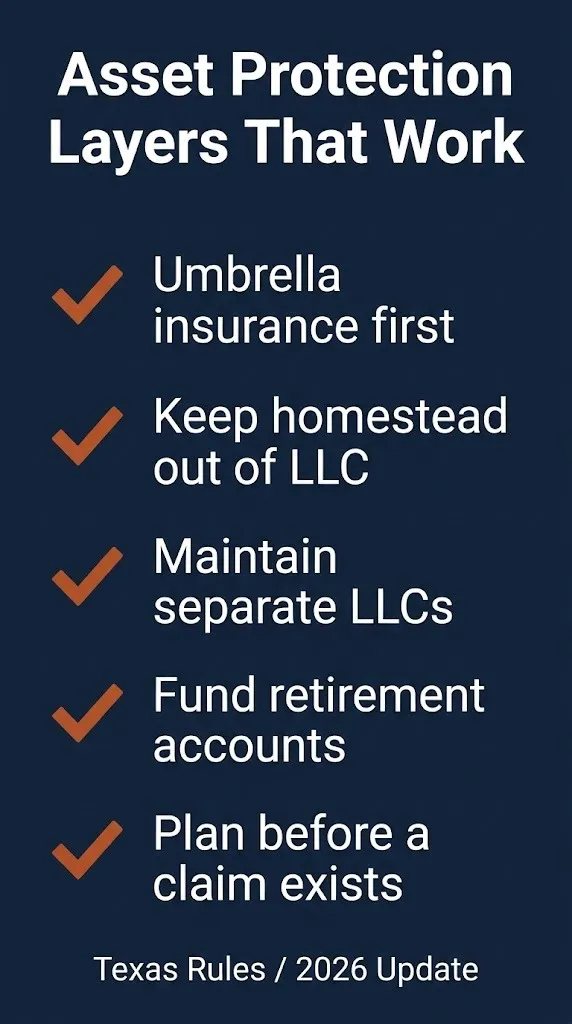
Asset protection works when it is boring and early. Umbrella insurance, a properly maintained LLC, a homestead you have not wrapped in an entity, and retirement accounts with named beneficiaries cover most of the risk for most people.
The date that matters is the one you cannot see: the day a claim becomes foreseeable. After that, TUFTA’s four-year window means every transfer you make is evidence. Build the plan now, while there is nothing to unwind.