Verizon Class Action Settlement 2026: Administrative Charge Claims, Deadlines, and Payout Dates
Quick Answer:
- The Verizon settlement is a real, court-approved $100 million class action over undisclosed administrative fees charged to postpaid wireless customers.
- Current and former Verizon customers who paid these fees between 2016 and 2023 may receive up to $100 per account.
- The claim deadline is April 15, 2026, and payments are expected to begin in the second half of 2026.
If you have a Verizon wireless bill, you have seen the administrative charge. It appears every month, a line item somewhere in the fees section, small enough that most people never question it. That charge is the subject of a $100 million class action settlement, and if you were a Verizon postpaid wireless customer anytime between January 1, 2016, and November 8, 2023, you may be entitled to a payment.
This article explains what the lawsuit alleged, who qualifies, how much you can expect, how to file a claim, and when checks will arrive. Every figure and date in this article comes from the official settlement website and the court-approved settlement agreement, not from a law firm advertisement.
One detail that surprises many customers: you do not need to prove you paid the fees. Verizon’s own billing records identify eligible accounts. The claim form asks for basic information, not receipts or old bills. If you were a postpaid wireless customer during the class period, you are likely already in the system.
| The Facts | |
|---|---|
| Case | In re: Verizon Wireless Administrative Charge Class Action, U.S. District Court for the District of New Jersey |
| Case Number | 2:23-cv-00178 |
| Current Status | Final approval granted; claim period open |
| Total Settlement Fund | $100,000,000 |
| Est. Per Person | Up to $100 per account; pro rata reduction possible |
| Claim Deadline | April 15, 2026 |
| Exclusion / Opt-Out Deadline | Passed; the opt-out period has closed |
| Final Approval Hearing | Final approval granted by the court |
| Expected Payment Window | Second half of 2026 |
| Settlement Administrator | Kroll Settlement Administration |
| Proof Required | Claim form with Notice ID and Confirmation Code; no receipts or bills needed |
Is the Verizon Class Action Lawsuit Real?
Yes. The Verizon administrative charge class action settlement is a real, court-approved resolution of a lawsuit that alleged Verizon charged postpaid wireless customers undisclosed and deceptive administrative fees. The case is pending in the U.S. District Court for the District of New Jersey. The court granted final approval to the $100 million settlement.
The lawsuit alleged that Verizon advertised flat monthly rates for its postpaid wireless plans but then added an administrative charge to every bill that was not disclosed in the advertised price. The plaintiffs argued that this practice violated consumer protection laws, including state deceptive trade practices statutes and breach of contract claims. Verizon denied all allegations and admitted no wrongdoing. The settlement resolves the claims without a trial.
Notices were mailed and emailed to eligible customers. The notice included a Notice ID and Confirmation Code needed to file a claim. If you received a notice, the settlement is real and your account was identified as eligible. If you did not receive a notice, you may still file a claim if you believe you fall within the class definition.
Scam risk exists with any high-profile class action. The real claim form never asks for a credit card number, a Social Security number, or any payment. Filing is free. The settlement administrator, Kroll Settlement Administration, is a legitimate firm that handles major class action distributions. The official settlement website is the only place to file.
Key Takeaway: The Verizon settlement is a legitimate, court-supervised $100 million class action; filing a claim costs nothing, and you should never pay anyone to file for you.
How Much Will Each Person Get from the Verizon Settlement?
The maximum payment is $100 per eligible account. However, the actual amount may be lower depending on how many valid claims are filed. This is the pro rata reduction that applies to almost all class action settlements. If the total value of approved claims exceeds the $100 million fund, each claim is reduced proportionally.
The settlement agreement specifies that each eligible account will receive a base payment, calculated from the total fund after deducting attorney fees, administrative costs, and any service award to the named plaintiffs. Attorney fees in a settlement of this size typically run 25 to 33 percent of the fund. The court must approve the fee award, and that approval has been granted.
After fees and costs, the remaining fund is divided among all valid claims. If 2 million people file claims, the per-person payout will be lower than if 1 million people file. This is why the “up to $100” language matters. It means $100 is the ceiling, not the floor.
A rough estimate, based on similar consumer class actions with comparable funds and class sizes, suggests individual payments may land in the $25 to $75 range, but the settlement administrator has not published a confirmed per-claimant amount. The final number depends on the claims rate, which will not be known until after the April 15, 2026 deadline.
| Payout Scenario | Estimated Per-Person Payment | Notes |
|---|---|---|
| Low claims rate (1 million valid claims) | Up to $60 to $100 | Near the $100 maximum |
| Medium claims rate (2 million valid claims) | $30 to $50 | Typical for settlements of this size |
| High claims rate (3 million plus valid claims) | $15 to $30 | Pro rata reduction applies significantly |
These are illustrative ranges, not confirmed amounts. The actual per-person payout will be published by Kroll after the claims period closes.
Key Takeaway: The $100 maximum is not a guarantee; your actual payment depends on how many people file, and payments are likely to fall somewhere between $15 and $100.
Who Is Eligible for the Verizon Class Action Settlement?
You may be eligible if you were a Verizon postpaid wireless customer who paid administrative charges on your monthly bill between January 1, 2016, and November 8, 2023. The class definition includes current and former customers. You do not need to still be a Verizon customer to file.
The key eligibility criteria are:
- You had a Verizon postpaid consumer wireless account. Prepaid accounts are not included.
- Your account was billed administrative charges during the class period. If you never paid an administrative charge, you may not be eligible.
- Your account was in your name. Business accounts may have separate eligibility rules; check the settlement agreement for the business account subclass.
- The class period runs from January 1, 2016, through November 8, 2023. Accounts active for any portion of that window may qualify.
Verizon customers who only had prepaid service, Verizon Fios home internet, or Verizon landline accounts are not part of this settlement. This class action specifically covers postpaid wireless service.
Multiple accounts held by the same person may each qualify for a separate claim, up to the $100 per account maximum. If you had three Verizon postpaid accounts during the class period, you may be eligible to file three claims.
Reality Check: Filing is always free. The claims administrator will never ask for your credit card, bank account number, or Social Security number to process a claim. If any website or person asks for payment to file your Verizon claim, it is a scam. File directly through the official settlement website only.
How to File a Verizon Settlement Claim
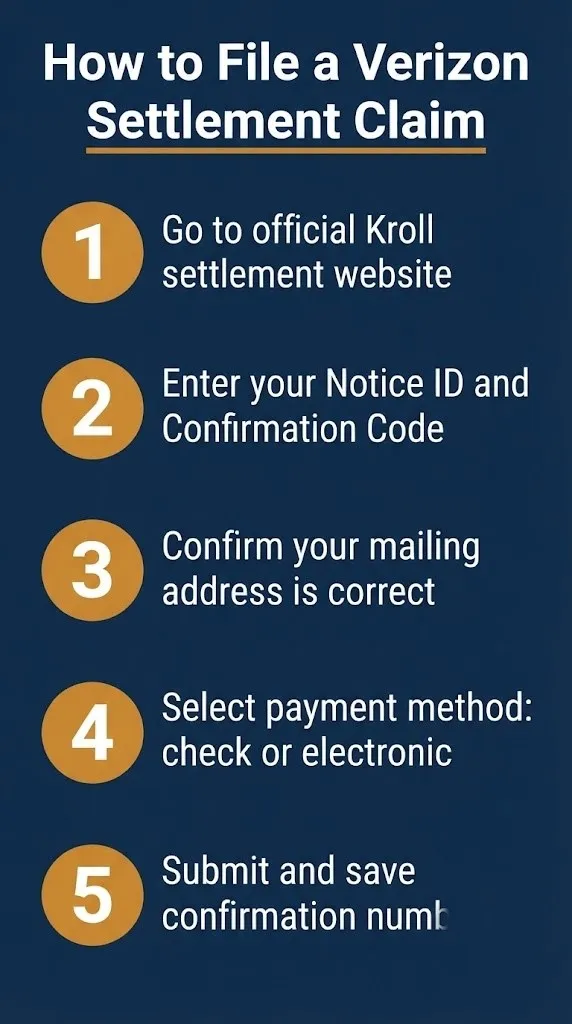
The claim process is straightforward and entirely online. You do not need a lawyer. You do not need old bills. Verizon’s records are used to verify eligibility. Here are the steps to file:
- Go to the official settlement website run by Kroll Settlement Administration. Confirm you are on the correct site by checking that it is the official Verizon administrative charge settlement page.
- Locate your Notice ID and Confirmation Code. If you received an email or postcard notice, these codes are printed on it. If you did not receive a notice, there is an option to file without a Notice ID.
- Enter the Notice ID and Confirmation Code into the claim form. This autofills your account information from Verizon’s records.
- Confirm your contact information. Verify that your mailing address is correct. If you want electronic payment, select that option and provide your PayPal, Venmo, or direct deposit information if available.
- Review your eligibility information displayed on the form. The system will show the accounts associated with your Notice ID.
- Submit the form. You will receive a confirmation number. Save this number or take a screenshot. It is your proof of filing.
- If your contact information changes before payments are mailed, update it immediately through the settlement website or by calling Kroll directly.
If you did not receive a notice but believe you qualify, you can still file. Use the option to file without a Notice ID. You will need to provide your name, mailing address, and the Verizon wireless phone number associated with the account. The administrator will cross-check your information against Verizon’s records.
When Is the Verizon Settlement Claim Deadline?
The deadline to file a claim is April 15, 2026. This is a hard deadline set by the court. Claims filed after April 15, 2026, will not be accepted.
The exclusion and opt-out deadline has already passed. If you did not opt out, you are bound by the settlement’s release. This means you cannot sue Verizon separately for the same claims, whether you file for payment or not. Filing a claim does not waive any rights beyond the release already agreed to by the class.
The deadline for objections has also passed. The final approval hearing has been held, and the court has granted final approval. The settlement is binding.
If you are reading this after April 15, 2026, the claims window has closed. There is no second chance to file. This is true of virtually all class action settlements. Once the court-ordered deadline passes, the administrator cannot accept late claims.
What Is the Verizon Administrative Charge?
The administrative charge is a monthly fee that appeared on Verizon postpaid wireless bills. Verizon described it as a charge to recover costs associated with network operations, regulatory compliance, and other business expenses. The lawsuit alleged that the fee was essentially a hidden price increase, not disclosed in advertised rates, and not tied to any actual government or regulatory cost.
The charge was typically a few dollars per month per line. Over months and years, it added up. A customer with two lines paying $3.30 in administrative charges monthly over five years paid approximately $396 in these fees alone. The settlement addresses only a portion of what customers paid, which is typical in class action resolutions where litigation risk and the cost of proving damages are weighed against the certainty of a settlement.
Verizon is not the only carrier to face litigation over administrative fees. Similar lawsuits have been filed against AT&T, T-Mobile, and other telecom providers. The legal theory in each case is substantially the same: the fees are deceptive because they are not included in the advertised price and are not mandatory government charges, even though customers reasonably believe they are.
The settlement does not require Verizon to stop charging the administrative fee. Verizon has adjusted its disclosures since the lawsuit was filed, but the fee itself remains on current bills. The settlement resolves past claims, not future billing practices.
When Will Verizon Settlement Payments Be Mailed?
Payments are expected to begin in the second half of 2026. No specific mailing date has been published by Kroll Settlement Administration. This is standard procedure. Administrators do not announce an exact date until checks are in the mail.
The timeline from the claim deadline to payment usually runs three to six months. After the April 15, 2026 deadline, Kroll must process claims, verify eligibility, calculate pro rata shares, and obtain final distribution approval from the court. Then checks are printed and mailed, or electronic payments are processed.
Payment options include a paper check mailed to the address on the claim form, or an electronic payment via PayPal, Venmo, Zelle, or direct deposit. If you selected electronic payment on your claim form, you will likely receive your money faster than those waiting for a paper check. Electronic payments can post within days of the distribution date. Paper checks can take weeks.
If you move before payments are distributed, update your address with Kroll immediately. Use the contact information on the official settlement website. Checks mailed to an old address will delay your payment by months. You will need to contact Kroll to request a reissued check.
How Do I Check My Verizon Settlement Claim Status?
You can check your claim status through the official settlement website administered by Kroll. You will need the Notice ID and Confirmation Code from your notice, or the confirmation number you received when you filed your claim.
The status check tool on the settlement website typically shows whether your claim has been received, whether it is under review, whether it has been approved, and whether payment has been issued. If your claim shows as deficient, it means there is a problem that needs to be corrected. Contact Kroll immediately if your claim status indicates an issue.
Do not contact Verizon customer service about the settlement. They cannot access the claims database. Only Kroll, the court-appointed settlement administrator, can tell you the status of your claim.
If you lost your Notice ID and confirmation number, the settlement website may have a lookup tool that uses your name and mailing address. If that tool does not work, call the toll-free number listed on the official settlement website. Be prepared to verify your identity.
Key Takeaway: Track your claim through Kroll, not Verizon; the administrator controls the claims database, and your Notice ID is your key to accessing your status.
What Happens Next
The settlement is in its final administrative phase. The claim deadline of April 15, 2026, is the next milestone that matters. After that, here is what to expect:
- April 15, 2026: Claim filing deadline. No late claims accepted after this date.
- April to July 2026: Claims processing and verification by Kroll. Invalid or deficient claims will be flagged. If you receive a deficiency notice, respond immediately.
- August to October 2026 (expected): Pro rata calculation and final distribution approval from the court.
- October to December 2026 (expected): Payments distributed. Electronic payments post first. Paper checks mailed in a single batch.
- 60 to 90 days after mailing: Uncashed check deadline. Checks not cashed within this period may be voided and the funds redistributed or donated to a cy pres recipient.
Frequently Asked Questions
Do I need old Verizon bills to file a claim?
No. The claim form does not require receipts or old bills.
Verizon’s account records are used to verify your eligibility.
Your Notice ID links to the billing data already provided by Verizon to the administrator.
Can I file a claim if I am no longer a Verizon customer?
Yes. Former customers are included in the class definition.
You must have been a postpaid wireless customer during the class period.
You do not need an active Verizon account to receive payment.
Is there a limit on how many claims I can file?
You may file one claim per eligible account.
If you had multiple Verizon postpaid accounts during the class period, each may qualify.
The $100 maximum applies per account, not per person.
Will I get my settlement payment by direct deposit?
Possibly. The claim form offers electronic payment options.
PayPal, Venmo, and direct deposit may be available depending on the administrator’s payment platform.
Electronic payments typically arrive faster than paper checks.
What if I threw away my Verizon settlement notice?
You can still file. Use the “file without a Notice ID” option on the official settlement website.
You will need to provide your name, address, and the Verizon phone number associated with the account.
The administrator will verify your information against Verizon’s records.
Is the Verizon settlement taxable?
Settlement payments may be taxable depending on your individual tax situation.
Class action settlement payments that represent a return of fees paid are generally not taxable as income.
Consult a tax professional for advice specific to your circumstances.
Will this settlement increase my Verizon bill?
No. The settlement is funded by Verizon as a separate payment.
The settlement does not authorize Verizon to impose new charges to recover the settlement cost.
Your current bill is unaffected by the claims process.
Can I still sue Verizon separately for the administrative charges?
No. If you did not opt out by the exclusion deadline, you are bound by the settlement’s release.
The opt-out deadline has passed.
You cannot file a separate lawsuit for the same claims covered by this settlement.
What You Should Do Now
File your claim before April 15, 2026. The form takes approximately five minutes. You need your Notice ID and Confirmation Code if you received a notice, or your name and old Verizon phone number if you did not. Filing costs nothing. Do not pay anyone to file for you.
After filing, save your confirmation number. Update your mailing address with Kroll if you move. Watch for a payment in the second half of 2026. If you selected electronic payment, check the email account or payment platform you specified. If you opted for a paper check, check your mail.