Debt Settlement vs Debt Consolidation 2026: Key Differences, Risks, and Which Works
Quick Answer
- Debt settlement means negotiating to pay less than you owe, often after stopping payments and going delinquent.
- Debt consolidation means combining multiple debts into one new loan, usually requiring good credit and steady income.
- Neither option has a government application deadline, but debt settlement carries serious credit and lawsuit risks.
If you are drowning in credit card debt, you have probably seen ads for debt settlement and debt consolidation. They sound similar. They are not. One can help you pay off debt faster. The other can wreck your credit and still leave you sued.
Debt settlement means you stop paying creditors and negotiate a lump sum for less than the full balance. Debt consolidation means you take out a new loan to pay off existing debts, then repay the new loan over time.
This article explains the verified differences, the costs, the risks, and how to decide which path, if either, makes sense for you in 2026.
The Facts
| Detail | Verified Information |
|---|---|
| Debt Settlement | Negotiate to pay less than full balance |
| Debt Consolidation | Combine debts into one new loan |
| Credit Impact of Settlement | Severe, accounts go delinquent |
| Credit Impact of Consolidation | Moderate, new loan inquiry |
| Settlement Fees | 15 to 25 percent of enrolled debt |
| Consolidation Rates | Vary by credit score, often 7 to 25 percent APR |
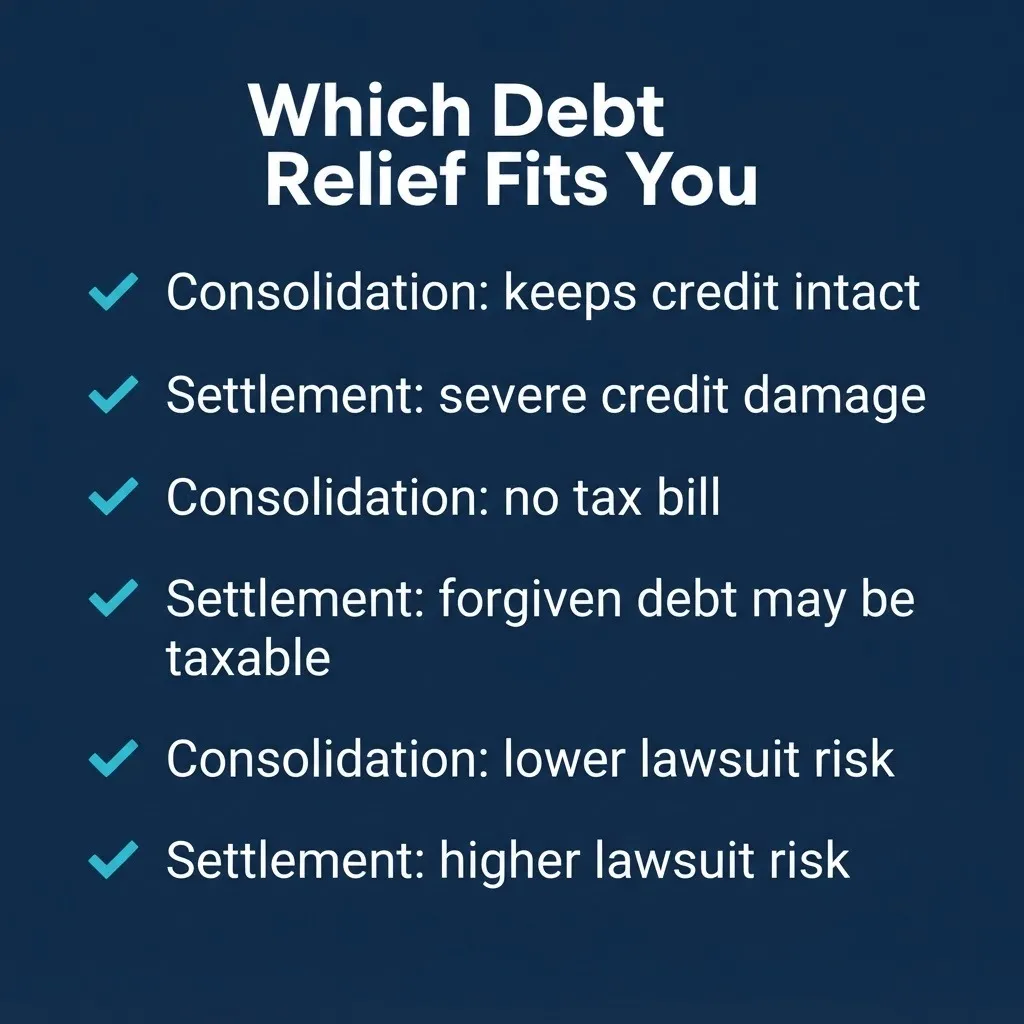
| Lawsuit Risk | Higher with settlement, lower with consolidation |
What Is the Difference Between Debt Settlement and Debt Consolidation?
The difference between debt settlement and debt consolidation is fundamental. Settlement reduces what you owe. Consolidation restructures how you pay it.
Debt settlement means you stop paying creditors, let accounts go delinquent, and then negotiate to pay a lump sum that is less than the full balance. A settlement company typically handles the negotiation and charges a fee based on the enrolled debt.
Debt consolidation means you take out a new loan, often a personal loan or balance transfer card, and use it to pay off multiple debts. You then repay the new loan on a fixed schedule.
One reduces the principal. The other moves it. The risks are different. The credit impacts are different. The timelines are different.
Key Takeaway: Settlement lowers the amount owed. Consolidation combines debts into one new payment. They are not interchangeable.
Is Debt Settlement or Debt Consolidation Better for Your Credit?
Debt consolidation is generally better for your credit than debt settlement. The reason is simple. Settlement requires delinquency. Consolidation does not.
When you settle a debt, you stop paying first. Those missed payments are reported to credit bureaus. Your score drops, often by 100 points or more. The settled accounts remain on your credit report for seven years.
Consolidation does not require missed payments. You apply for a loan, pay off the old debts, and make on-time payments on the new loan. Your score may dip slightly from the credit inquiry, but it recovers.
If your credit is still good, consolidation is the safer choice. If your credit is already damaged, the additional harm from settlement matters less.
Key Takeaway: Consolidation protects your credit. Settlement damages it, sometimes severely.
How Much Does Debt Settlement Cost?
Debt settlement is not free. Companies typically charge 15 to 25 percent of the total debt you enroll. That fee is often collected before any settlement is reached.
If you enroll $30,000 in debt, the fee could be $4,500 to $7,500. You pay that on top of whatever the settled amount turns out to be.
The Federal Trade Commission has rules about when settlement companies can charge fees. A company cannot collect a fee for a debt until it has actually settled that debt. But the total fee still applies.
Some people save money through settlement. Others end up paying fees and still get sued by creditors. The outcome is not guaranteed.
Key Takeaway: Debt settlement fees are high, often 15 to 25 percent of enrolled debt, and savings are not guaranteed.
How Much Does Debt Consolidation Cost?
Debt consolidation costs depend on the loan terms you qualify for. Interest rates in 2026 range from about 7 percent for excellent credit to over 25 percent for poor credit.
A personal loan for consolidation typically has a fixed rate and a fixed term, often three to seven years. The cost is the interest you pay over that term.
Balance transfer cards often offer a 0 percent introductory rate for 12 to 21 months, but they charge a transfer fee, usually 3 to 5 percent of the balance.
The total cost depends on your credit, the loan amount, and how quickly you repay. Consolidation is usually cheaper than settlement when you factor in credit damage.
Key Takeaway: Consolidation costs are interest and fees on the new loan, usually cheaper than settlement over time.
Does Debt Settlement Stop Lawsuits?
Debt settlement does not stop lawsuits. It may increase them.
When you stop paying creditors, they may sue you to collect the debt. A creditor can file a lawsuit, obtain a judgment, and garnish wages or bank accounts. Settlement companies cannot prevent this.
Some creditors are more aggressive than others. Original creditors like credit card banks often sue. Debt buyers who purchase old debt also sue frequently.
If a creditor sues while you are in a settlement program, the program may not help. You could end up with a judgment and still owe the settlement company fees.
Key Takeaway: Debt settlement increases lawsuit risk because you stop paying creditors while the program builds funds.
Reality Check: Debt Settlement Ads Overpromise
Debt settlement ads overpromise. They claim you can pay half of what you owe and walk away clean. The reality is messier. Many creditors refuse to settle, especially with settlement companies. You may pay fees for months and still face lawsuits. No debt relief service can guarantee a specific reduction. If a company promises to cut your debt by a fixed percentage, treat that promise as marketing, not fact.
What Is Debt Consolidation vs Debt Settlement for Credit Card Debt?
For credit card debt, consolidation and settlement produce very different outcomes.
Consolidation works best when you have good credit and can qualify for a lower interest rate. You pay off the cards and make one monthly payment. The debt is not reduced, but the interest cost falls.
Settlement works when you cannot afford the payments and your credit is already damaged. You stop paying, save money, and negotiate a reduced payoff. The debt is reduced, but the credit damage is severe.
Most financial counselors recommend consolidation over settlement for people with good credit. Settlement is a last resort for people facing default anyway.
Key Takeaway: Consolidation suits good credit. Settlement suits those already heading toward default.
How Does Debt Consolidation Affect Your Credit Score?
Debt consolidation has a moderate, usually temporary effect on your credit score. The main factors are the credit inquiry and the new account.
A hard inquiry from a loan application drops your score by a few points, typically five to ten. The new account lowers your average account age, which also has a small effect.
But consolidation can improve your score over time. Paying off credit cards lowers your credit utilization ratio, which is a major factor. On-time payments on the new loan build positive history.
The net effect is usually positive within six to twelve months if you keep balances low and pay on time.
Key Takeaway: Consolidation may dip your score briefly, then improve it through lower utilization and on-time payments.
How Does Debt Settlement Affect Your Credit Score?
Debt settlement has a severe effect on your credit score. The damage begins before any settlement occurs.
When you stop paying creditors, each missed payment is reported. A single 30-day late payment can drop a good score by 80 to 100 points. Multiple missed payments across multiple accounts compound the damage.
When a debt is settled for less than the full balance, the account is marked “settled” rather than “paid in full.” That notation stays on your credit report for seven years.
The damage makes it hard to get new credit, rent an apartment, or sometimes get a job.
Key Takeaway: Debt settlement can drop your score by 100 points or more and leaves a seven-year record.
What Are the Risks of Debt Consolidation?
Debt consolidation has real risks, though they are less severe than settlement.
The biggest risk is reusing the paid-off credit cards. If you consolidate $20,000 in card debt and then run the cards up again, you now have double the debt. Consolidation only works if you stop using the cards.
Another risk is a higher interest rate. If your credit is poor, the consolidation loan may carry a rate higher than your existing cards. The consolidation then costs more, not less.
Secured consolidation loans, like home equity loans, put your house at risk. If you default, you could lose the home.
Key Takeaway: Consolidation risks include running up cards again, higher rates, and losing collateral on secured loans.
What Are the Risks of Debt Settlement?
Debt settlement carries multiple serious risks.
First, credit damage is nearly guaranteed. Your score drops when you stop paying. It stays damaged for years.
Second, lawsuits are common. Creditors can sue while you are in the program. A judgment can lead to wage garnishment.
Third, forgiven debt may be taxable. The IRS generally treats forgiven debt over $600 as taxable income unless you are insolvent.
Fourth, fees are high. You may pay thousands in fees before any settlement occurs.
Fifth, there is no guarantee any creditor will settle. You could damage your credit for nothing.
Key Takeaway: Settlement risks include credit damage, lawsuits, tax liability, high fees, and no guaranteed outcome.
What Are the Tax Consequences of Debt Settlement vs Consolidation?
The tax consequences differ sharply. Debt settlement can create taxable income. Consolidation does not.
When a creditor forgives $600 or more of debt, the creditor may issue a Form 1099-C. The forgiven amount is generally taxable as income unless you qualify for an exception, such as insolvency.
If you settle a $10,000 debt for $4,000, the $6,000 forgiven may be taxable. That could add thousands to your tax bill.
Debt consolidation involves no forgiven debt. You repay the full amount through the new loan. No 1099-C is issued. No tax bill results.
Key Takeaway: Settled debt may be taxable. Consolidated debt is not forgiven, so no tax consequences apply.
What Are the Best Debt Consolidation Options in 2026?
The best debt consolidation options in 2026 depend on your credit and the amount of debt.
A personal loan is the most common option. Rates range from about 7 to 25 percent depending on credit. Fixed monthly payments make budgeting predictable.
A balance transfer card works for smaller amounts. The 0 percent introductory period, often 12 to 21 months, lets you pay down debt interest-free. But the transfer fee of 3 to 5 percent applies.
A home equity loan or line of credit may offer lower rates, but your home secures the loan. Default means foreclosure.
A nonprofit credit counseling agency may offer a debt management plan, which consolidates payments without a new loan and often reduces interest rates.
Key Takeaway: Personal loans, balance transfer cards, and nonprofit debt management plans are the main consolidation options.
What Are the Best Debt Settlement Alternatives in 2026?
The best debt settlement alternatives in 2026 are less damaging and often cheaper.
A nonprofit credit counseling agency can set up a debt management plan. The agency negotiates lower interest rates and fees with creditors. You make one monthly payment. Your credit is not damaged the way settlement damages it.
Bankruptcy is a legal alternative. Chapter 7 can eliminate unsecured debt in months. Chapter 13 creates a repayment plan. Bankruptcy damages credit, but it stops lawsuits immediately.
Direct negotiation with creditors is possible. You can call your credit card company and ask for a hardship program without paying a settlement company.
Key Takeaway: Nonprofit credit counseling, direct negotiation, and bankruptcy are the main alternatives to debt settlement.
What Happens Next After Choosing a Debt Relief Path
After you choose a debt relief path, the process follows a predictable sequence.
Week 1 to 2: Apply for consolidation loan or contact a nonprofit credit counselor.
Month 1: Consolidation loan funds and old debts are paid. Or settlement program begins and you stop paying creditors.
Month 3 to 6: Consolidation payments become routine. Or settlement program builds escrow funds and creditors begin calling.
Month 12 to 24: Consolidation balance decreases steadily. Or settlement negotiations begin for some debts.
Year 3 to 5: Consolidation loan is paid off. Or settlement program ends with mixed results and damaged credit.
These timelines vary. Settlement often takes three to four years.
Frequently Asked Questions
What is the main difference between debt settlement and debt consolidation?
Settlement reduces the amount you owe. Consolidation combines debts into one new loan without reducing the principal.
Which is better for my credit score?
Consolidation is better. Settlement requires missed payments and leaves a seven-year record.
Can debt settlement stop a lawsuit?
No. Settlement does not stop lawsuits and may increase them because you stop paying creditors.
Is debt consolidation a loan?
Usually, yes. A personal loan or balance transfer pays off old debts and creates one new payment.
How much can debt settlement save me?
Savings vary. Some creditors settle for 40 to 60 percent of the balance. Others refuse to settle.
Are forgiven debts taxable?
Yes, generally. Forgiven debt over $600 may be taxable unless you qualify for an exception.
Should I use a debt settlement company?
Most financial experts say no. Nonprofit credit counseling and direct negotiation are safer alternatives.
How long does debt consolidation take?
The loan process takes days to weeks. Repayment typically takes three to seven years.
The core difference is simple. Consolidation moves debt. Settlement tries to shrink it. Consolidation is safer for your credit and your legal exposure. Settlement is a high-risk gamble that can leave you with damaged credit, a lawsuit, and a tax bill. If your credit is still intact, look at consolidation or a nonprofit debt management plan first. If you are already facing default, talk to a bankruptcy attorney before paying a settlement company.