Equifax Settlement Prepaid Card 2026: Payment Status, Activation, and What Claimants Should Know
Quick Answer
- The Equifax settlement prepaid card is a real payment method from the 2019 data breach class action.
- Most initial prepaid cards were issued by 2023, with reissues still available for valid claims.
- No new claim deadline exists; the original filing deadline passed and is not reopening.
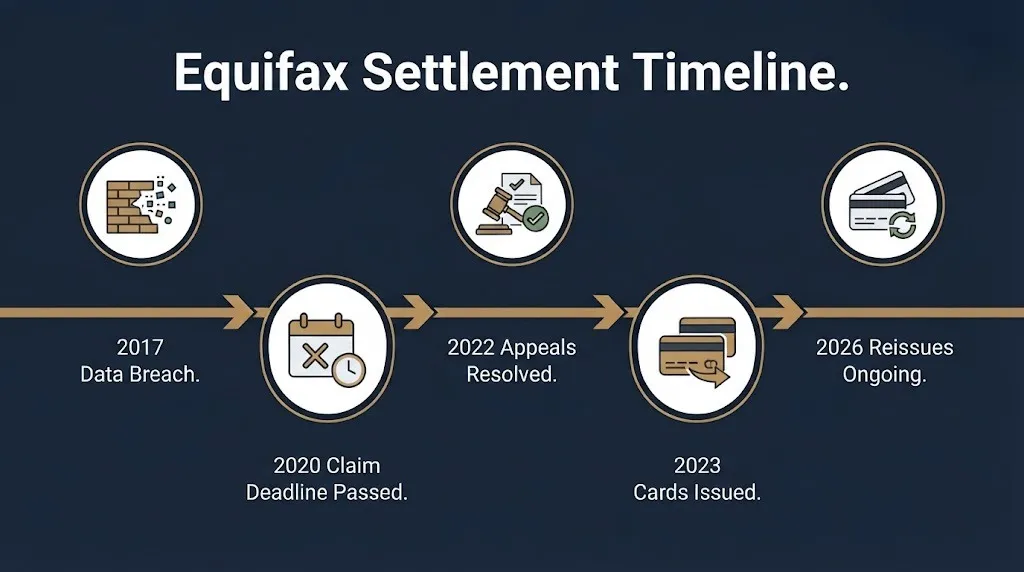
The Equifax settlement prepaid card is one of the most searched payment topics in consumer class action history, and in 2026 people still have questions. The card was a real payment option for the massive 2017 data breach settlement. The settlement fund totaled $425 million, and millions of Americans qualified for either free credit monitoring or a cash payment. If you are asking about a prepaid card now, you probably received one, lost one, or want to know if more money is coming.
The people affected were the roughly 147 million U.S. consumers whose personal data was exposed in the 2017 breach. The most important date in 2026 is not a deadline. It is the issue date on your card, because prepaid cards expire, and expired cards can sometimes be reissued. No new claims are being accepted.
This article explains what the prepaid card is, how to activate it, what to do if it expired or was lost, how payments were calculated, and how to avoid Equifax settlement scams. One surprising verified fact: many initial card payments were small, often under $25, because the per-person cash option was diluted by the huge number of valid claims.
| The Facts | |
|---|---|
| Case | In re Equifax Inc. Customer Data Security Breach Litigation |
| Status | Settled, initial payments distributed, reissues ongoing |
| Fund Size | $425 million total, plus credit monitoring costs |
| Est. Per Person | Varied; many cash payments under $25 |
| Claim Deadline | Passed January 22, 2020, closed |
| Administrator | Kroll Settlement Administration |
| Proof Needed | Claim form, identity verification, sometimes documentation of losses |
Is the Equifax Settlement Prepaid Card Real?
The Equifax settlement prepaid card is real and was one of the payment options for claimants who selected the cash payment alternative in the data breach settlement. The card was issued by a financial institution on behalf of the settlement administrator, Kroll Settlement Administration. It worked like a debit card at most retailers and for online purchases where prepaid cards are accepted.
The card came from the settlement of the 2017 Equifax data breach. Hackers accessed names, Social Security numbers, birth dates, addresses, and in some cases driver’s license and credit card numbers. The Federal Trade Commission, the Consumer Financial Protection Bureau, and 50 state attorneys general settled with Equifax for up to $425 million in consumer relief. That is the fund behind your card.
If you received a prepaid card in the mail, it was not a scam. But scam cards using the Equifax name do exist. The real card came with instructions from Kroll, not a random text or email. You never had to pay to receive it. Legitimate settlement payments never ask for money first.
Key Takeaway: The Equifax prepaid card was a real payment from the settlement, but scammers sometimes imitate it, and real payments never require a fee.
How Much Was the Equifax Settlement Prepaid Card Worth?
The amount on an Equifax settlement prepaid card varied widely. Many claimants who chose the cash option received less than $25. That small amount surprised people who remembered headlines about $125 payments. The reason is simple math. The settlement promised up to $125 for the cash alternative, but the fund had a limited amount set aside for cash claims, and far more people filed than expected.
The settlement allocated $31 million for cash payments to people who already had credit monitoring. When tens of millions of people filed claims, the per-person share collapsed. The court and administrator recalculated payments downward. Claimants who documented actual financial losses from identity theft could claim more, up to $20,000, but those claims required proof.
| Claim Type | Typical Payment |
|---|---|
| Cash alternative, no documented loss | Under $25 for most |
| Documented out-of-pocket losses | Up to $20,000 with proof |
| Time spent dealing with breach | $25 per hour, capped, with documentation |
| Free credit monitoring | 10 years of monitoring, no cash |
If your card had a small balance, that matches the verified outcome. It was not an error. The huge claim volume diluted the fund.
Key Takeaway: Most cash-option claimants received modest prepaid card balances because the cash fund was divided among far more people than anticipated.
How Do I Activate My Equifax Settlement Prepaid Card?
Activating your Equifax settlement prepaid card required calling the number on the back of the card or visiting the card issuer’s activation website. The process typically asked for the card number, expiration date, and security code. Some cards also required the last four digits of your Social Security number for identity verification.
If you still have an unactivated card in 2026, it may be too late. Many prepaid cards issued in 2022 and 2023 had expiration dates of 12 to 24 months. An expired card cannot be activated or used. But the administrator may still be able to reissue funds if the card was never activated and the claim remains valid. That process requires contacting Kroll Settlement Administration directly.
Do not call the retailer or the card network. They cannot reissue a settlement card. Only the administrator can verify your claim, cancel the old card, and issue a new one. The contact information is on the official settlement website and in your original claim confirmation.
Key Takeaway: Activation required the card issuer’s phone or website, and expired unactivated cards may still be reissued through Kroll, not the retailer.
What If My Equifax Settlement Prepaid Card Expired?
If your Equifax settlement prepaid card expired, you may still be able to recover the balance. The settlement administrator, Kroll, has handled reissue requests for cards that were never activated, lost, stolen, or expired. The process is not automatic. You must contact Kroll, verify your identity and claim, and request a reissue.
The reissue process is like a store return without a receipt. It works if you have the right details. You need your original claim confirmation number, the email or address used for the claim, and ideally a copy of the card or the mailing it came in. If you threw everything away, recovery is harder but not always impossible. Kroll can search by name and other identifying information.
The worst move is waiting. Prepaid cards with unused balances may eventually be turned over to state unclaimed property programs, which complicates recovery. If you believe you have money on an expired card, contact Kroll now. There is no guarantee of reissue, but verified reports from claimants show it happens.
Key Takeaway: Expired cards may be reissued if you contact the settlement administrator with your claim details and request a replacement.
How Do I Check My Equifax Settlement Payment Status?
Checking your Equifax settlement payment status requires contacting Kroll Settlement Administration, the court-appointed administrator. The official settlement website had a portal where claimants could check status during the active phase. In 2026, the fastest route is a direct call or email to Kroll using the contact information listed on the official settlement site.
You will need identifying information, usually your claim number, name, address, and possibly the last four digits of your Social Security number. Kroll can tell you whether your claim was approved, whether a payment was issued, and whether a card or check is still outstanding. If your payment was returned as undeliverable, Kroll may be able to update your address and reissue.
Do not rely on third-party websites that claim to check your status for a fee. They cannot see anything you cannot see by contacting Kroll directly. The administrator is the only entity with access to the claim database.
Key Takeaway: The only reliable way to check your payment status in 2026 is to contact Kroll Settlement Administration directly with your claim details.
Can I Still File an Equifax Claim in 2026?
No, you cannot file a new Equifax settlement claim in 2026. The claim deadline was January 22, 2020. That deadline passed more than six years ago. The settlement is closed to new claims, and no extension or reopening has been announced.
The settlement went through years of appeals before payments began. The final approval came in 2020, but payments were delayed until appeals resolved in 2022. Initial payments went out in late 2022 and 2023. A second distribution of remaining funds occurred later. But none of that reopened the claim window. If you did not file by the January 2020 deadline, you cannot file now.
The only exception is if you filed on time and your claim was approved but your payment was lost, expired, or returned. That is a payment reissue, not a new claim. The difference matters. You are recovering money already allocated to you, not joining a closed settlement.
Reality Check: If a website or email says you can file a new Equifax claim in 2026 for a fee, it is a scam. The settlement is closed. Legitimate reissues go through Kroll and never require payment.
What Was the Equifax Settlement for?
The Equifax settlement resolved claims that the credit bureau failed to protect the personal data of 147 million Americans. In 2017, hackers exploited a known vulnerability in Equifax’s systems and stole names, Social Security numbers, birth dates, addresses, and other sensitive information. The breach was one of the largest in U.S. history.
The legal claims centered on negligence and failure to safeguard consumer data. The Federal Trade Commission, Consumer Financial Protection Bureau, and all 50 state attorneys general joined the enforcement action. Equifax agreed to a global settlement that included up to $425 million for consumer relief, free credit monitoring, and significant security upgrades.
The settlement covered two main groups: people who wanted free credit monitoring and people who already had monitoring and wanted a cash payment. The cash option was always limited by the size of the cash fund. That design choice, approved by the court, is why the per-person cash amounts ended up so small.
Key Takeaway: The settlement resolved claims that Equifax failed to protect sensitive personal data, and the cash option was one part of a larger relief package.
Who Was Eligible for the Equifax Settlement?
Eligibility for the Equifax settlement was broad. Any U.S. consumer whose personal information was compromised in the 2017 breach was a class member. You did not need to prove that you were a victim of identity theft. The fact that your data was exposed was enough. The settlement estimated 147 million people qualified.
Class members could choose between free credit monitoring or a cash payment. The cash payment was capped at $125 for people who already had credit monitoring that would continue for at least six months. People who documented actual identity theft losses could claim up to $20,000. People who spent time dealing with the breach could claim $25 per hour up to a cap.
The key point is that eligibility was automatic for affected consumers. But filing a claim was not automatic. You had to submit a claim form by the deadline. Millions of people who were eligible never filed, which means they received nothing.
Key Takeaway: Eligibility was automatic for 147 million affected consumers, but only those who filed claims by January 2020 received benefits.
Why Were the Equifax Cash Payments So Small?
The Equifax cash payments were small because the settlement structure capped the cash fund and the number of claimants overwhelmed it. The settlement promised up to $125 per person but allocated only $31 million for cash payments. When millions of people filed, the per-person amount dropped dramatically. The math was unforgiving.
This was not a hidden trick. The settlement terms were public. The court approved the structure. But many consumers saw the $125 figure in headlines and did not read the details. The settlement also provided 10 years of free credit monitoring, which was the primary consumer benefit and the largest cost.
The lesson for future settlements is simple. When you see a maximum payout number, check the fund size and the expected claimant count. A $100 million fund divided among 10 million claimants is $10 per person before fees. That is how class action math works. It is not a scam. It is arithmetic.
Key Takeaway: Small payments happened because the cash fund was finite and claim volume was massive, not because the administrator shorted anyone.
How Do I Avoid Equifax Settlement Scams in 2026?
Avoiding Equifax settlement scams in 2026 means knowing one rule: the settlement is closed and Kroll will never call, text, or email you demanding payment to release funds. Scammers know people are still searching for Equifax money, and they exploit that. They send fake emails with links to claim a “remaining balance” or offer to help recover expired cards for a fee.
Legitimate reissue requests go through Kroll directly. You initiate the contact. You do not click a link in an unsolicited message. You do not pay a processing fee. You do not provide your full Social Security number or bank account details to someone who called you. The real process is free and starts with you.
If you are unsure, look up Kroll Settlement Administration’s contact information on the official settlement website. Do not use the phone number in a suspicious email. That is the same rule as any financial matter: verify the source before acting.
Key Takeaway: The settlement is closed, Kroll will not contact you first for a fee, and any unsolicited Equifax payment message is a scam.
What Happens Next
- Ongoing through 2026: Kroll continues processing reissue requests for lost, expired, or returned payments.
- Unclaimed funds: Any remaining money may eventually transfer to state unclaimed property programs.
- No new deadlines: The claim deadline passed in 2020 and will not reopen.
- If you have an old card: Contact Kroll now to check if a reissue is possible.
- If you never filed: There is no path to a late claim, and anyone offering one is a scam.
Frequently Asked Questions
Is the Equifax prepaid card real?
Yes, the Equifax settlement prepaid card was a real payment method for approved cash claims.
It was issued by a bank on behalf of Kroll Settlement Administration.
How much was on the Equifax prepaid card?
Most cash-option claimants received under $25 because the cash fund was divided among millions of people.
Documented loss claims could pay more, up to $20,000 with proof.
Can I still file an Equifax claim?
No, the claim deadline was January 22, 2020.
No new claims are being accepted in 2026.
What if my Equifax card expired?
You may be able to get a reissue if the card was never activated or the balance was never spent.
Contact Kroll Settlement Administration with your claim details.
How do I check my Equifax payment status?
Contact Kroll Settlement Administration directly with your name, claim number, and contact information.
They are the only entity with access to the claim database.
Is there a new Equifax settlement in 2026?
No new Equifax settlement has been announced for 2026.
The 2019 settlement is closed to new claims.
Will I get more Equifax money later?
No additional payments are scheduled for cash-option claimants.
Any remaining funds would go through reissue or unclaimed property, not new payouts.
How do I know if an Equifax email is real?
Real Equifax settlement messages come from Kroll and never ask for payment.
Verify any message by contacting Kroll through the official settlement website.
If you still have an Equifax prepaid card or believe you were owed money, the only move left in 2026 is a reissue request through Kroll. The claim window is closed, the payments were small for most, and anyone promising new money is lying.