IRS Tax Settlement Companies 2026: What They Can Actually Do, What They Charge, and How to Avoid the Scams
Quick Answer
- IRS tax settlement companies are private firms that negotiate with the IRS on your behalf for a fee.
- The IRS itself never charges for setting up a payment plan or applying for an Offer in Compromise.
- The most important deadline is the IRS collection statute expiration date, usually 10 years from assessment.
You owe back taxes. The notices are piling up. Now a company promises to settle your IRS debt for pennies on the dollar.
Here is the direct answer: private tax settlement companies are real businesses, but the IRS settlement programs they use are free to apply for on your own. The companies charge thousands for work you can often do yourself.
This article explains what these companies actually do, what they cost in 2026, how to spot the ones that overpromise, and how to settle tax debt without getting burned.
The Facts
| Topic | IRS Tax Settlement Companies |
| Status | Legal but heavily regulated by FTC and IRS rules |
| Typical Fee | $2,500 to $7,500 per case, sometimes more |
| Upfront Fee Rule | Companies cannot charge upfront fees for debt relief before settling |
| IRS Offer in Compromise Fee | $205 application fee, waived for low-income taxpayers |
| IRS Payment Plan Setup | $0 to $225 depending on method |
| Statute of Limitations | Usually 10 years from tax assessment |
Are IRS tax settlement companies legitimate?
Some are legitimate. Many are not. The industry has a long documented history of overpromising, underdelivering, and charging fees for things the IRS offers free.
The Federal Trade Commission has sued multiple tax settlement companies for deceptive practices. The IRS publishes warnings about firms that promise to settle debt for a fraction of what you owe but rarely deliver.
A legitimate company will review your finances, tell you which IRS program you may qualify for, and charge a disclosed fee for its work. A scam will guarantee a settlement, demand money upfront, and disappear.
What does an IRS tax settlement company actually do?
An IRS tax settlement company acts as a middleman between you and the IRS. It reviews your tax debt, determines which resolution program fits, and prepares and submits the paperwork.
The main IRS programs these companies use are:
- Installment agreements: monthly payment plans
- Offer in Compromise: settling for less than you owe
- Currently Not Collectible: pausing collection if you cannot pay
- Penalty abatement: removing penalties for reasonable cause
None of these programs require a private company. You can apply for every one of them directly with the IRS.
How much do IRS tax settlement companies charge in 2026?
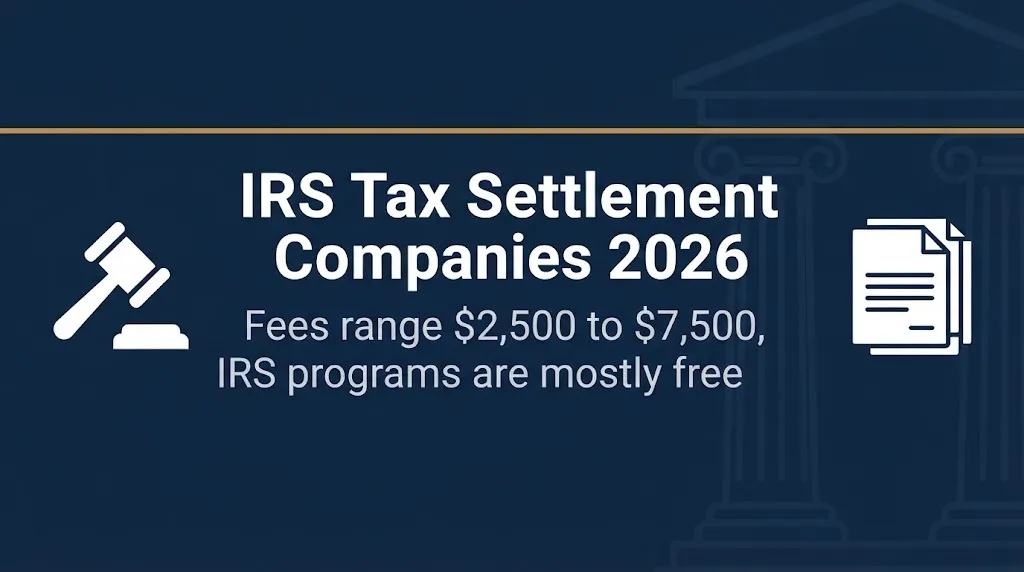
Most tax settlement companies charge between $2,500 and $7,500 per case. Some charge more for complex business tax debt or multiple years of unfiled returns.
The fee structure usually works like this. You pay an initial investigation fee, then a monthly retainer, then a final fee when the settlement is reached. The total often lands between $3,000 and $6,000.
Compare that to the IRS Offer in Compromise application fee, which is $205. The IRS waives that fee if you meet low-income guidelines. Setting up an installment agreement costs between $0 and $225 depending on how you apply and how you pay.
Key Takeaway: Private tax settlement companies charge thousands for work that uses free IRS programs, which is why you should understand the underlying programs before hiring anyone.
What is the IRS Offer in Compromise?
The Offer in Compromise is the real “settlement” program. It lets you settle your tax debt for less than the full amount if you can prove you cannot pay the full balance.
The IRS approves roughly 30% to 40% of Offer in Compromise applications in a typical year. Approval requires a detailed financial disclosure. The IRS looks at your income, expenses, assets, and future earning potential.
You can apply directly using IRS Form 656. The application fee is $205. You can request a fee waiver if your income falls below the IRS low-income guidelines.
Can you really settle IRS debt for pennies on the dollar?
Sometimes, but far less often than the ads suggest.
The IRS accepts an Offer in Compromise only when your reasonable collection potential is less than the full amount owed. If you have a steady income, a house with equity, or money in a retirement account, the IRS will calculate that you can pay more than you want to admit.
The “pennies on the dollar” pitch is a marketing line, not a typical outcome. Most approved offers still involve paying a meaningful share of the debt, often spread over months or years.
What is the difference between tax settlement and tax debt relief companies?
The terms are used interchangeably by the industry. Both describe private companies that negotiate with the IRS on your behalf.
There is no legal distinction between a “tax settlement company” and a “tax debt relief company.” Both use the same IRS programs. Both charge similar fees. Both are subject to the same FTC rules on telemarketing and upfront fees.
The difference is marketing, not substance. Some firms brand themselves as settlement specialists. Others call themselves relief experts. The underlying service is the same.
Key Takeaway: The label on the company matters less than the contract terms, the fee schedule, and the specific IRS program they propose for your case.
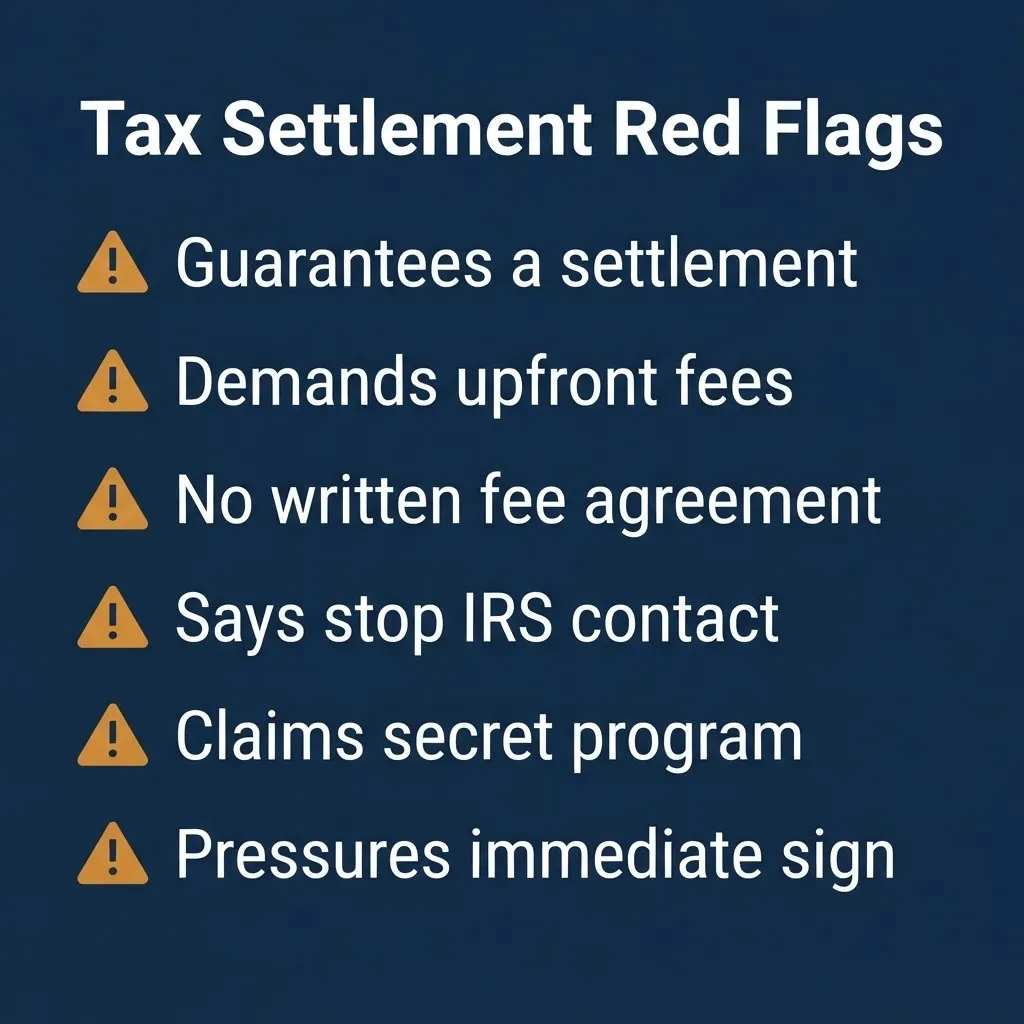
What are the red flags of an IRS tax settlement scam?
Several warning signs are consistent across FTC complaints and IRS warnings.
- Guaranteeing a specific settlement amount before reviewing your finances
- Demanding large upfront fees before doing any work
- Refusing to put the fee structure in writing
- Telling you to stop communicating with the IRS
- Claiming special access to a secret IRS program
- Pressuring you to sign immediately
- Asking for your bank account details for a fee payment before any settlement exists
The Federal Trade Commission’s Telemarketing Sales Rule prohibits debt relief companies from charging upfront fees before they settle or reduce your debt. If a company asks for money before delivering a result, that is a violation.
Can you negotiate with the IRS yourself?
Yes. Every program a tax settlement company uses is available to you directly.
You can call the IRS at its main collections number, set up an installment agreement online, or submit an Offer in Compromise using Form 656. You can request Currently Not Collectible status by providing financial information.
The process is not fun. It involves forms, phone calls, and waiting. But it is the same process a settlement company follows. The difference is the fee.
Reality Check: The IRS never calls or texts you out of nowhere threatening arrest. The IRS sends letters by mail first. Anyone calling about a tax debt you have never received a letter about is probably a scammer.
What IRS tax relief programs are available in 2026?
The IRS operates several collection alternatives. The main ones are unchanged in 2026.
| Program | What It Does | Cost |
|---|---|---|
| Installment Agreement | Monthly payments until the debt is paid | $0 to $225 setup |
| Offer in Compromise | Settle for less than you owe | $205 application fee |
| Currently Not Collectible | Pauses collection if you cannot pay | No fee |
| Penalty Abatement | Removes penalties for reasonable cause | No fee |
| Innocent Spouse Relief | Removes liability for a spouse’s error | No fee |
Each program has eligibility rules. The IRS website has an online tool called the Offer in Compromise Pre-Qualifier that tells you whether you may qualify before you apply.
What is the IRS 10-year collection statute?
The IRS generally has 10 years from the date a tax is assessed to collect it. After that, the debt expires.
This is the deadline that matters most for people with old tax debt. If the 10-year window is close to closing, you may not need to settle at all. The debt may simply expire.
But the clock can pause for many reasons: bankruptcy, a pending Offer in Compromise, an installment agreement default, or a collection due process hearing. A tax professional can help you determine your actual collection statute expiration date.
Key Takeaway: Before paying any settlement company, find out your Collection Statute Expiration Date. If the IRS has little time left to collect, paying a company thousands makes no sense.
How do you file a complaint against a tax settlement company?
If a tax settlement company took your money and did nothing, you have options.
- File a complaint with the Federal Trade Commission at its official complaint portal.
- File a complaint with your state attorney general’s consumer protection division.
- File a complaint with the Better Business Bureau for a public record of the issue.
- If the company misrepresented itself as affiliated with the IRS, report it to the Treasury Inspector General for Tax Administration.
- Consider small claims court for fees paid if the contract was breached.
Document everything. Save emails, contracts, receipts, and call logs. The paper trail is your leverage.
What should you do before hiring an IRS tax settlement company?
Take these five steps before signing anything.
- Request your IRS tax transcript to see your actual balance and filing status.
- Check your Collection Statute Expiration Date by calling the IRS or using a tax professional.
- Run the Offer in Compromise Pre-Qualifier on the IRS website.
- Call the IRS directly and ask about an installment agreement.
- If you still want help, interview at least three tax professionals, including CPAs and enrolled agents.
A CPA or enrolled agent often charges less than a settlement company and can represent you before the IRS. A tax attorney may be necessary if you face liens, levies, or possible criminal exposure.
What happens next if you owe back taxes in 2026?
The IRS collection process follows a predictable path.
| Stage | What Happens |
|---|---|
| Month 1 to 3 | IRS sends balance due notices by mail |
| Month 3 to 6 | IRS may file a federal tax lien |
| Month 6 to 12 | IRS may issue a levy on wages or bank accounts |
| Year 1 to 3 | Interest and penalties keep accruing |
| Year 10 | Collection statute expires if not paused |
The earlier you act, the more options you have. Waiting until a levy hits removes much of your negotiating room.
Frequently Asked Questions
Are IRS tax settlement companies worth it?
For simple cases, usually not.
You can apply for the same IRS programs yourself for little or no fee.
For complex cases with multiple years or levies, professional help may be worth the cost.
How much does a tax settlement company charge?
Most charge between $2,500 and $7,500 per case.
The total depends on complexity, firm, and how many years are involved.
Can I settle my IRS debt for less than I owe?
Yes, through the Offer in Compromise program.
Approval rates are around 30% to 40%, and you must prove you cannot pay the full amount.
What is the deadline for IRS tax debt?
The IRS usually has 10 years from the assessment date to collect.
After that, the debt expires, though the clock can pause for many reasons.
Do I need a tax attorney or a settlement company?
For most collection issues, a CPA or enrolled agent is enough.
A tax attorney is needed only for legal disputes, appeals, or possible criminal exposure.
Can a tax settlement company stop a wage garnishment?
A company can request a levy release, but so can you.
The IRS releases levies when you enter a payment plan or prove hardship.
Is the IRS Fresh Start program still available in 2026?
Yes, the IRS continues to offer streamlined installment agreements and expanded Offer in Compromise rules.
The basic programs remain available to individual taxpayers.
If you owe back taxes in 2026, do not hand thousands of dollars to a company before you understand the free IRS programs available to you. Check your balance, your collection statute date, and your eligibility for an installment agreement or Offer in Compromise.
Then decide if you need help. If you do, choose a CPA, enrolled agent, or tax attorney with a written fee agreement. The most important number in your case is not what a company promises to settle. It is the date the IRS loses its legal right to collect at all.