Life360 Lawsuit 2026: Settlement Claims and Payout Status
Quick Answer
- Is it real? Yes. A class action lawsuit alleges Life360 sold precise user location data to third party brokers without proper consent.
- How much? Payout amounts are not yet determined because a final settlement fund has not received court approval.
- When is the deadline? No claim deadline exists yet. You must wait for the court to approve the official settlement administrator.
The Life360 lawsuit centers on allegations that the family tracking app sold precise location history to data brokers. These brokers then sold that data to marketing firms and insurance companies. While Life360 claims it anonymizes data, the lawsuit argues the information was so precise it could identify specific individuals.
If you used the Life360 app between 2016 and 2022, you may qualify for a future settlement. The case is currently moving through the discovery phase where lawyers examine internal company emails and data logs. No checks have been mailed, and no official claim form is available as of mid 2026.
This report covers the current legal status of the case, who may qualify for a payout, and the specific data brokers involved. You will also find a guide on how to prepare your account information in case a settlement is reached this year.
The Facts
| Detail | Information |
|---|---|
| Case | Hedges v. Life360, Inc. |
| Status | Ongoing Litigation |
| Fund Size | Not yet confirmed |
| Est. Per Person | Not yet determined |
| Claim Deadline | TBD, watch the official site |
| Administrator | Not yet appointed |
| Proof Needed | Account email or Life360 ID |
life360 lawsuit
The Life360 lawsuit is a legal challenge against the popular family safety and tracking app. It alleges that the company engaged in deceptive business practices by selling user location data to third parties. These sales supposedly happened without clear disclosure to the parents and families using the service. The primary case, Hedges v. Life360, claims the company became a major player in the data brokerage industry.
Internal reports and investigative journalism first brought these practices to light. The lawsuit argues that Life360 acted more like a data vendor than a safety app. Millions of users across the United States are potentially affected by these claims. The court must now decide if Life360 violated privacy laws like the California Consumer Privacy Act.
- The case is filed in the U.S. District Court for the Northern District of California.
- The lawsuit seeks both monetary damages and a permanent change in how Life360 handles data.
- Attorneys for the plaintiffs argue that “anonymous” data is a myth when it includes precise GPS coordinates.
life360 settlement claim
A life360 settlement claim is the formal request a user makes to receive a portion of a legal payout. As of June 2026, you cannot file a claim because the court has not approved a final settlement. When the claim portal opens, it will likely be hosted by a third party settlement administrator. You will need to provide the email address associated with your Life360 account to verify your identity.
Most tech privacy settlements use an online portal for efficiency. You will probably have the option to receive funds via digital payment or a physical check. It is vital to use the official website once it is launched to avoid scams. The claim process usually stays open for several months after the court grants preliminary approval.
- Wait for the official settlement administrator to be named.
- Locate your Life360 account email and user ID.
- Fill out the online form with your current contact details.
- Attest that you used the app during the eligible period.
- Select your preferred payment method.
- Submit the form before the court ordered deadline.
life360 settlement
The life360 settlement refers to the total amount of money the company may agree to pay to end the litigation. Currently, a specific dollar amount is not yet confirmed. Large tech privacy settlements often range from $10 million to $100 million depending on the number of users affected. Life360 has signaled in financial filings that it intends to defend itself, but mediation is common in these cases.
Settlement funds are typically divided into several pools. One pool covers the lawyers who brought the case. Another pool covers the administrative costs of mailing notices and processing claims. The remaining money is split among the “class members,” which means the users who filed valid claims. If the fund is $50 million and 1 million people claim, the individual payout would be relatively small after fees.
Key Takeaway: You cannot file a claim for the Life360 lawsuit yet because a final settlement fund has not been approved by the court.
life360 class action lawsuit
The life360 class action lawsuit is a specific type of legal proceeding where one person represents a large group. This format allows millions of app users to seek justice without filing individual cases. The lawsuit focuses on the years 2016 through 2022. During this window, Life360 allegedly sold data to brokers like Arity, Cuebiq, and X-Mode.
Legal documents show that Life360 was one of the largest sources of location data for the marketing industry. The class action argues that most families would not have used the app if they knew their children’s movements were being sold. The company argues that its data sharing was necessary to keep the basic service free. The judge will decide if these disclosures were buried too deep in the terms of service.
- Plaintiff Allegation: Life360 failed to get “meaningful consent” for data sales.
- Company Defense: Users agreed to the privacy policy upon sign up.
- Discovery Evidence: Emails showing how much revenue Life360 generated from data sales.
life360 lawsuit claim
A life360 lawsuit claim involves more than just asking for money. It is a legal declaration that you were a user and that your privacy was potentially violated. In 2026, the focus for users should be on gathering proof of their account history. If you deleted the app years ago, you might still be in the company’s database. Settlement administrators usually cross reference claim forms with the company’s internal user lists.
Filing a claim does not require you to hire your own lawyer. The class counsel, the attorneys who filed the main lawsuit, represent your interests. If a settlement is reached, they will receive a percentage of the total fund. You only need to respond once the notice is sent to your email or appears on the official settlement site.
- Save old emails from Life360 support or billing.
- Take a screenshot of your “Account” tab if you still have the app.
- Note the years you actively used the “Circle” feature.
- Check for any past communications regarding privacy policy updates.
- Watch for an email with a “Notice ID” and “Confirmation Code.”
life360 class action
The life360 class action has reached a critical phase in 2026. After years of legal back and forth, the parties are moving toward a resolution. A class action is like a large group return at a department store. Instead of every customer complaining individually, one group handles the entire batch of issues at once. This case is especially complex because it involves children’s data, which has stricter protection under federal laws like COPPA.
The court must certify the class before any settlement can be paid. Certification means the judge agrees that all Life360 users share the same legal problem. Life360 has fought this step, arguing that every user had a different experience. If the class is certified, the case moves much faster toward a payout or a trial.
Key Takeaway: The Life360 case is moving through discovery, which is the stage where both sides exchange evidence before a trial or settlement.
life 360 settlement
The life 360 settlement process will follow a strict timeline once it begins. First, the judge gives “preliminary approval” to the deal. Then, a website is launched. After that, users have several months to submit their information. Finally, a “fairness hearing” occurs where the judge makes the deal official. Only after this final hearing are checks or digital payments sent out.
Many people expect a large payout, but these cases often result in smaller amounts per person. If the court finds that Life360’s data sales were particularly egregious, the settlement could be higher. It is also possible the settlement will include “injunctive relief.” This means Life360 would have to stop selling certain types of data or make their privacy settings much easier to find.
| Stage | Expected Status |
|---|---|
| Preliminary Approval | Pending 2026 |
| Claim Period | TBD |
| Final Approval | TBD |
| Payment Distribution | Expected Late 2026 or 2027 |
life 360 lawsuit
The life 360 lawsuit is part of a broader trend of tech companies facing heat for data monetization. In the early 2020s, many “free” apps were discovered to be selling user habits to the highest bidder. Life360 stands out because its entire brand is built on safety and trust. When parents track their children, they expect that data to stay within the family circle.
The lawsuit points out that data sold to brokers like X-Mode was often used by the military and government contractors. This specific detail has caused significant public outcry. Life360 has since claimed they stopped selling data to some of these brokers. However, the lawsuit seeks damages for the years when the sales were at their peak.
- Data Accuracy: GPS data was often accurate within 10 to 30 feet.
- Third Parties: Alleged buyers included Arity, Cuebiq, and Quadrant.
- User Base: Over 30 million active users may be part of the class.
What is the Life360 data sharing controversy?
The controversy began when a report from The Markup revealed that Life360 was a top source of data for the location industry. While the company stated it “anonymized” data, experts found that precise GPS paths are easy to de-anonymize. If a data point starts at a specific house every morning and ends at a specific school, it is obvious who that person is. This realization led to multiple lawsuits being consolidated into the current class action.
Life360’s acquisition of Tile, the tracking tag company, also raised concerns. Privacy advocates feared that Life360 would combine phone tracking with physical object tracking to create an even more intrusive profile. The lawsuit alleges that Life360 prioritized its $100 million data revenue over the privacy expectations of its users.
Key Takeaway: Precise GPS data is rarely anonymous, which is the core argument the lawsuit uses to challenge Life360’s privacy claims.
Who is eligible for the Life360 class action?
Eligibility usually depends on when you used the app and where you live. The current proposed class includes any person in the United States who used the Life360 app between approximately 2016 and 2022. Some states like California or Illinois may have higher payout tiers because of their specific state privacy laws. California’s CCPA and Illinois’s BIPA are often used to increase damages in tech lawsuits.
You do not need to still have the app installed to be eligible. As long as you had an account during the relevant years, you are likely part of the class. If you were a member of a “Circle” but did not pay for a premium subscription, you are still included. The lawsuit covers both free and paid users because data from both groups was allegedly sold.
- Primary Users: The person who set up the account.
- Circle Members: Family members whose phones were tracked.
- Minors: Parents can often file claims on behalf of their children.
How much is the Life360 payout per person?
The payout per person is currently not yet determined. In similar tech privacy cases, such as the Facebook user privacy settlement, payouts were between $30 and $400 depending on the number of claims. If many people ignore the notice, the individual payout for those who do file will be higher. If 10 million people file, the amount could drop to $10 or $20.
The court may also establish “tiers” of payments. For example, people who used the app for five years might get more than someone who used it for two months. If you can prove your data was sold to a specific high risk broker, you might qualify for a higher amount. These details will be finalized in the “Settlement Agreement” document once the lawyers reach a deal.
Is the Life360 settlement a scam or real?
The Life360 settlement is a real legal matter, but there are many scams surrounding it. Scammers often send text messages or emails claiming you have “unclaimed money” waiting. They will ask you to click a link and provide your social security number or bank login. No legitimate settlement administrator will ever ask for your bank password or your full social security number to file a claim.
Official notices usually come from a court approved email address ending in .com or .org. They will include a specific Case Number and a Notice ID. If you see an ad on social media promising a guaranteed $5,000 from Life360, it is almost certainly a scam. The actual payout will likely be much lower and will take months to process.
Reality Check: You do not have to pay a fee to join a class action lawsuit. Any website asking for a “filing fee” or “processing charge” to get your Life360 money is a scam. Filing a claim is always free.
What data did Life360 allegedly sell?
The lawsuit alleges that Life360 sold “raw” location data. This includes your latitude and longitude coordinates, the time of day, and how long you stayed at a location. This data allows buyers to see where you live, where you work, and where your children go to school. The company also supposedly shared device identifiers, which are unique numbers that link a phone to a specific person.
Marketing firms used this data to send targeted ads. For example, if Life360 data showed you visited a car dealership, you might start seeing more car ads on other websites. Insurance companies like Allstate, through their subsidiary Arity, used data to analyze driving habits. The lawsuit argues that users never expected their “family safety” app to be used for insurance risk profiling.
- Precise GPS coordinates.
- Timestamps of movement.
- Device ID numbers.
- Names of “Places” you created in the app (like “Home” or “Work”).
- Battery levels and phone status.
How to file a Life360 claim form
When the claim form becomes available, the process is designed to be simple. You will not need to provide receipts or detailed logs in most cases. The settlement administrator will have a list of eligible emails provided by Life360. Your main job is to confirm that you want to participate in the settlement.
The form will ask for your current contact information. This ensures the check goes to the right house or the digital payment goes to the right account. You should keep a record of your “Confirmation Number” after you hit submit. This number is the only way to prove you filed if the system has a glitch later.
- Go to the official settlement website (not yet live).
- Enter your Name and current Address.
- Enter the Email Address you used for your Life360 account.
- Answer any simple eligibility questions.
- Choose your payment method (Check, PayPal, Venmo, or Zelle).
- Sign the form electronically under penalty of perjury.
- Save a copy of the confirmation page for your records.
When will Life360 settlement checks be mailed?
Checks are not expected to mail until at least late 2026 or early 2027. The legal process for a class action is very slow. Even after a settlement is signed, the judge must hold a final hearing to listen to any objections. If someone objects to the settlement, it can delay payments by another six months to a year.
Once the “Final Effective Date” passes, the administrator begins the “Distribution” phase. This is when the computer system calculates the exact amount for every person based on the total number of valid claims. If you choose a digital payment, you will likely get your money 30 days faster than those who choose a physical paper check.
Key Takeaway: The time between filing a claim and receiving money is often six to twelve months in federal tech privacy cases.
Did Tile users get included in the Life360 lawsuit?
The role of Tile users in the Life360 lawsuit is a point of ongoing legal debate. Life360 bought Tile in 2021 and began integrating the two services. Some versions of the lawsuit include Tile users if their data was sucked into the broader Life360 data selling ecosystem. However, the primary focus remains on the mobile app users who provided 24/7 location tracking.
If you used a Tile tracker but never downloaded the Life360 app, you might not be part of this specific class. You should check the “Eligibility” section of the official notice once it is released. The lawyers may create a separate sub class for Tile users with a different payout structure.
- Life360 App Users: Most likely to qualify for the full settlement.
- Tile Tracker Only Users: May qualify if data was shared after the 2021 acquisition.
- Premium Members: May qualify for higher “Refund” style payments for their subscription fees.
How to opt out of Life360 data selling
You do not have to wait for a lawsuit to protect your current data. Life360 added more clear opt out toggles after the public backlash. You can find these in the “Privacy & Security” section of the app settings. Turning off “Personal Data Sales” will stop the company from sharing your information with their current data partners.
Choosing to opt out of data sales today does not disqualify you from the lawsuit for what happened in the past. The lawsuit covers historical data sales. By opting out now, you are simply preventing future privacy violations. You can also request a copy of your data from Life360 to see exactly what they have collected about your family over the years.
- Open the Life360 app.
- Tap on “Settings” in the top left corner.
- Select “Privacy & Security.”
- Tap on “Do Not Sell or Share My Personal Information.”
- Toggle the switch to the “Off” position.
- Repeat this for every family member in your Circle.
Legal status of the Life360 litigation in 2026
In 2026, the Life360 litigation is at a crossroads. The company has attempted to dismiss the case several times, but judges have allowed the core privacy claims to move forward. This means the case is “trial ready,” which is usually the point where companies decide to settle. A trial is risky and expensive for a tech firm, especially when internal emails about data profits might become public.
We are currently watching the court docket for a “Notice of Settlement.” This is a short document where lawyers tell the judge they have reached a deal in principle. Once that is filed, the specific payout amounts and claim deadlines will be released within 30 to 60 days. Until then, the case remains a “Proposed Class Action.”
What Happens Next
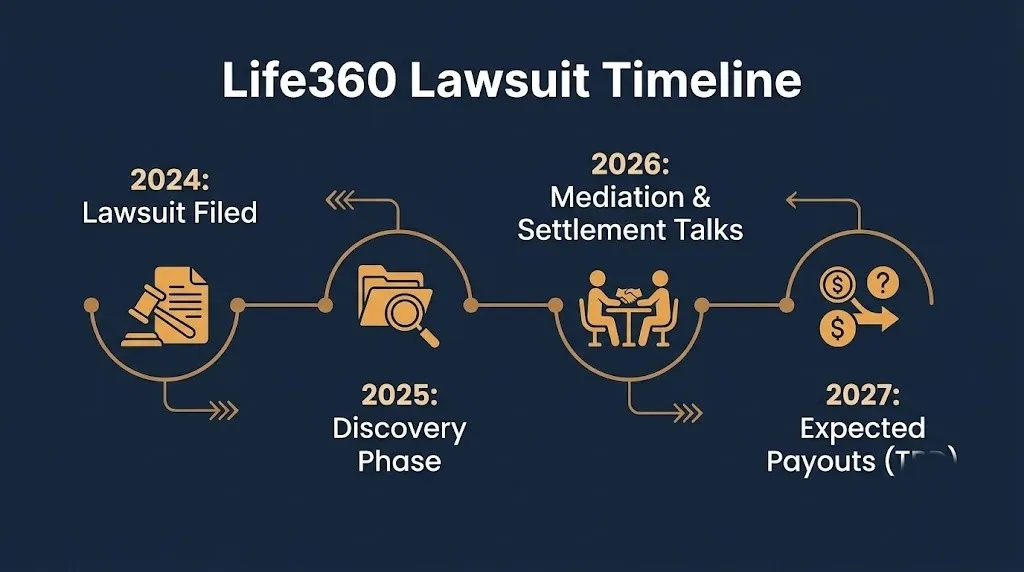
- Summer 2026: Expected completion of expert witness testimony and final discovery.
- Late 2026: Potential for a preliminary settlement announcement or a trial date.
- Early 2027: Expected window for the claim portal to open for all users.
Frequently Asked Questions
Is the Life360 lawsuit still active in 2026?
Yes, the litigation is currently active in the federal court system.
Lawyers for both sides are still exchanging evidence and attending hearings.
There is no final resolution yet, so you cannot get your money today.
How do I join the Life360 class action?
You are usually joined automatically if you fit the description of an eligible user.
You do not need to sign up with a lawyer to be part of the class.
You will only need to take action when the official claim form is released.
Does Life360 still sell user location data?
Life360 states it has reduced its data sales and stopped selling to certain brokers.
They now offer an opt out toggle in the app settings for all users.
The lawsuit seeks to hold them accountable for their past sales during the 2016 to 2022 period.
Will I get a check in the mail for Life360?
You will only get a check if you file a valid claim form on time.
Most settlements now offer digital payments like Venmo or PayPal as well.
Checks will not be sent until the judge gives final approval to the deal.
Can I sue Life360 individually?
Yes, you have the right to “opt out” of a class action and sue on your own.
However, hiring a lawyer for an individual privacy case is very expensive for most people.
Most users choose to stay in the class action to share the benefits with others.
How much money did Life360 make selling data?
Court documents allege Life360 made tens of millions of dollars from data sales.
In some years, data revenue was a significant portion of their total income.
The lawsuit wants this money returned to the users whose data was sold.
Is Life360 safe to use right now?
Safety is a personal choice based on your privacy comfort level.
The app still provides the tracking features many families rely on.
If you use it, ensure you have adjusted your privacy settings to “Do Not Sell.”
The Life360 lawsuit remains a significant case for consumer privacy rights. If you used the app during the last decade, you should monitor the status of the Hedges v. Life360 case. Keep your account email active and watch for official notices. The single most important step right now is to wait for the court to approve the official settlement site before providing any personal information.