NHL Offer Sheet Compensation in 2026: The $90 Million Leo Carlsson Case and What It Actually Costs
Quick Answer
- NHL offer sheet compensation is draft-pick payment owed when a team signs another team’s restricted free agent and the original team declines to match.
- Leo Carlsson’s $18 million average annual value triggered the maximum tier: four first-round picks.
- Anaheim matched, so no picks changed hands and no compensation was paid.
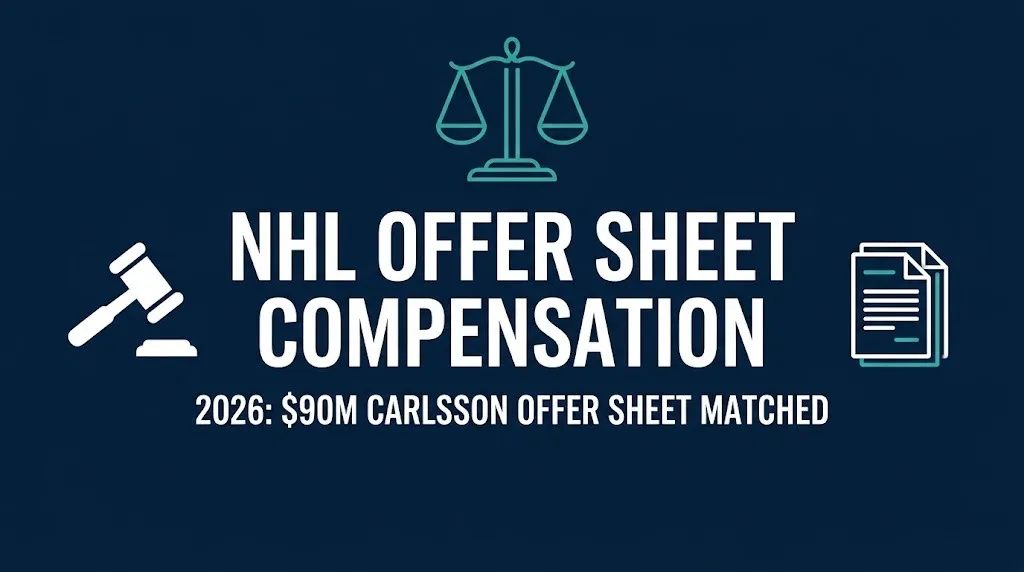
The Philadelphia Flyers signed Anaheim Ducks restricted free agent Leo Carlsson to a five-year, $90 million offer sheet on July 3, 2026 . That contract carried an $18 million average annual value, the highest in NHL history . Under NHL rules, Anaheim had seven days to either match the contract or accept four first-round draft picks from Philadelphia as compensation .
Anaheim matched on July 9, 2026 . The Ducks kept their franchise center. The Flyers kept their four first-round picks. And the NHL’s offer sheet compensation system, a mechanism that rarely produces actual player movement, delivered its most expensive test case in years without a single draft pick changing hands.
This article breaks down how NHL offer sheet compensation works, what the Carlsson case proved about the system, and why the number that matters most is not the salary but the draft capital behind it.
The Facts
| Item | Detail |
|---|---|
| Case | Leo Carlsson offer sheet, Philadelphia Flyers to Anaheim Ducks |
| Status | Matched by Anaheim on July 9, 2026 |
| Contract | Five years, $90 million ($18 million AAV) |
| Compensation if unmatched | Four first-round picks (Philadelphia’s own) |
| Matching Deadline | Seven days from signing (July 10, 2026) |
| Outcome | Anaheim matched; no picks transferred |
| Administrator | Not applicable (not a settlement or claims process) |
| Proof Needed | Not applicable |
Is NHL Offer Sheet Compensation Real or Just a Threat?
NHL offer sheet compensation is a real, binding mechanism in the Collective Bargaining Agreement, and it has been used to transfer players between teams. It is not a bluff. When a team signs a restricted free agent to an offer sheet, the player’s original team receives draft picks as compensation if it declines to match the contract .
The mechanism exists to give teams a path to acquire restricted free agents while ensuring the original team is not left with nothing. Think of it like a store return policy with teeth: if you take the player, you pay the listed price in draft picks. If the original team wants to keep the player, it matches the contract and the transaction never happens.
The rarity is the story. Since the 2004-05 lockout, only 14 players had signed offer sheets before 2026, and eight of the first nine were matched . The system is designed to make matching the easy choice. The compensation almost never reflects the player’s actual market value.
How Much Compensation Does an NHL Offer Sheet Actually Require?
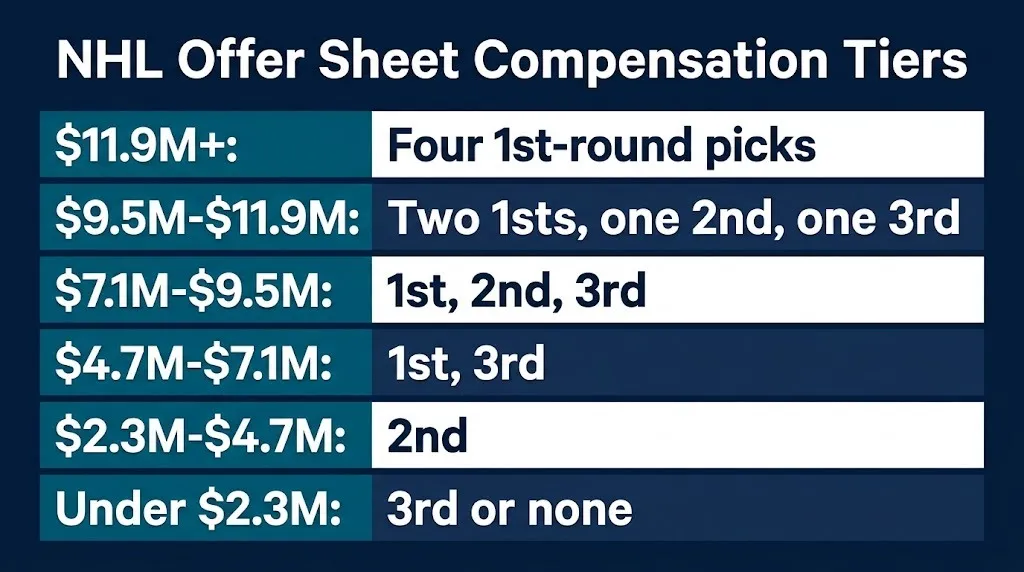
Compensation is determined by the average annual value of the offer sheet, not the total contract value, and the tiers are fixed by the CBA. A higher AAV triggers a steeper draft-pick price .
The 2026 tiers, as reported by PuckPedia and Sporting News:
| AAV Range | Compensation |
|---|---|
| $11,939,166 or more | Four first-round picks |
| $9,551,332 to $11,939,166 | Two first-round picks, one second-round pick, one third-round pick |
| $7,163,498 to $9,551,332 | First-round pick, second-round pick, third-round pick |
| $4,775,666 to $7,163,498 | First-round pick, third-round pick |
| $2,387,832 to $4,775,666 | Second-round pick |
| $1,575,969 to $2,387,832 | Third-round pick |
| $1,575,969 or less | No compensation |
The Carlsson offer sheet at $18 million AAV sat well above the top threshold of $11,939,166 . That meant Philadelphia would have owed four first-round picks, its own picks, not ones acquired from other teams . Teams cannot substitute acquired picks to satisfy offer sheet compensation.
Key Takeaway: The offer sheet compensation price is set by AAV, not total salary, which is why a front-loaded $90 million deal with a massive signing bonus still lands in the same four-first-round-pick bracket as any other contract above $11.94 million per year.
Why Did the Flyers Offer $90 Million If They Knew Anaheim Would Match?
The Flyers offered $90 million because the structure was designed to make matching painful, not impossible. Philadelphia front-loaded the contract with signing bonuses, including nearly $20 million due in the first year, to test whether Anaheim’s ownership would flinch at the cash outlay . The Ducks did not flinch .
General manager Daniel Briere took a calculated swing. Philadelphia had long searched for a top-line center and had the cap space to absorb an $18 million hit . The cost of failure was zero draft picks, because Anaheim matched. The cost of success would have been four first-rounders, a steep but tolerable price for a 21-year-old franchise center.
Ducks general manager Pat Verbeek admitted he did not see the number coming. “Did we expect the offer sheet to be this high? No. We did not see that one coming,” Verbeek said after matching . But billionaire owner Henry Samueli authorized the commitment, and Carlsson became the NHL’s highest-paid player at $18 million per season .
What Draft Picks Would Anaheim Have Received If It Declined to Match?
Anaheim would have received Philadelphia’s own first-round picks in each of the next four drafts. Not protected picks. Not picks acquired from another team. The Flyers’ original first-round selections, four years in a row .
PuckPedia confirmed that Philadelphia owned its first-rounder in each of the next four drafts, which is a prerequisite for signing an offer sheet at that threshold . A team cannot offer sheet a player at an AAV that requires four first-round picks unless it still controls four of its own first-rounders.
The picks would have been Anaheim’s outright. No lottery protection. No conditional conversion. The CBA does not allow teams discretion on which years’ picks to send when multiple picks from the same round are owed . The compensation is fixed and automatic once the original team declines to match.
Who Is Eligible to Receive an NHL Offer Sheet in 2026?
Only restricted free agents who qualify as Group 2 RFAs can receive offer sheets. Not every player coming off an entry-level contract qualifies. Players classified as 10.2(c) under the CBA are ineligible for offer sheets and salary arbitration .
To avoid 10.2(c) status, a player must meet professional experience thresholds based on the age at which they signed their entry-level contract. An 18-to-21-year-old signee needs three years of professional experience. A 22-to-23-year-old needs two. A 24-or-older signee needs one .
Cutter Gauthier, Anaheim’s other young star, was not offer sheet eligible in 2026 because he qualified as a 10.2(c) player . That distinction mattered enormously. Philadelphia could target Carlsson because he had completed three NHL seasons and met the Group 2 RFA threshold. Gauthier, despite his value, could not be signed to an offer sheet at all.
How Does the Matching Window Work and Why Is Seven Days the Deadline?
The matching window is seven days from the date the offer sheet is signed, per Section 10.3 of the NHL CBA . The original team must decide within that window whether to match the contract exactly as written or accept the draft-pick compensation. There is no negotiating the terms down.
The seven-day clock is short by design. It forces the original team to make a binary decision: pay the player what the market just set as his price, or take the picks and move on. The player cannot sign elsewhere during the window. The offering team cannot withdraw the offer sheet. Everyone waits.
For Carlsson, the clock started July 3 and expired July 10 . Anaheim announced its match on July 9, one day early . The Ducks had told the hockey world they would match any offer sheet for Carlsson, and they followed through .
Key Takeaway: The seven-day matching window is the entire leverage structure. The offering team front-loads the contract to create a cash crunch, the original team either pays or takes picks, and the player has no say once he signs the offer sheet.
Reality Check: Offer Sheet Compensation Is Not a Lawsuit or a Payout
Reality Check: There is no settlement fund, no claim form, and no money owed to fans or players under NHL offer sheet compensation. This is a league labor rule, not a consumer claim. If a website or social media account tells you that you can file a claim for compensation related to an NHL offer sheet, it is not legitimate. Offer sheet compensation is paid in draft picks between teams, never in cash to individuals.
What Does the Carlsson Match Mean for Future NHL Offer Sheets?
The Carlsson match means the four-first-round-pick tier remains a deterrent, not a death sentence. Anaheim paid the player, not the picks, and kept its franchise center. The system worked as designed: it forced a small-market team to pay market rate to retain elite young talent.
But the ripple effects are real. Carlsson’s $18 million AAV resets the ceiling for young restricted free agents. Chicago’s Connor Bedard is currently an RFA, and San Jose’s Macklin Celebrini becomes eligible for an offer sheet next year if he does not sign an extension . Their agents now have a comparable: a 21-year-old with 67 points got $18 million per season.
The Flyers showed that a team with cap space and four first-round picks can force another team’s hand. The Ducks showed that most teams will match. The compensation tier structure did its job: it made the offer sheet expensive enough that only a truly elite young player justifies the attempt.
How Does the Barrett Hayton Offer Sheet Compare?
The Barrett Hayton offer sheet is the second 2026 case and it landed in a much lower compensation tier. New Jersey signed Hayton, a Utah Mammoth restricted free agent, to a one-year, $4.775 million offer sheet on July 1 . Utah matched on July 8 .
Because Hayton’s AAV of $4.775 million sat just $667 below the $4,775,666 threshold for a first-round and third-round pick, the compensation would have been a second-round pick only . The margin was that thin. A slightly higher salary would have pushed Utah into a different compensation bracket and possibly changed its matching calculus.
Utah matched anyway. The Mammoth had the cap room and Hayton, a 26-year-old center, was worth keeping at that price . But the Hayton case illustrates how precisely the compensation tiers are drawn. A few hundred thousand dollars in AAV can be the difference between a second-round pick and a first-plus-third.
What Happens Next: NHL Offer Sheet Timeline After 2026
The 2026 offer sheet cycle is closed. Carlsson is signed in Anaheim through 2030-31. Hayton is signed in Utah for one season. The next inflection point is the 2027 RFA class, which includes players who will test whether the Carlsson precedent holds.
October 2026: NHL regular season begins. Carlsson’s $18 million cap hit is active on Anaheim’s books.
January 2027: Midseason trade deadline approaches. Any team that signed an offer sheet cannot trade that player for one year if the original team matched, so Carlsson stays put.
July 1, 2027: New league year opens. Macklin Celebrini becomes offer sheet eligible if unsigned by San Jose. Bedard’s situation resolves one way or another.
Summer 2027: Any new offer sheets will be measured against the Carlsson tier structure. The four-first-round-pick threshold remains the ceiling.
Frequently Asked Questions
Is NHL offer sheet compensation paid in money or draft picks?
It is paid in draft picks, not cash. The offering team surrenders its own original draft selections to the player’s former team if that team declines to match the contract.
How much compensation did the Flyers owe for Leo Carlsson?
The Flyers owed four first-round draft picks because Carlsson’s $18 million AAV exceeded the $11,939,166 top threshold. Anaheim matched, so Philadelphia kept the picks.
Did Anaheim receive any draft picks from the Carlsson offer sheet?
No. Anaheim matched the offer sheet on July 9, 2026, so no compensation was paid and no picks changed hands.
Can a team use traded draft picks to pay offer sheet compensation?
No. The CBA requires teams to use their own original draft picks. A team that has traded away any of its next four first-rounders cannot sign an offer sheet at the four-first-round tier.
What happens if a team does not have the required draft picks?
The team cannot sign the offer sheet at that AAV. The CBA prohibits offer sheets when the offering team does not control the necessary compensation picks.
Is an offer sheet the same as a trade?
No. An offer sheet is a contract offer to a restricted free agent. If the original team matches, the player stays and no transaction occurs. If the original team declines, the player joins the new team and draft picks serve as the trade return.
Why did Utah match the Barrett Hayton offer sheet?
Utah matched because it had the cap space and valued Hayton at $4.775 million for one season. The compensation, a second-round pick, was less valuable to the Mammoth than keeping the player.
Will there be more offer sheets in 2027?
That is not yet confirmed. The 2027 RFA class includes high-profile players, and the Carlsson precedent gives agents a new benchmark. But offer sheets remain rare, and most teams still match.
What You Should Do With This Information
If you are an NHL fan tracking the salary cap or a fantasy hockey player watching player movement, the Carlsson case gives you a clear rule to remember: the compensation number that matters is the AAV tier, not the total contract. A $90 million deal and a $60 million deal can trigger the same four first-round picks if both sit above $11.94 million per year.
The matching window is seven days. The picks are always original picks. The player has no say once he signs. And the team that loses the player gets the picks, not cash, not a player to be named later, not a settlement.
Anaheim kept Leo Carlsson. Philadelphia kept its four first-rounders. The system worked, in the sense that it forced a decision and produced one. Whether it deters or invites the next $90 million offer sheet is the question that will be answered in the summers to come.