Chime Settlement 2026: What’s Actually Paying Out and What Isn’t
Quick Answer
- The confirmed Chime settlement is a 2024 CFPB order requiring at least $1.3 million in automatic consumer redress, no claim form needed.
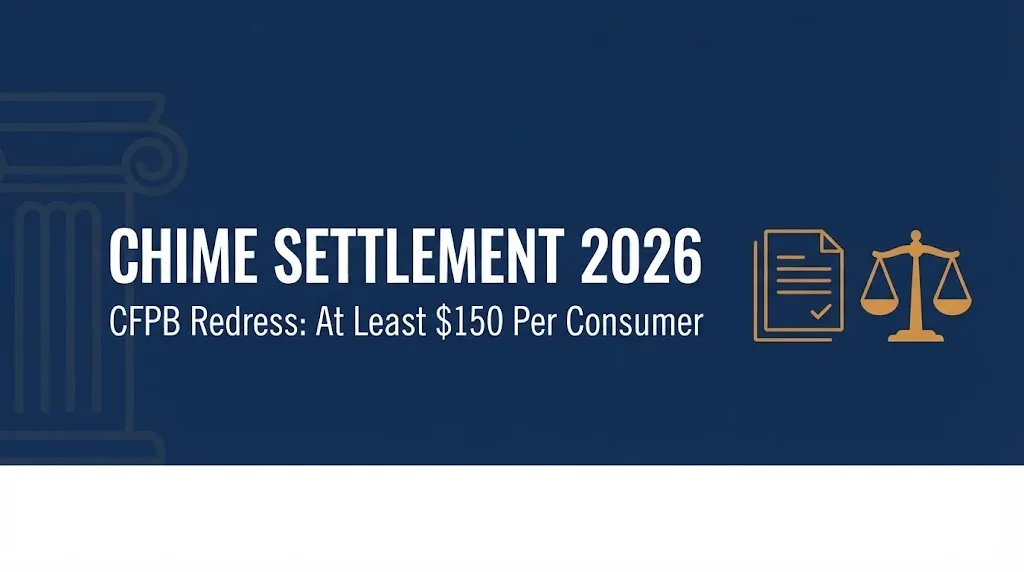
- Affected consumers get at least $150 if Chime held an unrefunded balance of $10 or more for over 14 days after account closure.
- A separate April 2026 data breach lawsuit against Chime has no settlement yet; no claim form for that case exists.
If you’re searching “Chime settlement” in 2026, you’re likely running into two different things. One already resulted in money for consumers. The other is still an active lawsuit with nothing to file yet.
The confirmed settlement is a Consumer Financial Protection Bureau consent order from May 7, 2024. It requires Chime to pay at least $150 to consumers whose account-closure refunds were delayed past 14 days. Separately, a class action over an April 2026 outage and alleged data breach is pending in federal court, with no settlement reached.
This article covers both, plus two smaller CFPB and state actions against Chime that also involved consumer money. One detail catches people off guard: the CFPB redress doesn’t require you to file anything. Chime is legally required to find and pay you.
The Facts
| Case | In the Matter of Chime Financial, Inc., CFPB File No. 2024-CFPB-0002 |
| Agency | Consumer Financial Protection Bureau (administrative consent order, not a court class action) |
| Status | Consent order finalized May 7, 2024, redress and compliance ongoing |
| Fund Size | $3.25 million penalty to the CFPB’s victims relief fund, plus at least $1.3 million in consumer redress |
| Est. Per Person | At least $150 for qualifying consumers |
| Claim Deadline | None. No claim form exists; redress is automatic |
| Administrator | Chime Financial, Inc., under CFPB compliance oversight |
| Proof Needed | None required from consumers |
Is the Chime Settlement Real?
Yes, the Chime settlement tied to delayed account refunds is real, and it came from a federal regulator, not a class action law firm. The Consumer Financial Protection Bureau issued the consent order on May 7, 2024.
The CFPB found that Chime failed to refund closed-account balances within its own stated 14-day policy. In thousands of cases, consumers waited more than 90 days to get their own money back.
Chime agreed to the order without admitting or denying the CFPB’s findings. That’s standard practice in regulatory consent orders and doesn’t change whether the redress requirement is enforceable.
If someone contacts you claiming you need to pay a fee or click a link to “activate” your Chime settlement payment, that’s not how this works. Redress here is automatic.
Is There a Chime Data Breach Settlement in 2026?
No, there is no settlement in the 2026 Chime data breach and outage litigation. The case is still in early federal litigation, and no claim form exists for it.
On April 1, 2026, a cyberattack knocked Chime’s platform offline, locking out account access for a period of time. Two customers filed a class action lawsuit on April 3, 2026, and additional related lawsuits followed within weeks.
Table: 2026 Litigation vs. Confirmed Settlement
| CFPB Refund Delay Settlement | 2026 Data Breach Lawsuit | |
|---|---|---|
| Status | Settled, redress in effect | Pending litigation, no settlement |
| Money for consumers | Confirmed, automatic | Not yet determined |
| Claim required | No | Not applicable yet |
| Case type | CFPB consent order | Federal class action |
How Much Is the Chime Settlement Worth?
The CFPB consent order requires Chime to pay a $3.25 million civil penalty into the agency’s victims relief fund, plus at least $1.3 million directly to harmed consumers. That puts the total order value at roughly $4.55 million.
That $1.3 million figure is a floor, not a cap. The exact total consumers receive depends on how many people Chime identifies as eligible under the order’s terms.
This settlement is separate from a related CFPB action against Chime’s Sendwave remittance app, which required a $3 million resolution including $1.5 million in fee refunds to certain international money transfer customers.
Key Takeaway: The confirmed Chime settlement money, at least $150 per eligible consumer, comes from a 2024 CFPB order that requires no claim form, not from the pending 2026 data breach lawsuit.
How Much Money Can You Get From the Chime Settlement?
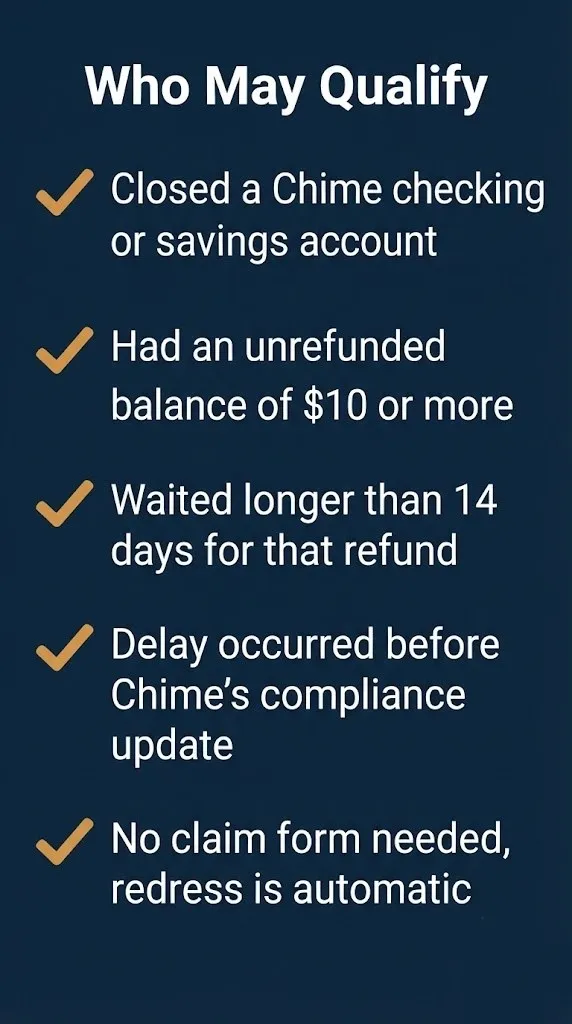
You can generally expect at least $150 in redress if you closed a Chime account, had an unrefunded balance of $10 or more, and waited longer than 14 days for that balance back. That’s the CFPB’s stated minimum.
The $150 figure applies specifically to the account-closure refund delay case. It is not tied to the 2026 data breach lawsuit, which has no payout figures at all since no settlement exists.
What determines your eligibility under the CFPB order:
- You had a Chime checking or savings account that was closed
- Your remaining balance was $10 or more
- Chime did not refund that balance within 14 days
- The delay happened before Chime came into compliance with the order
Not yet determined: any payout figure for the 2026 breach and outage lawsuit. The case has not reached class certification, settlement talks, or a trial date as of this writing.
Are There Other Chime Settlements With Payouts?
Yes, Chime has settled more than one regulatory matter involving consumer money, and each one covers a different issue and time period. Confusing them is common.
Confirmed Chime regulatory settlements involving consumer money:
- CFPB refund delay order (May 2024): at least $150 per affected consumer, automatic
- CFPB Sendwave remittance order (October 2023): $3 million total, including $1.5 million in fee refunds to eligible remittance customers who used the Sendwave app to send transfers to Nigeria during a specific window
- California DFPI consent order (February 2024): $2.5 million penalty tied to complaint-handling practices, no direct consumer claims process confirmed
- Richards v. Chime Financial (2019 service outage): a past class action settlement with a claims deadline that closed in 2021, no longer accepting claims
Reality Check
Nobody from Chime or the CFPB will text you a link asking you to “verify your account” to receive settlement money. Redress under the CFPB order is automatic and requires no payment, login, or personal data submission from you.
If you see a website claiming to accept claims for the 2026 Chime data breach lawsuit, be cautious. Multiple sources confirm no settlement or claims process exists for that case yet.
Do I Need to File a Claim for the Chime Settlement?
No, you do not need to file a claim for the confirmed CFPB refund delay settlement. Chime is required to identify eligible consumers using its own account records and issue payment automatically.
This is different from most class action settlements you might have filed for in the past, where you submit a claim form by a set deadline.
If you believe you’re owed money under this order:
- Check whether you closed a Chime account with an unrefunded balance
- Confirm the delay happened before Chime came into compliance
- Watch your mail or bank account for an unprompted refund payment
- Contact Chime directly if you believe you qualified but never received payment
- File a complaint with the CFPB if Chime does not respond
- Keep records of your account closure date and any communications with Chime
How Do I Know If I Qualify for Chime Redress?
You likely qualify if you closed a Chime checking or savings account, had a balance of $10 or more left in it, and did not receive that balance back within 14 days. The CFPB order applies to that specific pattern.
Chime’s own internal account records are the source of truth for this determination, not a self-reported claim form. If Chime’s records show you experienced this delay, you’re expected to be included automatically.
If you’re unsure and want confirmation, contacting Chime customer service or filing a complaint with the CFPB are your two direct paths. Neither should cost you money.
What Should I Do About the 2026 Chime Data Breach Lawsuit?
Right now, there’s nothing to file. The case is pending in federal court, and no settlement, claim form, or payout has been approved.
If you experienced account access issues, lost data, or financial harm from the April 2026 outage, document it now. Save screenshots, timestamps, and any financial losses tied to the incident, since that kind of documentation can matter if a settlement is reached later.
Data breach class actions like this one typically take one to three years to reach a resolution, depending on how litigation, discovery, and any settlement talks unfold.
Key Takeaway: No legitimate Chime data breach claim form exists in 2026. Anyone asking you to file or pay for one right now is not part of an official process.
What Is the Latest Chime Settlement News in 2026?
The most recent confirmed activity is that the CFPB’s 2024 consent order remains active, with a compliance deposit action logged in the case docket on July 11, 2025. No new claims process for consumers has opened since.
On the litigation side, the 2026 data breach case had an initial case management conference scheduled for July 7, 2026, following a case management statement deadline of June 30, 2026. No class certification or settlement has been reported.
Chime has publicly disputed the scope of the April 2026 incident, stating it affected the company’s marketing website rather than member account data. That dispute is part of why the case remains in early litigation rather than settlement talks.
Is the Chime Data Breach Lawsuit Close to a Settlement?
Not based on anything confirmed as of mid-2026. The case is still working through case management steps, not settlement negotiations.
Federal data breach class actions this early in the process, without a completed discovery period or class certification ruling, typically remain unsettled for a year or more. There’s no confirmed timeline for when or if this case reaches a deal.
Treat any online claim that a Chime data breach settlement fund already exists in 2026 as unconfirmed unless it links back to an actual court filing or an official settlement administrator.
What Happened With the Chime Sendwave Settlement?
Chime’s Sendwave subsidiary settled separate CFPB allegations in October 2023 over how it handled international remittance transfers. That resolution required $3 million total, including $1.5 million in direct fee refunds to eligible consumers.
The CFPB alleged Sendwave restricted consumer legal protections and made misleading claims about how fast and cheap remittance transfers to certain countries would be. This is a distinct matter from the account refund delay case.
If you used Sendwave to send remittance transfers to Nigeria during the specific period covered by that order, that redress process was handled separately from Chime’s main refund delay settlement.
What Did Chime Do Wrong in the CFPB Case?
According to the CFPB, Chime violated the Consumer Financial Protection Act by failing to refund closed-account balances within its own promised 14-day window. In thousands of cases, refunds took longer than 90 days.
What the CFPB’s findings described:
- Chime’s stated policy was 14-day refunds until 2021
- Thousands of consumers waited weeks to months for their own money
- Some consumers had to rely on credit cards or other borrowing to cover expenses while waiting
Chime has said the delays largely stemmed from a configuration error involving a third-party vendor during 2020 and 2021, and that it worked to resolve the issue and issue refunds once discovered.
What Happened in the 2026 Chime Data Breach?
On April 1, 2026, Chime experienced a platform-wide outage that customers and lawsuits allege was tied to a cyberattack. The outage reportedly locked some users out of account access for a period of time.
Plaintiffs allege the incident exposed personal data and that Chime failed to maintain adequate cybersecurity protections. Chime has publicly disputed that member account data was compromised, saying the incident affected its marketing website.
Multiple related lawsuits were filed within weeks of the outage in federal court in California, and they remain in early litigation as of mid-2026.
What Was the 2019 Chime Outage Settlement?
The 2019 Chime outage settlement, Richards et al. v. Chime Financial Inc., resolved claims tied to an earlier service disruption. That claims deadline closed in 2021, and the case is fully finished.
This older settlement is unrelated to both the 2024 CFPB refund order and the 2026 data breach lawsuit. If you’re searching for it hoping to still file, that window has been closed for years.
Who Regulates Chime as a Fintech?
Chime is regulated primarily by the CFPB at the federal level, and by California’s Department of Financial Protection and Innovation at the state level, since Chime itself is not a bank. Chime’s actual banking services run through FDIC-insured partner banks.
This structure matters because it explains why Chime settlements often come from regulators rather than only from private class action lawsuits. Think of it like a store brand versus the manufacturer behind it: Chime handles the customer relationship, but partner banks hold the actual deposits.
California’s DFPI issued a separate consent order in February 2024 addressing Chime’s complaint-handling practices, requiring a $2.5 million penalty and internal process changes.
What Happens Next
July 11, 2025 (confirmed): Compliance deposit activity logged in the CFPB’s Chime consent order docket.
July 7, 2026 (confirmed): Initial case management conference scheduled in the 2026 data breach litigation.
Ongoing: Chime continues compliance reporting to the CFPB under the 2024 refund delay order.
Expected, timeline unconfirmed: Further case management and possible discovery steps in the 2026 data breach lawsuit, with no settlement timeline announced.
Frequently Asked Questions
Is the Chime settlement legit?
Yes, the confirmed CFPB refund delay settlement is a real federal regulatory order.
It requires automatic redress with no fee or claim form required from consumers.
How much does the Chime settlement pay?
Affected consumers get at least $150 under the CFPB’s refund delay order.
The 2026 data breach lawsuit has no confirmed payout figures since it hasn’t settled.
Do I need to file a claim for Chime settlement money?
No, for the CFPB refund delay order, Chime is required to identify and pay you automatically.
No claim form or third-party site is involved in that process.
Is there a Chime data breach settlement right now?
No, the 2026 data breach lawsuit remains in early litigation with no settlement reached.
Any site claiming to accept claims for it should be treated as unverified.
What is the Chime Sendwave settlement?
It’s a separate October 2023 CFPB action requiring $3 million total from Chime’s Sendwave app.
It included $1.5 million in fee refunds tied to specific international remittance transfers.
Can I still file for the 2019 Chime outage settlement?
No, that claims deadline closed in 2021 and the case is fully resolved.
It is unrelated to the current 2024 CFPB order or the 2026 litigation.
Who administers the Chime CFPB settlement?
Chime Financial itself identifies and pays eligible consumers under CFPB compliance oversight.
There is no separate third-party claims administrator for this specific order.
Will there be a payout in the 2026 Chime lawsuit?
Not yet determined, since the case hasn’t reached class certification or a settlement.
Watch official court filings rather than third-party payout estimate articles.
Bottom Line
The real, confirmed Chime settlement money right now comes from a 2024 CFPB order paying at least $150 automatically to eligible consumers. The 2026 data breach lawsuit is a separate, still-pending case with no settlement yet.
If you closed a Chime account and waited weeks or months for your balance back, contact Chime or the CFPB directly. For the 2026 breach lawsuit, document any losses now and watch for official updates, since no claim process exists as of July 29, 2026.