What Does Litigation Mean? A 2026 Guide to the Lawsuit Process
Quick Answer:
- Litigation is the official court process for resolving legal disputes, from the initial complaint through trial or settlement.
- Most civil litigation cases settle before trial, with settlement rates consistently above 90 percent in U.S. federal courts.
- The statute of limitations sets a strict deadline to file, and missing it means losing your right to sue permanently.
If you received a notice about a lawsuit, saw a class action settlement email, or are considering legal action yourself, the word “litigation” keeps showing up. And if you have never been involved in a court case, the term can feel like a locked door.
This article breaks down exactly what litigation means, how the process works step by step, what you can expect if you are part of a case, and the single most important deadline you cannot afford to miss. One verified fact most people get wrong: the overwhelming majority of lawsuits never reach a courtroom trial. They resolve through settlement, motion practice, or dismissal long before a jury is seated.
The Facts
| Detail | Information |
|---|---|
| Definition | Formal court process for resolving civil disputes |
| Typical Duration | 12 to 36 months for most civil cases |
| Settlement Rate | Over 90% of civil cases settle before trial |
| Key Deadline Type | Statute of limitations, varies by state and claim type |
| First Filing | Complaint or petition |
| End Result | Settlement, dismissal, judgment, or verdict |
| Governing Rules | Federal Rules of Civil Procedure or state equivalents |
What Is Litigation in Simple Terms
Litigation is the formal process of taking a dispute to court and asking a judge or jury to decide the outcome. It is the official legal path for resolving conflicts when negotiation fails.
Think of it as the structured, rule-bound version of two parties who cannot agree on something, whether it is money, property, injuries, or contract terms, and now a neutral third party with authority will decide for them. Every civil lawsuit filed in the United States operates under litigation rules.
The process starts when one party, the plaintiff, files a complaint with the court. The complaint names the defendant, states the facts, and asks the court for a remedy, typically money. Once filed, the defendant must respond, and from that point forward, court deadlines, discovery obligations, and procedural rules govern every move.
Litigation covers everything from multimillion-dollar corporate battles to small claims court disputes over a few thousand dollars. The same basic framework applies regardless of dollar amount. What changes is the complexity, the time involved, and the procedural rules depending on whether the case is in state court, federal court, or a specialized tribunal.
What Does Litigation Mean in a Lawsuit
In a lawsuit, litigation refers specifically to the active court-based phase of a dispute. It means the case has moved past demand letters and informal negotiation and is now inside the formal legal system.
Once litigation begins, the court has jurisdiction over the parties. That changes everything. Deadlines become mandatory. Discovery, the process of exchanging evidence, is compulsory. A judge manages the schedule, and failing to respond to a complaint on time can result in a default judgment against the defendant, meaning the plaintiff wins automatically because the other side did not show up.
This is the phase where legal representation is critical. Procedural rules govern how documents are filed, how evidence is shared, and how motions are argued. Missing a single deadline can end a case. The Federal Rules of Civil Procedure, adopted by most state courts with variations, dictate exactly how litigation proceeds from the complaint through any appeal.
Key Takeaway: Litigation is the court-supervised phase of a dispute, with mandatory deadlines, formal evidence exchange, and a judge overseeing every step.
Why Do Cases Enter Litigation
Cases enter litigation because the parties could not reach an agreement through informal means. Demand letters, mediation, or direct negotiation either failed or were never attempted.
The most common trigger is a statute of limitations deadline. Every civil claim has a filing deadline set by law. If you wait too long to negotiate and the deadline approaches, you must file a complaint in court to preserve your rights. Filing a lawsuit freezes the clock. This is why many lawsuits are filed even when settlement talks are ongoing, the court filing protects the plaintiff’s legal position.
Another driver is insurance company behavior. Personal injury claims, property damage disputes, and employment matters often end up in litigation because an insurer refuses to offer a reasonable settlement. The plaintiff files suit to force a more serious evaluation of the claim. The court docket itself becomes leverage.
In class action and mass tort litigation, the trigger is often widespread harm. Consumers, employees, or patients who suffered similar damages from the same product, practice, or drug band together in a single case. Here, litigation is not just about individual compensation. It is also about changing corporate behavior and publicly exposing wrongdoing through the discovery process.
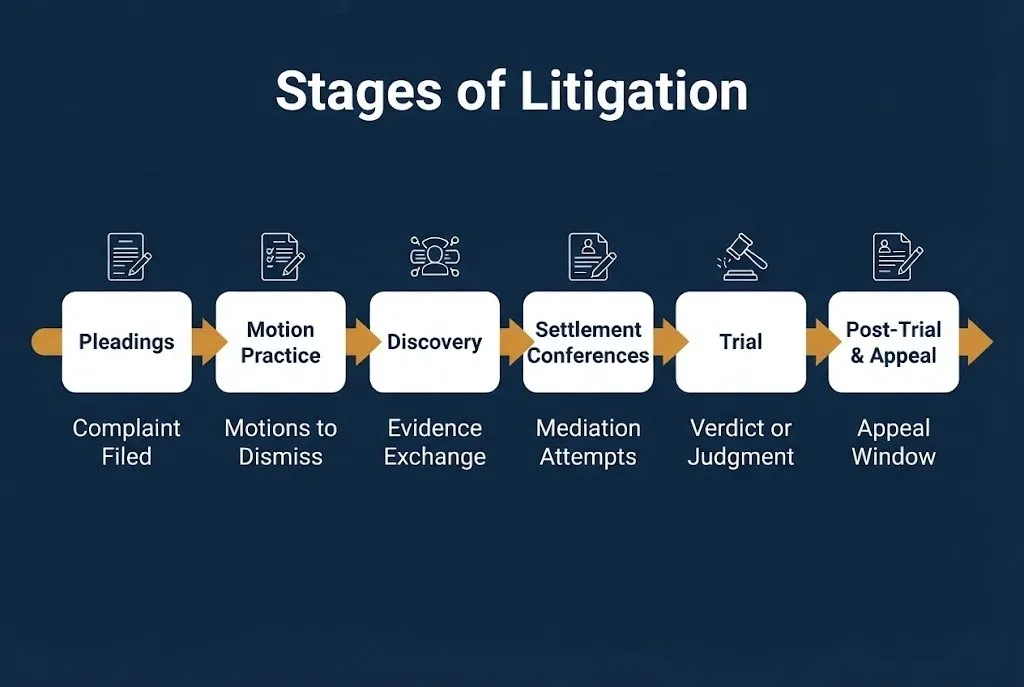
What Are the Stages of Litigation
Litigation follows a predictable sequence of stages, and knowing them helps you understand what to expect and when. Each stage has specific deadlines and requirements.
1. Pleadings
The plaintiff files a complaint with the court and serves it on the defendant. The complaint states the legal claims, the facts supporting them, and the relief sought. The defendant then files an answer, admitting or denying each allegation, or moves to dismiss the case entirely.
This stage sets the boundaries of the dispute. Everything that follows is shaped by what the complaint alleges and what defenses the answer raises.
2. Motion Practice
Either side can file motions asking the court to rule on specific legal issues before trial. A motion to dismiss argues the complaint fails to state a legal claim even if every fact alleged is true. A motion for summary judgment argues there are no material facts in dispute and the moving party should win as a matter of law.
These motions can end a case early or narrow the issues that actually go to trial.
3. Discovery
This is the longest and most expensive phase. Both sides exchange documents, answer written interrogatories, and conduct depositions, which are sworn interviews of witnesses and parties under oath. Discovery can take six months to two years depending on case complexity.
The goal is to uncover every relevant fact so there are no surprises at trial. It is also where cases often settle, because both sides see the strength and weakness of the evidence laid bare.
4. Pre-Trial and Settlement Conferences
The court typically orders the parties to meet and discuss settlement before trial. A judge or magistrate may facilitate settlement discussions. Many federal courts require mandatory settlement conferences before a trial date is set.
Most cases that have not already been dismissed end here. The parties negotiate a settlement that both can accept, avoiding the risk and expense of trial.
5. Trial
If no settlement is reached, the case goes to trial before a judge or jury. Each side presents evidence, examines witnesses, and makes arguments. The jury or judge renders a verdict.
Trials are rare. The National Center for State Courts consistently reports that fewer than 3 percent of civil cases reach trial.
6. Post-Trial and Appeal
The losing party may file post-trial motions or appeal to a higher court. Appeals focus on legal errors, not factual re-litigation. An appeal can add one to three years to the process.
Key Takeaway: Discovery is the longest and costliest stage, and it is where most settlements happen because both sides see the evidence clearly for the first time.
How Long Does Litigation Take
The duration depends on case complexity, court caseload, and whether the case settles. Most civil litigation resolves in 12 to 36 months from filing to resolution, though complex class actions and mass torts can take three to five years or more.
A straightforward breach of contract case in state court might wrap up in under a year if it settles early. A federal antitrust class action with millions of documents and multiple defendants routinely takes four to six years before settlement funds reach class members.
The discovery phase alone typically accounts for 50 to 70 percent of the total timeline. Courts set discovery deadlines, but extensions are common when parties cooperate. Aggressive motion practice, where one side files multiple motions to dismiss or for summary judgment, also lengthens the timeline.
Small claims court is the notable exception. Most small claims cases resolve in 30 to 90 days, with simplified procedures and no formal discovery. Dollar limits vary by state, typically ranging from $2,500 to $25,000.
What Does It Mean When a Case Goes Into Litigation for a Claimant
For a claimant, the person bringing the claim, litigation means you have moved from asking for compensation to legally demanding it. The process is now formal, adversarial, and governed by strict rules.
You will need to produce documents, answer written questions under oath, and likely sit for a deposition where the opposing attorney questions you face to face. Your medical records, financial history, employment file, and social media accounts may become discoverable evidence. The defendant’s attorney is not your friend. Every statement you make in discovery can be used against you.
The upside is leverage. Once litigation is filed, the defendant, and especially their insurance carrier, must spend money to defend. That defense cost often motivates more serious settlement offers than you received during pre-litigation demand letters. Many cases that sat stagnant for months settle within weeks of a deposition being scheduled.
Reality Check: No legitimate litigation process involves someone texting you first with a settlement offer. If you receive an unsolicited message claiming you have money waiting from a lawsuit you never joined, it is a scam. Real settlements require verified claim forms and court approval. Filing a claim is always free.
What Does It Mean When a Case Goes Into Litigation for a Defendant
For a defendant, litigation means you have been formally accused in a court of law and must respond or risk losing by default. The complaint you received is not a request. It is the opening move in a legal process that will demand your time, money, and attention.
Your first obligation is to answer the complaint within the deadline set by court rules, typically 20 to 30 days after service. If you ignore it, the plaintiff can seek a default judgment against you for the full amount demanded. That judgment is enforceable, meaning the plaintiff can garnish wages, levy bank accounts, or place liens on property.
You have a right to defend yourself, to hire an attorney, to challenge the legal sufficiency of the complaint, and to conduct discovery of your own. If you have insurance that covers the claim, your insurer likely has a duty to defend you and will appoint counsel. Notify your insurer immediately upon being served.
How Is Litigation Different From Arbitration
Litigation takes place in public courtrooms with government-appointed judges. Arbitration is a private process where a neutral third party, chosen and paid for by the parties, decides the dispute outside the court system.
The key differences matter for anyone deciding how to resolve a dispute.
| Feature | Litigation | Arbitration |
|---|---|---|
| Forum | Public court | Private conference room or virtual |
| Decision Maker | Judge or jury | Arbitrator, often an industry expert |
| Discovery | Broad, compulsory | Limited, by agreement |
| Appeal Rights | Full appeal to higher court | Extremely narrow, rarely overturned |
| Cost | High, but public funding | High, parties pay arbitrator fees |
| Speed | Slower, congested dockets | Often faster, flexible scheduling |
| Public Record | Yes, filings are public | No, proceedings are confidential |
Many consumer contracts now include mandatory arbitration clauses that waive the right to litigation and class actions. These clauses are generally enforceable under federal law, though some states and agencies have limited their reach in employment and consumer contexts.
For plaintiffs, litigation usually offers more procedural protections, broader discovery, and the leverage of a public filing. For defendants, arbitration can mean faster resolution, lower defense costs in some cases, and avoiding negative publicity.
What Is Class Action Litigation
Class action litigation is a procedural mechanism that allows one or a few plaintiffs to sue on behalf of a much larger group of people with similar claims. It aggregates individual claims into a single case.
For class members, this means you do not need to hire your own attorney or file your own lawsuit to potentially receive compensation. If the case settles or results in a judgment, class members who meet the definition and follow claim procedures may receive a share of the recovery.
Class certification is the pivotal stage. The plaintiffs must convince the court that the claims are similar enough, the class is large enough, and the named plaintiffs will adequately represent the interests of absent class members. If certification is denied, the case proceeds as an individual action only.
Most high-profile consumer settlements you hear about are class action cases. Data breaches, defective products, false advertising, and wage and hour violations frequently proceed as class actions. Notices arrive by email or postcard because the settlement administrator identified you as a potential class member from company records.
Key Takeaway: Class action litigation aggregates individual claims so many people can seek compensation together, and you typically do not need to hire a lawyer to participate.
What Is Discovery in Litigation
Discovery is the formal, court-supervised process of exchanging information between parties in litigation. It is how each side learns what evidence the other side has before trial.
The Federal Rules of Civil Procedure authorize several discovery tools. Interrogatories are written questions that must be answered under oath. Requests for production demand documents, electronically stored information, and physical evidence. Depositions are live, in-person examinations of witnesses under oath, transcribed by a court reporter. Requests for admission ask a party to admit or deny specific facts, narrowing what must be proven at trial.
Discovery is intentionally broad. The legal standard is that information is discoverable if it is reasonably calculated to lead to admissible evidence. That means far more is exchanged in discovery than would ever be shown to a jury.
This stage is expensive. Document review alone can cost hundreds of thousands of dollars in complex cases. It is also where litigation strategy plays out most visibly. Aggressive discovery tactics, objections, and motions to compel or for protective orders are common. Courts have broad discretion to manage discovery and sanction parties who abuse the process.
For individuals involved in litigation, discovery means your personal records, communications, and testimony may become part of the case file. Assume everything you have written about the matter, including texts and emails, will be read by the other side.
What Is a Litigation Hold
A litigation hold is a written notice directing an organization or individual to preserve all documents and electronically stored information that may be relevant to anticipated or pending litigation.
The duty to preserve evidence arises as soon as litigation is reasonably anticipated, not just after a complaint is filed. Failing to issue and comply with a litigation hold can result in severe sanctions, including adverse jury instructions, monetary fines, or even default judgment.
For companies, a litigation hold suspends routine document destruction policies. Automatic email deletion, for instance, must be stopped for relevant custodians. IT departments are typically involved to ensure backup tapes, cloud storage, and device data are preserved.
For individuals, a litigation hold means you cannot delete relevant texts, emails, social media posts, or other records once you know a lawsuit is likely. Spoliation of evidence, the destruction of relevant information, is one of the fastest ways to lose credibility with a judge and can turn a defensible case into a lost one.
What Happens After Litigation Ends
Litigation ends in one of four ways: settlement, voluntary dismissal, summary judgment, or trial verdict. Each has different consequences and timelines.
Settlement is the most common outcome. The parties agree on terms, the plaintiff signs a release of claims, and the defendant pays the agreed amount. In class actions, the settlement must receive court approval after a fairness hearing where class members can object. Payouts typically begin 60 to 180 days after final approval, depending on any appeals.
Dismissal with prejudice means the case is over permanently and the plaintiff cannot refile the same claims. Dismissal without prejudice means the plaintiff can refile, assuming the statute of limitations has not expired.
A judgment after trial or summary judgment is a court order determining the rights of the parties. If the plaintiff wins, the judgment states the amount owed. Collecting a judgment is a separate process. The winning party may need to garnish wages, levy bank accounts, or record liens to actually get paid. A judgment is a piece of paper until it is enforced.
Appeals delay finality. Even after a trial verdict, the losing party typically has 30 days to file a notice of appeal. The appellate process takes a year or more. No payment is made while an appeal is pending unless the judgment is bonded.
Key Takeaway: Even after litigation formally ends, collecting a judgment or waiting for settlement distribution can take months, and appeals add significant time.
What Happens Next
If you are considering litigation or have just been served with a complaint, here is the expected sequence.
- Immediately upon service: Calendar the response deadline, typically 20 to 30 days. Contact an attorney or, if insured, your insurance carrier.
- Within 30 days: File an answer or motion to dismiss. Failure to respond risks default judgment.
- Within 60 to 90 days: Initial case management conference where the judge sets the discovery schedule and trial date.
- Next 6 to 18 months: Discovery phase, including document production, interrogatories, and depositions.
- Mid-discovery: Settlement discussions often intensify as evidence becomes clear. Mediation may be ordered.
- Post-discovery: Dispositive motions like summary judgment. If denied, trial preparation begins.
- Trial: Only if settlement fails, likely 18 to 36 months after filing for most civil cases.
- Post-trial: 30-day window for appeals. Judgment enforcement if no appeal.
Frequently Asked Questions
Is litigation the same as a lawsuit
Yes, litigation is the process that begins when a lawsuit is filed. A lawsuit is the case itself, and litigation is the court-based procedure used to resolve it.
Can I start litigation without a lawyer
Yes, you can file a complaint and represent yourself, a practice called proceeding pro se. However, corporations and most business entities must be represented by counsel in litigation. Self-representation is risky and courts hold pro se litigants to the same procedural standards as attorneys.
How much does litigation cost
Costs vary enormously. Filing fees range from $100 to $500. Attorney fees for a simple case may be $5,000 to $15,000 total. Complex commercial litigation can exceed $100,000 in legal fees. Many plaintiff-side attorneys work on contingency, meaning they are paid only from any recovery.
What happens if I ignore a litigation notice
Ignoring a complaint will likely result in a default judgment against you. The plaintiff gets what they asked for without having to prove their case. That judgment is enforceable against your assets.
Is litigation public record
Yes, litigation filings are generally public records accessible through court dockets. Some documents may be filed under seal or subject to protective orders, but the case itself and most filings remain public. Federal cases are searchable through the PACER system.
What is a litigation guardian
A litigation guardian, also called a guardian ad litem, is a person appointed by the court to represent the interests of a minor or incapacitated adult in litigation. The guardian makes decisions about the case on behalf of the person who cannot represent themselves.
Can litigation be paused once it starts
Yes, the court can stay litigation, meaning pause it, for various reasons. Common grounds include pending settlement negotiations, related bankruptcy filings, or awaiting the outcome of a related appellate decision. A stay is requested by motion and granted at the court’s discretion.
What is vexatious litigation
Vexatious litigation refers to lawsuits filed without merit, often repeatedly, to harass or burden the defendant. Courts can sanction vexatious litigants and, in extreme cases, restrict their ability to file new cases without prior court permission.