Tepezza Lawsuit: 2026 Update on Hearing Loss Claims and Litigation
Quick Answer:
- The Tepezza lawsuit is real, with claims that the thyroid eye disease drug caused permanent hearing loss or tinnitus that the manufacturer failed to adequately warn about.
- Settlement amounts are not yet determined, with no global settlement reached as of mid-2026.
- If you took Tepezza and suffered hearing problems, contact an attorney now because statute of limitations deadlines are approaching.
If you or someone you know received Tepezza infusions for thyroid eye disease and later developed hearing loss, ringing in the ears, or muffled hearing, you are not alone. Thousands of patients have reported similar experiences, and a growing body of litigation now targets the drug’s manufacturer, Horizon Therapeutics, over what plaintiffs say was a failure to warn about the true scope of the risk.
This article covers where the Tepezza litigation stands right now, who may be eligible to file a claim, what the science says about the hearing loss connection, what a potential settlement might look like, and the deadlines you cannot afford to miss. One verified fact that surprises most people: the clinical trials that led to Tepezza’s FDA approval showed hearing-related side effects in a notable percentage of patients, yet stronger warnings only came after the drug was already on the market and widely prescribed.
The Facts
| Detail | Information |
|---|---|
| Drug | Tepezza (teprotumumab-trbw) |
| Manufacturer | Horizon Therapeutics (now part of Amgen) |
| FDA Approval Date | January 21, 2020 |
| Condition Treated | Thyroid Eye Disease (TED) |
| Primary Injury Alleged | Permanent sensorineural hearing loss, tinnitus |
| Litigation Type | Multidistrict litigation (MDL) and individual state court cases |
| MDL Court | U.S. District Court, Northern District of Illinois |
| Number of Cases | Over 150 in federal MDL as of mid-2026 |
| Settlement Status | No global settlement reached |
| Claim Deadline | None set yet; statute of limitations varies by state |
Is the Tepezza Lawsuit Legitimate
Yes, the Tepezza lawsuit is a legitimate mass tort litigation with real plaintiffs, active federal multidistrict litigation proceedings, and serious allegations backed by published medical research. This is not a class action settlement notice you received out of nowhere. It is an active, ongoing set of individual lawsuits consolidated for efficiency.
The U.S. District Court for the Northern District of Illinois is overseeing the federal cases under MDL No. 3079. Judge Thomas M. Durkin is presiding. An MDL, or multidistrict litigation, is a federal procedure that groups similar cases from across the country into one court for pretrial proceedings. Each plaintiff’s case remains individual. If the cases do not settle, each one eventually returns to its original court for trial.
State court cases are also proceeding in Illinois, New Jersey, California, and Delaware. Some law firms have filed large inventories of cases in state courts where procedural rules may differ from the federal MDL. The litigation is real, the court dockets are public, and the proceedings are moving forward. There is nothing phantom about this case.
Are There Any Tepezza Lawsuit Payouts Yet
No, there are no Tepezza lawsuit payouts as of July 2026. No global settlement has been reached. No settlement fund has been established. No claims administrator has been appointed. Any website or social media post claiming that Tepezza settlement checks are being mailed right now is inaccurate.
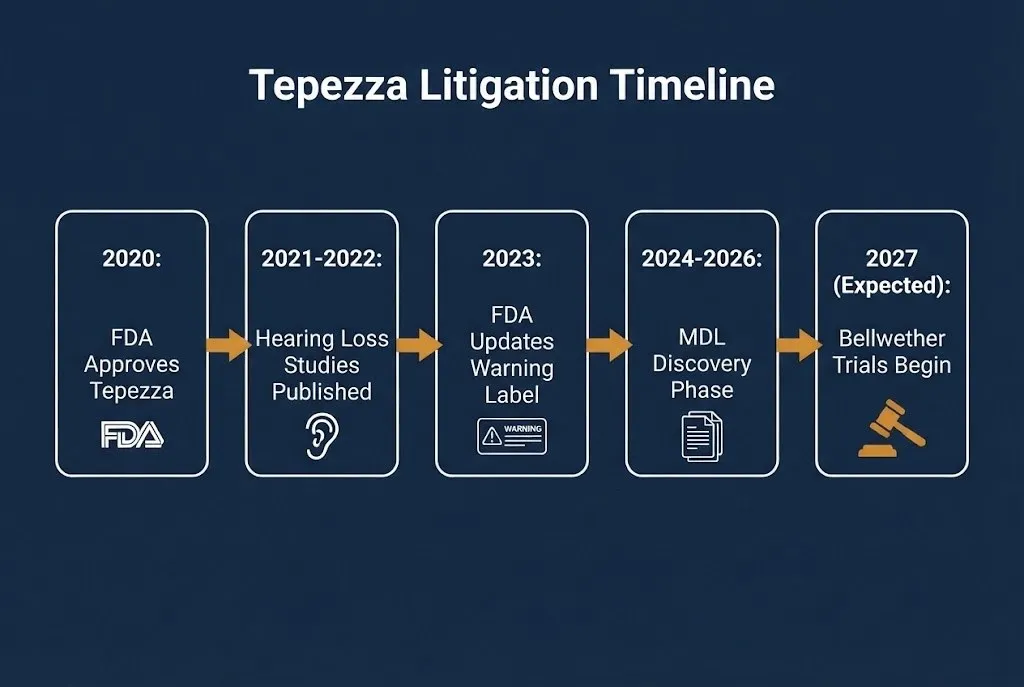
Litigation of this type takes time. Mass tort cases involving prescription drugs typically take three to six years from the first filings to any settlement or verdict. The first Tepezza lawsuits were filed in 2022. With bellwether trials expected no earlier than 2027, any settlement payouts are realistically still at least one to two years away, and that timeline assumes a settlement is actually reached.
Individual settlements before a global resolution are rare but possible. In some mass torts, a manufacturer settles with a subset of plaintiffs who have particularly strong injury profiles while continuing to litigate others. There is no public evidence that Horizon or Amgen has done this in the Tepezza litigation as of mid-2026.
Key Takeaway: No Tepezza settlement exists yet. Any payout figures you see online are speculation, not verified fact. The litigation is still in its pretrial phase.
How Much Could a Tepezza Settlement Be Worth
There is no confirmed settlement range for the Tepezza litigation because no settlement has been reached. Any dollar figure you see online is an estimate or projection from a law firm, not a court-approved amount. Estimates from plaintiff-side firms and legal analysts vary widely, from low six figures to over a million dollars for the most severe injuries, depending on multiple factors that are not yet resolved.
What drives settlement value in drug injury cases is the severity and permanence of the injury, the strength of the causation evidence linking the drug to the injury, the plaintiff’s age and life expectancy, and the extent of economic damages like lost wages and medical costs. Permanent bilateral hearing loss in a younger patient will almost certainly be valued higher than mild unilateral tinnitus in an older patient.
Bellwether trials, expected to begin in 2027, are the critical valuation event. These test trials give both sides a realistic picture of what juries think the cases are worth. Settlement negotiations in mass torts often intensify significantly after the first few bellwether verdicts. Until those verdicts come in, any settlement estimate is a rough projection, not a reliable number.
Tepezza Lawsuit Update: What Is Happening Right Now
As of mid-2026, the Tepezza MDL is deep into discovery. The parties are exchanging millions of pages of documents, taking depositions of key Horizon and Amgen witnesses, and preparing for expert discovery on both general causation and specific causation issues.
The court has entered a series of case management orders setting the schedule. Fact discovery is expected to conclude by late 2026 or early 2027. Expert discovery will follow. The first bellwether trials are tentatively expected in late 2027, though that date could shift based on the pace of discovery and any motions for summary judgment.
In May 2026, the court addressed several discovery disputes regarding the scope of Horizon’s internal communications about hearing-related adverse events. These rulings matter because they determine what evidence plaintiffs can access about what the company knew and when. Early rulings have generally favored plaintiffs on discovery scope, but no dispositive motions have been ruled on yet.
Amgen completed its acquisition of Horizon Therapeutics in October 2023 for approximately $27.8 billion. Amgen now controls the defense and any settlement decisions. This kind of corporate acquisition can shift settlement dynamics. A large acquiring company may be more willing to set aside a reserve fund and resolve litigation than a smaller standalone company. It can also mean a more aggressive litigation posture if Amgen believes the cases are defensible.
What Is the Tepezza Hearing Loss Connection
The central allegation in the Tepezza litigation is that the drug causes sensorineural hearing loss, a type of permanent inner ear damage, at rates far higher than Horizon originally disclosed. Published research now supports this connection.
A 2021 study published in the American Journal of Ophthalmology found that approximately 65 percent of Tepezza patients in a clinical cohort experienced some degree of hearing-related symptoms. That figure grabbed headlines and galvanized the litigation. A larger 2022 study, along with subsequent analyses, confirmed the signal. The types of injuries reported include hearing loss ranging from mild to profound, tinnitus or constant ringing in the ears, a feeling of ear fullness or pressure, and in some cases, vertigo or balance problems.
The mechanism is not fully understood, but the prevailing hypothesis involves the drug’s effect on the insulin-like growth factor 1 receptor, or IGF-1R. Tepezza works by blocking IGF-1R, which reduces the inflammation and tissue expansion behind the eyes that characterizes thyroid eye disease. The problem is that IGF-1R also plays a role in the inner ear’s ability to maintain and repair sensory hair cells. Blocking that receptor may damage those cells in susceptible patients.
In July 2023, the FDA updated Tepezza’s prescribing information to include a more prominent warning about hearing impairment. The label now recommends baseline hearing assessments before starting treatment and monitoring during and after infusions. For plaintiffs, that label change is a key piece of evidence. The question in litigation is whether the company should have included stronger warnings earlier, before thousands of patients had already been treated.
Who Qualifies for a Tepezza Lawsuit
You may qualify to file a Tepezza lawsuit if you meet specific criteria tied to the drug exposure and the resulting injury. No one is automatically part of this litigation. Filing a claim requires you to proactively contact an attorney and have your medical records reviewed.
The typical eligibility criteria that law firms are screening for include:
- You received at least one Tepezza infusion for thyroid eye disease.
- You developed hearing loss, tinnitus, muffled hearing, or balance problems after starting Tepezza.
- Your hearing problems were diagnosed by an audiologist or ENT physician.
- Your symptoms began during or within months of completing Tepezza treatment.
- You have audiograms or medical records documenting your hearing before and after treatment, though post-treatment documentation alone may suffice in some cases.
Filing is not like joining a class action where you fill out a short online form and wait for a check. These are individual lawsuits. Your attorney will need your complete medical records, pharmacy records confirming Tepezza infusions, audiology records including audiograms, and a detailed timeline of when you received the drug and when symptoms began. The stronger your documentation, the stronger your case.
How to File a Tepezza Lawsuit Claim
Filing a Tepezza claim means hiring an attorney who handles pharmaceutical mass torts and having them prepare and file an individual lawsuit on your behalf. This is not a simple claims form process. There are no court-appointed claim forms yet because no settlement exists.
Here is the step-by-step process.
- Contact a law firm that is actively handling Tepezza cases and accepting new clients.
- Complete an intake questionnaire detailing your Tepezza treatment dates and hearing symptoms.
- Sign medical record authorization forms so the firm can obtain your records.
- Provide the firm with any audiograms, ENT records, and pharmacy records you already have.
- Wait for the firm’s medical review team to evaluate whether your records support a viable claim.
- If accepted, sign a retainer agreement, which is typically a contingency fee agreement meaning the firm is paid only from any recovery.
- The firm drafts and files your individual complaint in the appropriate court.
- Your case becomes part of discovery, and you may be asked to provide deposition testimony or respond to written questions.
This process takes weeks to months, not days. The firms with the largest Tepezza inventories have teams dedicated to this specific litigation. Choosing a firm with actual mass tort experience matters. Ask any firm you contact how many pharmaceutical injury cases they have handled and whether they have experience in MDLs.
Key Takeaway: Filing is a medical record-driven process. Your audiogram is the most important document. Without it, most firms will decline your case.
What Is the Statute of Limitations for Tepezza Lawsuits
The statute of limitations is the legal deadline by which you must file your lawsuit. If you miss it, you lose your right to seek compensation permanently. This is the single most urgent issue for anyone considering a Tepezza claim.
There is no single national deadline. The statute of limitations is set by each state’s law. In most states, the personal injury statute of limitations is two or three years from the date the injury was discovered or reasonably should have been discovered. In a few states, it can be as short as one year.
The discovery date matters because hearing loss can develop gradually. Courts generally apply the discovery rule in pharmaceutical injury cases. The clock starts ticking when a reasonable person would have connected their injury to the drug. For many Tepezza patients, that connection may not have been obvious until the 2021 and 2022 studies were widely reported or until the FDA label change in 2023.
If you took Tepezza and developed hearing problems, do not wait to consult an attorney. Even if you are unsure whether the drug caused your hearing loss, an initial consultation is free, and the attorney can help you determine whether the statute of limitations is a concern. The cost of waiting is the potential loss of your claim forever.
Reality Check: No legitimate Tepezza lawyer will contact you unsolicited by text message or robocall. If someone reaches out claiming you have money waiting from a Tepezza settlement that does not exist yet, it is a scam. Real law firms do not operate that way. Initial consultations are always free. You never pay upfront fees in a legitimate pharmaceutical injury case.
Tepezza Litigation: What Is the MDL Process
The Tepezza federal cases are consolidated into multidistrict litigation, or MDL No. 3079, in the Northern District of Illinois. MDL is a procedural tool, not a class action, and understanding the distinction matters for anyone with a claim.
MDL consolidation means all federal Tepezza cases are transferred to one judge for pretrial proceedings. This avoids duplicate discovery, inconsistent rulings, and wasteful motion practice across dozens of courts. The MDL judge handles discovery disputes, rules on evidentiary motions, and selects bellwether cases for early trial.
Critically, each plaintiff retains their own individual lawsuit. If your case does not settle during MDL proceedings, it gets remanded, or sent back, to the federal district court where it was originally filed, and you get a trial date there. MDL is not a class action where you are bound by whatever the named plaintiffs and their attorneys negotiate. You have your own case, your own attorney, and your own settlement decision to make if a global resolution is proposed.
The bellwether selection process is now underway. Both sides will propose a pool of cases that are representative of the broader litigation. From that pool, the court will select a smaller number, typically six to twelve, for trial preparation. Bellwether verdicts are not binding on anyone except the plaintiff in that specific trial, but they provide the negotiating framework for a global settlement.
What to Expect Next in the Tepezza Litigation
The Tepezza litigation is following the standard mass tort trajectory, though the timeline stretches further out than many plaintiffs would like. Here is what the next several stages look like based on the current court schedule and typical MDL timelines.
- Late 2026 to early 2027: Fact discovery concludes. Expert discovery begins. Both sides designate their expert witnesses on general causation, specific causation, and damages.
- Mid-2027: Expert discovery closes. Both sides may file Daubert motions seeking to exclude the other side’s experts.
- Late 2027: Court rules on expert challenges. Bellwether trial pool is finalized. First bellwether trial dates are set.
- 2028: First bellwether trials take place. Settlement negotiations, which often occur in parallel throughout the MDL, intensify significantly after verdicts.
- 2028 to 2029: If bellwether outcomes favor plaintiffs, a global settlement framework may be negotiated. If outcomes favor the defense, individual cases may still proceed but settlement leverage shifts.
- After any global settlement: A claims process would be established with a settlement administrator, claim forms, a filing deadline, and a review period before payouts begin.
This timeline is not guaranteed. Litigation is unpredictable. Cases can settle earlier if the defense decides to resolve the litigation, or trials can be delayed by procedural disputes. The one certain thing is that no checks are being mailed in 2026.
Key Takeaway: Bellwether trials are the pivot point. Once those verdicts start coming in, the settlement picture will clarify substantially. Until then, patience and strong medical documentation are your most valuable assets.
Frequently Asked Questions
Is Tepezza a class action lawsuit
No, the Tepezza litigation is a mass tort consolidated into an MDL, not a class action.
Each plaintiff files an individual lawsuit and maintains control over their own case.
If a settlement is reached, each plaintiff’s payout is based on their individual injury severity.
What injuries are included in the Tepezza lawsuits
The primary injuries are permanent sensorineural hearing loss and chronic tinnitus.
Some cases also include claims for vertigo, balance disorders, and ear fullness or pressure.
The hearing loss can range from mild to profound and may affect one or both ears.
How long do I have to file a Tepezza lawsuit
The deadline depends on your state’s statute of limitations, typically two to three years from discovery.
You should contact an attorney immediately because the clock may already be running.
Waiting risks losing your right to file permanently.
Do I need an audiogram to file a Tepezza claim
Yes, an audiogram or audiology report is the single most important piece of evidence.
It documents the type, severity, and configuration of your hearing loss.
Without it, most law firms will not accept your case.
Can I still file if I took Tepezza years ago
Possibly, depending on when you discovered the connection to your hearing loss.
The discovery rule may extend the statute of limitations if the link was not reasonably knowable earlier.
An attorney can evaluate whether the statute of limitations is still open for you.
Will the Amgen acquisition affect my Tepezza case
Amgen now controls the defense and any settlement decisions.
A large acquiring company may be more willing to settle, but could also litigate aggressively.
The acquisition does not change the underlying medical facts or the legal strength of your claim.
What if my hearing returned to normal after stopping Tepezza
You may still have a claim, but the settlement value will likely be lower.
Permanent injuries drive higher settlement amounts.
Documentation of even temporary hearing loss supports the fact that you experienced an adverse event.
How are Tepezza lawsuits different from other drug injury cases
The volume of published medical literature supporting the hearing loss connection is unusually strong.
The FDA label change in 2023 provides a clear regulatory acknowledgment of the risk.
The relatively small patient population means the total number of claims may be lower than mass torts involving blockbuster drugs.