Commercial Litigation 2026: Process, Costs, and Trends
Quick Answer:
- What it is: Commercial litigation is the legal process for resolving business disputes through the court system, covering issues like breach of contract, partnership conflicts, and intellectual property claims.
- How much it costs: There is no set price. Costs depend on case complexity, location, and law firm rates. Small claims can be under £10,000, while High Court cases can cost hundreds of thousands .
- Most important thing to know: Most commercial disputes settle before trial. Engaging in pre-action correspondence is critical, and courts may impose cost penalties on parties who fail to do so .
Commercial litigation is a formal legal process. It resolves disputes that arise within a business context. These disputes can be between companies, partners, shareholders, or a business and a contractor. The goal is usually to seek monetary compensation for losses or damages caused by a breach of contract or other wrongful acts. The process follows a structured path through the court system.
This article breaks down the commercial litigation process step by step. We cover the key stages, costs, common types of disputes, and what you can expect if you are involved in a case.
The Facts
| Case | The process of commercial litigation, not a specific case |
|---|---|
| Status | Active legal process, applicable in 2026 |
| Spending Projection | $32 billion in the U.S. for 2026 |
| Est. Cost Per Case | Varies widely, from under £10,000 to over £100,000 |
| Claim Deadline | N/A; this is a process, not a class action |
| Administrator | N/A |
| Proof Needed | Varies by case; typically contracts, emails, and financial records |
What is commercial litigation in 2026?
Commercial litigation is the legal process for resolving business disputes in court. It is a subset of civil litigation, which covers legal disagreements between individuals or entities without criminal allegations . The core difference is that commercial litigation involves business entities . These disputes are often more complex and can involve specialized legal issues. They may be heard in federal court or specialized commercial courts .
Companies are spending more on this process in 2026. U.S. litigation spending is expected to reach $32 billion . This growth is driven by the rising complexity, contentiousness, and financial stakes of these disputes. Many businesses plan to increase their litigation budgets by at least 10% in 2026 .
Key Takeaway: Commercial litigation is the formal process used by businesses to resolve complex disputes in court, and it is a growing area of legal activity in 2026.
What are the most common types of commercial disputes?
Commercial litigation covers a wide range of business conflicts. The most common types include contract breaches, partnership and shareholder disputes, employment issues, and intellectual property or trade secret claims . Disputes can also arise from commercial real estate, construction, and insurance coverage . For example, a breach of contract is one of the most frequent reasons for a lawsuit. This occurs when one party fails to fulfill its obligations under a signed agreement.
Legal experts have noted that employment-related litigation is expected to grow the most in 2026, driven by new claims and regulatory changes . You should be aware that disputes can also involve fraud, misrepresentation, and cybersecurity breaches, which are increasingly common areas of litigation .
Key Takeaway: The majority of commercial lawsuits arise from broken contracts, business partnership conflicts, or disputes over intellectual property.
What is the first step in a commercial litigation case?
The process typically starts with pre-action correspondence. This is a mandatory step designed to avoid going to court. The party intending to sue sends a detailed letter of claim to the other side. The letter should outline the key facts, the legal basis for the claim, the losses suffered, and the remedy sought . The defendant then has a set time, often 14 to 28 days, to respond .
These pre-action protocols encourage parties to exchange information early. The goal is to try and settle the dispute without court intervention. The courts actively encourage this process and may impose cost penalties on parties who do not engage properly . Think of it like a formal warning and a final chance to talk things through before incurring major legal costs.
Key Takeaway: The first mandatory step is pre-action correspondence, where you set out your claim in a letter and give the other party a chance to respond before you actually file a lawsuit .
How do you actually start a court case?
If pre-action discussions fail, the claimant formally starts the case by filing a claim form. This is done with the appropriate court, which could be the High Court or a County Court depending on the claim’s value . In England and Wales, for example, claims over £100,000 are typically started in the High Court . This process is commonly known as “issuing a claim.”
The claim form must be accompanied by full “particulars of claim.” This document explains the detailed facts and legal arguments for the lawsuit . The court then issues the claim and serves it on the defendant. The defendant must then respond, which is usually the next key step in the process.
Key Takeaway: To start a court case, you file a claim form and particulars of claim with the court, formally notifying the defendant of the lawsuit .
What happens after a claim is filed?
After the defendant is served with the claim form, they have a limited time to respond. They have 14 days to either file a defence or file an acknowledgment of service. The acknowledgment of service buys them extra time to prepare a defence, extending the total time to 28 days from the date of service . If the defendant fails to respond in time, the claimant can request a “judgment in default,” which is a win without a trial .
If a defence is filed, the claimant can choose to file a reply. In many cases, a defendant will also file a counterclaim. This is a new claim against the claimant, which often relates to the same dispute . The court will then move into the next, more intensive, phase.
Key Takeaway: Once a claim is filed, the defendant has a short window to respond. If they don’t, the claimant can win by default .
What happens during the discovery phase?
Discovery, also known as disclosure, is often the most time-consuming and expensive part of commercial litigation. It is the formal process where each party is required to share evidence with the other side. This evidence can include contracts, emails, financial documents, and other relevant records . The idea is to eliminate surprises and clarify the issues before a trial .
In complex commercial cases, discovery often involves sifting through massive volumes of electronic documents, a process known as e-discovery. This can be costly, but it is essential for building your case. Courts can impose sanctions, including fines, if a party fails to produce documents or obstructs the discovery process .
Key Takeaway: Discovery is the phase where both sides must exchange their evidence, which can be a costly and lengthy process, especially in complex cases with large amounts of data.
How do most commercial cases end?
Most commercial disputes are resolved before they ever reach a trial. This happens through settlement negotiations or alternative dispute resolution (ADR), such as mediation. Courts strongly encourage this to save time and costs for the parties and the court system . In many ways, it is like settling a debt before it goes to collections; it can prevent further damage and expense.
A commercial litigation lawyer will work to get the best possible outcome for their client, which often means a favorable settlement. A successful outcome varies depending on the company’s business objectives . Effective negotiation requires demonstrating a willingness to go to trial while exploring a practical resolution.
Key Takeaway: The vast majority of commercial cases settle out of court through negotiation or mediation, avoiding the expense and risk of a trial .
What is the trial process?
If a case cannot be settled, it proceeds to trial. A trial involves presenting evidence, questioning witnesses, and making legal arguments before a judge or jury . The process includes opening statements, direct and cross-examinations, and closing arguments. Preparing for trial requires a huge investment of time and resources. This can include pre-trial conferences, exhibit preparation, and witness preparation .
The trial outcome is a verdict. After the verdict, parties can file post-trial motions. They can also appeal the decision to a higher court if they believe there were significant legal errors . Like a final exam, the trial is the culmination of all the work done in the previous stages.
Key Takeaway: Trial is the final stage where both sides present their case to a judge or jury, though it is rare because most cases settle first .
How much does commercial litigation cost?
The cost of commercial litigation varies widely. There is no set price . In the UK, a small claim might cost up to £10,000. A complex High Court case, however, can cost hundreds of thousands of pounds . The total cost depends on the complexity of the case, the law firm’s rates, the court fees, and the amount of money or damages at stake.
A notable example is the case of Municipio de Mariana v BHP Group. The court heard that the claimants had spent over £189 million on legal costs for a complex commercial dispute. This case shows how high the costs can escalate . You should remember that the losing party is typically expected to pay a significant portion of the winner’s legal costs . The decision to litigate should be a business decision based on a cost-benefit analysis.
Key Takeaway: Commercial litigation is very expensive. Costs can range from thousands to hundreds of thousands of dollars, and the loser often has to pay the winner’s legal fees .
Reality Check:
Litigation is a last resort, not a first step. The court process is slow, expensive, and public. Most disputes are resolved through negotiation or mediation long before they get to a trial. If you are involved in a business dispute, prioritize settlement discussions and alternative dispute resolution to save time and money.
What happens next in a commercial litigation case?
The process is highly structured and follows a predictable timeline, from initial filing to potential appeal.
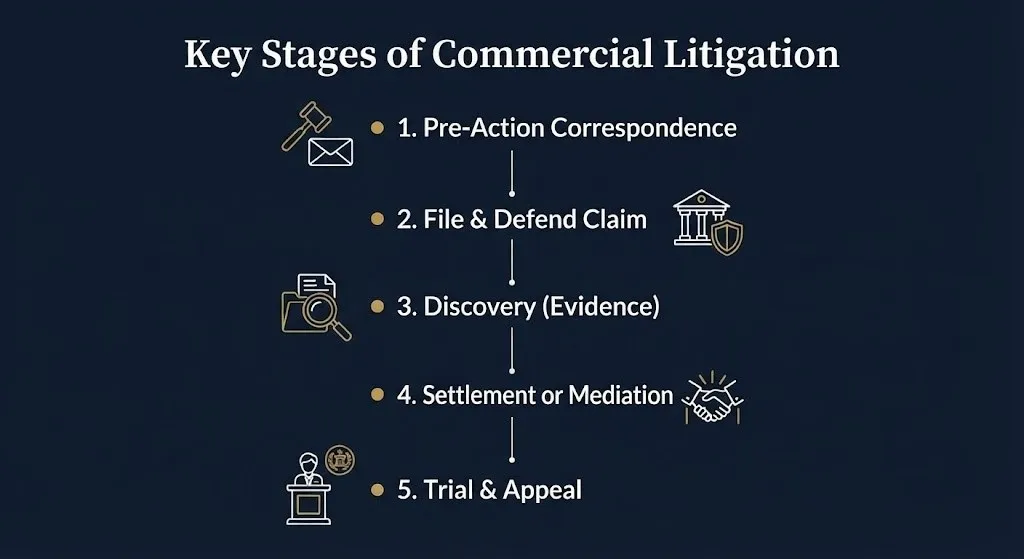
- Pre-Action Correspondence: The claimant sends a letter of claim, and the defendant responds within 14 to 28 days .
- Commencing Proceedings: If unresolved, the claim is filed in court. The defendant responds with a defence or acknowledgment .
- Discovery (Disclosure): Both parties exchange evidence. This can be the longest and most expensive stage .
- Pre-Trial Motions: Parties file motions, such as a motion for summary judgment, to try and resolve the case without a full trial .
- Settlement / Mediation: A significant effort is made to settle, often at the court’s encouragement .
- Trial: If no settlement is reached, the case goes to trial. The judge or jury gives a verdict .
- Appeal: The losing party can appeal the decision to a higher court .
Frequently Asked Questions
What is the difference between commercial litigation and civil litigation?
Commercial litigation is a subset of civil litigation. Civil litigation covers all non-criminal disputes between individuals or entities, like personal injury cases. Commercial litigation specifically involves business-to-business disputes, such as contract breaches or partnership conflicts .
Why is commercial litigation so expensive?
It is expensive because of the time and expertise required. Costs include lawyers’ fees, court fees, and discovery. Complex cases often require forensic experts, e-discovery specialists, and extensive document review. The case Municipio de Mariana v BHP Group saw costs of over £189 million, highlighting the high financial stakes .
How long does a commercial litigation case take?
There is no set timeline. A straightforward case might take 12 to 18 months. Complex cases can take three years or more. The length depends on the amount of evidence, the court’s schedule, and whether the case goes to trial or settles early .
What types of cases are common in commercial litigation?
Common types include breach of contract, shareholder and partnership disputes, employment issues, intellectual property infringement, fraud, and real estate disputes .
What is “discovery” or “disclosure” in a commercial lawsuit?
It is the formal pre-trial phase where both parties exchange relevant documents and information. This includes contracts, emails, financial records, and other evidence to help each side prepare for trial and avoid surprises .
What happens if a defendant doesn’t respond to a claim?
If a defendant fails to file a defence or acknowledgment of service within the time limit, the claimant can apply for a “judgment in default.” This means the claimant wins the case without a trial, and the court can order the defendant to pay damages .
Do most commercial cases go to trial?
No. The vast majority of commercial cases are settled before trial through negotiation, mediation, or other forms of alternative dispute resolution (ADR) .
The most important action you can take is to seek legal advice from a qualified commercial litigation lawyer early if you are involved in a dispute. They can guide you through the pre-action stage, help you avoid costly mistakes, and assess your options. The sooner you get professional advice, the more options you will likely have.