Baby Formula Lawsuit 2026: NEC Claims, Settlement Status, and How to Join
Quick Answer
- The baby formula NEC lawsuits are real. Over 500 cases are consolidated in federal MDL in Illinois.
- No settlement has been reached. The first bellwether trials are expected to begin in 2027.
- There is no deadline to join. Attorneys are still accepting new clients with qualifying cases.
If your premature baby developed necrotizing enterocolitis after being fed cow’s milk-based formula in a neonatal intensive care unit, you may have a claim. This is not a class action with a single claim form. It is a mass tort, where each family files an individual lawsuit against the formula manufacturers, primarily Abbott Laboratories (maker of Similac) and Mead Johnson (maker of Enfamil).
This article tracks every verified detail about the NEC formula litigation as of August 2026. You will find what the lawsuits allege, which formulas are named, who may qualify, how to find an attorney, and what timeline to expect. Every fact comes from federal court records, the MDL docket, and publicly available filings, not marketing pages from law firms.
The Facts
| Case | In re: Abbott Laboratories Preterm Infant Nutrition Products Liability Litigation (MDL) |
| Court | U.S. District Court, Northern District of Illinois |
| MDL Number | 1:22-cv-00071 |
| Status | Active litigation. No global settlement. Bellwether trials approaching. |
| Fund Size | Not yet confirmed |
| Est. Per Person | Not yet determined |
| Claim Deadline | No deadline. Cases accepted on a rolling basis. |
| Administrator | Not yet appointed |
| Proof Needed | Medical records confirming NEC diagnosis, premature birth, and formula feeding history |
Is the Baby Formula Lawsuit Real?
Yes. The baby formula NEC litigation is real and substantial. It is not a rumor. It is not a single lawsuit. It is a coordinated federal proceeding involving over 500 individual cases filed by families across the United States.
The Judicial Panel on Multidistrict Litigation consolidated these cases in the Northern District of Illinois before a single federal judge. This MDL structure is the same procedure used in major pharmaceutical and medical device litigations. It signals that the federal courts consider these cases serious and numerous enough to warrant coordinated management.
The defendants are the largest infant formula manufacturers in the country. Abbott Laboratories produces Similac. Mead Johnson, a subsidiary of Reckitt Benckiser, produces Enfamil. Both companies deny the allegations and are actively defending the cases.
The litigation is not about product contamination or the 2022 formula shortage. It is about whether cow’s milk-based formulas designed for premature infants cause a devastating intestinal disease called necrotizing enterocolitis, and whether the manufacturers knew or should have known about this risk and failed to warn hospitals and parents.
Key Takeaway: The litigation is real, active, and substantial. It is also in the middle stages. No settlement. No claims process. No checks have been mailed.
What Is the NEC Baby Formula Lawsuit About?
The lawsuits allege that cow’s milk-based infant formulas and fortifiers given to premature babies in neonatal intensive care units cause or substantially increase the risk of necrotizing enterocolitis.
Necrotizing enterocolitis, or NEC, is a catastrophic intestinal disease that primarily affects premature infants. The intestinal tissue becomes inflamed, then begins to die. Bacteria can leak into the abdomen and bloodstream. The mortality rate is high. Survivors often face lifelong complications including short bowel syndrome, intestinal strictures, feeding difficulties, and severe neurodevelopmental delays.
The central allegation in the lawsuits is that cow’s milk-based formulas significantly increase NEC risk compared to human milk or donor breast milk, and that the formula manufacturers knew this for decades but failed to include adequate warnings on their products.
Plaintiffs cite decades of medical research, including randomized controlled trials and meta-analyses published in major journals like The Lancet and Pediatrics, showing that premature infants fed cow’s milk-based formula are at substantially higher risk of developing NEC than those fed human milk. The lawsuits argue that the warning labels on these products did not reflect this known risk.
The manufacturers maintain that NEC has multiple causes, that their products are safe when used as directed, and that neonatologists and NICUs make informed feeding decisions based on each infant’s clinical needs.
What Is Necrotizing Enterocolitis (NEC)?
NEC is a disease that destroys the intestinal tissue of vulnerable infants. It is not a minor stomach problem. It is a life-threatening emergency.
The disease begins when the intestinal wall becomes inflamed. Blood flow to the affected area decreases. The tissue starts to die. The intestinal wall can perforate, allowing bacteria and waste to spill into the abdominal cavity. Sepsis often follows.
Treatment is aggressive and urgent. Infants may require immediate surgery to remove the dead portion of intestine. Some require multiple surgeries. Some lose so much intestine that they cannot absorb nutrition normally, a condition called short bowel syndrome. These children may depend on intravenous nutrition for years or for life.
NEC is the most common surgical emergency in premature infants. It affects roughly 5 to 10 percent of very low birth weight infants. The mortality rate ranges from 20 to 50 percent, with the highest rates in the smallest, most premature babies.
The lawsuits do not allege that formula is the only cause of NEC. They allege that cow’s milk-based formula dramatically increases the risk, that the manufacturers knew this, and that they failed to adequately warn hospitals and parents.
Which Baby Formulas Are Named in the Lawsuits?
The lawsuits target cow’s milk-based formulas and fortifiers specifically designed for and marketed to premature infants in hospital NICUs. The products most frequently named include the following.
- Similac Special Care (Abbott Laboratories)
- Similac Human Milk Fortifier (Abbott Laboratories)
- Similac NeoSure (Abbott Laboratories)
- Enfamil Premature (Mead Johnson)
- Enfamil Human Milk Fortifier (Mead Johnson)
- Enfamil NeuroPro Enfacare (Mead Johnson)
These are not the standard infant formulas sold on grocery store shelves for healthy full-term babies. They are specialized products used in hospital settings for premature and medically fragile infants. They are often administered through feeding tubes. Parents may not even know which specific formula their baby received in the NICU unless they review the medical records.
Generic store-brand formulas are not part of this litigation. The lawsuits focus on the major brand-name manufacturers who developed, marketed, and sold these products directly to hospitals.
Who May Qualify for a Baby Formula NEC Lawsuit?
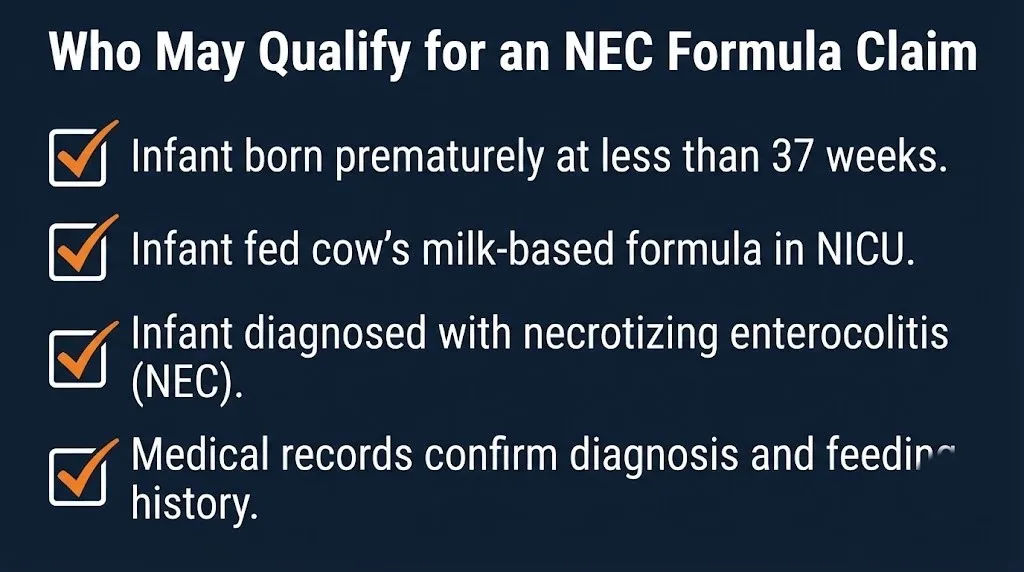
Qualification requires a specific fact pattern. Not every premature infant who received formula qualifies. The core criteria based on the MDL filings are as follows.
- The infant was born prematurely at less than 37 weeks gestation.
- The infant was fed cow’s milk-based formula or fortifier in a hospital NICU.
- The infant developed necrotizing enterocolitis.
- The NEC diagnosis was confirmed by a physician and documented in medical records.
- The formula manufacturer can be identified (Similac or Enfamil products).
- The infant either died from NEC or survived with ongoing medical complications.
The strongest cases involve infants who received formula exclusively or primarily, rather than those who received mostly human milk with minimal formula supplementation. Cases where the infant received donor breast milk and still developed NEC are more complex and may have different legal hurdles.
Time matters. Each state has a statute of limitations for personal injury and wrongful death claims. These deadlines vary. In many states, the clock starts when the injury is discovered or should have been discovered. For a 2018 NEC diagnosis, the deadline may already be approaching or passed in some jurisdictions. Only an attorney reviewing your specific timeline can tell you whether you are within the statute of limitations.
Key Takeaway: The qualifying criteria are specific. You need a premature birth, a documented NEC diagnosis, and a clear history of formula feeding in the NICU. A full-term baby who developed gastrointestinal issues does not qualify for this litigation.
What Is the Status of the NEC Baby Formula Lawsuits in 2026?
The MDL is in the discovery and bellwether selection phase. This is a critical stage that will shape whether the cases settle or go to trial.
The judge has overseen extensive document discovery. Plaintiffs’ attorneys have obtained internal company documents, research files, and communications between formula manufacturers and hospitals. Defendants have obtained each plaintiff’s medical records and are reviewing them case by case.
A bellwether trial process is being established. Bellwether trials are test cases selected by both sides to be tried first. The outcomes of these trials provide a signal to both sides about how juries respond to the evidence. Strong plaintiff verdicts typically push defendants toward settlement. Defense verdicts do the opposite.
The first bellwether trials are expected to begin in 2027. No firm trial date has been set as of August 2026, but the court has indicated it is working toward trials in the coming year.
No global settlement has been reached. Some individual cases may settle confidentially before bellwether trials, but those settlements do not establish a per-case value for the broader litigation and are typically not disclosed.
What Is the Difference Between This Litigation and the 2022 Formula Shortage?
They are completely separate. The 2022 formula shortage was a supply crisis. This litigation is a product liability case.
The shortage began when Abbott Nutrition voluntarily recalled certain Similac products manufactured at its Sturgis, Michigan plant after several infants developed Cronobacter sakazakii infections and two died. The plant shutdown, combined with ongoing supply chain issues, created a nationwide formula shortage that lasted months.
That event generated separate lawsuits against Abbott related to the bacterial contamination and the recall. Those cases are distinct from the NEC litigation. The NEC lawsuits are about whether cow’s milk-based formula causes a specific disease in premature infants. They are not about contamination or manufacturing defects.
Some families searching for “baby formula lawsuit” are looking for the shortage-related cases. Others are looking for the NEC cases. The distinction matters. If your baby was harmed by a contaminated formula, your case is different from an NEC claim.
How Do I Join the Baby Formula NEC Lawsuit?
You join by contacting a law firm that handles pharmaceutical and medical device mass torts. There is no central registry. There is no government intake form.
The process follows predictable steps.
- Gather your child’s medical records. The most important records are the NICU admission and discharge summaries, the NEC diagnosis documentation, feeding logs, and surgical records if applicable.
- Contact a law firm with experience in the NEC formula litigation. Most offer free case evaluations.
- Provide the firm with your medical records and a brief timeline of what happened.
- The firm reviews whether your case matches the MDL criteria.
- If your case is viable, the firm drafts and files an individual complaint.
- Your case is coordinated with the MDL for pretrial proceedings.
- Discovery proceeds. You may need to provide a deposition.
- Your case is eventually resolved by settlement, trial, or summary judgment.
You pay nothing upfront. These cases are handled on contingency. The firm covers all case costs and takes a percentage of any recovery, typically 33% to 40% depending on the stage at which the case resolves and the fee agreement you sign.
Reality Check: The process of joining an MDL is not like filing a class action claim form. You are filing a lawsuit. You will be required to produce medical records. You may be required to sit for a deposition. Your child’s medical history will be scrutinized by defense attorneys and expert witnesses. This is emotionally difficult. Law firms advertising for NEC cases should prepare you for this reality, not just promise a settlement. If a firm tells you the process will be quick and easy, get a second opinion.
How Much Could the NEC Baby Formula Settlement Be Worth?
No settlement has been reached. No per-case value has been established. Any specific dollar amount you see online is fabricated.
What can be said is that cases involving infant death or catastrophic lifelong injury in a product liability MDL typically have significant value. Bellwether verdicts and settlements in other pharmaceutical mass torts involving serious pediatric injuries provide some reference, but every case is different.
Case value in the NEC litigation will likely depend on several factors.
| Factor | Impact on Case Value |
|---|---|
| Severity of NEC (medical management vs. surgical) | Higher severity = higher value |
| Whether the infant died | Wrongful death cases are valued differently than injury cases |
| Extent of lifelong complications | Short bowel syndrome, TPN dependence, neurodevelopmental delays increase value |
| Strength of medical evidence linking formula to NEC | Clear temporal link strengthens the case |
| Jurisdiction and venue | Some states are more plaintiff-friendly |
| Defendant | Cases may name Abbott, Mead Johnson, or both |
These are general factors. No settlement matrix exists. No court has approved any compensation tiers. The bellwether trials will provide the first real data points on case value.
What Are the Key Dates in the NEC Formula Litigation?
The litigation has been moving through predictable stages. Here are the milestones to date and what comes next.
| Date | Event |
|---|---|
| 2021 | First NEC formula lawsuits filed against Abbott and Mead Johnson |
| 2022 | Judicial Panel on Multidistrict Litigation consolidates federal cases into MDL in Northern District of Illinois |
| 2023 to 2025 | Discovery phase: document production, depositions, expert witness development |
| Mid-2026 | Bellwether selection process underway. Parties identifying potential trial cases. |
| Expected 2027 | First bellwether trials |
| Post-bellwether | Mediation and potential global settlement negotiations |
These dates reflect the court’s public scheduling orders and the typical pace of pharmaceutical MDLs. Delays are common. Trial dates shift. The process is slow by design. Both sides need time to build their cases.
What Does the Medical Research Say About Formula and NEC?
The lawsuits are built on a foundation of published medical research. This is not junk science. Major medical organizations have weighed in.
Multiple meta-analyses have concluded that premature infants fed human milk have a significantly lower incidence of NEC than those fed cow’s milk-based formula. A landmark 2019 meta-analysis published in the Journal of Pediatrics found that exclusive human milk feeding was associated with a substantially reduced NEC risk compared to formula feeding.
The American Academy of Pediatrics has stated that all preterm infants should receive human milk, with pasteurized donor human milk as the preferred alternative when mother’s own milk is unavailable. The AAP policy statement on breastfeeding and the use of human milk explicitly references the protective effect against NEC.
The World Health Organization and UNICEF have published guidance emphasizing that donor human milk is the best alternative for infants who cannot receive their own mother’s milk. These recommendations are global.
The formula manufacturers do not dispute that human milk reduces NEC risk. Their defense focuses on whether their products are unreasonably dangerous when used as part of a NICU’s feeding protocol, whether the causal link is as strong as plaintiffs claim, and whether neonatologists are already well aware of the risks.
Why Are the Lawsuits Targeting Cow’s Milk-Based Products Specifically?
Cow’s milk-based formulas are the focus because the medical research identifies them as carrying the highest NEC risk.
Human milk contains factors that protect the immature gut: immunoglobulins, growth factors, enzymes, and anti-inflammatory compounds. Cow’s milk lacks these protective factors. It also contains proteins that can be more difficult for the premature infant’s digestive system to process.
Donor human milk, when pasteurized and processed, retains many protective properties. The lawsuits argue that donor milk is a safer alternative that was available and that manufacturers failed to warn that their cow’s milk-based products carried higher risks.
Soy-based formulas are also cow’s milk-free but are rarely used in premature infants for reasons unrelated to this litigation. The focus remains on the standard cow’s milk-based NICU formulas and fortifiers.
What Happens Next in the Baby Formula Litigation?
The litigation is entering its most important phase. Here are the expected next stages.
- Late 2026: Bellwether case selection is finalized. The specific cases that will be tried first are chosen by both sides.
- Early to mid-2027: First bellwether trials begin. These are full trials with live testimony and jury verdicts.
- Mid to late 2027: Additional bellwether trials. The outcomes of the first trials shape settlement posture on both sides.
- 2028: If bellwether verdicts favor plaintiffs, global settlement negotiations begin in earnest.
- 2029 or later: If no global settlement, individual cases are remanded to their home districts for trial.
These are estimates. Litigation this large does not resolve quickly. Families filing cases now should expect a multi-year process before any resolution.
Frequently Asked Questions
Is there a baby formula class action lawsuit?
No. The NEC cases are individual lawsuits consolidated as multidistrict litigation.
Each family files separately. Each case is valued on its own facts.
What formula brands are involved in the lawsuits?
Similac and Enfamil cow’s milk-based NICU products are the primary brands named.
These include Similac Special Care, Enfamil Premature, and human milk fortifiers.
Can I join the lawsuit if my baby survived NEC?
Yes. Cases involving surviving children with ongoing medical complications are accepted.
The value of the case depends on the severity and permanence of the injury.
What if my baby died from NEC?
You may have a wrongful death claim. The statute of limitations runs from the date of death.
Contact an attorney promptly. These deadlines are strict.
How long does an NEC lawsuit take?
Mass torts typically take two to four years from filing to resolution.
Bellwether trials begin in 2027. Settlement timing depends on trial outcomes.
Does it cost money to join the baby formula lawsuit?
No upfront cost. Law firms handle these cases on contingency.
You pay only if you recover compensation. Fees are typically 33% to 40%.
What if I do not know which formula my baby received?
Medical records from the NICU should document feeding details.
An attorney can help obtain and review these records before filing.
Is the NEC lawsuit only for premature babies?
Yes. NEC predominantly affects premature infants.
The litigation focuses on products marketed specifically for preterm infants in NICUs.
The baby formula NEC litigation is real, active, and moving toward bellwether trials. No settlement. No claim form. No deadline to join yet. What exists are over 500 individual cases, a federal MDL, and law firms actively evaluating new families.
If your premature baby developed NEC after receiving cow’s milk-based formula in a NICU, the next step is to gather your medical records and contact a qualified law firm for a case evaluation. The call costs nothing. The evaluation is free. The statute of limitations is running. Do not wait to find out whether you have a claim.