What Is a Lawsuit: Meaning, Definition, and How the Legal Process Works in 2026
Quick Answer
- A lawsuit is a formal legal dispute resolved by a court. It is not a complaint call or demand letter.
- Lawsuits can seek money, an order to stop something, or a declaration of legal rights.
- Filing deadlines called statutes of limitations apply. Missing the deadline can bar your claim permanently.
You may have received a notice about a class action settlement. You may be thinking about suing someone. You may just want to understand what all the legal headlines mean. Whatever brought you here, the question “what is a lawsuit” deserves a clear, plain-language answer that does not assume you already know legal terminology.
This guide explains what a lawsuit is, how it works from start to finish, what different types exist, how long they take, and what you should know before filing or responding to one. Every section is written to be quotable, so whether you are reading for yourself or researching for a project, the answers are direct and sourced.
The Facts
| Legal System | United States civil and criminal court system |
| Governing Rules | Federal Rules of Civil Procedure, state court rules |
| Annual Filings | Over 40 million cases filed per year across all U.S. courts |
| Most Common Type | Civil lawsuits (contract disputes, personal injury, class actions) |
| Average Duration | 12 to 36 months for civil cases that do not go to trial |
| Filing Cost | Varies by court. Federal filing fee is $402. State fees range from $50 to $500. |
| Statute of Limitations | Varies by claim type and state. Typically 1 to 6 years. |
What Is the Definition of a Lawsuit?
A lawsuit is a formal legal action brought by one party against another in a court of law. The party who files is called the plaintiff. The party being sued is called the defendant.
A lawsuit asks the court to do something. Usually that means awarding money damages. Sometimes it means ordering the defendant to stop doing something, like a trademark infringement. Sometimes it means declaring the rights of the parties, like who owns a piece of property.
The key word is formal. A lawsuit is not an argument. It is not a demand letter. It is not a complaint to a regulator. It is a case filed in a court with a docket number, a judge assigned, and a set of procedural rules that both sides must follow.
Lawsuits are the mechanism the legal system provides for resolving disputes without self-help. If your neighbor builds a fence on your land, you cannot tear it down yourself. You file a lawsuit for trespass and let the court order its removal. That is the core function: replacing private force with public process.
What Does the Word “Lawsuit” Actually Mean?
The word lawsuit breaks down into “law” and “suit.” A suit is an old English term meaning the act of following or pursuing. A lawsuit is literally the pursuit of a legal remedy.
In modern American legal usage, a lawsuit is synonymous with a civil action. Criminal cases are prosecutions, not lawsuits, though the term is sometimes used loosely in conversation to refer to any court case.
The formal legal term in federal court is “civil action.” State courts use various terms: complaint, action, case, or suit. They all mean the same thing: someone has asked a court to resolve a dispute.
The distinction between lawsuit and claim matters. A claim is the underlying legal right you are asserting. The lawsuit is the procedural vehicle you use to enforce that claim. You may have a valid claim for breach of contract. If you do not file the lawsuit within the statute of limitations, you lose the right to enforce it. The claim existed. The lawsuit was the tool to pursue it.
How Does a Lawsuit Start?
A lawsuit starts when the plaintiff files a complaint with the court and serves it on the defendant. The complaint is a document that explains what happened, why the plaintiff thinks the defendant is legally responsible, and what the plaintiff wants the court to do.
Filing the complaint is the administrative act. The plaintiff delivers the document to the court clerk and pays a filing fee. The clerk assigns a case number and a judge. The case is now open.
Service is the constitutional act. The defendant must receive a copy of the complaint and a summons in a way that satisfies due process. Personal service, where a process server hands the documents directly to the defendant, is the most common method. Mail service is allowed in some circumstances. Publication in a newspaper is a last resort when the defendant cannot be found.
The defendant then has a set number of days to respond, usually 20 to 30 days in federal court. The response is typically an answer admitting or denying each allegation, or a motion to dismiss arguing that even if everything in the complaint is true, the plaintiff has no valid legal claim.
Key Takeaway: Filing the complaint starts the case. Serving the complaint gives the court power over the defendant. Both must happen for the lawsuit to proceed.
What Is a Class Action Lawsuit?
A class action is a lawsuit where one or a few plaintiffs sue on behalf of a larger group with similar claims. It is a procedural device that makes it practical to litigate cases where individual damages are too small to justify separate lawsuits.
Class actions follow specific rules, primarily Rule 23 of the Federal Rules of Civil Procedure. The court must certify the class, finding that there are enough people with similar claims, that the named plaintiffs will adequately represent the group, and that common legal issues predominate over individual ones.
Most consumer class actions settle. The settlement creates a fund. Class members receive notice and can file a claim form. Those who do nothing are bound by the settlement and release their claims. Those who opt out keep the right to sue individually.
Class actions are how most people encounter lawsuits. The notice that arrives in the mail or email saying “you may be entitled to compensation” is a class action settlement notice. It is real. It is not a scam, though scam notices that mimic real ones do exist and should be verified against court records.
What Is the Difference Between Civil and Criminal Lawsuits?
Civil lawsuits involve disputes between private parties. Criminal cases involve the government prosecuting someone for violating a law. The differences are fundamental.
In a civil case, the plaintiff sues for money or equitable relief. The burden of proof is preponderance of the evidence, meaning more likely than not. The defendant does not go to jail if they lose. They pay damages or comply with a court order.
In a criminal case, the government prosecutes. The burden of proof is beyond a reasonable doubt. The defendant can go to prison if convicted. The penalties are loss of liberty, not just money.
Some conduct generates both civil and criminal cases. A company that defrauds investors may face a civil class action from shareholders and a criminal prosecution from the Department of Justice. The cases proceed independently. A civil verdict does not require a criminal conviction. A criminal acquittal does not bar a civil lawsuit.
What Are the Most Common Types of Lawsuits?
The American legal system handles a vast range of disputes. The most common types break down into recognizable categories.
| Type | Description | Example |
|---|---|---|
| Personal Injury | Harm caused by another’s negligence or intent | Car accident, medical malpractice, slip and fall |
| Breach of Contract | Failure to perform as agreed | Unpaid business debt, broken lease, warranty claim |
| Class Action | Group lawsuit for widespread harm | Data breach, false advertising, defective product |
| Employment | Workplace disputes | Wrongful termination, discrimination, wage theft |
| Family Law | Domestic relations | Divorce, custody, child support |
| Property | Real estate and ownership disputes | Boundary disputes, landlord-tenant, foreclosure |
| Intellectual Property | Patents, trademarks, copyrights | Patent infringement, trademark dilution |
| Mass Tort | Individual injuries from a common product or event | Drug side effects, toxic exposure, defective devices |
Each type follows the same basic lawsuit structure but has specific procedural rules, evidence requirements, and typical timelines.
How Long Does a Lawsuit Take?
Most civil lawsuits take 12 to 36 months from filing to resolution. Cases that go to trial take longer. Cases that settle early resolve faster.
The timeline depends on the complexity of the case, the court’s docket, and the behavior of the parties. A simple breach of contract case with clear evidence might settle in six months. A complex antitrust class action might take five years or more.
Here is a typical civil lawsuit timeline.
- Month 1: Complaint filed, served, and answered.
- Months 2 to 6: Early motions. Motion to dismiss argued and ruled on.
- Months 6 to 18: Discovery. Document production, interrogatories, depositions.
- Months 18 to 24: Summary judgment motions. The court decides if the case can be resolved without trial.
- Months 24 to 36: Trial or settlement. Most cases settle during or after discovery.
This is a rough average. Federal courts often move slower than state courts. Cases in large urban jurisdictions move slower than rural ones. Cases with many parties or complex expert testimony move slower than straightforward disputes.
What Happens During Discovery in a Lawsuit?
Discovery is the fact-gathering phase. Both sides exchange information relevant to the claims and defenses. It is the longest and most expensive part of most lawsuits.
Discovery takes several forms. Interrogatories are written questions that must be answered under oath. Requests for production ask for documents, emails, records, and other physical or electronic evidence. Depositions are live, in-person interviews where attorneys question witnesses under oath with a court reporter present. Requests for admission ask a party to admit or deny specific facts to narrow the issues for trial.
Discovery is broad. The federal rules allow discovery of anything reasonably calculated to lead to admissible evidence. This is not a fishing license with no limits, but it is wide. Parties routinely produce thousands or millions of pages of documents.
Discovery disputes are common. One side may withhold documents as privileged or claim the other side is asking for irrelevant material. The judge resolves these disputes. Discovery sanctions for failing to comply can include monetary fines, orders deeming certain facts established, or in extreme cases, dismissal of the lawsuit.
Key Takeaway: Discovery is where lawsuits are won and lost. The documents and testimony gathered during discovery determine whether a case settles and for how much.
What Is a Settlement in a Lawsuit?
A settlement is an agreement between the parties to resolve the lawsuit without a trial. The defendant typically pays money in exchange for the plaintiff dismissing the case and releasing all claims.
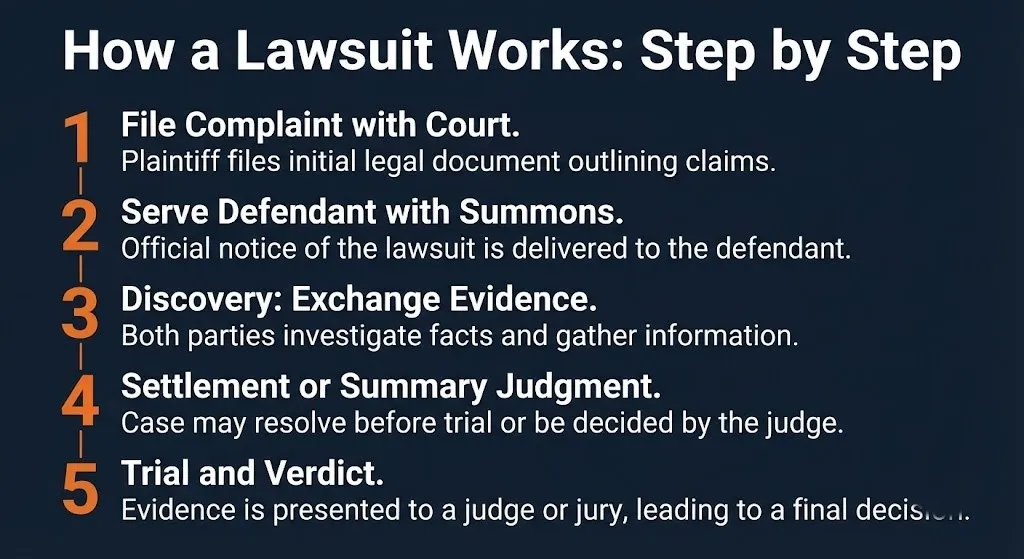
Settlements are voluntary. The court does not order a settlement, though judges often encourage it. The parties negotiate terms. If they agree, they document the agreement in a written settlement contract and file a dismissal with the court.
Most civil lawsuits settle. Roughly 95% of cases filed in federal court resolve without trial. Some settle before discovery. Some settle on the courthouse steps. The reasons are practical. Trials are expensive, public, and unpredictable. Settlement provides certainty and finality.
Class action settlements require court approval. The judge must find the settlement fair, reasonable, and adequate. Class members receive notice and can object. This judicial review is unique to class actions and is designed to protect absent class members from collusive or inadequate deals.
What Happens If a Lawsuit Goes to Trial?
If the case does not settle, it goes to trial. A trial is a formal proceeding where each side presents evidence and arguments to a judge or jury.
Jury trials are available in most civil cases for money damages. The plaintiff must request a jury. If neither side does, the judge hears the case alone in what is called a bench trial.
The trial follows a structured sequence. Opening statements from each side outline what the evidence will show. The plaintiff presents witnesses and evidence first. The defendant cross-examines. After the plaintiff rests, the defendant presents its case. Closing arguments summarize the evidence for the jury. The judge instructs the jury on the law. The jury deliberates and returns a verdict.
Civil jury verdicts do not need to be unanimous in all states. Federal civil juries must be unanimous unless the parties agree otherwise. Some states allow verdicts based on a supermajority.
After the verdict, the losing party can file post-trial motions or appeal. An appeal asks a higher court to review the trial court’s legal rulings, not to reweigh the evidence. Appeals add months or years to the process.
How Much Does It Cost to File a Lawsuit?
Filing fees are just the start. The cost of a lawsuit includes court fees, attorney fees, discovery costs, expert witness fees, and the enormous time investment required.
The federal filing fee for a civil action is $402 as of 2026. State court fees range from roughly $50 to $500 depending on the jurisdiction and the amount in controversy. This is the price of admission. It gets your complaint on the docket. It does not cover anything else.
Attorney fees are the dominant cost for most litigants. Hourly rates for civil litigators range from $250 to over $1,000 per hour depending on the market, the firm, and the lawyer’s experience. A case taken through discovery and trial can generate hundreds of thousands of dollars in legal fees.
Contingency fee arrangements change this calculus. In personal injury and some other plaintiff-side cases, the lawyer takes a percentage of the recovery instead of charging by the hour. The client pays nothing upfront. The lawyer only gets paid if the client wins. This is how most individual plaintiffs access the legal system.
Cost-shifting rules can matter. In the American system, each side usually pays its own attorney fees regardless of who wins. Some statutes and contracts include fee-shifting provisions that require the losing party to pay the winner’s fees. These provisions dramatically affect settlement leverage.
What Are the Risks of Filing a Lawsuit?
Filing a lawsuit carries financial, emotional, and reputational risks. These should be weighed before you file.
You can lose. If you lose at trial, you get nothing. You may owe costs to the other side in some circumstances. You have spent years in litigation with nothing to show for it.
You can be countersued. The defendant can file claims against you. What starts as your lawsuit can become your liability. This is common in business disputes where both sides accuse the other of breach.
Your private information can become public. Court filings are generally public records. Your financial records, your emails, your deposition testimony, and your medical history may all become accessible to anyone who visits the courthouse or searches the electronic docket.
Litigation is emotionally draining. Depositions are adversarial. Your credibility will be challenged. Your past statements will be scrutinized. The process takes a toll that has nothing to do with money.
These are not reasons to avoid a meritorious lawsuit. They are reasons to count the cost before you file. A good attorney will explain the risks, not just the potential reward.
Reality Check: Television and movies depict lawsuits as dramatic, fast, and lucrative. They are none of those things. Real litigation is slow, procedural, expensive, and uncertain. The plaintiff who wins a $500,000 jury verdict after a week-long trial probably waited two to three years to get there and spent $100,000 or more in costs. If the defendant appeals, the wait continues. Filing a lawsuit is not like buying a lottery ticket. It is a serious undertaking with serious consequences.
What Should You Do If You Are Sued?
Do not ignore it. The single worst thing you can do when sued is nothing. A default judgment will be entered against you. You will lose automatically without ever having your side heard.
Read the complaint and summons carefully. The summons tells you how long you have to respond, usually 20 to 30 days. The complaint tells you what you are accused of and what the plaintiff wants.
Contact a lawyer immediately. Do not try to handle a lawsuit yourself, even if you think it is frivolous. A lawyer can file a motion to dismiss, negotiate a settlement, or mount a defense. Self-representation is risky even in small claims court. In regular civil court, it is dangerous.
Notify your insurance company if the lawsuit relates to something that might be covered. Homeowner’s insurance, auto insurance, and business liability policies often include a duty to defend, meaning the insurer hires a lawyer for you.
Preserve all relevant documents and evidence. Do not delete emails, texts, or files. Spoliation of evidence can lead to severe sanctions, including the judge instructing the jury to assume the destroyed evidence would have hurt your case.
What Is the Statute of Limitations?
The statute of limitations is the deadline for filing a lawsuit. It varies by claim type and by state. Missing the deadline bars your claim forever.
Personal injury claims typically have a two to three year statute of limitations from the date of injury. Breach of written contract claims often have four to six years. Fraud claims vary. Some states allow discovery-based tolling, meaning the clock starts when you discovered or reasonably should have discovered the fraud.
The statute of limitations is absolute. Courts have no discretion to extend it based on fairness or sympathy. If you file one day late, your case is dismissed. The only exceptions are narrow and state-specific, such as the defendant leaving the state or the plaintiff being a minor or mentally incapacitated.
This is why timely action matters. If you think you have a claim, do not wait to investigate. The clock is running.
Frequently Asked Questions
What is a lawsuit in simple terms?
A lawsuit is a formal request for a court to resolve a legal dispute.
One party sues another, asking for money or an order to do or stop something.
What is the difference between a lawsuit and a claim?
A claim is the legal right you assert. A lawsuit is the court case you file to enforce that right.
You can have a valid claim without filing a lawsuit, but you must sue before the deadline.
How much can you get from a lawsuit?
It depends entirely on the case. Some lawsuits settle for thousands. Some result in multimillion-dollar verdicts.
The value depends on your damages, the strength of your evidence, and the defendant’s ability to pay.
Do all lawsuits go to trial?
No. Roughly 95% of civil lawsuits settle before trial.
Most cases resolve through negotiation during or after discovery.
Can you file a lawsuit without a lawyer?
Yes. It is called proceeding pro se. You have the right to represent yourself.
Self-representation is risky. Courts hold pro se litigants to the same rules as lawyers.
What happens if you lose a lawsuit?
You may owe the other side’s costs in limited circumstances. You do not typically owe their attorney fees.
The judgment against you becomes a public record and can be collected through wage garnishment or asset seizure.
How long does a lawsuit stay on your record?
Judgments are public records and appear on credit reports for up to seven years.
Some professional licenses and security clearances require disclosure of lawsuits regardless of age.
A lawsuit is the formal mechanism for resolving legal disputes through the court system. It starts with a complaint, proceeds through discovery, and ends in settlement, trial, or dismissal. The process is slow, expensive, and governed by strict rules and deadlines.
If you are considering filing a lawsuit, consult a lawyer. The statute of limitations is running. The evidence is not getting easier to gather. The first conversation is usually free. From that conversation, you will know whether you have a case worth pursuing or whether your best move is to let the matter go and move on.