Florida Workers Compensation Exemption: Rules, Filing, and 2026 Updates
Quick Answer
- A Florida workers compensation exemption is a state-issued certificate, not a settlement or payout program.
- It lets certain business owners opt out of mandatory workers’ compensation coverage, but it does not pay benefits.
- Exemptions must be applied for or renewed through the Florida Division of Workers’ Compensation, and fees apply.
If you searched for “workers compensation exemption Florida,” you likely own a small business, work as an independent contractor, or received a notice about coverage requirements. The exemption is a real state process, but it is not a claim, a lawsuit, or a settlement fund.
The most important thing to understand right now is that an exemption removes your obligation to carry workers’ compensation insurance. It does not remove your obligation to pay for injuries if you get sued.
This article explains what the exemption actually is, who can get one, how much it costs, how to file, what deadlines exist, and what risks come with being exempt in 2026. One fact many business owners miss: exempting yourself can leave you personally liable for medical bills and lost wages if someone gets hurt on your job site.
| The Facts | |
|---|---|
| Case | Florida Workers Compensation Exemption (state regulatory process) |
| Status | Active, ongoing application processing |
| Fund Size | No settlement fund involved |
| Est. Per Person | Not applicable; this is a coverage opt-out, not a payout |
| Filing Deadline | No single deadline; renewals run every 2 years |
| Administrator | Florida Division of Workers’ Compensation |
| Proof Needed | Business registration, ownership details, industry classification |
Is the Florida Workers Compensation Exemption Real or a Scam?
The Florida workers compensation exemption is a real state program.
It is administered by the Florida Division of Workers’ Compensation, part of the Florida Department of Financial Services. The exemption has existed under Florida law for decades.
The purpose is narrow. It lets certain business owners, particularly in construction, declare that they are not employees and therefore not required to be covered by workers’ compensation insurance.
Third-party websites often charge extra fees to “help” you file. Those sites are not scams in the criminal sense, but they charge for something you can do directly through the state for the official fee.
If someone calls or emails saying you owe money for an exemption or that your exemption is suspended, verify directly with the Division. The state does not call to demand immediate payment over the phone.
What Does a Workers Compensation Exemption in Florida Actually Do?
An exemption removes you from the legal definition of an employee under Florida’s workers’ compensation law.
When you hold an active exemption, general contractors and hiring entities do not have to count you as an employee for insurance purposes. That can make it easier to get hired as a subcontractor.
The exemption also means you are not entitled to workers’ compensation benefits if you get hurt on the job. You cannot collect wage replacement or medical benefits through the workers’ compensation system for your own injury.
This is the trade-off. You save on insurance premiums, but you give up the safety net. Think of it like canceling your car insurance to save money. It works until there is an accident.
Who Qualifies for a Florida Workers Compensation Exemption?
Qualification rules vary by industry and business structure.
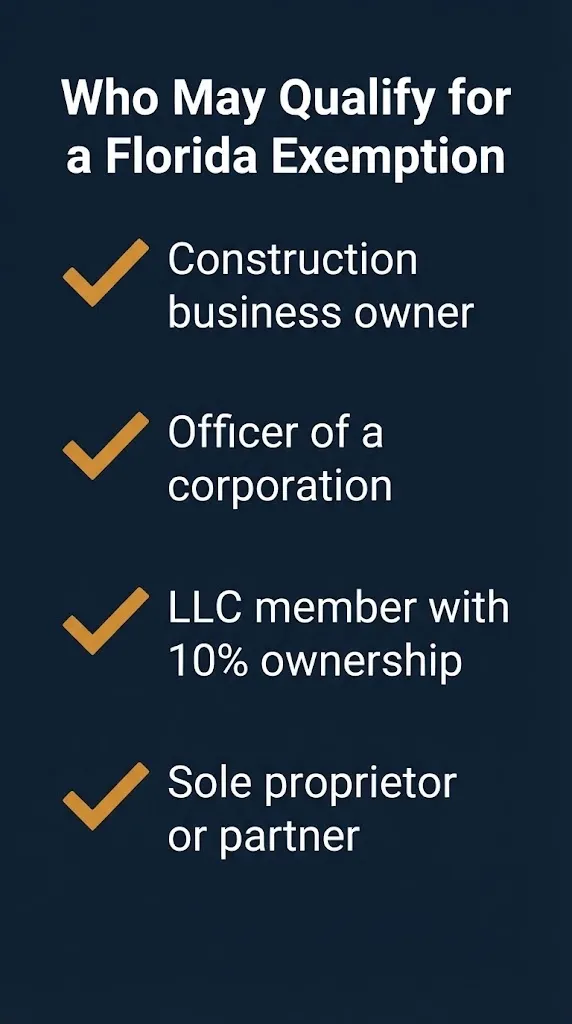
In construction, an exemption is available to officers of a corporation or members of a limited liability company who own at least 10 percent of the business. Sole proprietors and partners in construction can also apply.
Outside construction, owners of non-construction businesses generally do not need an exemption because they are not automatically considered employees under Florida law. Their inclusion in coverage is optional.
To qualify, you must submit proof of your ownership stake and your business registration with the Florida Division of Corporations. The state cross-checks these records before approving an exemption.
A business with employees cannot exempt those workers. The exemption covers only the owner or officer who applies. Everyone else who meets the definition of an employee must still be covered.
How Much Does a Florida Workers Compensation Exemption Cost?
The application fee for a Florida workers compensation exemption is $50.
This fee has been in place for years and remains unchanged as of 2026. You pay the fee when you submit your application or renewal through the Division of Workers’ Compensation.
The exemption is valid for two years. After that, you must renew and pay the fee again.
Third-party filing services may charge additional fees, sometimes $100 to $200 on top of the state fee. You are not required to use those services. The state processes applications directly.
There is no per-person payout, no settlement fund, and no money coming back to you. This is a fee you pay for a certificate, not an investment.
| Fee Type | Amount | Frequency |
|---|---|---|
| Initial application | $50 | Once |
| Renewal | $50 | Every 2 years |
| Late renewal penalty | May apply | Check with Division |
| Third-party service fees | Varies, often $100+ | Optional |
How Do You File for a Florida Workers Compensation Exemption?
Filing is done online through the Florida Division of Workers’ Compensation website.
Step one: Confirm you meet the ownership requirements for your industry.
Step two: Gather your business documents, including your Florida Division of Corporations registration number and proof of ownership percentage.
Step three: Visit the Division of Workers’ Compensation exemption application portal.
Step four: Complete the online application with your business name, industry classification, and ownership details.
Step five: Pay the $50 fee by credit card or electronic check.
Step six: Wait for the state to verify your business registration and ownership.
Step seven: Print or save your exemption certificate once approved. The certificate is your proof of status.
The process usually takes a few business days. Complex applications with ownership discrepancies may take longer while the Division requests additional proof.
What Is the Deadline to Renew a Florida Workers Compensation Exemption?
Exemptions expire two years from the date of issuance.
There is no single annual deadline that applies to everyone. Your renewal date is specific to your certificate.
The Division sends renewal reminders before expiration, but the responsibility to renew falls on you. If your exemption lapses, you may lose your exempt status.
A lapsed exemption means general contractors may be required to cover you as an employee. That can disrupt your work, since many contractors check exemption status before hiring.
Treat the two-year renewal like a passport expiration. You do not need to file anything for two years, but when it expires, you cannot work as exempt until it is current.
Key Takeaway: The exemption is a legal status change, not a money program. It removes coverage obligations but also removes your own right to workers’ compensation benefits if you are injured.
Does a Florida Workers Compensation Exemption Protect You From Lawsuits?
No. An exemption does not protect you from lawsuits.
If you are exempt and someone working for you gets injured, that person may sue you personally. Workers’ compensation normally shields employers from most injury lawsuits. That shield disappears when coverage is missing or when the injured person is not an employee.
A homeowner who hires an exempt contractor and gets injured due to the contractor’s negligence can still file a liability claim. The exemption has no effect on that type of lawsuit.
Many exempt business owners carry general liability insurance to cover this risk. That is separate from workers’ compensation and is not required by the exemption itself.
The exemption only changes your status under Florida workers’ compensation law. It does not change tort law, contract law, or any other legal obligation.
Can an Exempt Worker Still Get Workers Compensation in Florida?
No, not for injuries they suffer while working under the exemption.
The exemption means you are not an employee for workers’ compensation purposes. You cannot collect benefits from a general contractor’s policy as an employee.
There is one narrow exception. If you have your own workers’ compensation policy covering yourself, you may be able to claim under that policy. Most exempt workers do not carry such a policy.
If you get hurt on a job site, your only recovery options are your own health insurance, your own disability policy, or a personal injury lawsuit against whoever caused your injury.
This is the part many new contractors misunderstand. They think the exemption is a way to avoid insurance costs. Then they get hurt and discover there is no wage replacement waiting for them.
Reality Check: No one from the state will text you asking for money to keep your exemption active. The Division of Workers’ Compensation processes applications online. If a third-party company charges you hundreds of dollars for a “$50 filing,” you are paying for convenience, not a government requirement.
What Is the Difference Between a Workers Comp Exemption and Insurance in Florida?
Workers’ compensation insurance pays for injuries. An exemption says you do not need that insurance for yourself.
Insurance protects you from liability and provides benefits to injured workers. An exemption provides no benefits and no liability protection.
A contractor with a full workers’ compensation policy covers all employees, including the owner if the owner is included. A contractor with an exemption covers no one through workers’ compensation.
Some exempt business owners buy a “ghost policy” that covers employees but excludes the owner. That is common in construction where proof of coverage is required for a license. The ghost policy satisfies the legal requirement for having coverage while the owner remains exempt.
| Feature | Workers’ Comp Insurance | Exemption |
|---|---|---|
| Pays medical bills for injured worker | Yes | No |
| Replaces lost wages | Yes | No |
| Shields employer from most injury lawsuits | Yes | No |
| Costs money | Yes, premiums | Yes, $50 per 2 years |
| Required for employers with employees | Yes | No |
How Does the Florida Division of Workers’ Compensation Enforce Exemption Rules?
The Division of Workers’ Compensation audits businesses and investigates complaints.
Construction businesses are subject to stop-work orders if they fail to maintain required coverage. A stop-work order halts all business activity at a job site until coverage is secured and penalties are paid.
The Division can also issue fines for noncompliance. Penalties in Florida start at $1,000 for certain violations and can increase based on the number of employees and the length of noncompliance.
Exemption holders who misrepresent their status can face consequences beyond fines. Providing false information on an exemption application is a legal violation and can lead to the revocation of the exemption.
The Division cross-checks exemption data with contractor licensing records and insurance filings. If you claim an exemption but are later determined to be an employee, the general contractor’s insurer may be required to cover you anyway.
What Changes Are Coming to Florida Workers Compensation Exemptions in 2026?
No major legislative overhaul of Florida’s workers’ compensation exemption rules took effect in 2026.
The core structure remains unchanged: $50 fee, two-year validity, construction industry focus, and ownership percentage requirements.
What has changed is enforcement. The Division continues to increase use of data matching to identify businesses that misclassify employees as exempt owners. Several construction staffing investigations have resulted in stop-work orders and penalties.
If you hold an exemption and also perform work that looks like employment, you may face scrutiny. The question is control. If a general contractor tells you when to show up, provides your tools, and directs your daily tasks, you may be an employee regardless of what your exemption says.
The safest approach is to know what your exemption covers and what it does not. It covers your own status as an owner. It does not cover anyone you treat like an employee.
Key Takeaway: Enforcement is getting tighter, not looser. The state is matching exemption data against licensing and insurance records to catch misclassification.
What Happens If You Work Without a Florida Workers Compensation Exemption?
If you work in construction and do not have either an exemption or workers’ compensation coverage, you may face penalties.
General contractors are required to verify that subcontractors have either coverage or an exemption. If they do not, the contractor may be responsible for covering you as an employee.
You also risk a stop-work order if the Division determines you are an employer without coverage. That order shuts down your work until you comply.
If you get injured while working without an exemption or coverage, you may be left with no workers’ compensation benefits and no clear path to recover lost wages.
The exemption is not optional for construction business owners who want to work as independent entities. It is the legal mechanism that keeps you outside the employee classification.
What Happens Next
- Immediately: Check your current exemption status on the Florida Division of Workers’ Compensation website.
- If your exemption is expired or expiring: File a renewal with the $50 fee.
- If you are starting a new construction business: Apply for an exemption after your business registration is complete.
- Ongoing: Keep your exemption certificate on file and provide it to every general contractor who asks.
- Expected 2027: The Division will continue data-matching enforcement and may update fee schedules or forms.
Frequently Asked Questions
Is a Florida workers compensation exemption the same as a settlement?
No. An exemption is a state certificate that removes you from employee status. It is not a settlement fund or payout program.
How much does a Florida workers compensation exemption cost?
The state filing fee is $50. The exemption is valid for two years before renewal.
Do I need a workers compensation exemption if I am a sole proprietor in Florida?
If you are a sole proprietor in construction, you may need an exemption to avoid being classified as an employee. Outside construction, you are generally not automatically covered.
Can I get workers compensation benefits if I am exempt?
No. An exempt worker is not an employee and cannot collect workers’ compensation benefits for their own injury.
What happens if my exemption expires?
General contractors may be required to cover you as an employee. You should renew immediately to restore your exempt status.
Does an exemption protect me from lawsuits?
No. An exemption does not shield you from personal injury lawsuits. You need separate liability insurance for that protection.
How long does it take to get an exemption in Florida?
The online application usually processes within a few business days if your business records are in order.
What is the penalty for working without an exemption or coverage in Florida construction?
Penalties can include a stop-work order, fines starting at $1,000, and responsibility for any injured worker’s claim.
The single most important fact about a Florida workers compensation exemption is that it removes protection in exchange for lower costs. Know that trade-off before you file.
Check your status today on the Division of Workers’ Compensation website. If your exemption has expired, renew it now before your next job.
Sources checked July 14, 2026: Florida Division of Workers’ Compensation official website, Florida Statutes Chapter 440, Florida Department of Financial Services exemption application portal, Division of Workers’ Compensation enforcement notices, Florida construction licensing records.
LawCompensate.com is an independent news publisher, not a law firm. This article is information, not legal advice. Verify current details on the official Florida Division of Workers’ Compensation website before filing.