Loan Against Car Accident Settlement 2026: Funding Options, Costs, and What to Know Before You Borrow
Quick Answer
- Lawsuit funding against car accident settlements is legal in most states but is not a traditional loan.
- You may qualify for 10 to 20 percent of your expected settlement value, depending on case strength.
- No fixed deadline applies, but borrowing early costs more because fees compound the longer your case takes.
You can borrow against a car accident settlement in 2026. The product is called lawsuit funding, pre-settlement funding, or a settlement advance.
It is not a loan in the traditional sense. It is a non-recourse cash advance. You repay only if you win or settle your case.
That distinction matters. It also explains why the cost is so high compared to a bank loan or credit card.
The Facts
| Product | Pre-settlement funding against car accident claims |
| Status | Available in most U.S. states |
| Typical Advance | 10 to 20 percent of expected settlement value |
| Cost | Varies widely, often 2 to 4 percent per month |
| Repayment | Only if you win or settle |
| Regulation | State-by-state, no federal cap |
| Proof Needed | Case documents from your attorney |
Is a Loan Against a Car Accident Settlement Legit?
Yes, borrowing against a car accident settlement is a legitimate financial product in most states. Reputable funding companies have operated for over two decades.
The industry is not a scam. But it is lightly regulated. Some funders charge rates that consumer advocates call predatory.
The key distinction is non-recourse. A real settlement advance is repaid only from your case proceeds. If you lose, you owe nothing.
A scam version asks for upfront fees. It may ask for your bank account or personal information before approving anything. Legitimate funders never charge application fees or upfront costs.
State attorneys general have issued warnings about high-cost lawsuit advances. New York and Illinois have some oversight. Other states have none.
Key Takeaway: Lawsuit funding is real, but upfront fees are the red flag that separates legitimate funders from scams.
How Much Can You Borrow Against a Car Accident Settlement?
You can typically borrow 10 to 20 percent of your expected settlement value. Some funders go up to 25 percent for very strong cases.
The exact amount depends on three factors. First, the strength of your liability claim. Second, the available insurance coverage. Third, your expected damages.
A case worth $50,000 may yield an advance of $5,000 to $10,000. A case worth $200,000 may yield $20,000 to $40,000.
Funders rarely advance more than $100,000 on any single case. Larger advances require extensive underwriting.
| Expected Settlement | Typical Advance Range |
|---|---|
| $25,000 | $2,500 to $5,000 |
| $50,000 | $5,000 to $10,000 |
| $100,000 | $10,000 to $20,000 |
| $250,000 | $25,000 to $50,000 |
These are estimates based on industry practice. Actual offers depend on your case facts and the funder’s underwriting criteria.
How Much Does a Car Accident Settlement Loan Cost?
Car accident settlement funding is expensive. Most funders charge 2 to 4 percent per month, compounded.
That means a $10,000 advance at 3 percent monthly costs $300 in the first month. By month 12, the balance is approximately $14,260 if no payments are made. By month 24, it is approximately $20,340.
The longer your case takes, the more you owe. A case that settles in six months costs far less than one that drags on for three years.
Some funders charge flat fees instead of monthly rates. Flat fees may be 50 to 100 percent of the advance, regardless of time. These can be cheaper for long cases but more expensive for quick settlements.
| Advance Amount | Monthly Rate | Cost After 12 Months | Cost After 24 Months |
|---|---|---|---|
| $5,000 | 2.5% | $6,720 | $9,030 |
| $10,000 | 3% | $14,260 | $20,340 |
| $25,000 | 3.5% | $37,810 | $57,180 |
These figures are illustrative based on common industry rates. Your actual contract terms may differ.
Key Takeaway: The cost of settlement funding compounds quickly, and a two-year case can nearly double what you owe.
Car Accident Lawsuit Funding: How Does It Work?
Car accident lawsuit funding works like this. You apply through a funding company. The funder reviews your case with your attorney’s cooperation.
The funder evaluates liability, damages, and insurance coverage. It decides whether your case is likely to settle and for how much.
If approved, you sign a funding agreement. The funder sends money to your bank account, usually within 24 to 48 hours.
You owe nothing until your case resolves. If you win or settle, your attorney repays the funder from the proceeds. If you lose, you owe nothing.
The process is faster than a bank loan. There is no credit check. Your income and employment do not matter.
Are Car Accident Settlement Loans Regulated?
Car accident settlement loans are regulated unevenly across the United States. No federal law caps rates or fees.
Some states treat lawsuit funding as a loan subject to usury laws. Others treat it as an investment, exempt from lending rules.
New York has disclosure requirements for funders. Illinois caps fees for advances under certain amounts. California has minimal regulation. Texas and Florida have almost none.
The Consumer Financial Protection Bureau has not issued binding rules for the industry. State attorneys general occasionally bring enforcement actions against the worst actors.
You should check your state’s rules before signing. Your attorney can advise on whether a specific funding offer complies with local law.
What Are the Alternatives to a Car Accident Settlement Loan?
Alternatives to settlement funding exist. You may not need an expensive advance if other options are available.
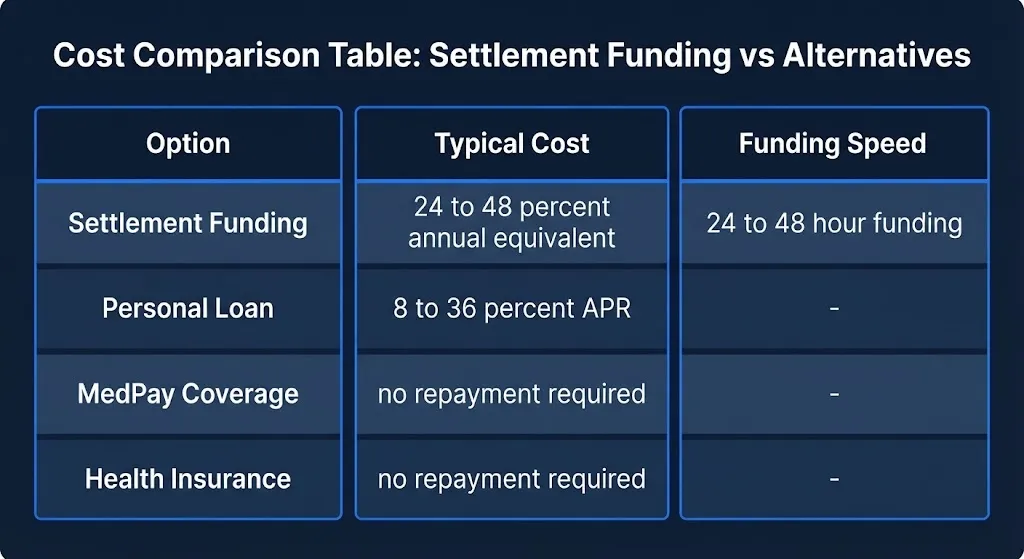
Health insurance should cover your medical bills first. MedPay coverage on your auto policy can pay medical costs without a lawsuit.
Disability insurance may replace lost income if you cannot work. A personal loan from a bank or credit union costs far less than lawsuit funding.
Borrowing from family or friends is difficult but often cheaper. A payment plan with medical providers can reduce immediate cash pressure.
Selling assets or using savings may be painful but avoids compounding fees.
Consider settlement funding only after exhausting these options.
| Alternative | Typical Cost | Speed |
|---|---|---|
| Health insurance | Copays and deductibles | Immediate |
| MedPay coverage | No repayment required | Immediate |
| Personal loan | 8 to 36 percent APR | Days to weeks |
| Family loan | Varies | Immediate |
| Settlement funding | 24 to 48 percent annual equivalent | 24 to 48 hours |
Key Takeaway: Settlement funding should be a last resort, not a first choice, because cheaper alternatives often exist.
How Do You Apply for a Loan Against a Car Accident Settlement?
Applying for settlement funding follows a consistent process. You cannot apply without an attorney because the funder needs case documents.
Here are the verified steps:
- Discuss your financial need with your attorney first.
- Ask your attorney to recommend reputable funding companies.
- Contact two or three funders to compare offers.
- Sign a release allowing the funder to review your case file.
- Provide case documents, including the police report and medical records.
- Review the funding agreement with your attorney before signing.
- Receive funds if approved, typically within 24 to 48 hours.
Never sign a funding agreement without your attorney reviewing it first. The contract terms can be dense and one-sided.
What Should You Watch Out for With Car Accident Settlement Loans?
Several practices in the settlement funding industry deserve caution. Not every funder is reputable.
Some funders charge undisclosed fees on top of the stated monthly rate. Application fees, processing fees, and documentation fees add up fast.
Some contracts include a minimum repayment period. You may owe six months of interest even if your case settles in two months.
Some funders pressure you to settle quickly. They want repayment fast. Your attorney should push back.
Some contracts include arbitration clauses. You give up your right to sue the funder in court if something goes wrong.
Read the full contract. Ask your attorney to flag anything unusual.
Reality Check: No legitimate settlement funding company charges upfront fees. If a funder asks for money before sending you money, that is a scam or a predatory practice. Filing is always free, and your attorney should review every line before you sign.
When Does a Settlement Loan Make Sense?
A settlement loan makes sense in narrow circumstances. You have a strong case. You have no cheaper alternatives. You face an immediate financial emergency.
An emergency might be eviction, utility shutoff, or urgent medical care not covered by insurance. Borrowing to cover rent while you recover may be reasonable.
Borrowing for discretionary spending is not reasonable. Taking an advance to buy a new phone or take a vacation will cost you dearly later.
The best time to apply is after your case has developed. Liability should be clear. Medical treatment should be complete or nearly complete. A demand letter may already be sent.
Applying too early means the funder sees a weaker case. That leads to smaller advances and higher rates.
What Happens If You Lose Your Car Accident Case?
If you lose your case with a non-recourse settlement advance, you owe nothing. That is the defining feature of the product.
The funder loses its money. You keep the advance. No collection calls. No lawsuits. No wage garnishment.
This is why rates are high. Funders price in the risk that some cases lose.
If you have a traditional loan instead of a non-recourse advance, losing your case does not erase the debt. You still owe the lender.
Confirm in writing that your agreement is non-recourse before signing. If the word “loan” appears without a non-recourse clause, you may be dealing with a different product.
What Happens Next
Here is the typical timeline if you pursue settlement funding in 2026:
Day 1 to 3: Apply and authorize case review with your attorney’s help.
Day 3 to 7: Funder reviews case documents and makes an offer.
Day 7 to 10: You and your attorney negotiate terms if needed.
Day 10 to 14: Funds deposited if you accept and sign.
Case resolution: Funder repaid from settlement proceeds, or you owe nothing if you lose.
Frequently Asked Questions
Is a loan against a car accident settlement a real loan?
No, it is a non-recourse cash advance that you repay only if you win or settle your case.
How much can I borrow against my car accident settlement?
You can typically borrow 10 to 20 percent of your expected settlement value, depending on case strength.
How much does a car accident settlement loan cost?
Most funders charge 2 to 4 percent per month, which compounds and can double your balance in two years.
Do I need good credit to get settlement funding?
No, there is no credit check because repayment comes from your settlement, not your income.
What happens if I lose my car accident case?
You owe nothing with a true non-recourse advance, and the funder absorbs the loss.
Can I apply for settlement funding without an attorney?
No, funders require an attorney because they need case documents and expect repayment from the case.
Are car accident settlement loans regulated?
Regulation varies by state, with some states requiring disclosures and others imposing no limits on fees.
Is there a deadline to apply for settlement funding?
No fixed deadline exists, but applying after your case is more developed usually gets better terms.
Compare at least three funders before signing anything. Ask your attorney to review every contract line.
The single most important thing is the non-recourse clause. If it is not in writing, you are signing a different and riskier product.