Truck Accident Lawsuit in 2026: What Victims Need to Know
Quick Answer
- A truck accident lawsuit is a civil claim against a trucking company, driver, or insurer for crash injuries.
- Settlements often exceed $100,000 for serious injuries, but every case depends on facts and insurance limits.
- Most states set a two to three year statute of limitations, so filing deadlines matter.
If you were hit by a commercial truck, you are likely searching for answers about lawsuits, settlements, and what your case might be worth. The legal process for truck accident claims is different from car accident claims. Trucking companies carry larger insurance policies, face stricter federal regulations, and often fight claims harder.
A truck accident lawsuit is a civil action seeking compensation for injuries, lost income, medical bills, and pain and suffering caused by a commercial vehicle crash. These cases involve federal trucking rules, electronic logging devices, driver fatigue records, and often multiple defendants.
This guide explains how truck accident lawsuits work in 2026, what compensation you may be entitled to, how long cases take, and what steps protect your claim. One fact matters most: evidence disappears fast, and the first weeks after a crash determine what your case is worth.
The Facts
| Case | General information, no single case |
| Status | Active area of civil litigation in all U.S. states |
| Fund Size | Varies by case and insurance coverage |
| Est. Per Person | Varies widely; serious injury cases often exceed $100,000 |
| Claim Deadline | Statute of limitations, typically 1 to 3 years depending on state |
| Administrator | Not applicable; individual lawsuits, not class actions |
| Proof Needed | Police reports, medical records, trucking logs, witness statements |
What Is a Truck Accident Lawsuit in 2026?
A truck accident lawsuit is a civil claim filed by an injured person against the parties responsible for a commercial truck crash. Those parties may include the truck driver, the trucking company, the truck owner, the cargo loader, or the vehicle manufacturer.
The lawsuit seeks money damages for medical expenses, lost wages, future care needs, property damage, and pain and suffering. In cases involving death, the family may file a wrongful death claim. In cases involving drunk or reckless conduct, punitive damages may also be sought.
Truck accident lawsuits differ from car accident cases in one key way: federal regulations. The Federal Motor Carrier Safety Administration sets hours-of-service rules, maintenance requirements, and driver qualification standards. Violations of those rules often form the backbone of a truck accident claim.
Most truck accident cases are individual personal injury lawsuits, not class actions. Each victim files separately, and each case turns on its own facts.
Key Takeaway: A truck accident lawsuit targets the parties responsible for a commercial vehicle crash and seeks money for the victim’s losses.
How Much Is a Truck Accident Settlement Worth?
Truck accident settlements vary widely, but serious injury cases often exceed $100,000. Catastrophic injury cases involving brain damage, spinal cord injury, or death can reach $1 million or more. Minor injury cases may settle for $25,000 to $75,000.
The settlement value depends on several factors. Medical costs, lost income, future care needs, the severity of the injury, the strength of liability evidence, and the insurance limits all shape the final number.
Trucking companies typically carry $750,000 to $5 million in liability insurance. Federal law requires a minimum of $750,000 for interstate carriers. Many companies carry more, and that insurance is usually the source of settlement funds.
| Injury Severity | Typical Settlement Range |
|---|---|
| Minor soft tissue | $10,000 to $50,000 |
| Broken bones, surgery | $75,000 to $300,000 |
| Traumatic brain injury | $500,000 to $2 million+ |
| Spinal cord injury | $1 million to $5 million+ |
| Wrongful death | $500,000 to $3 million+ |
These ranges are estimates based on published settlement data, not guarantees. Every case turns on its own facts.
Key Takeaway: Truck accident settlements often exceed $100,000 for serious injuries, but each case depends on evidence and insurance limits.
What Is the Average Settlement for a Commercial Truck Accident?
No official average settlement exists for commercial truck accidents. Published data from legal reporting services shows a wide range, with most serious injury cases settling between $100,000 and $500,000.
The absence of a reliable average matters. Some websites publish misleading figures, often $50,000 or $200,000, without citing a source. Those numbers do not reflect the reality that each case is unique.
Factors that push settlements higher include clear liability, severe injuries, high insurance limits, and strong evidence of federal regulation violations. Factors that push settlements lower include shared fault, minor injuries, low insurance limits, and weak documentation.
If someone tells you the average is a specific number, ask for the data source. If no source exists, the number is a guess.
Key Takeaway: No verified average settlement exists; serious cases often settle in the six-figure range.
What Should You Do After a Truck Accident to Protect a Lawsuit?
The first weeks after a truck accident determine what your case is worth. Evidence disappears, witnesses forget details, and trucking companies move quickly to protect themselves.
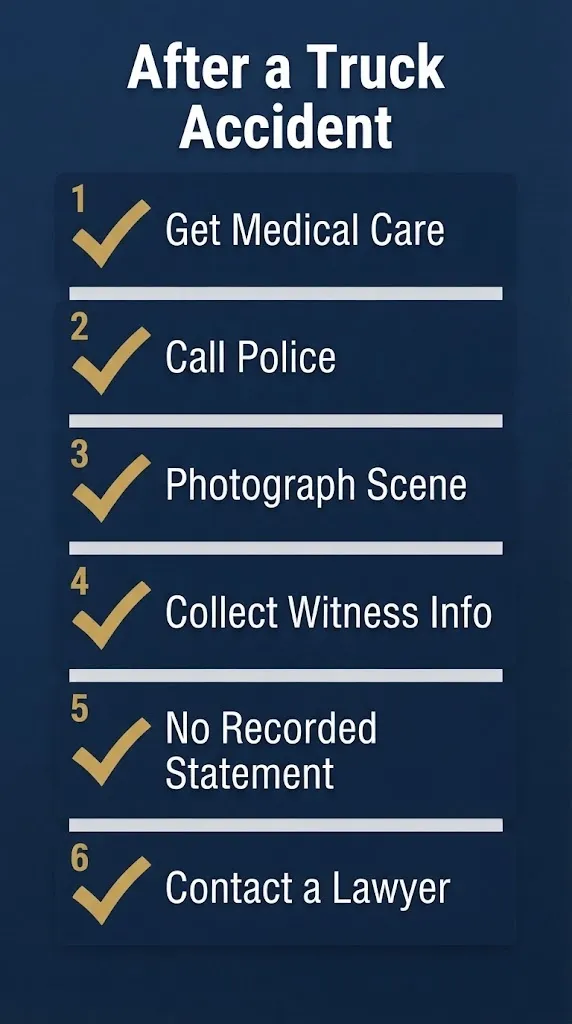
The most important steps are immediate. Get medical care, even if you feel fine. Call the police and get a report. Photograph the scene, the vehicles, and your injuries. Collect witness names and contact information. Do not speak to the trucking company’s insurance adjuster before consulting a lawyer.
A common mistake is giving a recorded statement to the trucking company’s insurer. That statement will be used against you. Another mistake is accepting an early settlement offer. Early offers are usually far below what a case is worth.
- Step 1: Call 911 and get medical attention immediately
- Step 2: Obtain the police report number and officer name
- Step 3: Photograph the accident scene, vehicle damage, and injuries
- Step 4: Collect witness names, phone numbers, and statements
- Step 5: Do not give a recorded statement to the trucking company’s insurer
- Step 6: Contact a personal injury lawyer experienced in truck accident claims
- Step 7: Preserve all medical records, bills, and missed work documentation
Key Takeaway: The steps you take in the first days after a truck accident directly affect your settlement value.
How Long Do You Have to File a Truck Accident Lawsuit?
The deadline to file a truck accident lawsuit depends on the statute of limitations in your state. Most states allow two to three years from the date of the crash. Some allow less, and a few allow more.
The deadline is not flexible in most cases. If you miss it, your claim is barred forever. That is true no matter how strong your evidence or how severe your injuries.
There are exceptions. If the victim was a minor, the clock may not start until they turn 18. If the defendant left the state, the deadline may be paused. If a government vehicle was involved, special notice rules apply, often with much shorter deadlines.
The safest approach is to treat every day after the crash as important. Consult a lawyer as soon as possible. A lawyer can identify the correct deadline and file before it expires.
Reality Check: No legitimate settlement ever asks you to pay a fee to file a claim. No real lawyer guarantees a result. Any truck accident post that promises a specific payout or demands upfront money is misleading.
Key Takeaway: Most states give two to three years to file, but the deadline varies, and missing it kills the claim.
What Damages Can You Recover in a Truck Accident Lawsuit?
A truck accident lawsuit can recover economic damages, non-economic damages, and sometimes punitive damages. Each category covers different losses.
Economic damages are the concrete financial losses. Medical bills, rehabilitation costs, lost wages, future lost earning capacity, and property damage all fall in this category. These are documented with bills, pay stubs, and expert testimony.
Non-economic damages cover the human costs. Pain and suffering, emotional distress, loss of enjoyment of life, and loss of consortium for a spouse are common examples. These damages are harder to calculate but often represent the largest share of a settlement.
Punitive damages punish egregious conduct. If the trucking company knowingly violated safety rules, forced drivers to skip rest breaks, or falsified logs, punitive damages may apply. They are rare but can multiply a settlement.
- Medical expenses: current and future treatment costs
- Lost income: wages missed during recovery
- Reduced earning capacity: permanent limits on your ability to work
- Pain and suffering: physical pain and emotional trauma
- Property damage: vehicle repair or replacement
- Punitive damages: punishment for reckless company conduct
Key Takeaway: A truck accident claim can recover both financial losses and human costs, and sometimes punitive damages.
Who Can Be Sued in a Truck Accident Lawsuit?
A truck accident lawsuit can name multiple defendants. The truck driver is the most obvious. The trucking company is often the more important defendant because it carries the insurance.
Other potential defendants include the truck owner if different from the driver, the cargo loading company if shifting cargo caused the crash, the truck manufacturer if a defect contributed, and the maintenance provider if poor repairs were a factor.
In some cases, the shipper or broker who hired the trucking company may face liability. A broker that hired an unsafe carrier may share responsibility. A shipper that overloaded a trailer may also be liable.
Identifying all responsible parties matters because each defendant brings additional insurance coverage. The more defendants, the larger the potential recovery.
Key Takeaway: Multiple parties may share fault, and each one may have separate insurance that contributes to the settlement.
How Long Does a Truck Accident Lawsuit Take?
A truck accident lawsuit typically takes 12 to 24 months from filing to resolution. Some cases settle in months. Others go to trial and take three years or more.
The timeline depends on several factors. The severity of injuries, the complexity of liability, the number of defendants, and the court’s schedule all affect duration. Cases involving catastrophic injuries often take longer because future medical costs need expert analysis.
Settlement can happen at any stage. Many cases settle after discovery, when both sides see the full evidence. A smaller number settle before filing. Only a small fraction go all the way to trial.
The key is patience. The trucking company’s insurer wants you to settle fast for less. A good lawyer builds the case, documents the damages, and negotiates from strength.
Key Takeaway: Most truck accident cases resolve in one to two years, but complex cases can take longer.
What Federal Rules Apply to Truck Accident Lawsuits?
Federal trucking regulations from the Federal Motor Carrier Safety Administration play a central role in truck accident lawsuits. These rules set standards for driver hours, vehicle maintenance, cargo securement, and driver qualifications.
Hours-of-service rules limit how long a driver can operate without rest. Violations often cause fatigue-related crashes. Electronic logging devices now track driver hours automatically, creating evidence that was hard to obtain a decade ago.
Maintenance rules require trucking companies to inspect, repair, and maintain their vehicles. Poor brake maintenance, worn tires, and defective lights frequently show up in truck accident investigations.
Driver qualification rules require valid commercial driver’s licenses, drug and alcohol testing, and clean driving records. A trucking company that hires an unqualified driver may face liability beyond the driver’s own fault.
Key Takeaway: Federal trucking rules create the evidence trail that often decides who wins a truck accident lawsuit.
What Is a Rear-Ended by a Commercial Truck Settlement Worth?
A rear-end collision with a commercial truck often produces a strong liability case. The truck driver is usually presumed at fault for following too closely or failing to stop in time.
Settlement value in rear-end truck crash cases depends on injuries. Minor whiplash may settle for $15,000 to $50,000. Spinal injuries requiring surgery can push a settlement to $250,000 or more. Brain injuries from a violent rear-end impact can reach seven figures.
The strength of liability in a rear-end case often leads to faster settlements. The trucking company knows a jury will likely blame its driver. That knowledge gives the injured person’s lawyer leverage.
But insurance limits still cap recovery. If the trucking company carries only the federal minimum of $750,000, that is the practical ceiling unless other defendants or policies exist.
Key Takeaway: Rear-end truck crash cases often settle faster and for more because liability is usually clear.
What Evidence Wins a Truck Accident Lawsuit?
The evidence that wins a truck accident lawsuit comes from multiple sources. The truck’s electronic logging device, the engine control module, the driver’s personnel file, and the company’s safety records all matter.
Electronic logging devices show whether the driver exceeded hours-of-service limits. Engine control modules show speed, braking, and acceleration before impact. Personnel files reveal whether the company knew the driver had safety violations.
Dashcam footage, both from the truck and from nearby vehicles, often proves decisive. Witness statements, police reports, and accident reconstruction experts fill in the gaps.
The trucking company will not hand over this evidence voluntarily. A lawyer must send preservation letters and file discovery requests. Waiting too long can allow evidence to be destroyed.
Key Takeaway: Electronic records from the truck and the company’s safety files often decide the outcome of a truck accident case.
What Happens Next After You File a Truck Accident Lawsuit?
Filing the lawsuit starts a process that moves through predictable stages. Each stage has its own timeline and purpose.
Within 30 days: The complaint is filed and served on the defendants.
Within 60 to 90 days: The defendants answer or move to dismiss.
6 to 12 months: Discovery proceeds, including depositions, document production, and expert reports.
12 to 18 months: Settlement negotiations intensify; many cases resolve here.
18 to 30 months: If no settlement, trial preparation and trial.
These timelines are general estimates. Your case may move faster or slower depending on the court and the parties.
Frequently Asked Questions
Is a truck accident lawsuit worth filing?
Yes, if you suffered injuries and someone else was at fault.
Truck accident settlements often exceed car accident settlements.
The insurance limits are higher, and the injuries are often more severe.
How much does a truck accident lawyer cost?
Most truck accident lawyers work on contingency.
You pay nothing upfront and nothing unless you win.
The fee is typically 33 to 40 percent of the recovery.
What if the truck driver was at fault but has no insurance?
The trucking company’s insurance usually covers the driver.
Federal law requires interstate carriers to carry at least $750,000 in coverage.
If no insurance exists, your own uninsured motorist coverage may apply.
Can I sue the trucking company instead of the driver?
Yes, the trucking company is usually the primary defendant.
Companies are liable for their drivers’ negligence under respondeat superior.
They also carry the insurance that pays settlements.
What if I was partially at fault for the truck accident?
You may still recover damages in most states.
Comparative fault rules reduce your recovery by your share of fault.
In some states, you recover nothing if you were 50 percent or more at fault.
How long after a truck accident can I sue?
Most states allow two to three years.
The deadline starts on the date of the crash.
Some exceptions apply, but do not rely on them.
What should I not do after a truck accident?
Do not give a recorded statement to the trucking company’s insurer.
Do not accept an early settlement offer.
Do not post about the accident on social media.
A truck accident lawsuit is a serious undertaking with serious potential. The compensation you can recover depends on the evidence you preserve, the lawyer you hire, and the deadlines you meet. Start by getting medical care and legal advice.
The single most important fact is this: the statute of limitations is running from the day of your crash. Every day you wait is a day of evidence lost and a day closer to losing your right to sue.